1

Curriculum Developer Jobs (NOW HIRING)

The Training Curriculum Developer is responsible for creating comprehensive learning content, presentations and programs that foster institution-wide educational experiences. These programs include ...

The Training Curriculum Developer is responsible for creating comprehensive learning content, presentations and programs that foster institution-wide educational experiences. These programs include ...

We are looking for a professional Curriculum Developer/Instructor to join the 6K Team! JOB RESPONSIBILITIES The AUTLC provides developmental support to faculty and students across all of AU. The ...

next page

Showing results 1-20

Curriculum Developer information

See salary details

$17

$37

$56

How much do curriculum developer jobs pay per hour?

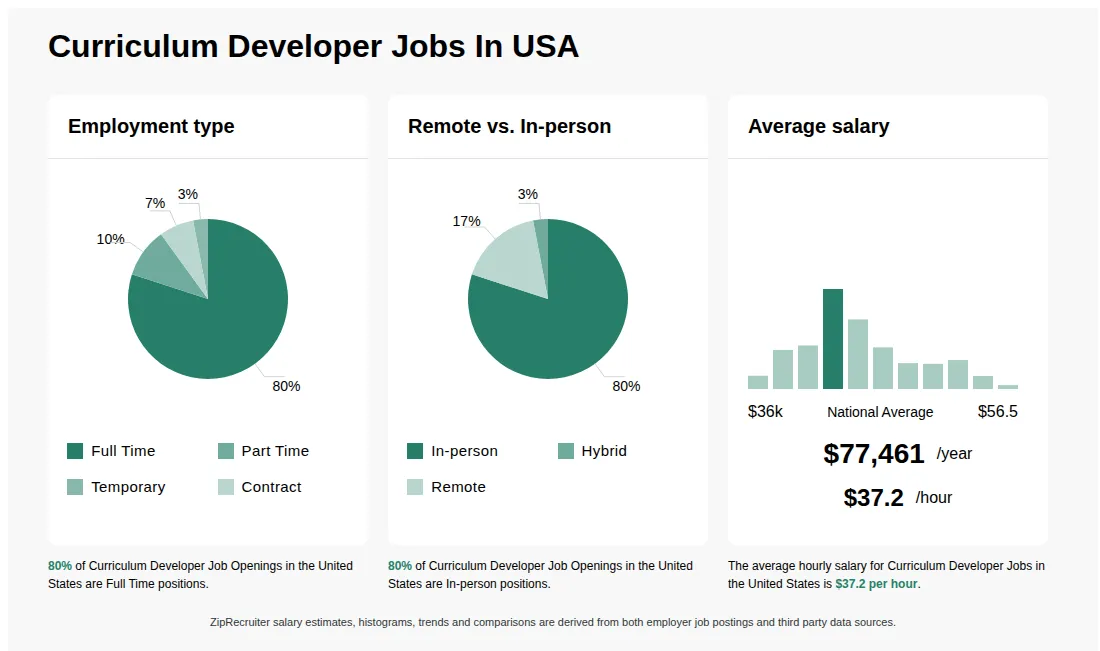
As of Jun 5, 2026, the average hourly pay for curriculum developer in the United States is $37.24, according to ZipRecruiter salary data. Most workers in this role earn between $28.37 and $39.18 per hour, depending on experience, location, and employer.

What Does a Curriculum Developer Do?

A curriculum developer or instructional coordinator helps a school develop and implement a teaching plan with lessons designed to meet the educational standards of the school or district. In this career, you often begin by evaluating the existing system and observing students in the classroom. Your responsibilities as a curriculum developer involve all aspects of instruction, from the textbooks to the teaching methods. You are also involved in staff training programs, whether working with a group or one-on-one to teach instructional techniques. That makes excellent interpersonal skills essential for success in this position. You can find jobs at all grade levels.

What are the key skills and qualifications needed to thrive as a Curriculum Developer, and why are they important?

To thrive as a Curriculum Developer, you need expertise in instructional design, educational theory, and subject matter knowledge, often supported by a degree in education or a related field. Familiarity with learning management systems (LMS), digital authoring tools, and curriculum mapping software is typically required. Strong collaboration, project management, and communication skills help you work effectively with educators and stakeholders. These skills ensure the creation of effective, engaging curricula that meet educational standards and learner needs.

How does a Curriculum Developer typically collaborate with subject matter experts and instructors during the course creation process?

Curriculum Developers work closely with subject matter experts (SMEs) and instructors to ensure instructional materials are accurate, engaging, and aligned with learning objectives. This collaboration often involves conducting interviews or workshops with SMEs to gather content, reviewing drafts for technical accuracy, and incorporating instructor feedback to enhance clarity and relevance. Effective communication and teamwork are key, as the developer must balance educational standards with practical teaching needs, often revising materials based on iterative feedback. This process ensures the final curriculum is both pedagogically sound and practically applicable for learners.

What are Curriculum Developers?

Curriculum Developers are education professionals who design, organize, and update educational programs and materials for schools, organizations, or companies. They analyze educational standards, assess learning needs, and work with teachers or subject matter experts to create effective and engaging instructional content. Their goal is to ensure that curricula meet educational objectives, comply with regulations, and support both teachers and learners in achieving desired outcomes.

What job makes $10,000 a month without a degree?

A curriculum developer typically earns less than $10,000 per month without a degree, but some freelance or specialized roles in digital content creation, online coaching, or consulting can reach or exceed this income level through experience, niche expertise, and self-employment. High earnings often depend on skills, reputation, and the ability to scale services independently.

What is the difference between Curriculum Developer vs Instructional Designer?

AspectCurriculum DeveloperInstructional Designer
CredentialsBachelor's or Master's in Education, Instructional Design, or related fieldBachelor's or Master's in Education, Instructional Design, or related field
Work EnvironmentEducational institutions, corporate training, e-learning companiesEducational institutions, corporate training, e-learning companies
Primary FocusDeveloping comprehensive curricula and course contentDesigning instructional materials and learning experiences
Common UsageCreating curricula for schools, training programs, online coursesDesigning e-learning modules, instructional strategies

Both roles often require similar educational backgrounds and work in similar environments. However, Curriculum Developers focus on creating entire curricula and course structures, while Instructional Designers specialize in designing specific instructional materials and learning experiences. Understanding these distinctions helps in choosing the right career path or job search focus.

What cities are hiring for Curriculum Developer jobs? Cities with the most Curriculum Developer job openings:
What are the most commonly searched types of Curriculum Developer jobs? The most popular types of Curriculum Developer jobs are:
Who are the top companies hiring for Curriculum Developer jobs? The top employers for Curriculum Developer jobs are:
What states have the most Curriculum Developer jobs? States with the most job openings for Curriculum Developer jobs include:

Training Curriculum Developer

Alabama ONE

Tuscaloosa, AL โ€ข On-site

Full-time

This job post hasย expired 1 day ago.ย Applications are no longer accepted.


Job description

The Training Curriculum Developer is responsible for creating comprehensive learning content, presentations and programs that foster institution-wide educational experiences. These programs include detailed training agendas, lesson plans, varied assessments and engaging multimedia resources tailored to diverse learning styles. This role partners closely with subject matter experts (SMEs), operations leaders, and Learning & Development team members to build structured, scalable, and measurable training curricula aligned with organizational goals.
Requirements

  • Bachelor's degree in Education, Curriculum Development, Instructional Design or a related field (or equivalent experience)
  • 2+ years of experience developing and implementing curriculum
  • Proven ability to create engaging and effective instructional materials
  • Strong writing, editing, and communication skills
  • Ability to translate complex procedures into clear, structured training materials
  • Proficiency in digital tools and platforms used in Learning & Development
  • Demonstrate the ability to work collaboratively with diverse teams
  • Experience in banking, credit unions, or other regulated industries
  • Familiarity with learning management systems and training documentation
  • Experience creating technical, compliance, and soft skills based training
  • Experience with LemonadeLXP and Articulate 360 Suite is preferred
  • General knowledge of credit union processes such as tellering, lending, member service, digital and telephone banking, and debit and credit cards
  • Strong understanding of instructional design principles and adult learning theory
  • Ability to manage multiple priorities and deadlines
  • Exceptional research skills to stay updated on educational trends
  • Design comprehensive training curricula for on-boarding, role-based learning paths, and ongoing professional development
  • Develop instructor-led, virtual, and eLearning content using modern instructional design methodologies
  • Create structured learning journeys, including lesson plans, participant guides, facilitator guides, and job aids
  • Ensure content aligns with operational procedures, policies, and regulatory requirements
  • Translate complex operational processes into clear, engaging, and learner-focused training materials
  • Maintain consistency in branding, tone, and instructional quality across all learning assets\
  • Develop assessments, quizzes, and knowledge checks to evaluate learning effectiveness
  • Establish and maintain standardized curriculum templates and frameworks
  • Partner with business units, SMEs, and leadership to identify training needs and performance gaps
  • Facilitate content reviews to ensure accuracy, compliance, and operational relevance
  • Serve as a liaison between operations and Learning & Development to ensure alignment with strategic priorities
  • Maintain curriculum maps and learning pathways across departments
  • Support the implementation of training programs within the Learning Management System (LMS)
  • Monitor training completion, effectiveness, and feedback to drive continuous improvement
  • Update content regularly to reflect process changes, system updates, or regulatory requirements
  • Track and analyze training effectiveness metrics (e.g., completion rates, assessment scores, performance outcomes)
  • Incorporate feedback and data insights into ongoing curriculum enhancements
  • Other duties as assigned.