1

Clinical Coder Jobs (NOW HIRING)

Clinical Data Coder

Cincinnati, OH · On-site

$18 - $22.75/hr

Job Summary Our corporate activities are growing rapidly, and we are currently seeking a full-time, office-based Clinical Data Coder to join our Clinical Coding & Support team in Cincinnati, OH. This ...

Clinical Data Coder

Cincinnati, OH · On-site

$18 - $22.75/hr

Job Summary Our corporate activities are growing rapidly, and we are currently seeking a full-time, office-based Clinical Data Coder to join our Clinical Coding & Support team in Cincinnati, OH. This ...

MRU Nurse Coder

Farmingdale, NY · On-site

$90K - $110K/yr

Ensure proper clinical coding and case-mix accuracy * Identify documentation gaps and coordinate corrections prior to billing * Support timely claim submission and reduce billing delays * Collaborate ...

MRU Nurse Coder

Farmingdale, NY · On-site

$90K - $110K/yr

Ensure proper clinical coding and case-mix accuracy * Identify documentation gaps and coordinate corrections prior to billing * Support timely claim submission and reduce billing delays * Collaborate ...

MRU Nurse Coder

Farmingdale, NY · On-site

$90K - $110K/yr

Ensure proper clinical coding and case-mix accuracy * Identify documentation gaps and coordinate corrections prior to billing * Support timely claim submission and reduce billing delays * Collaborate ...

next page

Showing results 1-20

Clinical Coder information

See salary details

$29K

$57.4K

$80.5K

How much do clinical coder jobs pay per year?

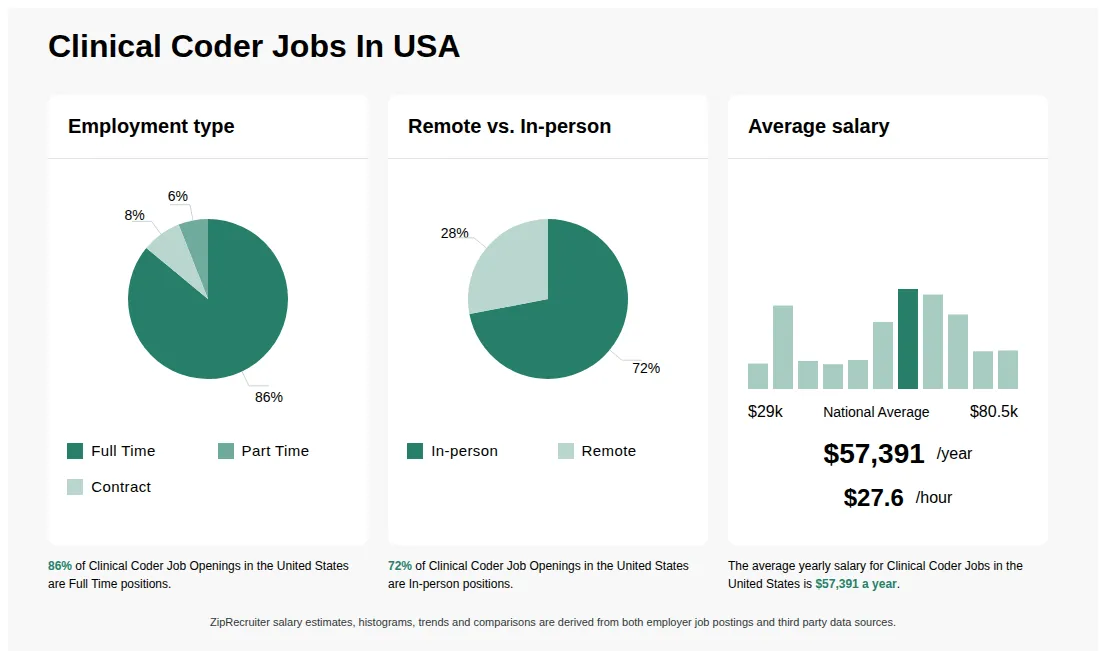
As of Jun 19, 2026, the average yearly pay for clinical coder in the United States is $57,391.00, according to ZipRecruiter salary data. Most workers in this role earn between $46,000.00 and $66,500.00 per year, depending on experience, location, and employer.

Will AI replace clinical coders?

AI technology is increasingly used to assist clinical coders by automating routine coding tasks and improving accuracy. However, clinical coders are essential for interpreting complex cases, ensuring compliance, and providing clinical context, so AI is more likely to augment rather than replace their roles entirely. Skilled coders with knowledge of medical terminology and coding standards remain vital in healthcare settings.

What is a Clinical Coder job?

A Clinical Coder is responsible for translating medical diagnoses, procedures, and treatments into standardized codes used for billing, healthcare records, and insurance purposes. They analyze patient records and apply classification systems such as ICD-10 and CPT to ensure accurate and consistent data entry. Clinical Coders work in hospitals, clinics, and healthcare organizations, playing a vital role in healthcare administration. Their work helps with reimbursement, research, and healthcare planning. Strong attention to detail and a thorough understanding of medical terminology, anatomy, and coding guidelines are essential for this role.

What are the key skills and qualifications needed to thrive in the Clinical Coder position, and why are they important?

To thrive as a Clinical Coder, you need a solid understanding of medical terminology, anatomy, and clinical procedures, usually backed by a relevant qualification in health information management or medical coding. Familiarity with coding systems like ICD-10, CPT, and specialized medical coding software is essential, and certifications such as CCS, CPC, or equivalent are highly valued. Attention to detail, analytical thinking, and effective communication are important soft skills for success in this field. Mastering these skills ensures accurate translation of clinical data into standardized codes, which is critical for billing, compliance, and healthcare quality reporting.

What do you do as a Clinical Coder?

A Clinical Coder reviews medical records and assigns standardized codes to diagnoses, procedures, and treatments using classification systems like ICD-10. This process ensures accurate billing, data collection, and healthcare reporting, often requiring attention to detail and familiarity with coding software. Certification and knowledge of medical terminology are typically necessary for this role.

What pays more, CCS or CPC?

Clinical Coders with CCS (Certified Coding Specialist) certification generally earn higher salaries than those with CPC (Certified Professional Coder) certification, as CCS is often required for hospital coding roles and involves more complex coding tasks. Salary differences can also depend on experience, location, and employer, but CCS typically commands higher pay in the healthcare coding field.

What are some common challenges faced by Clinical Coders in their daily work?

Clinical Coders often encounter challenges such as deciphering incomplete or unclear clinical documentation, staying current with frequent updates to coding standards, and managing high volumes of records within tight deadlines. These professionals must constantly collaborate with healthcare providers to clarify details and ensure that codes accurately reflect the care delivered. Adapting to new coding software or changes in healthcare regulations can also be part of the job. However, these challenges offer valuable opportunities for growth and skill development, and strong problem-solving abilities can help you excel in this dynamic field.

How do you become a Clinical Coder?

To become a clinical coder, individuals typically complete a relevant health information management qualification or coding certification, such as the International Classification of Diseases (ICD) coding courses. Gaining experience with coding software and understanding medical terminology and clinical documentation are also important steps in preparing for this role.
What cities are hiring for Clinical Coder jobs? Cities with the most Clinical Coder job openings:
What are the most commonly searched types of Clinical Coder jobs? The most popular types of Clinical Coder jobs are:
What states have the most Clinical Coder jobs? States with the most job openings for Clinical Coder jobs include:
Infographic showing various Clinical Coder job openings in the United States as of June 2026, with employment types broken down into 8% Locum Tenens, and 92% Contract. Highlights an 62% Physical, 2% Hybrid, and 36% Remote job distribution, with an average salary of $57,391 per year, or $27.6 per hour.
Clinical Policy Clinical Coder RN II

Clinical Policy Clinical Coder RN II

L.A. Care Health Plan

Los Angeles, CA

$132K - $163K/yr

Other

Medical, Dental, Vision, Retirement, PTO

Posted 10 days ago


L.A. Care Health Plan rating

9.1

Company rating: 9.1 out of 10

Based on 7 frontline employees who took The Breakroom Quiz

24th of 261 rated insurance


Job description

Salary Range:  $102,183.00 (Min.) - $132,838.00 (Mid.) - $163,492.00 (Max.)

Established in 1997, L.A. Care Health Plan is an independent public agency created by the state of California to provide health coverage to low-income Los Angeles County residents. We are the nation's largest publicly operated health plan. Serving more than 2 million members, we make sure our members get the right care at the right place at the right time.
Mission: L.A. Care's mission is to provide access to quality health care for Los Angeles County's vulnerable and low-income communities and residents and to support the safety net required to achieve that purpose.
 

Job Summary

The Clinical Policy Clinical Coder RN II is responsible for analyzing, interpreting, and operationalizing medical and utilization management policies to ensure accurate coding, appropriate authorization requirements, compliant claims processing, and effective utilization oversight.

This position serves as a key clinical and coding resource, translating medical policy requirements into diagnosis, procedure, and service code logic, including determining which codes require prior authorization. Conducts in-depth research and analysis of legislation and regulatory requirements, clinical outcomes, utilization, claims, and financial data to identify utilization trends, fiscal risk, and opportunities for policy enhancement and cost containment.

This position works cross-functionally with internal teams to ensure policies are codified, consistently applied, and monitored through reporting and data analysis. This position collaborates closely with internal stakeholders and external entities to support standardized benefit administration, effective program implementation, and organizational compliance with state, federal, and accreditation requirements. 

Duties
Translate approved clinical policies and utilization management criteria into clear, codified claims rules and system logic to support accurate claims adjudication. Develop, revise, and recommend clinical policies and internal utilization management criteria when standard clinical guidelines are insufficient to support appropriate decision-making based on codified claim rules. Assess the downstream claims impact of new or revised clinical policies prior to implementation and recommend configuration updates to mitigate operational or financial risk. Participate in validation of claims configuration changes to ensure policies are applied correctly and consistently across all lines of business. Monitor post-implementation claims activity to identify configuration issues, unintended denials, or payment discrepancies related to clinical policy application. Support remediation of claims configuration defects by identifying root causes and coordinating corrective actions with internal teams. Participate in and lead specialty and cross-functional workgroups and committees focused on healthcare services clinical policies, utilization management processes, strategic initiatives, policy governance, operational alignment, and continuous improvement efforts. Ensure timely dissemination of accurate and consistent policies and procedures across departments. Promote collaboration, engagement, and a positive work environment while supporting departmental initiatives and team-based activities. Manage assigned projects from concept through implementation, ensuring timelines, quality standards, and deliverables are met. Analyze and interpret medical and utilization management policies to identify applicable diagnosis, procedure, and service codes and determine authorization, pre-payment, or post-payment review requirements. Define and maintain code lists that require prior authorization or other utilization management controls based on clinical evidence, regulatory guidance, utilization trends, and financial risk.
Duties Continued
Collaborate with internal teams to ensure authorization requirements and coding logic are accurately configured in authorization and claims systems based on authorization matrix requirements. Support accurate claims processing by validating codified authorization and policy requirements are correctly applied and aligned with approved medical policies. Provide clinical and coding recommendations to support the development, revision, and implementation of new or updated medical and utilization management policies. Investigate and resolve coding and authorization related issues, including claim denials, coding edits, authorization discrepancies, and policy interpretation questions. Review and assess claims edits, authorization matrixes, and coding rules to identify root causes of errors or inconsistencies and recommend corrective actions. Ensure coding, authorization requirements, and claims-related guidance align with medical necessity criteria, benefit structures, and applicable state, federal, and regulatory requirements. Develop, review, and maintain reporting related to authorization required codes, approval and denial rates, utilization patterns, claims payment outcomes, and policy effectiveness. Prepare reports, summaries, and presentations and communicate findings, recommendations, and action plans to internal and external stakeholders. Analyze claims, authorization, and utilization data to identify trends, measure policy impact, and recommend opportunities for policy refinement, cost containment, or reduction of administrative burden. Monitor post-implementation performance of authorization-required codes and recommend additions, removals, or modifications to authorization requirements based on regulatory thresholds and utilization outcomes. Perform other duties as assigned.
Education Required
Associate's Degree in Nursing
Education Preferred
Bachelor's Degree in Nursing
Experience

Required:

At least 8 years of experience in Clinical Nursing.

At least 3 years of experience with Medi-Cal and Medicare in a managed care environment.

Experience in performing and creating clinical documentation.

Experience in regulatory compliance for a health plan.

Experience with medical coding systems.

Preferred: 

At least 1 year of experience in editing and writing clinical health services policies within a managed care health plan.  

Skills

Required:

Proficient with clinical policy through skills in literature searching and clinical research analysis based on the best available evidence.

Working knowledge of clinical policies.

Working knowledge of CPT/HCPC codes and claims.

Ability to translate regulatory requirements into auditable tools.

Ability to perform independent research on complex medical topics.

Excellent verbal and written communication skills.

Strong analytical, problem solving, and team building skills.

Ability to work independently with strong self-direction.

Advanced proficiency in Microsoft Word, Excel, and PDF documentation tools.

Ability to work effectively with diverse teams in cross-functional work groups.

Ability to multitask, re-prioritize tasking, and streamline day-to-day operations.

Ability to identify discrepancies, assess risk, and recommend actionable solutions.

Knowledge of medical coding systems, including ICD-10-CM, CPT, and HCPCS, and their application in authorization and claims environments.

Strong organizational and time-management skills.

Preferred:

Advanced skills in assessing clinical policy deficiencies through literature searching and clinical research analysis based on the best available evidence.

Proficient in claims configuration, including claims adjudication workflows, configuration of claims edits and rules, and the translation of clinical and utilization management policies into system-based claims logic to support accurate, compliant payment outcomes.

Understanding of the managed care industry and market conditions.

Licenses/Certifications Required
Registered Nurse (RN) - Active, current and unrestricted California License
Licenses/Certifications Preferred
Certified Professional Coder (CPC)
Required Training
Physical Requirements
Light
Additional Information

Salary Range Disclaimer: The expected pay range is based on many factors such as geography, experience, education, and the market.  The range is subject to change.

L.A. Care offers a wide range of benefits including

  • Paid Time Off (PTO)
  • Tuition Reimbursement
  • Retirement Plans
  • Medical, Dental and Vision
  • Wellness Program
  • Volunteer Time Off (VTO)