We are seeking an experienced EHR Integration & Implementation Project Manager to oversee the consolidation of six operating companies onto a single ClinicMind EHR platform. The ideal candidate will ...
We are seeking an experienced EHR Integration & Implementation Project Manager to oversee the consolidation of six operating companies onto a single ClinicMind EHR platform. The ideal candidate will ...
We are seeking an experienced EHR Integration & Implementation Project Manager to oversee the consolidation of six operating companies onto a single ClinicMind EHR platform. The ideal candidate will ...
Quick apply
We are seeking an experienced EHR Integration & Implementation Project Manager to oversee the consolidation of six operating companies onto a single ClinicMind EHR platform. The ideal candidate will ...

Job Type Full-time Description We are seeking an experienced and strategic Program Director, EHR Implementation to lead a complex and high-profile healthcare transformation initiative. This role will ...
Job Type Full-time Description We are seeking an experienced and strategic Program Director, EHR Implementation to lead a complex and high-profile healthcare transformation initiative. This role will ...

State EHR Project Manager
Providence, RI · On-site
Lead project management activities for the planning and implementation of a state-sponsored EHR solution. * Coordinate activities across vendors, state agencies, healthcare providers, and other ...
State EHR Project Manager
Providence, RI · On-site
Lead project management activities for the planning and implementation of a state-sponsored EHR solution. * Coordinate activities across vendors, state agencies, healthcare providers, and other ...

The ideal candidate will possess deep experience leading multi-facility EHR implementations, strong stakeholder management skills, and the ability to coordinate efforts across executive leadership ...
The ideal candidate will possess deep experience leading multi-facility EHR implementations, strong stakeholder management skills, and the ability to coordinate efforts across executive leadership ...
The ideal candidate will possess deep experience leading multi-facility EHR implementations, strong stakeholder management skills, and the ability to coordinate efforts across executive leadership ...
The ideal candidate will possess deep experience leading multi-facility EHR implementations, strong stakeholder management skills, and the ability to coordinate efforts across executive leadership ...

Statewide Electronic Health Records (EHR) Project Manager - Correctional Facilities
Jessup, MD · On-site
The role involves overseeing complex, multi-site implementations, managing project timelines and ... Responsibilities : • Lead statewide EHR implementation, upgrade, and optimization projects across ...
Statewide Electronic Health Records (EHR) Project Manager - Correctional Facilities
Jessup, MD · On-site
The role involves overseeing complex, multi-site implementations, managing project timelines and ... Responsibilities : • Lead statewide EHR implementation, upgrade, and optimization projects across ...
The ideal candidate will possess deep experience leading multi-facility EHR implementations, strong stakeholder management skills, and the ability to coordinate efforts across executive leadership ...
The ideal candidate will possess deep experience leading multi-facility EHR implementations, strong stakeholder management skills, and the ability to coordinate efforts across executive leadership ...

Thomas Jefferson University in Orlando is hiring a technical solutions leader to guide complex integrations and oversee system enhancements. The ideal candidate will have significant experience with ...
Thomas Jefferson University in Orlando is hiring a technical solutions leader to guide complex integrations and oversee system enhancements. The ideal candidate will have significant experience with ...

EHR - Project Manager
Harrisburg, PA · On-site
... the implementation of a new EHR system, and transition from system implementation to program ... operations and maintenance Lead, plan, execute, and monitor all project activities for EHR ...
EHR - Project Manager
Harrisburg, PA · On-site
... the implementation of a new EHR system, and transition from system implementation to program ... operations and maintenance Lead, plan, execute, and monitor all project activities for EHR ...

The EHR Project Manager will actively manage the implementation of all components of the EHR implementation and will have demonstrated successful experience leading and supporting the implementation ...
The EHR Project Manager will actively manage the implementation of all components of the EHR implementation and will have demonstrated successful experience leading and supporting the implementation ...

EHR Business Analyst - Oracle Health/Cerner
Richmond, VA · On-site
$59.50 - $82/hr
Richmond, VA - Hybrid Duration : 12+ Months Number of Positions : 5 Our client is seeking mid-level EHR Business Analysts with strong Oracle Health/Cerner experience to support EHR implementation ...
EHR Business Analyst - Oracle Health/Cerner
Richmond, VA · On-site
$59.50 - $82/hr
Richmond, VA - Hybrid Duration : 12+ Months Number of Positions : 5 Our client is seeking mid-level EHR Business Analysts with strong Oracle Health/Cerner experience to support EHR implementation ...
... EHR implementation experience (8+ preferred) with a healthcare vendor or consultancyHands-on expertise with at least one major EMR (Epic, Cerner, MEDITECH, Athenahealth, etc.)Strong background ...
Quick apply
... EHR implementation experience (8+ preferred) with a healthcare vendor or consultancyHands-on expertise with at least one major EMR (Epic, Cerner, MEDITECH, Athenahealth, etc.)Strong background ...

Designs, develops, configures, implements, and supports the Electronic Health Record (EHR) implementation and solution in compliance with CTSU Application Lifecycle Management (ALM) guidelines and ...
Quick apply
Designs, develops, configures, implements, and supports the Electronic Health Record (EHR) implementation and solution in compliance with CTSU Application Lifecycle Management (ALM) guidelines and ...

Participates in EHR implementation projects and supports deployment of new features and processes. Collaborates with departments to improve documentation efficiency and reinforce agency standards.
Participates in EHR implementation projects and supports deployment of new features and processes. Collaborates with departments to improve documentation efficiency and reinforce agency standards.

EHR Specialist
Arden, NC · On-site
Blue Ridge Health is currently seeking an EHR Specialist to be part of our Athena Support and D ... Collaborate with senior staff, clinicians, and end users to design, build, test, train, implement ...
Quick apply
EHR Specialist
Arden, NC · On-site
Blue Ridge Health is currently seeking an EHR Specialist to be part of our Athena Support and D ... Collaborate with senior staff, clinicians, and end users to design, build, test, train, implement ...
EHR Support Specialist
Wichita, KS · On-site
Projects & Special Assignments • Assists with testing new EHR functionality, forms, templates, and workflows before implementation. • Participates in EHR implementation projects and supports ...
EHR Support Specialist
Wichita, KS · On-site
Projects & Special Assignments • Assists with testing new EHR functionality, forms, templates, and workflows before implementation. • Participates in EHR implementation projects and supports ...
Share field insights to shape product roadmap and improve client experience Qualifications Required Qualifications * 5+ years of EMR/EHR implementation experience (8+ preferred) with a healthcare ...
Share field insights to shape product roadmap and improve client experience Qualifications Required Qualifications * 5+ years of EMR/EHR implementation experience (8+ preferred) with a healthcare ...

Project Manager - Senior Information Technology - RHTP State EHR Project Manager
Providence, RI · On-site
$132K - $132K/yr
Given the complexity of any EHR implementation and the complexity of the necessary legal framework ... and financial sustainability structure for this particular program, the State intends to conduct a ...
Project Manager - Senior Information Technology - RHTP State EHR Project Manager
Providence, RI · On-site
$132K - $132K/yr
Given the complexity of any EHR implementation and the complexity of the necessary legal framework ... and financial sustainability structure for this particular program, the State intends to conduct a ...
Share field insights to shape product roadmap and improve client experience Qualifications Required Qualifications * 5+ years of EMR/EHR implementation experience (8+ preferred) with a healthcare ...
Share field insights to shape product roadmap and improve client experience Qualifications Required Qualifications * 5+ years of EMR/EHR implementation experience (8+ preferred) with a healthcare ...
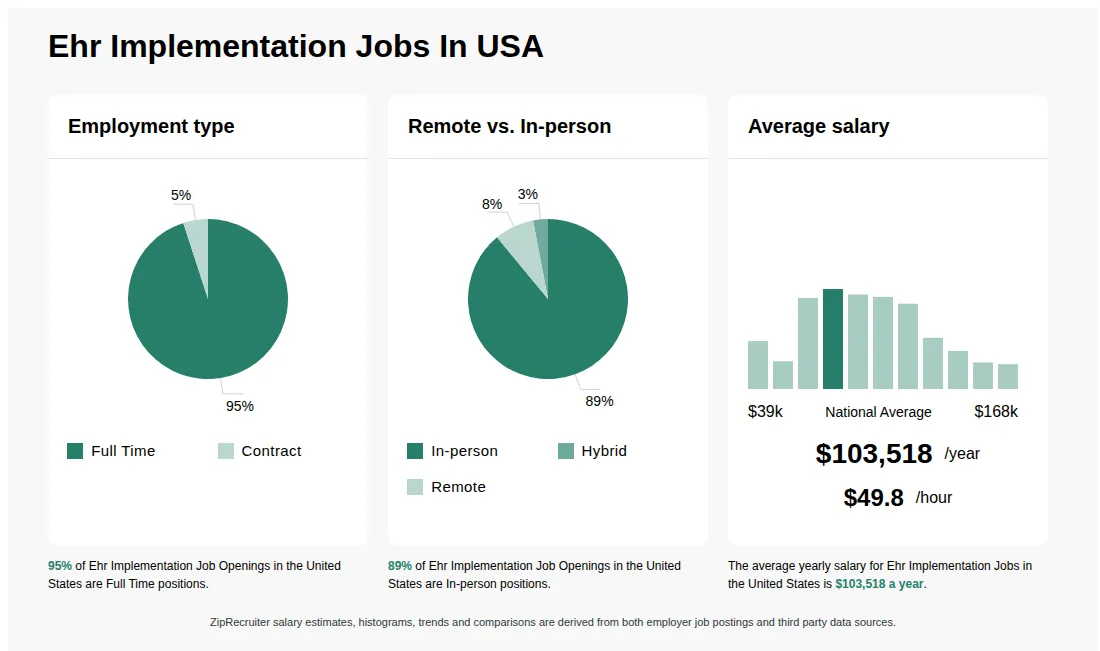
Ehr Implementation information
See salary details
$39K - $50.7K
7% of jobs
$50.7K - $62.5K
4% of jobs
$73.7K is the 25th percentile. Wages below this are outliers.
$62.5K - $74.2K
14% of jobs
$74.2K - $85.9K
15% of jobs
The median wage is $94K / yr.
$85.9K - $97.6K
14% of jobs
$97.6K - $109.4K
14% of jobs
$115.7K is the 75th percentile. Wages above this are outliers.
$109.4K - $121.1K
13% of jobs
$121.1K - $132.8K
7% of jobs
$132.8K - $144.5K
5% of jobs
$144.5K - $156.3K
3% of jobs
$156.3K - $168K
3% of jobs
$39K
$103.5K
$168K
How much do ehr implementation jobs pay per year?
As of Sep 12, 2026, the average yearly pay for ehr implementation in the United States is $103,518.00, according to ZipRecruiter salary data. Most workers in this role earn between $75,500.00 and $121,000.00 per year, depending on experience, location, and employer.
What is an EHR implementation?
An EHR Implementation job involves managing the deployment of Electronic Health Record (EHR) systems in healthcare settings. Professionals in this role work with healthcare staff to ensure a smooth transition, including system customization, data migration, user training, and troubleshooting. They collaborate with IT teams, vendors, and medical personnel to optimize workflows and ensure compliance with healthcare regulations. Strong project management, technical expertise, and communication skills are essential for success in this role.
What are the key skills and qualifications needed to thrive in the EHR implementation position?
To thrive in EHR Implementation, you need a solid understanding of healthcare workflows, IT systems, and project management, often supported by a degree in health informatics, information technology, or a healthcare-related field. Familiarity with major EHR platforms (such as Epic, Cerner, or MEDITECH), knowledge of HL7/FHIR protocols, and certifications like CPHIMS or PMP are highly advantageous. Strong communication, problem-solving, and interpersonal skills help drive user adoption and facilitate collaboration across multidisciplinary teams. These abilities are crucial for successfully guiding healthcare organizations through complex technology transitions while minimizing disruptions to patient care.
What are the common challenges faced in an EHR implementation role, and how are they typically addressed?
EHR Implementation professionals often encounter challenges such as resistance to change among clinical staff, integrating new systems with existing workflows, and ensuring data accuracy during the migration process. To address these obstacles, they collaborate closely with end-users, provide thorough training, and maintain clear lines of communication throughout the project. Working as part of a cross-functional team—including IT, clinicians, and administrative staff—enables effective troubleshooting and problem resolution. Adaptability and a proactive approach are essential for navigating these challenges and ensuring a smooth rollout of the new electronic health record system.
More about Ehr Implementation jobs
What cities are hiring for Ehr Implementation jobs?
Cities with the most Ehr Implementation job openings:
What are the most commonly searched types of Ehr Implementation jobs?
The most popular types of Ehr Implementation jobs are:
What states have the most Ehr Implementation jobs?
States with the most job openings for Ehr Implementation jobs include:
What job categories do people searching Ehr Implementation jobs look for?
The top searched job categories for Ehr Implementation jobs are:
What other helpful pages are available for Ehr Implementation?
Other pages related to Ehr Implementation:
EHR Integration & Implementation Project Manager (Consultant)
New York, NY • On-site
PAX Health
$30/hr
Full-time
Posted 20 days ago
Job description
PAX Health is a leading mental and behavioral health organization dedicated to providing comprehensive and compassionate care to individuals facing mental health challenges. Our team of professionals strive to create an environment where mental health is prioritized, stigma is eradicated, and individuals can thrive in their journey towards well-being.
We are seeking an experienced EHR Integration & Implementation Project Manager to oversee the consolidation of six operating companies onto a single ClinicMind EHR platform. The ideal candidate will have experience managing complex healthcare technology implementations, including EHR integrations, data migration, vendor coordination, testing, and go-live support. This individual should be a strong project leader who can manage multiple workstreams, collaborate across technical and operational teams, and communicate effectively with senior leadership
Scope of Services
1. Enterprise EHR Integration Oversight
2. Referral Portal Build & Integration
3. Website Scheduling Integration
4. AI Receptionist Deployment
5. Data Migration Oversight
Project Management Responsibilities
Deliverables
Expected Outcomes
Term
The engagement will continue through completion of implementation, data migration, stabilization, and final project closeout, unless otherwise modified by mutual written agreement.
Reporting
The consultant will report directly to the COO and provide regular progress updates, identify implementation risks, recommend corrective actions, and coordinate all implementation activities with ClinicMind and other project stakeholders.
Requirements
Salary Description
$30 per hour
We are seeking an experienced EHR Integration & Implementation Project Manager to oversee the consolidation of six operating companies onto a single ClinicMind EHR platform. The ideal candidate will have experience managing complex healthcare technology implementations, including EHR integrations, data migration, vendor coordination, testing, and go-live support. This individual should be a strong project leader who can manage multiple workstreams, collaborate across technical and operational teams, and communicate effectively with senior leadership
Scope of Services
1. Enterprise EHR Integration Oversight
- Lead and oversee the implementation of ClinicMind across six companies.
- Develop and maintain the overall implementation timeline, milestones, and deliverables.
- Coordinate meetings with stakeholders, ClinicMind implementation teams, and third-party vendors.
- Monitor project progress, identify risks, and implement mitigation strategies.
- Ensure implementation activities remain on schedule and within agreed project objectives.
2. Referral Portal Build & Integration
- Oversee the design, configuration, testing, and deployment of the ClinicMind referral portal.
- Coordinate integration with referral partners and internal workflows.
- Validate referral processes for accuracy, efficiency, and compliance.
- Manage issue resolution during implementation and post-launch stabilization.
3. Website Scheduling Integration
- Oversee integration between ClinicMind scheduling functionality and the organization's websites.
- Coordinate with web developers, ClinicMind technical teams, and internal stakeholders.
- Ensure appointment scheduling workflows function accurately and efficiently.
- Supervise user acceptance testing and deployment.
4. AI Receptionist Deployment
- Manage the implementation and rollout of the AI receptionist solution.
- Coordinate system configuration, call routing, scripting, scheduling integration, and workflow automation.
- Ensure the AI receptionist integrates effectively with ClinicMind scheduling and patient communication workflows.
- Oversee testing, staff training, and go-live support.
5. Data Migration Oversight
- Coordinate the migration of patient and operational data from legacy EHR systems and other data sources into ClinicMind.
- Oversee data mapping, validation, cleansing, and migration testing.
- Ensure data integrity, completeness, and compliance throughout the migration process.
- Coordinate reconciliation efforts and resolve migration-related issues prior to final go-live.
Project Management Responsibilities
- Serve as the primary implementation oversight lead across all workstreams.
- Maintain project documentation, status reports, action items, and risk logs.
- Provide regular executive updates regarding project status, risks, and key decisions.
- Facilitate cross-functional communication among leadership, operations, IT, vendors, and implementation teams.
- Escalate critical issues and recommend solutions to maintain project momentum.
Deliverables
- Comprehensive implementation project plan.
- Integrated project timeline with milestones and dependencies.
- Weekly project status reports.
- Risk and issue tracking log.
- Data migration readiness and validation reports.
- Referral portal implementation oversight.
- Website scheduling integration oversight.
- AI receptionist implementation oversight.
- Go-live readiness assessment.
- Post-implementation stabilization support and transition documentation.
Expected Outcomes
- Successful implementation of ClinicMind across all six companies.
- Standardized EHR workflows across the organization.
- Fully operational referral portal.
- Seamless website appointment scheduling integrated with ClinicMind.
- Successful deployment of the AI receptionist solution.
- Accurate migration of legacy data into ClinicMind.
- Minimal operational disruption during implementation and transition.
Term
The engagement will continue through completion of implementation, data migration, stabilization, and final project closeout, unless otherwise modified by mutual written agreement.
Reporting
The consultant will report directly to the COO and provide regular progress updates, identify implementation risks, recommend corrective actions, and coordinate all implementation activities with ClinicMind and other project stakeholders.
Requirements
- Bachelor's degree in Information Technology, Healthcare Administration, Business, Project Management, or a related field.
- 3-5+ years of experience managing healthcare IT or EHR implementation projects.
- Experience leading cross-functional projects involving multiple stakeholders, vendors, and executive leadership.
- Demonstrated experience with EHR implementations, data migration, system integrations, and go-live support.
- Strong project management skills, including timeline development, risk management, issue tracking, and status reporting.
- Excellent communication, facilitation, and organizational skills.
- Ability to manage multiple workstreams simultaneously in a fast-paced environment.
- Experience implementing ClinicMind or another ambulatory EHR platform.
- Knowledge of healthcare operations, referral workflows, scheduling systems, and patient access processes.
- PMP, CAPM, or other project management certification.
- Experience supporting AI workflow or patient communication technology implementations.
Salary Description
$30 per hour