... medical challenges of tomorrow. We strive to have a remarkable impact on people's lives across ... The Archive Records Analyst provides leadership for high-priority, complex initiatives supporting ...
... medical challenges of tomorrow. We strive to have a remarkable impact on people's lives across ... The Archive Records Analyst provides leadership for high-priority, complex initiatives supporting ...

Medical Record Comp Analyst
Toledo, OH · On-site
$19.75 - $23.15/hr
Medical Record Comp Analyst Job no: 501218 Work type: Staff - Full-Time Location: Health Science ... records required Other required qualifications/knowledge/skills/abilities: 1. Knowledge of JCAHO ...
Medical Record Comp Analyst
Toledo, OH · On-site
$19.75 - $23.15/hr
Medical Record Comp Analyst Job no: 501218 Work type: Staff - Full-Time Location: Health Science ... records required Other required qualifications/knowledge/skills/abilities: 1. Knowledge of JCAHO ...

OPS RECORDS ANALYST - 64858462
Tampa, FL · On-site
$20.25/hr
OPS RECORDS ANALYST - 64858462 Pay Plan: Temp Position Number: 64858462 Salary: $20.25 Hourly ... This requires independent decision-making responsibility regarding the maintenance of medical ...
OPS RECORDS ANALYST - 64858462
Tampa, FL · On-site
$20.25/hr
OPS RECORDS ANALYST - 64858462 Pay Plan: Temp Position Number: 64858462 Salary: $20.25 Hourly ... This requires independent decision-making responsibility regarding the maintenance of medical ...
Archive Records Analyst
North Chicago, IL · On-site
... medical challenges of tomorrow. We strive to have a remarkable impact on people's lives across ... The Archive Records Analyst provides leadership for high-priority, complex initiatives supporting ...
Quick apply
Archive Records Analyst
North Chicago, IL · On-site
... medical challenges of tomorrow. We strive to have a remarkable impact on people's lives across ... The Archive Records Analyst provides leadership for high-priority, complex initiatives supporting ...

AOT Records Analyst III
Barre, VT · On-site
Who May Apply This position, AOT Records Analyst III (Job Requisition #55379) , is open to all ... State Paid Family and Medical Leave Insurance (FMLI) * Two ways to save for your retirement: A ...
AOT Records Analyst III
Barre, VT · On-site
Who May Apply This position, AOT Records Analyst III (Job Requisition #55379) , is open to all ... State Paid Family and Medical Leave Insurance (FMLI) * Two ways to save for your retirement: A ...

Special Instructionsneed knowledge of medical insurance rules and guidelines and appeals Responsibilities Interview members of the medical staff to record the optimum measures and standards accepted ...
Special Instructionsneed knowledge of medical insurance rules and guidelines and appeals Responsibilities Interview members of the medical staff to record the optimum measures and standards accepted ...
OPS RECORDS ANALYST - 64858462
Tampa, FL · On-site
$20.25/hr
OPS RECORDS ANALYST - 64858462 Pay Plan: Temp Position Number: 64858462 Salary: $20.25 Hourly ... This requires independent decision-making responsibility regarding the maintenance of medical ...
OPS RECORDS ANALYST - 64858462
Tampa, FL · On-site
$20.25/hr
OPS RECORDS ANALYST - 64858462 Pay Plan: Temp Position Number: 64858462 Salary: $20.25 Hourly ... This requires independent decision-making responsibility regarding the maintenance of medical ...

Medical Records Clerk
Los Angeles, CA · On-site
$17.25 - $21.25/hr
Medical Records - HIM (Medical Records) Duration: 8 months Work Location: Los Angeles, CA Working ... Analyze reports to determine status of records to be processed and entered into the Electronic ...
Medical Records Clerk
Los Angeles, CA · On-site
$17.25 - $21.25/hr
Medical Records - HIM (Medical Records) Duration: 8 months Work Location: Los Angeles, CA Working ... Analyze reports to determine status of records to be processed and entered into the Electronic ...
Archive Records Analyst
North Chicago, IL · On-site
$84K/yr
... medical challenges of tomorrow. We strive to have a remarkable impact on people's lives across ... The Archive Records Analyst provides leadership for high-priority, complex initiatives supporting ...
Archive Records Analyst
North Chicago, IL · On-site
$84K/yr
... medical challenges of tomorrow. We strive to have a remarkable impact on people's lives across ... The Archive Records Analyst provides leadership for high-priority, complex initiatives supporting ...
Special Instructionsneed knowledge of medical insurance rules and guidelines and appeals Responsibilities Interview members of the medical staff to record the optimum measures and standards accepted ...
Special Instructionsneed knowledge of medical insurance rules and guidelines and appeals Responsibilities Interview members of the medical staff to record the optimum measures and standards accepted ...
Medical Records
$32K - $44K/yr
Consults with staff to help define and analyze information needed from the clinical record ... Medical Records Technician (MRT), Accredited Records Technician (ART) or a Medical Records ...
Quick apply
Medical Records
$32K - $44K/yr
Consults with staff to help define and analyze information needed from the clinical record ... Medical Records Technician (MRT), Accredited Records Technician (ART) or a Medical Records ...
Medical Records
$16.50 - $19.50/hr
About the Role As a Medical Records professional, you will be responsible for accurately and efficiently capturing, managing, and analyzing patient medical records. You will work closely with our ...
Quick apply
Medical Records
$16.50 - $19.50/hr
About the Role As a Medical Records professional, you will be responsible for accurately and efficiently capturing, managing, and analyzing patient medical records. You will work closely with our ...

Responsibilities HIM/Medical Records Analyst/Coding Specialist Opportunity West Oaks Hospital has provided psychiatric care to the Houston area and surrounding communities for over four decades. Our ...
Responsibilities HIM/Medical Records Analyst/Coding Specialist Opportunity West Oaks Hospital has provided psychiatric care to the Houston area and surrounding communities for over four decades. Our ...
Medical Records
$16.75 - $20/hr
Medical Records - Join Our Team at Spring River Rehabilitation and Care Center At Spring River ... Excellent organizational, analytical, and communication skills * Familiarity with medical ...
Quick apply
Medical Records
$16.75 - $20/hr
Medical Records - Join Our Team at Spring River Rehabilitation and Care Center At Spring River ... Excellent organizational, analytical, and communication skills * Familiarity with medical ...
Pipeline Integrity Records Analyst
Wall, NJ · Hybrid
$53K - $72K/yr
... Records Analyst to support the Pipeline Integrity team's efforts to maintain accurate records as ... Day one medical coverage, including prescription, vision and dental plans, so you're supported ...
Pipeline Integrity Records Analyst
Wall, NJ · Hybrid
$53K - $72K/yr
... Records Analyst to support the Pipeline Integrity team's efforts to maintain accurate records as ... Day one medical coverage, including prescription, vision and dental plans, so you're supported ...
Responsibilities HIM/Medical Records Analyst/Coding Specialist Opportunity West Oaks Hospital has provided psychiatric care to the Houston area and surrounding communities for over four decades. Our ...
Responsibilities HIM/Medical Records Analyst/Coding Specialist Opportunity West Oaks Hospital has provided psychiatric care to the Houston area and surrounding communities for over four decades. Our ...

Compliance Medical Records Assistant Location: Wilmington, NC | Coastal Horizons Center, Inc ... Strong analytical skills with the ability to review records for accuracy, completeness, and ...
Quick apply
Compliance Medical Records Assistant Location: Wilmington, NC | Coastal Horizons Center, Inc ... Strong analytical skills with the ability to review records for accuracy, completeness, and ...

The Electronic Health Records Systems Analyst will help improve the staff and provider experience ... The analyst will work closely with clinical leadership, providers, nurses, medical assistants ...
The Electronic Health Records Systems Analyst will help improve the staff and provider experience ... The analyst will work closely with clinical leadership, providers, nurses, medical assistants ...
Compliance Medical Records Assistant Location: Wilmington, NC | Coastal Horizons Center, Inc ... Strong analytical skills with the ability to review records for accuracy, completeness, and ...
Compliance Medical Records Assistant Location: Wilmington, NC | Coastal Horizons Center, Inc ... Strong analytical skills with the ability to review records for accuracy, completeness, and ...
HIM/MEDICAL RECORDS ANALYST/CODING SPECIALIST-FT
Houston, TX · On-site
$89K - $90K/yr
Responsibilities HIM/Medical Records Analyst/Coding Specialist Opportunity West Oaks Hospital has provided psychiatric care to the Houston area and surrounding communities for over four decades. Our ...
HIM/MEDICAL RECORDS ANALYST/CODING SPECIALIST-FT
Houston, TX · On-site
$89K - $90K/yr
Responsibilities HIM/Medical Records Analyst/Coding Specialist Opportunity West Oaks Hospital has provided psychiatric care to the Houston area and surrounding communities for over four decades. Our ...
Medical Records Analyst information
See salary details
$9.13 - $12.13
3% of jobs
$12.13 - $15.12
0% of jobs
$15.12 - $18.12
15% of jobs
$18.93 is the 25th percentile. Wages below this are outliers.
$18.12 - $21.11
26% of jobs
The median wage is $22.11 / hr.
$21.11 - $24.10
19% of jobs
$24.10 - $27.10
6% of jobs
$28.20 is the 75th percentile. Wages above this are outliers.
$27.10 - $30.09
16% of jobs
$30.09 - $33.09
6% of jobs
$33.09 - $36.08
5% of jobs
$36.08 - $39.07
2% of jobs
$39.07 - $42.07
1% of jobs
$9
$25
$42
How much do medical records analyst jobs pay per hour?
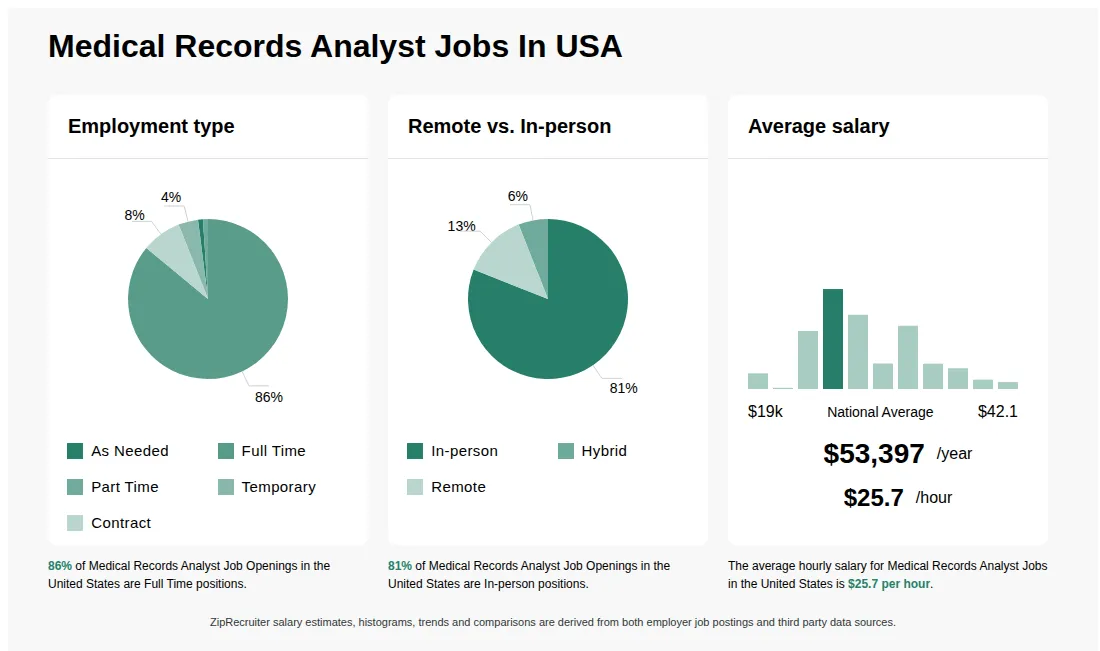
As of Jul 24, 2026, the average hourly pay for medical records analyst in the United States is $25.67, according to ZipRecruiter salary data. Most workers in this role earn between $19.23 and $27.88 per hour, depending on experience, location, and employer.
How long does it take to become a medical data analyst?
Becoming a medical records analyst typically requires a postsecondary certificate or an associate degree in health information technology or a related field, which can take about 1 to 2 years. Gaining proficiency in electronic health record systems and obtaining certifications like the RHIT (Registered Health Information Technician) can enhance job prospects and may require additional time for training and certification preparation.
What does a Medical Records Analyst do?
A Medical Records Analyst is responsible for reviewing, organizing, and maintaining patient health records to ensure accuracy, completeness, and compliance with regulations. They analyze data for quality assurance, prepare reports, and may assist in implementing electronic health record (EHR) systems. Their work helps healthcare providers deliver effective care and ensures that records are properly managed for billing, legal, and research purposes.
How much does a medical records analyst make?
The average salary for a medical records analyst in Florida is approximately $45,000 to $55,000 per year, depending on experience, certifications, and the healthcare facility. Entry-level positions may start lower, while experienced analysts with certifications like RHIT or RHIA can earn higher salaries. The role often requires proficiency with electronic health record (EHR) systems and attention to detail.
What are the 5 C's of medical records?
The 5 C's of medical records are Completeness, Consistency, Clarity, Confidentiality, and Chronology. As a Medical Records Analyst, ensuring these qualities helps maintain accurate, secure, and well-organized patient documentation essential for quality healthcare and compliance.
What Does a Medical Records Analyst Do?
A medical records analyst is responsible for collecting, organizing, and analyzing healthcare records data. Job duties may include using health information to create reports about how to streamline the collection and sharing of patient records. Career qualifications for a medical records analyst often include an associate’s or bachelor’s degree in health information management or a related IT field. Larger healthcare organizations may require experience and additional certification that shows your analysis skills.
How does a Medical Records Analyst typically collaborate with other healthcare professionals?
Medical Records Analysts frequently work alongside physicians, nurses, and administrative staff to ensure patient records are accurate, complete, and compliant with regulations. They may participate in interdisciplinary meetings to clarify documentation needs or resolve discrepancies in patient information. Effective communication and teamwork are essential, as analysts often act as the bridge between clinical staff and IT or billing departments, helping to streamline record-keeping processes and support quality patient care.
What is the difference between Medical Records Analyst vs Medical Coder?
| Aspect | Medical Records Analyst | Medical Coder |
|---|---|---|
| Credentials | Typically requires a health information management degree or certification | Requires coding certifications like CPC or CCS |
| Work Environment | Hospitals, clinics, health info departments | Medical offices, billing companies, hospitals |
| Job Focus | Managing, organizing, and analyzing patient records | Assigning codes to diagnoses and procedures for billing |
| Common Usage | Health information management, record accuracy | Medical billing, insurance claims |
While both roles work within healthcare data, Medical Records Analysts focus on managing and analyzing patient information, whereas Medical Coders specialize in translating medical services into codes for billing and insurance purposes. Understanding these differences helps in choosing the right career path or job search focus.
What are the key skills and qualifications needed to thrive as a Medical Records Analyst, and why are they important?
To thrive as a Medical Records Analyst, you need a solid understanding of health information management, medical terminology, and regulatory compliance, often supported by a degree in health information technology or a related field. Familiarity with electronic health record (EHR) systems, coding software like ICD-10/CPT, and certifications such as RHIT or RHIA is typically required. Attention to detail, analytical thinking, and strong organizational skills help ensure data accuracy and effective record-keeping. These skills are vital for maintaining accurate patient records, supporting healthcare operations, and ensuring compliance with legal and ethical standards.
What degree do you need to be a medical records specialist?
A medical records analyst typically needs at least an associate's degree in health information technology, health information management, or a related field. Some positions may require a bachelor's degree, and certifications such as Registered Health Information Technician (RHIT) can enhance job prospects. Strong knowledge of medical coding, data management, and healthcare regulations is also important.
More about Medical Records Analyst jobs
What cities are hiring for Medical Records Analyst jobs? Cities with the most Medical Records Analyst job openings:
What are the most commonly searched types of Medical Records Analyst jobs? The most popular types of Medical Records Analyst jobs are:
What states have the most Medical Records Analyst jobs? States with the most job openings for Medical Records Analyst jobs include:
What job categories do people searching Medical Records Analyst jobs look for? The top searched job categories for Medical Records Analyst jobs are:
What are popular job titles related to Medical Records Analyst jobs? For Medical Records Analyst jobs, the most frequently searched job titles are:

Full-time
Medical, Dental, Vision, Retirement, PTO
Posted 7 days ago
AbbVie rating

8.7
Based on 100 frontline employees who took The Breakroom Quiz
10th of 74 rated pharmaceutical
Job description
Company Description
About AbbVie
AbbVie's mission is to discover and deliver innovative medicines and solutions that solve serious health issues today and address the medical challenges of tomorrow. We strive to have a remarkable impact on people's lives across several key therapeutic areas including immunology, oncology and neuroscience - and products and services in our Allergan Aesthetics portfolio. For more information about AbbVie, please visit us at www.abbvie.com. Follow @abbvie on LinkedIn, Facebook, Instagram, X and YouTube.
Job Description
Purpose:
The Archive Records Analyst provides leadership for high-priority, complex initiatives supporting the records management electronic archiving program. This department archives records from across the company, including business and GxP regulated records such as Pre-Clinical, Clinical, Regulatory and Safety.
This position is a key member of the Electronic Records Archiving Center of Practice, with responsibility for supporting the global deployment of the records lifecycle governance and applications. This position reports to the AbbVie Archive Senior Manager/Manager.
Responsibilities
Assumes a leadership role in driving records management enterprise governance
Contributes to program performance including implementation of activities per the records strategy
Key interface with global records management teams
Monitor and report on global deployment project plans / deliverables as required for management
Provide program status updates as required against milestones to management and business stakeholders
Ability to work with archiving IT system(s) and team(s)
Can create and effectively deliver communication plans and communications that are:
Clear and concise
Across management levels
Targeted for a country, region or global audience
Must have excellent partnering skills to facilitate projects within and across organizations
Accountable for providing input and managing within budgetary requirements
Responsible for compliance with applicable policies and procedures
Perform other duties as assigned
Qualifications
Qualifications
Required Education:
Associate, Bachelor's degree or equivalent with 5 years minimum related
experience OR High School diploma or equivalent and 7 years related experience ;
Related certifications a plus
5+ years related experience in a regulated industry such as, pharmaceutical, medical device manufacturing, regulatory affairs or quality
5+ years of experience in records management and/or working in an archive
Knowledge and hands on experience with a Document and/or Records Management System
Experience working in a complex, matrixed environment
Robust communication skills, both oral and written
Advanced knowledge and experience with MS Excel, Word, PowerPoint, and SharePoint
Preferred Experience:
Experience with global teams and/or deployments
Experience working with IT systems
Additional Information
Applicable only to applicants applying to a position in any location with pay disclosure requirements under state or local law:
The compensation range described below is the range of possible base pay compensation that the Company believes in good faith it will pay for this role at the time of this posting based on the job grade for this position. Individual compensation paid within this range will depend on many factors including geographic location, and we may ultimately pay more or less than the posted range. This range may be modified in the future.
We offer a comprehensive package of benefits including paid time off (vacation, holidays, sick), medical/dental/vision insurance and 401(k) to eligible employees.
This job is eligible to participate in our short-term incentive programs. Note: No amount of pay is considered to be wages or compensation until such amount is earned, vested, and determinable. The amount and availability of any bonus, commission, incentive, benefits, or any other form of compensation and benefits that are allocable to a particular employee remains in the Company's sole and absolute discretion unless and until paid and may be modified at the Company's sole and absolute discretion, consistent with applicable law.
AbbVie is an equal opportunity employer and is committed to operating with integrity, driving innovation, transforming lives and serving our community. Equal Opportunity Employer/Veterans/Disabled.
US & Puerto Rico only - to learn more, visit https://www.abbvie.com/join-us/equal-employment-opportunity-employer.html
US & Puerto Rico applicants seeking a reasonable accommodation, click here to learn more:
https://www.abbvie.com/join-us/reasonable-accommodations.html

About AbbVie
Sourced by ZipRecruiter
AbbVie's mission is to discover and deliver innovative medicines that solve serious health issues today and address the medical challenges of tomorrow. We strive to have a remarkable impact on people's lives across several key therapeutic areas: immunology, oncology, neuroscience, eye care, virology, women's health, and gastroenterology, in addition to products and services across its Allergan Aesthetics portfolio. For more information about AbbVie, please visit us at www.abbvie.com. Follow @abbvie on Twitter, Facebook, Instagram, YouTube, and LinkedIn.
Industry
Scientific research and development services
Company size
10,000+ Employees
Headquarters location
North Chicago, IL, US
Year founded
2013