1

Insurance Manager Jobs (NOW HIRING)

Managing the finance and insurance process for vehicle purchases from approval through delivery. Presenting financing options, payment choices, service contracts, protection products, and other ...

Commercial Insurance Manager

Woburn, MA · On-site

$90K - $120K/yr

Train newly hired Commercial Lines Account Managers on rating, quoting, new business applications, binders of insurance, endorsements, certificates of insurance, audits, renewal reviews, remarketing ...

next page

Showing results 1-20

Insurance Manager information

See salary details

$37.5K

$82.8K

$122.5K

How much do insurance manager jobs pay per year?

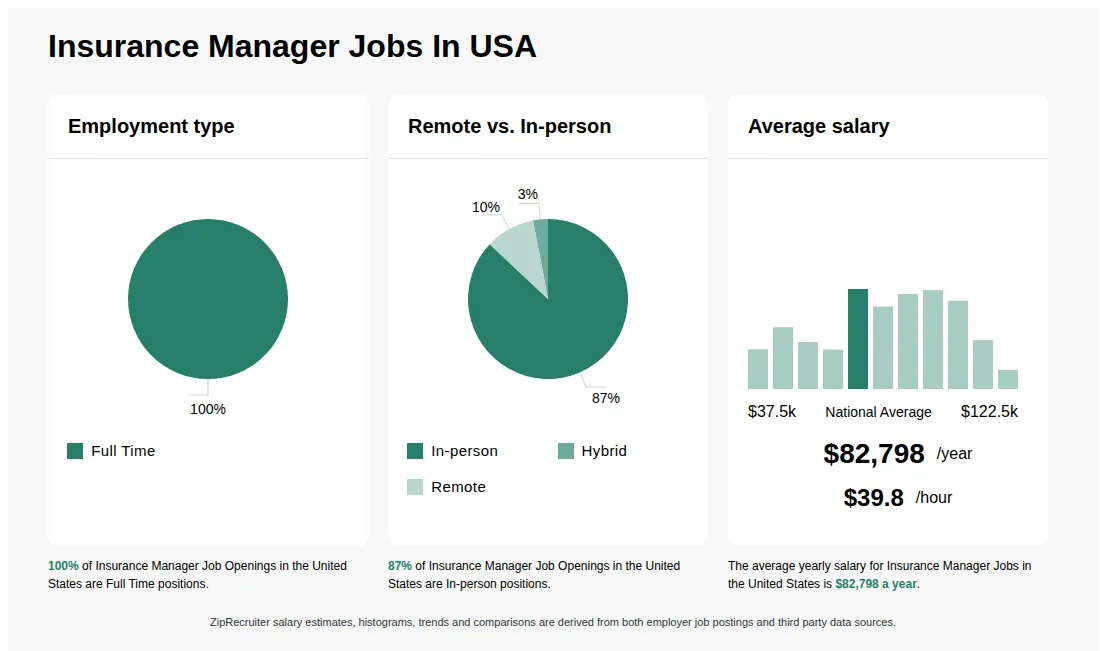
As of Jun 24, 2026, the average yearly pay for insurance manager in the United States is $82,798.00, according to ZipRecruiter salary data. Most workers in this role earn between $66,500.00 and $99,000.00 per year, depending on experience, location, and employer.

Why do so many insurance agents quit?

Insurance managers and agents often leave the profession due to high workload, commission-based pay structures, and job stress. The industry's competitive environment and the need for strong sales skills can also contribute to turnover. Many quit to seek more stable or less demanding careers or to improve work-life balance.

What are some common challenges faced by Insurance Managers and how can they be addressed?

Insurance Managers often face challenges such as keeping up with changing regulations, managing diverse client portfolios, and balancing risk assessment with customer service. Staying updated with industry regulations and investing in continuous professional development can help address compliance issues. Effective communication and strong organizational skills are essential for managing multiple clients and teams. Additionally, leveraging modern insurance software can streamline operations and enhance accuracy in policy management.

What is the highest paying position in insurance?

The highest paying positions in insurance often include Chief Underwriting Officer, Chief Risk Officer, or Chief Executive Officer, which require extensive experience, leadership skills, and advanced certifications. These roles typically oversee company strategy, risk management, and large teams, and can earn six-figure salaries or higher depending on the company size and location.

What is the role of insurance manager?

An insurance manager oversees the development, implementation, and management of insurance policies within an organization or for clients. They analyze risks, ensure compliance with regulations, and coordinate with underwriters and agents. Strong analytical skills, knowledge of insurance laws, and certification such as CPCU or ARM are often required.

What are the key skills and qualifications needed to thrive as an Insurance Manager, and why are they important?

To thrive as an Insurance Manager, you need expertise in risk assessment, policy analysis, and regulatory compliance, often supported by a bachelor's degree in finance, business, or a related field. Familiarity with insurance management software, claims processing systems, and industry certifications like CPCU or ARM is highly valuable. Strong leadership, negotiation, and interpersonal skills help build effective teams and maintain client relationships. These abilities are crucial for ensuring seamless operations, regulatory adherence, and delivering excellent service in a competitive insurance environment.

What is the difference between Insurance Manager vs Insurance Underwriter?

AspectInsurance ManagerInsurance Underwriter
CredentialsOften requires insurance-related certifications and management experienceTypically holds actuarial, underwriting, or insurance licenses
Work EnvironmentManages teams, oversees policies, and develops strategies within insurance companiesEvaluates risks, assesses applications, and determines policy terms
Employer & Industry UsageCommonly employed in insurance firms, brokers, and agenciesPrimarily found in insurance companies and underwriting firms
Search & Comparison IntentPeople compare roles involving insurance policy oversight and managementIndividuals interested in risk assessment and policy issuance

The main difference between an Insurance Manager and an Insurance Underwriter lies in their responsibilities. Insurance Managers oversee teams, develop policies, and manage overall operations, while Insurance Underwriters focus on evaluating individual risks and determining policy terms. Both roles require insurance-related credentials and are integral to the insurance industry, but they serve different functions within the insurance process.

What does an Insurance Manager do?

An Insurance Manager is responsible for overseeing the operations of an insurance department or company, ensuring that policies and procedures comply with industry regulations. Their duties often include managing staff, developing insurance policies, assessing risk, and working with clients to provide the best coverage options. Insurance Managers also analyze claims, monitor financial performance, and implement strategies for growth and customer satisfaction. They play a key role in decision-making and maintaining strong relationships with clients, brokers, and underwriters.

What jobs pay 2000 a day?

High-paying jobs that can pay around $2,000 a day typically include executive roles such as CEOs, CFOs, and other C-suite positions, as well as specialized professions like anesthesiologists, surgeons, and certain legal or consulting roles. These positions often require advanced degrees, extensive experience, and sometimes ownership of a business or high-level consulting contracts.

What Is the Role of an Insurance Manager?

An insurance manager oversees the performance of all the employees who work for an insurance branch and verifies that all corporate policies are followed, including the filing of client records. Specifically, as an insurance manager, you supervise a sales agent or broker to help them drive sales and make sure they sell enough policies. Then, you ensure each of your sales agents receives a commission for excelling in their duties. To maximize profits, you set premiums by using actuary data and information from appraisers to determine the likelihood of clients filing claims, as well as the value of their assets. In this role, you are typically involved in many actions that the branch takes, such as the approval, denial, or investigation of claims.

What cities are hiring for Insurance Manager jobs? Cities with the most Insurance Manager job openings:
What are the most commonly searched types of Insurance jobs? The most popular types of Insurance jobs are:
Who are the top companies hiring for Insurance Manager jobs? The top employers for Insurance Manager jobs are:
What states have the most Insurance Manager jobs? States with the most job openings for Insurance Manager jobs include:
Infographic showing various Insurance Manager job openings in the United States as of June 2026, with employment types broken down into 1% As Needed, 73% Full Time, 20% Part Time, and 6% Contract. Highlights an 92% Physical, 2% Hybrid, and 6% Remote job distribution, with an average salary of $82,798 per year, or $39.8 per hour.

Finance & Insurance Manager

Jenkins Genesis of NE Jacksonville

Jacksonville, FL • On-site

Full-time

Medical, Dental, Vision, Life, Retirement, PTO

This job post has expired today. Applications are no longer accepted.


Job description

Job Summary:
Working as a key member of our team, the F&I Manager routinely collaborates with the sales team and general manager in order to maintain leading-edge currency and directly consults with our customers. The successful F&I Manager maintains a high manufacturer-required CSI by maintaining an outstanding customer service delivery level within strict legal compliance and with unwavering ethics.
He/she achieves this by providing a true value-add to the closing support function of the sales life cycle. First and foremost, the ideal F&I Manager is a superior communicator who is expert at building customer rapport and effecting profitable closure for the enterprise.
The mission of the F&I Manager is to present and articulate a menu of credit service options to the customer in order to optimize the transaction, and to also offer product protection choices in support of the purchase.
Benefits:
  • Medical- 4 plans (BCBS)
  • Dental
  • Vision
  • Term Life
  • Company-paid Term Life
  • STD/LTD
  • Accident indemnity rider
  • PTO / Sick days (annually)
  • 401(k) with an employer match
  • Employee Assistant Program
  • FMLA / Maternity/Paternity Leave
  • Bereavement Leave

Essential Functions: (Essential functions, as defined under the Americans with Disabilities Act, may include the following tasks, knowledge, skills and other characteristics. This list is ILLUSTRATIVE ONLY and is not a comprehensive listing of all functions and tasks performed by incumbents of this class.)
Duties and Responsibilities:
The following is a representative list of the duties and responsibilities associated with this position:
  • Reviews customer credit application and credit report
  • Presents financing options in a clear and concise fashion
  • Prepares loan documents
  • Prepares delivery documentation
  • Prepares DMV documents
  • Prepares other state and federal documents as appropriate
  • Acts as facilitator for any questions that may arise during the process
  • Collaborates with dealership team to stay leading-edge sharp
  • Maintains currency with regard to all financial instruments and value-add products/services
  • Adhere to all company policies, procedures and safety standards
  • Perform other duties as assigned

Physical Demands:
The physical demands described here are representative of those that must be met by an employee to successfully perform the essential functions of this job. Reasonable accommodations may be made to enable individuals with disabilities to perform the essential functions.
  • Sitting: Remaining in the seated position
  • Feel / Touch: Picking, pinching, or otherwise working primarily with fingers rather than with the whole hand or arm as in handling
  • Talking: Expressing or exchanging ideas by means of the spoken word to impart oral information to clients or to the public and to convey detailed spoken instructions to other workers accurately, loudly, or quickly

Environmental Conditions: Be able to work in a climate-controlled environment
We are an equal opportunity employer and prohibit discrimination/harassment without regard to race, color, religion, age, sex, national origin, disability status, genetics, protected veteran status, sexual orientation, gender identity or expression, or any other characteristic protected by federal, state or local laws.