The Enterprise Voice Engineer II role is ideal for a skilled engineer with experience in IP voice systems, network infrastructure, and enterprise communications who can help maintain secure, reliable ...
The Enterprise Voice Engineer II role is ideal for a skilled engineer with experience in IP voice systems, network infrastructure, and enterprise communications who can help maintain secure, reliable ...

Voice Engineer III
Baton Rouge, LA · On-site
A Voice Engineer meticulously analyzes network infrastructure, troubleshoots issues, and optimizes performance to provide reliable and clear voice transmission. Additionally, they collaborate with ...
Voice Engineer III
Baton Rouge, LA · On-site
A Voice Engineer meticulously analyzes network infrastructure, troubleshoots issues, and optimizes performance to provide reliable and clear voice transmission. Additionally, they collaborate with ...
Voice Engineer III
Baton Rouge, LA · On-site
A Voice Engineer meticulously analyzes network infrastructure, troubleshoots issues, and optimizes performance to provide reliable and clear voice transmission. Additionally, they collaborate with ...
Quick apply
Voice Engineer III
Baton Rouge, LA · On-site
A Voice Engineer meticulously analyzes network infrastructure, troubleshoots issues, and optimizes performance to provide reliable and clear voice transmission. Additionally, they collaborate with ...

Sr. Voice Engineer
Mason, OH · On-site
Company Description Title: Sr. Voice Engineer Term: 6 Months C2H Location: Mason, OH Position type: Long term contract / contract to hire possible Unfortunately, we cannot work with 3rd party & H1B ...
Sr. Voice Engineer
Mason, OH · On-site
Company Description Title: Sr. Voice Engineer Term: 6 Months C2H Location: Mason, OH Position type: Long term contract / contract to hire possible Unfortunately, we cannot work with 3rd party & H1B ...

UC/Voice Engineer
Fort Belvoir, VA · On-site
Overview QBE, LLC is seeking a UC/Voice Engineer to support the US Army Comprehensive Modernization (COMPMOD) program. The program delivers end-to-end EFIS&T services, including survey and design ...
UC/Voice Engineer
Fort Belvoir, VA · On-site
Overview QBE, LLC is seeking a UC/Voice Engineer to support the US Army Comprehensive Modernization (COMPMOD) program. The program delivers end-to-end EFIS&T services, including survey and design ...

Telecom Voice Engineer Job Location: Rolling Meadows - Illinois Job Type: Contract Technical Skills Primary * Deep expertise in Genesys Cloud architecture call routing and telephony integrations
Quick apply
Telecom Voice Engineer Job Location: Rolling Meadows - Illinois Job Type: Contract Technical Skills Primary * Deep expertise in Genesys Cloud architecture call routing and telephony integrations
Cisco Voice Engineer
Waller, TX · On-site
We are seeking a Cisco Voice Engineer with hands-on expertise in Microsoft Teams Voice to join our team. This role involves supporting large-scale enterprise environments with a mix of Cisco UC ...
Cisco Voice Engineer
Waller, TX · On-site
We are seeking a Cisco Voice Engineer with hands-on expertise in Microsoft Teams Voice to join our team. This role involves supporting large-scale enterprise environments with a mix of Cisco UC ...

Cisco Voice Engineer
Detroit, MI · On-site
Position: Cisco Voice Engineer Location: Detroit, MI Job Type: Full Time As a Voice Engineer is responsible for the design, support and maintenance of the Client telephony systems. This highly ...
Cisco Voice Engineer
Detroit, MI · On-site
Position: Cisco Voice Engineer Location: Detroit, MI Job Type: Full Time As a Voice Engineer is responsible for the design, support and maintenance of the Client telephony systems. This highly ...
Voice Engineer
Fort George G Meade, MD · On-site
A telecommunicationsnetwork engineer must perform maintain data, voice and/or video network hardware and systems; Investigates and resolving network and hardware matters of significance; Researches ...
Quick apply
Voice Engineer
Fort George G Meade, MD · On-site
A telecommunicationsnetwork engineer must perform maintain data, voice and/or video network hardware and systems; Investigates and resolving network and hardware matters of significance; Researches ...
Voice Engineer III
Baton Rouge, LA · On-site
A Voice Engineer meticulously analyzes network infrastructure, troubleshoots issues, and optimizes performance to provide reliable and clear voice transmission. Additionally, they collaborate with ...
Voice Engineer III
Baton Rouge, LA · On-site
A Voice Engineer meticulously analyzes network infrastructure, troubleshoots issues, and optimizes performance to provide reliable and clear voice transmission. Additionally, they collaborate with ...

Senior Voice Engineer - Avaya Location: Portland, OR (Onsite) We are seeking an experienced Senior Voice Engineer - Avaya to provide L3 support for enterprise voice and unified communications ...
Senior Voice Engineer - Avaya Location: Portland, OR (Onsite) We are seeking an experienced Senior Voice Engineer - Avaya to provide L3 support for enterprise voice and unified communications ...

Senior Voice Engineer
Mitchell, SD · On-site +1
Senior Voice Engineer As a Senior Voice Engineer , you will play a critical role in supporting and optimizing VoIP environments with a strong focus on advanced troubleshooting, incident resolution ...
Senior Voice Engineer
Mitchell, SD · On-site +1
Senior Voice Engineer As a Senior Voice Engineer , you will play a critical role in supporting and optimizing VoIP environments with a strong focus on advanced troubleshooting, incident resolution ...
Network voice Engineer
Manhattan, NY · On-site
Network voice Engineer Location: New York, NY (Onsite) Rate: 75/hr Need 15+ years of experience JD :- Role Purpose Design, implement, and operate enterprise voice services across Microsoft Teams and ...
Network voice Engineer
Manhattan, NY · On-site
Network voice Engineer Location: New York, NY (Onsite) Rate: 75/hr Need 15+ years of experience JD :- Role Purpose Design, implement, and operate enterprise voice services across Microsoft Teams and ...

Sr. Voice Engineer
Elk Grove Village, IL · On-site
Position : Sr. Voice Engineer Candidates must have CUCM 10.5 experience. . Duration: 12 months plus Location: Elk Grove Village, IL Description: Supports the enterprise voice technologies including ...
Sr. Voice Engineer
Elk Grove Village, IL · On-site
Position : Sr. Voice Engineer Candidates must have CUCM 10.5 experience. . Duration: 12 months plus Location: Elk Grove Village, IL Description: Supports the enterprise voice technologies including ...

Carrier Voice Engineer
Brunswick, ME · On-site
$75K - $95K/yr
We are seeking an experienced Carrier Voice Engineer to secure, support, and optimize carrier-grade voice services across wireline, wireless, wholesale, enterprise, and interconnect environments.
Quick apply
Carrier Voice Engineer
Brunswick, ME · On-site
$75K - $95K/yr
We are seeking an experienced Carrier Voice Engineer to secure, support, and optimize carrier-grade voice services across wireline, wireless, wholesale, enterprise, and interconnect environments.
About the Role Vamonos IT is seeking an experienced Team Lead, Voice Engineering to lead the design, implementation, and ongoing support of enterprise voice and unified communications platforms. This ...
About the Role Vamonos IT is seeking an experienced Team Lead, Voice Engineering to lead the design, implementation, and ongoing support of enterprise voice and unified communications platforms. This ...
MS Teams Voice Engineer
Alexandria, VA · On-site
$75K - $110K/yr
About the Role Vamonos IT is seeking an experienced Team Lead, Voice Engineering to lead the design, implementation, and ongoing support of enterprise voice and unified communications platforms. This ...
MS Teams Voice Engineer
Alexandria, VA · On-site
$75K - $110K/yr
About the Role Vamonos IT is seeking an experienced Team Lead, Voice Engineering to lead the design, implementation, and ongoing support of enterprise voice and unified communications platforms. This ...

Voice Engineer
Denver, CO · On-site
Voice Dial Plan Engineer Location: Greenwood Village, CO or Denver, CO Type: Fulltime Interview: Phone and Skype Responsibilities: Configuring MGCF translations Voice Network architecture planning ...
Voice Engineer
Denver, CO · On-site
Voice Dial Plan Engineer Location: Greenwood Village, CO or Denver, CO Type: Fulltime Interview: Phone and Skype Responsibilities: Configuring MGCF translations Voice Network architecture planning ...
Senior Voice Engineer - Avaya Location: Portland, OR (Onsite) We are seeking an experienced Senior Voice Engineer - Avaya to provide L3 support for enterprise voice and unified communications ...
Quick apply
Senior Voice Engineer - Avaya Location: Portland, OR (Onsite) We are seeking an experienced Senior Voice Engineer - Avaya to provide L3 support for enterprise voice and unified communications ...
Overview QBE, LLC is seeking a UC/Voice Engineer to support the US Army Comprehensive Modernization (COMPMOD) program. The program delivers end-to-end EFIS&T services, including survey and design ...
Overview QBE, LLC is seeking a UC/Voice Engineer to support the US Army Comprehensive Modernization (COMPMOD) program. The program delivers end-to-end EFIS&T services, including survey and design ...
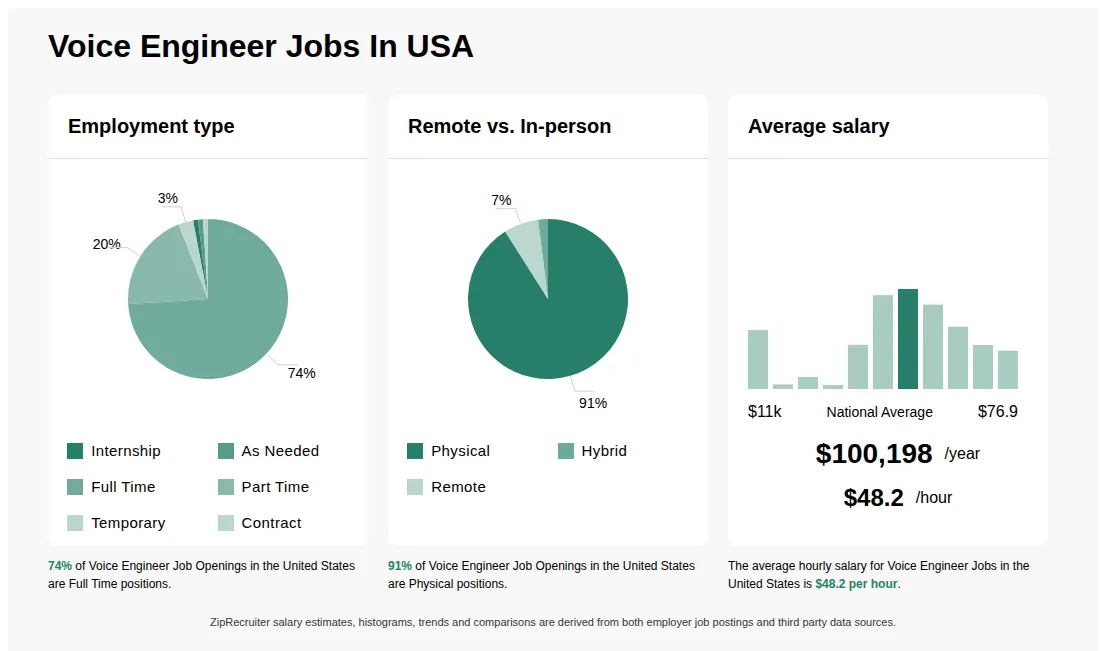
Voice Engineer information
See salary details
$5.29 - $11.80
10% of jobs
$11.80 - $18.31
0% of jobs
$18.31 - $24.83
2% of jobs
$24.83 - $31.34
0% of jobs
$31.34 - $37.85
8% of jobs
$39.38 is the 25th percentile. Wages below this are outliers.
$37.85 - $44.36
18% of jobs
The median wage is $48.34 / hr.
$44.36 - $50.87
19% of jobs
$50.87 - $57.39
16% of jobs
$58.57 is the 75th percentile. Wages above this are outliers.
$57.39 - $63.90
11% of jobs
$63.90 - $70.41
8% of jobs
$70.41 - $76.92
7% of jobs
$5
$48
$76
How much do voice engineer jobs pay per hour?
As of Jul 21, 2026, the average hourly pay for voice engineer in the United States is $48.17, according to ZipRecruiter salary data. Most workers in this role earn between $39.18 and $60.10 per hour, depending on experience, location, and employer.
What is the difference between Voice Engineer vs VoIP Engineer?
| Aspect | Voice Engineer | VoIP Engineer |
|---|---|---|
| Certifications | CCNA Voice, CCNP Collaboration | CCNA Voice, CCNP Collaboration |
| Work Environment | Telecommunications, enterprise networks | Internet Protocol networks, enterprise systems |
| Industry Usage | Telecom providers, large corporations | IT firms, service providers |
| Job Focus | Designing and maintaining voice communication systems | Implementing and managing VoIP solutions |
Voice Engineers and VoIP Engineers often share certifications and work environments, focusing on voice communication systems. While Voice Engineers may concentrate more on traditional telephony and hardware, VoIP Engineers specialize in internet-based voice solutions. Both roles are essential in modern communication infrastructure, with overlapping skills but different primary focuses.
How to become a voice engineer?
To become a voice engineer, typically one needs a bachelor's degree in telecommunications, computer science, or a related field, along with experience in networking, VoIP systems, and audio technologies. Certifications such as Cisco CCNA or CCNP, and proficiency with tools like Cisco Call Manager or Asterisk, can enhance job prospects. Practical experience with network configuration, troubleshooting, and voice communication protocols is essential.
What are the key skills and qualifications needed to thrive as a Voice Engineer, and why are they important?
To thrive as a Voice Engineer, you need expertise in telephony systems, VoIP technologies, and network protocols, often supported by a degree in computer science or a related field. Familiarity with tools like Cisco Unified Communications, SIP, QoS, and relevant certifications such as CCNA Collaboration or CCNP Voice is highly valuable. Strong problem-solving skills, attention to detail, and effective communication enable you to address complex technical issues and collaborate with stakeholders. These skills ensure reliable voice infrastructure, minimize downtime, and support seamless business communications.
What Is a Voice Engineer?
A voice engineer manages the telecommunication systems for a company or other organization. As a voice engineer, you may work heavily with voice over internet protocols (VoIP). In these positions, your title may change to VoIP engineer. Your responsibilities center on quality control with the implementation of new hardware or systems and troubleshooting any issues that arise. Your daily duties typically include installation, customization, maintenance, and repair of telecommunication systems. It’s important to stay abreast of technology trends, especially regarding cybersecurity. Some positions are customer-facing, which require excellent verbal communication skills. This is especially true if you work for a third party IT company. Critical thinking is also essential for creating solutions.
What does a voice engineer do?
A voice engineer designs, implements, and maintains voice communication systems such as VoIP, PBX, and telephony infrastructure. They troubleshoot technical issues, optimize system performance, and often work with networking and audio hardware, requiring knowledge of protocols like SIP and tools such as Cisco or Avaya systems.
How does a Voice Engineer typically collaborate with other IT teams to ensure seamless communication systems?
Voice Engineers often work closely with network, security, and support teams to design, implement, and maintain unified communications infrastructure. They frequently coordinate with network engineers to ensure voice traffic is prioritized and troubleshoot quality issues. Collaboration with cybersecurity teams is also essential to safeguard VoIP systems against threats. Regular communication with help desk and end-user support teams helps Voice Engineers address user concerns and improve service reliability.
What is a Voice Engineer?
A Voice Engineer is an IT professional who designs, implements, and manages voice communication systems, such as VoIP (Voice over Internet Protocol) and traditional telephony networks. They are responsible for ensuring the reliability, security, and quality of voice communication services within an organization. Their duties often include configuring call routing, troubleshooting voice issues, and maintaining related hardware and software. Voice Engineers work closely with network engineers and support teams to provide seamless voice communication solutions.
Are voice engineers in demand?
Voice engineers are in demand due to the growth of VoIP, unified communications, and cloud-based voice solutions. They typically require skills in networking, telephony systems, and certifications such as CCNA or CCNP, making their expertise valuable in many organizations seeking reliable voice infrastructure.
What engineers make $500,000?
Senior voice engineers with extensive experience, specialized skills in VoIP, cloud communications, and certifications like CCNP or CCIE can reach or exceed $500,000 annually, especially in high-cost-of-living areas or executive roles. Such compensation often includes bonuses, stock options, or profit sharing, and typically requires leadership responsibilities and advanced technical expertise.
More about Voice Engineer jobs
What cities are hiring for Voice Engineer jobs? Cities with the most Voice Engineer job openings:
What are the most commonly searched types of Voice Engineer jobs? The most popular types of Voice Engineer jobs are:
Who are the top companies hiring for Voice Engineer jobs? The top employers for Voice Engineer jobs are:
What states have the most Voice Engineer jobs? States with the most job openings for Voice Engineer jobs include:
What job categories do people searching Voice Engineer jobs look for? The top searched job categories for Voice Engineer jobs are:
What are popular job titles related to Voice Engineer jobs? For Voice Engineer jobs, the most frequently searched job titles are:

Enterprise Voice Engineer II with Security Clearance
Honolulu, HI • On-site
Other
Medical, Dental, Vision, Retirement
This job post has expired today. Applications are no longer accepted.
Job description
Piper Companies is seeking an Enterprise Voice Engineer II to support a government-focused technology and communications environment. The Enterprise Voice Engineer II role is ideal for a skilled engineer with experience in IP voice systems, network infrastructure, and enterprise communications who can help maintain secure, reliable, and highly available voice services in a mission-critical setting. Responsibilities of the Enterprise Voice Engineer II: • Perform engineering and sustainment activities for a large-scale IP voice and video communications infrastructure. • Manage, configure, and troubleshoot voice, video, and data network systems to ensure high availability and performance. • Execute system maintenance, capacity planning, and configuration change management activities. • Configure and manage call routing components including calling search spaces, route plans, route partitions, route lists, and device profiles. • Configure and support Cisco or Juniper routing and switching devices. • Support distributed firewall infrastructure and ensure secure voice communications. • Develop and maintain technical documentation, diagrams, and operational procedures. • Analyze SIP signaling, call flows, and resolve complex communication issues. • Troubleshoot site registration, signaling, and media-related issues across distributed environments. • Validate and implement configuration changes in accordance with enterprise standards. • Perform fault analysis for voice subscribers, call handlers, routing rules, and network configurations. • Contribute to technical policies, work instructions, and reporting for enterprise voice services. Qualifications of the Enterprise Voice Engineer II: • Active TS/SCI clearance required. • Must possess DoD 8570 IAT Level II certification (e.g., Security+ CE or equivalent). • Hands-on experience with enterprise voice platforms such as Cisco Unified Communications Manager (CUCM), Cisco Unity, Cisco Unified Border Element (CUBE), Oracle SBC, or Avaya Aura. • Strong expertise in SIP signaling, call flows, and IP telephony systems. • Experience troubleshooting complex routing, switching, security, and voice infrastructure issues. • Strong understanding of WAN principles and enterprise networking concepts. • Ability to document systems, create diagrams, and support structured operational processes. Compensation for the Enterprise Voice Engineer II includes: • Salary range: • Comprehensive benefits package including medical, dental, vision, and 401(k) • Opportunity to support a mission-critical government program • Professional growth within a highly technical and secure environment This job opens for applications on 06/28/2026. Applications for this job will be accepted for at least 30 days from the posting date. #LI-AR2 #LI-ONSITE

About Zachary Piper Solutions
Sourced by ZipRecruiter
Industry
It services
Company size
51 - 200 Employees
Headquarters location
McLean, VA, US
Year founded
2011