1

Supply Chain Development Program Jobs (NOW HIRING)

Supply Chain Development Program

Oshkosh, WI · On-site

$139K/yr

Generac's Supply Chain Rotational Program provides early career individuals with a 3-year rotational career experience which consists of three, one-year rotations across Generac's Supply Chain ...

next page

Showing results 1-20

Supply Chain Development Program information

See salary details

$46K

$144K

How much do supply chain development program jobs pay per year?

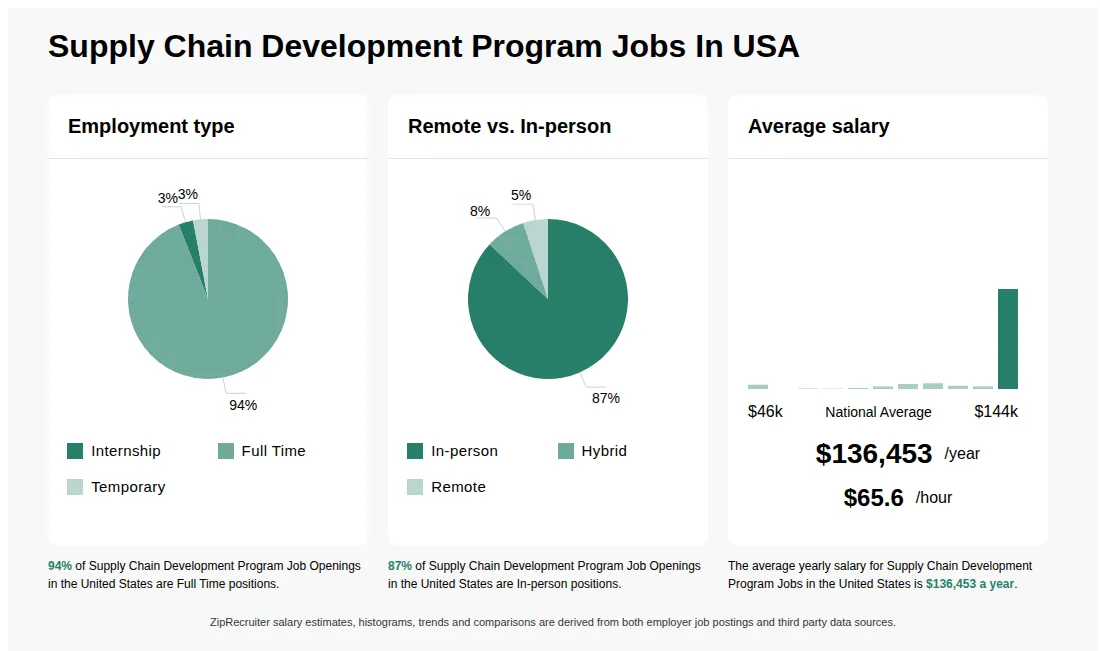
As of Jul 8, 2026, the average yearly pay for supply chain development program in the United States is $136,453.00, according to ZipRecruiter salary data. Most workers in this role earn between $143,000.00 and $143,000.00 per year, depending on experience, location, and employer.

What are the key skills and qualifications needed to thrive in a Supply Chain Development Program, and why are they important?

To thrive in a Supply Chain Development Program, you need a solid understanding of supply chain principles, analytical skills, and often a bachelor's degree in business, engineering, or a related field. Familiarity with ERP systems like SAP, data analysis tools such as Excel, and sometimes certifications like APICS CPIM are commonly required. Strong communication, problem-solving, and adaptability help individuals excel in cross-functional teams and dynamic environments. These skills and qualities are crucial for optimizing processes, driving efficiency, and supporting organizational growth within the supply chain.

What is the difference between Supply Chain Development Program vs Supply Chain Analyst?

AspectSupply Chain Development ProgramSupply Chain Analyst
CredentialsTypically requires a bachelor's degree in supply chain, logistics, or related field; certifications like CSCP are a plusUsually requires a bachelor's degree in supply chain, business, or logistics; certifications like CSCP or APICS preferred
Work EnvironmentRotational program within a company's supply chain departments, involving diverse projectsAnalyzing data, optimizing processes, and supporting supply chain operations
Employer & Industry UsageOffered by large corporations and manufacturing firms as entry-level developmentCommonly employed across industries for ongoing supply chain analysis roles

The Supply Chain Development Program is an entry-level rotational program designed to develop future supply chain leaders, while a Supply Chain Analyst focuses on analyzing and improving supply chain processes. Both roles require similar educational backgrounds and certifications, but the program offers broader exposure, whereas the analyst role emphasizes data analysis and process optimization.

What are the typical rotational assignments in a Supply Chain Development Program, and how do they contribute to professional growth?

In a Supply Chain Development Program, participants usually rotate through key departments such as procurement, logistics, inventory management, and production planning. These rotations provide hands-on experience with different aspects of the supply chain, allowing you to build a holistic understanding of how products move from suppliers to customers. By working closely with cross-functional teams and tackling real-world challenges, you'll develop critical problem-solving skills and a network of professional relationships. These experiences are designed to prepare you for advanced roles within the organization, often leading to faster career progression.

What is a Supply Chain Development Program?

A Supply Chain Development Program is a structured training initiative, often offered by large organizations, designed to develop future leaders in supply chain management. Participants typically rotate through various departments such as procurement, logistics, operations, and planning to gain a comprehensive understanding of the end-to-end supply chain process. These programs combine practical experience with mentorship and formal training, preparing individuals to take on advanced roles in supply chain management. Graduates of these programs often move into positions such as supply chain analyst, operations manager, or procurement specialist.
More about Supply Chain Development Program jobs
What cities are hiring for Supply Chain Development Program jobs? Cities with the most Supply Chain Development Program job openings:
What are the most commonly searched types of Supply Chain Development Program jobs? The most popular types of Supply Chain Development Program jobs are:
What states have the most Supply Chain Development Program jobs? States with the most job openings for Supply Chain Development Program jobs include:
Infographic showing various Supply Chain Development Program job openings in the United States as of July 2026, with employment types broken down into 90% Full Time, 9% Part Time, and 1% Contract. Highlights an 93% Physical, 2% Hybrid, and 5% Remote job distribution, with an average salary of $136,453 per year, or $65.6 per hour.
Supply Chain Development Program

Supply Chain Development Program

RWI Logistics

Fort Thomas, KY • On-site

$129K/yr

Full-time

Re-posted 22 days ago


Job description

Supply Chain Development Program
The Supply Chain Development Program at RWI Logistics is an entry-level, full-time role designed for recent college graduates that provides foundational training and development necessary to prepare for a career in supply chain logistics. The position is comprised of rotational opportunities over the span of approximately 18-24 months that provide cross-departmental exposure and a position placement upon the rotation completion. The program aims to provide hands-on experience in understanding our business operations, how various components work together to drive our success, and be fully integrated into our organizational culture.
Key Components
You will work independently and in a team environment with practical experience in 2 to 4 rotations, lasting 6 to 9 months (timing and length of rotations are based on business need). Examples of department or team areas you may work in:
  • Finance & Accounting participation in accounting basics
  • Customer-focused operations training in efficiency and service excellence
  • Carrier-focused operations managing fast-paced carrier-related activities
  • Technology & Continuous Improvement: developing process and project skills

Example Duties and Responsibilities You Could Expect to Perform:
  • Accounts Receivable Management: Oversee customer invoicing, payment application, and collections to ensure timely cash flow. Resolve short/overpayments and maintain accurate records of collection efforts while minimizing write-offs.
  • Cross-Functional Coordination & Dispute Resolution: Collaborate with Sales, Operations, and customers to investigate and resolve billing disputes quickly. Support accurate account setup, documentation, and prompt resolution of A/R aging issues.
  • Process Execution & Continuous Support: Maintain billing accuracy, meet invoicing deadlines, support carrier invoice processing, and assist the Finance team with reporting and special projects as needed to improve operational efficiency.
  • System Utilization and Data Accuracy: Learn to utilize the Transportation Management System (TMS) to manage customer shipments, load updates, and ensure compliance with carriers. Ensuring data integrity in the system is crucial for effective operations and decision-making.
  • Scheduling and Coordination: Schedule and reschedule pick-up and delivery appointments for all loads. Proactively notify shippers and receivers of any changes to optimize the scheduling process and minimize disruptions.
  • Communication and Collaboration: Maintain regular communication and collaboration with customer/carrier representatives to update the status of loads and meet customer service and reporting requirements.
  • Develop Carrier Relationships: Identify, source, and develop business relationships with new motor carriers to support spot and contract customer freight effectively. Aim to grow existing carrier partnerships, enhancing the company's capacity to meet diverse shipping needs.
  • Issue Resolution: Identify and troubleshoot load issues, think critically, and collaborate cross-functionally to determine and implement the best course of action.
  • Operational Support and Data Reporting: Take appropriate actions to support the completion of all carrier-related dispatching activities, including reporting the accuracy of data (driver information, carrier dispatch contacts, and equipment types), initiating tracking technology, and escalating driver management issues to relevant parties.
  • Process Improvement & Project Execution: Collaborate on cross-functional initiatives aimed at streamlining workflows, reducing inefficiencies, and improving system performance. Contribute to project planning, documentation, stakeholder coordination, and implementation of solutions that deliver measurable business value.
  • Data Analysis & Business Reporting: Analyze business processes and performance metrics to identify gaps and opportunities. Develop reports and dashboards that translate complex data into insights that drive strategic decisions and continuous improvement across the organization.

Skills and Competencies
Educational Background: 4-year degree in Logistics, Operations Management, or a related Supply Chain/Business Logistics field.
Technical Proficiency:
  • Strong proficiency in Microsoft Office Suite and the ability to quickly learn company-specific software.
  • Experience using Transportation Management Systems (TMS) for load management, shipment tracking, and data entry is a plus.

Communication Skills:
  • Exceptional verbal and written communication skills for effective interaction with internal teams, carriers, and customers.
  • Able to convey information clearly, providing updates on shipments and coordinating changes with various stakeholders.

Problem Solving and Critical Thinking:
  • Excellent critical thinking and problem-solving abilities, capable of addressing logistics issues proactively and escalating complex problems appropriately.
  • Able to identify patterns or trends in logistics data that may indicate potential issues or areas for improvement.

Organizational and Time Management Skills:
  • Strong prioritization and multitasking skills, able to handle multiple tasks simultaneously in a fast-paced, deadline-driven environment.
  • Highly organized and detail-oriented, with the ability to manage and track multiple shipments efficiently.

Customer Service Orientation:
  • Demonstrated commitment to outstanding customer service, ensuring customer needs are met promptly and efficiently.
  • Able to maintain a customer-focused approach while managing the logistics processes effectively.

Personal Attributes
  • Team Player: Thrives in a collaborative team environment, working closely with others to achieve operational objectives.
  • Adaptable and Flexible: Comfortable in a dynamic work environment, able to adapt to changing priorities and handle unexpected challenges.
  • Sense of Urgency: Works with urgency and precision, understanding the importance of timely delivery and operational efficiency.

Working Conditions and Physical Requirements
This position is performed in a general office setting. The role requires the ability to operate a computer/laptop and telephone, and the capacity to communicate effectively. Reasonable accommodations may be made to enable individuals with disabilities to perform the essential functions.
RWI Logistics is an Equal Opportunity Employer. All qualified applicants will receive consideration for employment without regard to race, color, religion, sex, sexual orientation, gender identity or national origin.