1

Legal Word Processor Jobs (NOW HIRING)

At least two (2) years of word processing experience, including one year in the specific office ... Prior experience working in a legal office valued. * Basic understanding of court docket extremely ...

At least two (2) years of word processing experience, including one year in the specific office ... Prior experience working in a legal office valued. * Basic understanding of court docket extremely ...

Minimum of 5 years' legal word processing experience. * Typing speed of 60+ wpm. * Advanced proficiency with MS Office (Word, Excel). * Strong attention to detail and document formatting expertise.

next page

Showing results 1-20

Legal Word Processor information

See salary details

$17

$28

$40

How much do legal word processor jobs pay per hour?

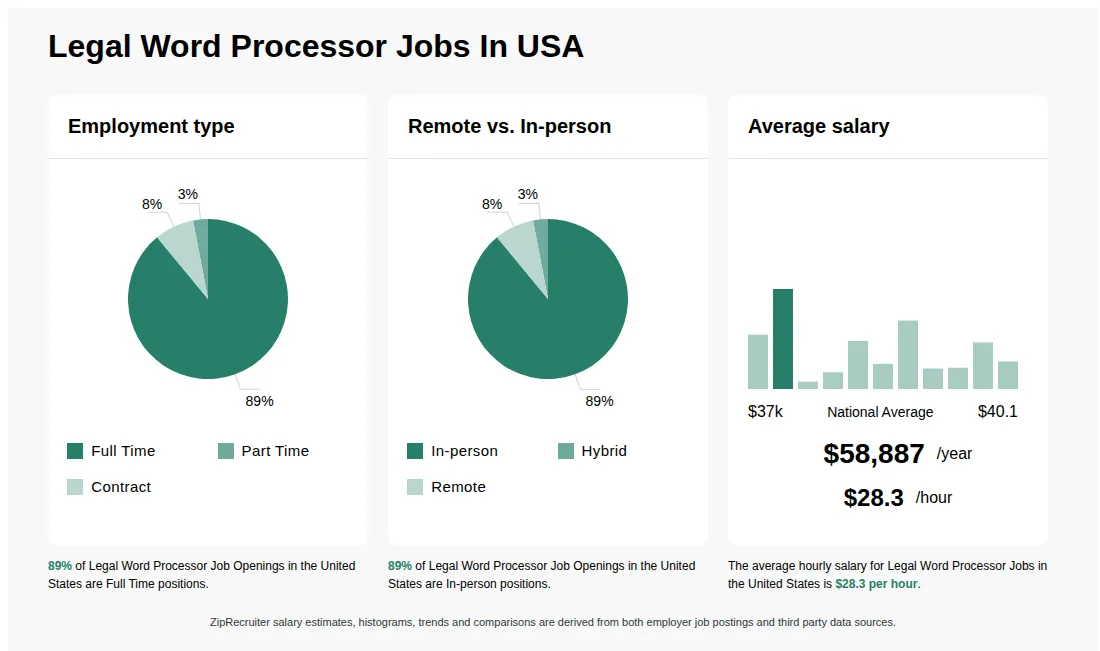
As of Jun 9, 2026, the average hourly pay for legal word processor in the United States is $28.31, according to ZipRecruiter salary data. Most workers in this role earn between $21.15 and $34.62 per hour, depending on experience, location, and employer.

What are the key skills and qualifications needed to thrive as a Legal Word Processor, and why are they important?

To thrive as a Legal Word Processor, you need expertise in document formatting, legal terminology, and a strong command of spelling and grammar, often supported by a high school diploma or equivalent. Familiarity with word processing software like Microsoft Word, legal document management systems, and sometimes transcription technology is typically required. Attention to detail, time management, and the ability to work under tight deadlines are essential soft skills in this role. These skills ensure accurate, timely, and professional legal documentation, supporting attorneys and legal teams in delivering effective client service.

What are some common challenges faced by Legal Word Processors and how can they be managed effectively?

Legal Word Processors often encounter tight deadlines, complex formatting requirements, and frequent document revisions. Managing these challenges involves maintaining strong attention to detail, staying organized, and becoming proficient with legal document management software and advanced features in word processing programs. Clear communication with attorneys and paralegals is also essential to anticipate changes and prioritize urgent tasks. Building strong time management skills and being adaptable to shifting priorities can help Legal Word Processors succeed in fast-paced legal environments.

What are Legal Word Processors?

Legal Word Processors are specialized administrative professionals who create, edit, and format legal documents such as briefs, contracts, and correspondence using word processing software. They ensure documents meet legal standards, are properly formatted, and free of errors. Legal Word Processors often work in law firms, corporate legal departments, or government agencies, supporting attorneys and paralegals by handling complex document production tasks. Their expertise in legal terminology and document formatting is essential for maintaining the accuracy and professionalism of legal documents.

What is the difference between Legal Word Processor vs Legal Secretary?

AspectLegal Word ProcessorLegal Secretary
CredentialsTypically requires strong typing, legal document formatting skills, and familiarity with legal terminologyOften requires administrative skills, basic legal knowledge, and sometimes legal assistant certification
Work EnvironmentPrimarily works in law firms, legal departments, or courts, focusing on document preparationWorks in law firms or legal offices, handling administrative tasks and client communication
Employer & Industry UsageUsed mainly in legal document production and formatting rolesCommonly employed in legal support staff roles for administrative and clerical duties

Legal Word Processors focus on preparing and formatting legal documents, while Legal Secretaries handle administrative tasks and support legal staff. Both roles are essential in legal settings but differ in responsibilities and skill requirements.

What Does a Legal Word Processor Do?

As a legal word processor, you work for a law firm or corporation. Your primary responsibilities are legal correspondence and written documentation. Your job duties include administrative work, like answering the phone or distributing mail to colleagues, but most of your work involves typing drafts of reports, documents, and legal correspondence to clients from notes, rough drafts, corrected copies, or voice recordings. The qualifications for a job as a legal word processor are a certificate or associate degree in legal studies or paralegal studies, excellent written communications skills, and general computer proficiency. Previous administrative or office management experience can help you start a career as a legal word processor.


What cities are hiring for Legal Word Processor jobs? Cities with the most Legal Word Processor job openings:
What are the most commonly searched types of Legal Word Processor jobs? The most popular types of Legal Word Processor jobs are:
What states have the most Legal Word Processor jobs? States with the most job openings for Legal Word Processor jobs include:
What job categories do people searching Legal Word Processor jobs look for? The top searched job categories for Legal Word Processor jobs are:
What are popular job titles related to Legal Word Processor jobs? For Legal Word Processor jobs, the most frequently searched job titles are:
Senior Word Processor

Senior Word Processor

Pae

Phoenix, AZ

$20.60/hr

Full-time

Medical, Dental, Vision, Life, Retirement, PTO

Posted 12 days ago


Job description

  • Light typing, faxing, copying, and filing.
  • Operate a computer terminal, personal computer.
  • Maintain records (stored both manually and electronically)
  • Assist preparing case files for shipment to FRC and in closing and packaging files for shipment to Federal Records Center

Required:

  • Must be able to obtain and maintain MRPT facility credentials/authorization. Note: US Citizenship is required for MRPT facility credentials/authorization at this work location.
  • At least two (2) years of word processing experience, including one year in the specific office automation environment required (e.g., JCON 2a, Microsoft Office).
  • High school diploma or GED required.
  • Demonstrated experience working in a high volume workload setting with ability to complete tasks within specified time frame.
  • Excellent oral and written communication skills required.
  • Ability to produce highest quality work under extreme pressure very important.
  • Skilled in operating a computer terminal, personal computer.
  • Requires ability to frequently move, sort, and file physical case files, folders and documents.
  • While performing the duties of this job, the employee is occasionally required to stand; walk; sit; use hands and fingers to handle, or feel objects office equipment; use fingers and hands to type or write; reach with hands and arms; talk or hear. Specific vision abilities required by the job include close vision, distance vision, color vision, peripheral vision, depth perception, and the ability to adjust focus. Ability to Lift up to 15 lbs, bend, reach, carry, stoop, kneel, climb, etc.

Preferred:

  • Prior Experience assisting with managing file room helpful
  • Prior experience working in a legal office valued.
  • Basic understanding of court docket extremely helpful.

Work Environment:

This position is generally sedentary and is performed in an open office environment with a large personal desk space

*Employees will earn H&W dollars per eligible hour (including vacation and holiday up to 40 hours/week). H&W monies are used to offset the employer's cost of benefits the employee elects into and/or utilizes. Any remaining health and welfare monies after all applicable deductions would be cashed out to the employee on a 1 pay period lag.

Service Contract Act (SCA) Compensation & Benefits:

This is an hourly, overtime-eligible position that falls under the Service Contract Act (SCA). In accordance with the Health and Welfare provisions of the SCA, and in addition to your base hourly rate, you may be eligible to receive an additional health and welfare payment for each hour you work to ensure compliance with the minimums set forth by the act. The amount you are entitled to receive will vary depending upon the fringe benefits you select now and in the future.

Compensation Details:

$20.60

The compensation range or hourly rate listed for this position is provided as a good-faith estimate of what the company intends to offer for this role at the time this posting was issued. Actual compensation may vary based on factors such as job responsibilities, education, experience, skills, internal equity, market data, applicable collective bargaining agreements, and relevant laws.

Benefits Overview:

Our health and welfare benefits are designed to support you and your priorities. Offerings include:

  • Health, dental, and vision insurance

  • Paid time off and holidays

  • Retirement benefits (including 401(k) matching)

  • Educational reimbursement

  • Parental leave

  • Employee stock purchase plan

  • Tax-saving options

  • Disability and life insurance

  • Pet insurance

Note: Benefits may vary based on employment type, location, and applicable agreements. Positions governed by a Collective Bargaining Agreement (CBA), the McNamara-O'Hara Service Contract Act (SCA), or other employment contracts may include different provisions/benefits.

Original Posting:

04/27/2026 - Until Filled

Amentum anticipates this job requisition will remain open for at least three days, with a closing date no earlier than three days after the original posting. This timeline may change based on business needs.

Amentum is proud to be an Equal Opportunity Employer. Our hiring practices provide equal opportunity for employment without regard to race, sex, sexual orientation, pregnancy (including pregnancy, childbirth, breastfeeding, or medical conditions related to pregnancy, childbirth, or breastfeeding), age, ancestry, United States military or veteran status, color, religion, creed, marital or domestic partner status, medical condition, genetic information, national origin, citizenship status, low-income status, or mental or physical disability so long as the essential functions of the job can be performed with or without reasonable accommodation, or any other protected category under federal, state, or local law. Learn more about your rights under Federal laws and supplemental language atLabor Laws Posters.