Business & Executive Coach (Full-Time, Salaried) You're the kind of leader who gets things done, builds trust fast, and inspires people to act. You love meaningful conversations, clear goals, and ...
Quick apply
Business & Executive Coach (Full-Time, Salaried) You're the kind of leader who gets things done, builds trust fast, and inspires people to act. You love meaningful conversations, clear goals, and ...
Quick apply
Business & Executive Coach (Full-Time, Salaried) You're the kind of leader who gets things done, builds trust fast, and inspires people to act. You love meaningful conversations, clear goals, and ...
Jacksonville, FL · Remote
Overview Coaches Seeking More in 2025! Ready for a Mid-Year Reset? With the mid-year mark just around the corner, it's the perfect time to reflect, realign, and take bold action towards the life you ...
Jacksonville, FL · Remote
Overview Coaches Seeking More in 2025! Ready for a Mid-Year Reset? With the mid-year mark just around the corner, it's the perfect time to reflect, realign, and take bold action towards the life you ...
Boulder, CO · Remote
Do you ever get the sense that you are playing a smaller game than you are actually meant to be playing? Perhaps you have spent years building a successful track record in marketing, retail ...
Quick apply
Boulder, CO · Remote
Do you ever get the sense that you are playing a smaller game than you are actually meant to be playing? Perhaps you have spent years building a successful track record in marketing, retail ...
Boulder, CO · Remote
Do you ever get the sense that you are playing a smaller game than you are actually meant to be playing? Perhaps you have spent years building a successful track record in marketing, retail ...
Boulder, CO · Remote
Do you ever get the sense that you are playing a smaller game than you are actually meant to be playing? Perhaps you have spent years building a successful track record in marketing, retail ...
Princeton, NJ · Remote
ProSidian Seeks a Senior Executive Coach | Professional & Executive Leadership Coaching Services [PPPL0008007] for Professional And Executive Leadership Coaching on a Exempt 1099 Contract: No ...
Princeton, NJ · Remote
ProSidian Seeks a Senior Executive Coach | Professional & Executive Leadership Coaching Services [PPPL0008007] for Professional And Executive Leadership Coaching on a Exempt 1099 Contract: No ...
Boulder, CO · On-site +1
Do you ever get the sense that you are playing a smaller game than you are actually meant to be playing? Perhaps you have spent years building a successful track record in marketing, retail ...
Boulder, CO · On-site +1
Do you ever get the sense that you are playing a smaller game than you are actually meant to be playing? Perhaps you have spent years building a successful track record in marketing, retail ...
The Senior Manager, Executive Coach and Facilitator is critical in designing, executing, and communicating enterprise leadership and talent development strategies. This role will be based in Owings ...
The Senior Manager, Executive Coach and Facilitator is critical in designing, executing, and communicating enterprise leadership and talent development strategies. This role will be based in Owings ...
The Executive Coach partners with graduate students through transformational coaching methods and holistic life design concepts to empower them to realize and achieve their full professional and ...
The Executive Coach partners with graduate students through transformational coaching methods and holistic life design concepts to empower them to realize and achieve their full professional and ...
The Executive Coach & Peer Group Facilitator occupies ATI's highest-touch client-facing role. This position serves CEOs, owners, and C-suite leaders of automotive repair businesses - a population ...
The Executive Coach & Peer Group Facilitator occupies ATI's highest-touch client-facing role. This position serves CEOs, owners, and C-suite leaders of automotive repair businesses - a population ...
The Executive Coach partners with graduate students through transformational coaching methods and holistic life design concepts to empower them to realize and achieve their full professional and ...
The Executive Coach partners with graduate students through transformational coaching methods and holistic life design concepts to empower them to realize and achieve their full professional and ...
Houston, TX · On-site
The Executive Function Coach serves on the interdisciplinary team made up of other professionals to provide student support services. The Executive Function Coach team member's primary responsibility ...
Quick apply
Houston, TX · On-site
The Executive Function Coach serves on the interdisciplinary team made up of other professionals to provide student support services. The Executive Function Coach team member's primary responsibility ...
Saint Louis Park, MN · On-site
$40/hr
Executive Functioning Coach Reporting To: ADHD amp; Executive Functioning Coach Manager Employment Status: Part-time, Year-Round FLSA Status: Non-Exempt, Hourly Pay: $40.00/hour Summary Of Core ...
Saint Louis Park, MN · On-site
$40/hr
Executive Functioning Coach Reporting To: ADHD amp; Executive Functioning Coach Manager Employment Status: Part-time, Year-Round FLSA Status: Non-Exempt, Hourly Pay: $40.00/hour Summary Of Core ...
Program Development, Delivery, and Assessment - 50% Executive Coaches will independently design and deliver programmatic offerings that support employer and alumni engagement, career exploration and ...
Program Development, Delivery, and Assessment - 50% Executive Coaches will independently design and deliver programmatic offerings that support employer and alumni engagement, career exploration and ...
Princeton, NJ · Remote
We seek Leadership Coach | Professional & Executive Leadership Coaching Services [PPPL0011010] candidates with relevant Energy & Scientific Research Sector Experience (functional and technical area ...
Princeton, NJ · Remote
We seek Leadership Coach | Professional & Executive Leadership Coaching Services [PPPL0011010] candidates with relevant Energy & Scientific Research Sector Experience (functional and technical area ...
In-Home (19147) Executive Functioning Coach for Elementary Students Company Overview Prep Academy Tutors is a private in-home tutoring company delivering flexible, personalized academic support to ...
Quick apply
In-Home (19147) Executive Functioning Coach for Elementary Students Company Overview Prep Academy Tutors is a private in-home tutoring company delivering flexible, personalized academic support to ...
In-Home (19147) Executive Functioning Coach for Elementary Students Company Overview Prep Academy Tutors is a private in-home tutoring company delivering flexible, personalized academic support to ...
In-Home (19147) Executive Functioning Coach for Elementary Students Company Overview Prep Academy Tutors is a private in-home tutoring company delivering flexible, personalized academic support to ...
In-Home (19147) Executive Functioning Coach for Elementary Students Company Overview Prep Academy Tutors is a private in-home tutoring company delivering flexible, personalized academic support to ...
In-Home (19147) Executive Functioning Coach for Elementary Students Company Overview Prep Academy Tutors is a private in-home tutoring company delivering flexible, personalized academic support to ...
Hamden, CT · On-site
$30K/mo
Executive Functioning Coach at Hamden Middle School Qualifications * Minimum of an Associate's Degree or the equivalent of two years of college. * Experience working with adolescents within the last ...
Hamden, CT · On-site
$30K/mo
Executive Functioning Coach at Hamden Middle School Qualifications * Minimum of an Associate's Degree or the equivalent of two years of college. * Experience working with adolescents within the last ...
We are currently looking for Executive Function & ADHD Coaches. Are you an energetic , enthusiastic , and driven educator who wants to make a real difference? Are you passionate about shaping young ...
We are currently looking for Executive Function & ADHD Coaches. Are you an energetic , enthusiastic , and driven educator who wants to make a real difference? Are you passionate about shaping young ...
We are currently looking for Executive Function & ADHD Coaches. Are you an energetic , enthusiastic , and driven educator who wants to make a real difference? Are you passionate about shaping young ...
Quick apply
We are currently looking for Executive Function & ADHD Coaches. Are you an energetic , enthusiastic , and driven educator who wants to make a real difference? Are you passionate about shaping young ...
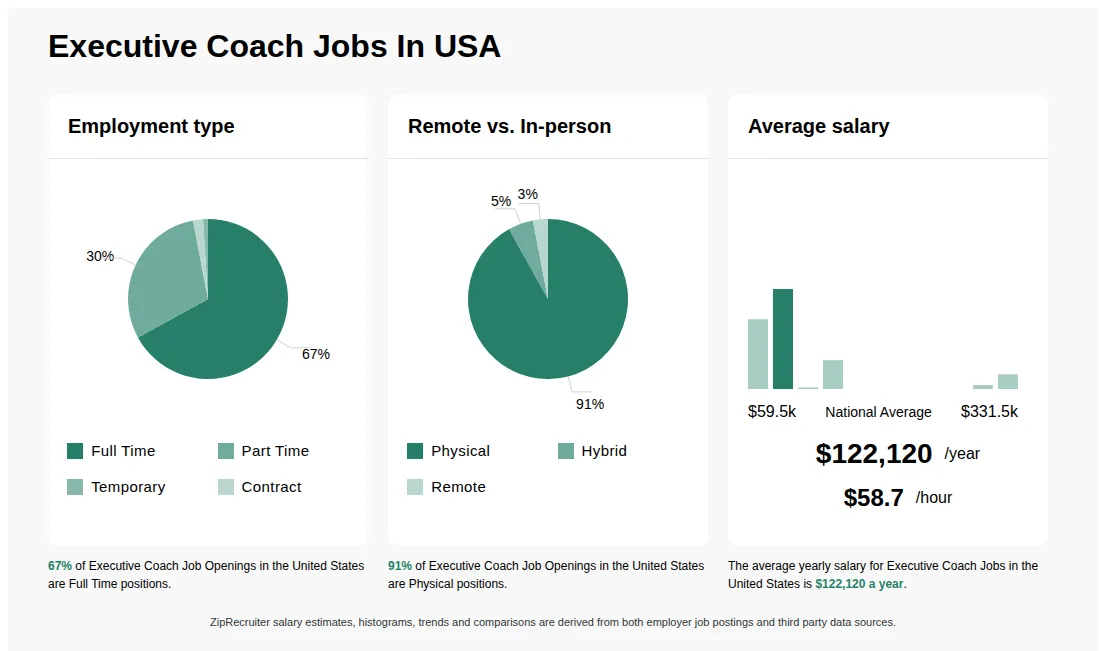
$78.6K is the 25th percentile. Wages below this are outliers.
$59.5K - $84.2K
32% of jobs
The median wage is $93.6K / yr.
$84.2K - $109K
47% of jobs
$109K - $133.7K
0% of jobs
$133.7K - $158.4K
14% of jobs
$158.4K - $183.1K
0% of jobs
$183.1K - $207.9K
0% of jobs
$207.9K - $232.6K
0% of jobs
$232.6K - $257.3K
0% of jobs
$257.3K - $282K
0% of jobs
$282K - $306.8K
1% of jobs
$306.8K - $331.5K
6% of jobs
$59.5K
$122.1K
$331.5K
Executive coaches work with executives, managers, and occasionally other employees to focus on their strengths and weaknesses and help them to make improvements in their work productivity. Sometimes you work with an individual, other times you will be hired to oversee more significant organizational changes. Your main responsibilities and duties you are meeting clients, discussing their goals, and creating strategies to help them achieve the goals. Your work will vary depending on the company or organization. Rather than teaching a particular skill, you often help a client change their outlook or approach so that they can make their own improvements.
| Aspect | Executive Coach | Career Coach |
|---|---|---|
| Credentials | Often certified through programs like ICF or EMCC | May hold certifications but less standardized; focus on career development |
| Work Environment | Works with executives, leaders, and high-level professionals | Works with individuals seeking career change, advancement, or job search |
| Industry Usage | Common in corporate, leadership, and organizational settings | Common in job search agencies, personal development, and career services |
| Search & Comparison Intent | People compare to other leadership or coaching roles | People compare to coaching roles focused on career transition |
Executive Coaches primarily work with senior leaders to enhance leadership skills and organizational impact, often requiring certifications like ICF. Career Coaches assist individuals in exploring career options, job searching, and career transitions, with less emphasis on executive-specific credentials. While both roles involve coaching, their target clients, work environments, and goals differ significantly.
Cities with the most Executive Coach job openings:
The most popular types of Coach jobs are:
The top employers for Executive Coach jobs are:
States with the most job openings for Executive Coach jobs include:
The top searched job categories for Executive Coach jobs are:
For Executive Coach jobs, the most frequently searched job titles are:
Full-time
Re-posted 21 days ago
Business & Executive Coach (Full-Time, Salaried)
You’re the kind of leader who gets things done, builds trust fast, and inspires people to act. You love meaningful conversations, clear goals, and measurable progress. You balance pace with poise—moving with moderate urgency and a friendly, influential presence that makes you easy to talk to and great to partner with.
If this sounds like you, here is a rare opportunity: a full-time, salaried Business & Executive Coach role (with performance incentives) in a profession that’s often commission-only or contract-based. You’ll have the stability to focus on impact while growing your influence and changing lives—starting with the owners and leadership teams you coach.
What You’ll Do (Impact You Create)
Measurable Expectations & Responsibilities
You bring a task-driven approach, and we’ll give you the clarity to win:
First 30–60 days
Complete our onboarding, certification pathway, and core tool mastery.
Shadow/observe client sessions and co-facilitate at least 2 workshops or group sessions.
Own a personal development plan with weekly milestones and a coaching cadence.
By 90–120 days
Maintain 8–12 active 1:1 clients (mix of weekly/biweekly) with documented growth plans.
Facilitate 1–2 group programs per month and 1 workshop per quarter.
Achieve an average client NPS ≥ 70 and session attendance ≥ 95%.
Ensure 90% of clients have clear 90-day plans with KPIs and weekly scorecards.
Ongoing KPIs (reviewed monthly/quarterly)
Client retention ≥ 85% over rolling 12 months.
Client revenue/profit growth tracked quarterly (leading indicators: conversion rate, average transaction value, frequency).
Prospect-to-client conversion ≥ 30% from qualified consultations.
Pipeline health: 6–10 qualified opportunities in play at any time.
Execution rhythm: All clients in a weekly accountability loop with documented actions and results.
Culture contribution: Participation in team training, events, and content creation (2+ contributions/month).
Core responsibilities
Coach 1:1 and groups; prepare agendas, capture actions/metrics, and follow through.
Facilitate leadership, management, sales, and execution workshops.
Collaborate with our team on events, marketing, and community impact.
Model our values—integrity, professionalism, heart—in every interaction.
Commit to continuous learning and certification progression.
What You Bring (Your Superpowers)
Prior experience as a business owner, executive, senior leader, or GM.
Strong understanding of operations, leadership/management, sales/marketing, and financial fundamentals.
Excellent listening and questioning; you challenge while preserving trust.
High emotional intelligence and facilitation skills (groups and workshops).
Coachable, growth-minded, and committed to following a proven coaching system.
Bonus: coaching/mentoring/consulting experience; experience with SMBs; proficiency with KPIs/dashboards.
What You’ll Love (Compensation, Autonomy & Support)
Full-time salaried position (rare in business coaching) with performance incentives.
Flexible schedule with the autonomy to run your book of business the right way.
World-class training, certification, and ongoing support.
Mission-driven team that celebrates results and relationships.
A platform for personal and professional growth beyond most roles.
Who We Are (Vision & Culture You’ll Join)
You believe business can be a force for good. So do we. We are a culture- and mission-driven business coaching firm committed to helping business owners build profitable, sustainable companies with strong cultures and engaged teams. Our purpose is simple and bold: give business owners more life while helping them build businesses that thrive. Thriving businesses change families, communities, and the world—and you’ll be part of that ripple effect.
You’ll join a team that:
Speaks the language of results and the language of people—with heart.
Values discipline, clarity, and accountability—delivered with warmth and enthusiasm.
Invests in you so you can invest in your clients.
Celebrates diversity and creates an inclusive environment for every team member.