1

Human Resources Leadership Development Program Jobs

... and career development. * Partner with leadership to identify process improvements and drive ... Support shared HR services including payroll, benefits, HRIS administration, and 401k programs.

... and career development. * Partner with leadership to identify process improvements and drive ... Support shared HR services including payroll, benefits, HRIS administration, and 401k programs.

Support enterprise HR initiatives such as performance management cycles, engagement surveys, compliance training, and leadership development programs. * Manage day-to-day HR operations including ...

This executive leadership role will oversee all human resources operations, including employee relations, talent acquisition, compliance, compensation, organizational development, and labor relations ...

Contribute to leadership development programs Minimum Qualifications: * Bachelor's degree in human resources or equivalent experience work experience. * 3 - 5 years previous work experience in the ...

Partner with site leadership to align HR initiatives with business objectives * Support operational performance through workforce planning, talent development, and employee engagement strategies

HR Director Reports To: CEO, CFO Location: Lenexa, KS (onsite) Direct Reports: HR Coordinator ... Design and implement performance management, leadership development, and employee training programs.

Apply Early

next page

Showing results 1-20

Human Resources Leadership Development Program information

See salary details

$34K

$65.8K

$98K

How much do human resources leadership development program jobs pay per year?

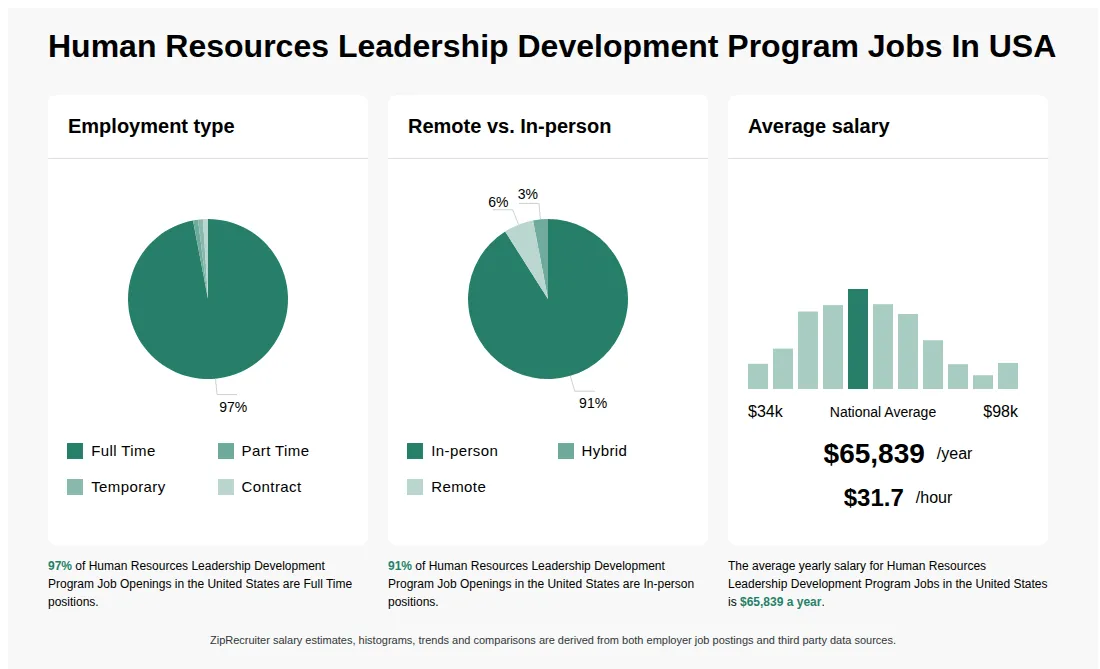
As of Jul 7, 2026, the average yearly pay for human resources leadership development program in the United States is $65,839.00, according to ZipRecruiter salary data. Most workers in this role earn between $52,000.00 and $74,000.00 per year, depending on experience, location, and employer.

What is a Human Resources Leadership Development Program?

A Human Resources Leadership Development Program (HRLDP) is a structured, rotational training program designed to prepare early-career professionals for leadership roles within the HR function of an organization. Participants typically rotate through various HR disciplines such as talent acquisition, employee relations, compensation and benefits, and learning and development. These programs often combine on-the-job experience, formal training, mentorship, and networking opportunities. The goal is to develop broad HR expertise and leadership skills, enabling graduates to take on strategic HR positions in the future.

What are the key skills and qualifications needed to thrive in a Human Resources Leadership Development Program, and why are they important?

To excel in a Human Resources Leadership Development Program, you need a foundational understanding of HR principles, strong analytical skills, and typically a bachelor’s degree in human resources, business, or a related field. Familiarity with HRIS platforms, talent management systems, and certifications like SHRM-CP or PHR can be highly advantageous. Exceptional interpersonal skills, leadership potential, and adaptability are crucial soft skills for building relationships and navigating organizational change. These abilities are vital for successfully rotating through diverse HR functions, driving strategic initiatives, and preparing for future HR leadership roles.

What types of projects or rotations can participants expect in a Human Resources Leadership Development Program?

Participants in a Human Resources Leadership Development Program typically rotate through multiple HR functions, such as talent acquisition, employee relations, compensation and benefits, and organizational development. These rotations allow participants to gain hands-on experience in diverse HR specialties and develop a well-rounded skill set. Projects may include leading recruitment campaigns, supporting change management initiatives, analyzing workforce data, or contributing to employee engagement programs. This structure is designed to build leadership capabilities and prepare participants for advanced HR roles upon program completion.
More about Human Resources Leadership Development Program jobs
What cities are hiring for Human Resources Leadership Development Program jobs? Cities with the most Human Resources Leadership Development Program job openings:
What are the most commonly searched types of Human Resources Leadership Development Program jobs? The most popular types of Human Resources Leadership Development Program jobs are:
What states have the most Human Resources Leadership Development Program jobs? States with the most job openings for Human Resources Leadership Development Program jobs include:
What job categories do people searching Human Resources Leadership Development Program jobs look for? The top searched job categories for Human Resources Leadership Development Program jobs are:
Infographic showing various Human Resources Leadership Development Program job openings in the United States as of July 2026, with employment types broken down into 1% As Needed, 83% Full Time, 14% Part Time, and 2% Contract. Highlights an 92% Physical, 2% Hybrid, and 6% Remote job distribution, with an average salary of $65,839 per year, or $31.7 per hour.
Director of Human Resources

Director of Human Resources

United Insurance

Portland, ME

Other

Posted yesterday


Job description

Description

The Director of Human Resources is responsible for leading and overseeing all human resource functions for a multi-state insurance agency with 18 locations and over 200 employees. This role serves as a strategic business partner to leadership while ensuring operational excellence in talent management, employee relations, compliance, compensation, benefits, performance management, and organizational development.


The Director of HR develops and implements strategies that support business growth, employee engagement, and a strong organizational culture across multiple office locations and remote teams.


The essential functions include, but are not limited to the following:


Strategic HR Leadership

  • Partner with executive leadership to develop and implement HR strategies aligned with organizational goals. 
  • Provide guidance and coaching to managers on employee relations, leadership development, workforce planning, and performance management. 
  • Lead organizational initiatives related to culture, engagement, retention, and change management. 
  • Analyze workforce trends and HR metrics to support business decisions. 

Employee Relations & Performance Management

  • Oversee employee relations matters including conflict resolution, investigations, corrective action, and terminations. 
  • Ensure consistent application of company policies and employment practices across all locations. 
  • Guide managers through performance management processes, employee development planning, and annual review cycles. 
  • Promote a positive and inclusive work environment. 

Compliance & Risk Management

  • Ensure compliance with federal, state, and local employment laws and regulations across multiple states. 
  • Maintain and update employee handbook, policies, and HR procedures. 
  • Oversee HR-related audits, reporting, and recordkeeping requirements. 
  • Partner with legal counsel as needed regarding employment matters and risk mitigation. 

Talent Acquisition & Workforce Planning

  • Oversee recruitment and onboarding strategies to attract and retain top talent. 
  • Support workforce planning and succession planning initiatives. 
  • Collaborate with department leaders on staffing needs and organizational structure. 
  • Execute and manage the internship program. 

Compensation & Benefits

  • Oversee compensation programs including salary administration, benchmarking, incentive plans, and annual merit processes. 
  • Manage employee benefits programs in partnership with brokers and vendors. 
  • Evaluate and recommend competitive compensation and benefits strategies. 

Training & Development

  • Identify training and professional development opportunities for employees and managers. 
  • Support leadership development and employee growth initiatives. 
  • Ensure compliance-related training requirements are met. 

HR Operations

  • Oversee HR systems, processes, and data integrity. 
  • Manage HR budgets and vendor relationships. 
  • Supervise and mentor HR team members. 
  • Continuously improve HR processes and employee experience.
  • Travel as needed. 
  • Other duties as assigned. 


Requirements

  •  Bachelor's degree in HR, Business Administration, or equivalent work experience. 
  • 7 plus years of HR leadership experience, preferably in financial services, insurance, or other regulated industries. 
  • Experience supporting multi-state operations and knowledge of federal and state employment laws.      
  • Strong leadership, communication, and interpersonal skills. 
  • Experience managing employee relations and complex HR matters. 
  • Demonstrated ability to influence and partner with senior leadership. 
  • Strong organizational, analytical, and problem-solving skills. 
  • Proficient in Microsoft Office, specifically Excel, Word, and PowerPoint.
  • Positive, friendly, and professional attitude.
  • HR certification such as SHRM-SCP or SPHR preferred. 


PHYSICAL DEMANDS AND WORK ENVIRONMENT 

The physical demands described here are representative of those that must be met by an employee to successfully perform the essential functions of this position. Reasonable accommodations may be made to enable individuals with disabilities to perform the functions. While performing the duties of this position, the employee is regularly required to talk or hear. The employee frequently is required to use hands or fingers, handle or feel objects, tools, or controls. The employee is occasionally required to stand; walk; sit; and reach with hands and arms. The employee must occasionally lift and/or move up to 25 pounds. Specific vision abilities required by this position include close vision, distance vision, and the ability to adjust focus. The noise level in the work environment is usually low to moderate.