As a Chief Executive Officer (CEO) joining our team, you're embracing our promise to provide superior patient care that exceeds industry standards as well as patient expectations. Join us on this ...
As a Chief Executive Officer (CEO) joining our team, you're embracing our promise to provide superior patient care that exceeds industry standards as well as patient expectations. Join us on this ...
As a Chief Executive Officer (CEO) joining our team, you're embracing our promise to provide superior patient care that exceeds industry standards as well as patient expectations. Join us on this ...
As a Chief Executive Officer (CEO) joining our team, you're embracing our promise to provide superior patient care that exceeds industry standards as well as patient expectations. Join us on this ...

Chief Executive Officer
Carroll, IA · On-site
Job Category Executive , Health care, CEO * Employee Type Full-Time * Required Degree 4 Year Degree * Manage Others Yes Contact information * Name Shanon Lux, Director of Human Resources * Phone 712 ...
Chief Executive Officer
Carroll, IA · On-site
Job Category Executive , Health care, CEO * Employee Type Full-Time * Required Degree 4 Year Degree * Manage Others Yes Contact information * Name Shanon Lux, Director of Human Resources * Phone 712 ...

Select Medical Inpatient Rehab Chief Executive Officer (CEO) We are seeking a CEO for a 50 bed inpatient rehabilitation hospital. This role is responsible for providing leadership, superior quality ...
Select Medical Inpatient Rehab Chief Executive Officer (CEO) We are seeking a CEO for a 50 bed inpatient rehabilitation hospital. This role is responsible for providing leadership, superior quality ...

Chief Executive Officer
San Leandro, CA · On-site
$350K/yr
Chief Executive Officer Full Time Management AHC EMPLOYEES, San Leandro, CA, US Salary: $350,001.60 Annually Organizational Description Alameda Health Consortium is the association of community ...
Chief Executive Officer
San Leandro, CA · On-site
$350K/yr
Chief Executive Officer Full Time Management AHC EMPLOYEES, San Leandro, CA, US Salary: $350,001.60 Annually Organizational Description Alameda Health Consortium is the association of community ...
Chief Executive Officer (CEO)
$150K - $200K/yr
Chief Executive Officer (CEO) Pay: $150K-$200K | Location: 3625 Parkmoor Village Dr, Colorado Springs, CO 80917 | Schedule: Day Shift | On-Site and On Call as Needed. About Alpine Vista Alpine Vista ...
Chief Executive Officer (CEO)
$150K - $200K/yr
Chief Executive Officer (CEO) Pay: $150K-$200K | Location: 3625 Parkmoor Village Dr, Colorado Springs, CO 80917 | Schedule: Day Shift | On-Site and On Call as Needed. About Alpine Vista Alpine Vista ...

Position Summary The Chief Executive Officer (CEO) will be responsible for leading the APGA Tour and APGA Foundation next phase of growth and impact. The CEO will be responsible for advancing the ...
Position Summary The Chief Executive Officer (CEO) will be responsible for leading the APGA Tour and APGA Foundation next phase of growth and impact. The CEO will be responsible for advancing the ...

Job Title: Chief Executive Officer Department: Executive Leadership Reports To: Board of Directors FLSA Status: Exempt Prepared/Revised Date: June 2026 Summary The Chief Executive Officer is ...
Job Title: Chief Executive Officer Department: Executive Leadership Reports To: Board of Directors FLSA Status: Exempt Prepared/Revised Date: June 2026 Summary The Chief Executive Officer is ...
Chief Executive Officer (ceo)
New York, NY · On-site
$180K - $300K/yr
The CEO will be responsible for leading the company's strategic direction, overseeing financial performance, managing operations, and driving overall business growth. Key responsibilities include ...
Quick apply
Chief Executive Officer (ceo)
New York, NY · On-site
$180K - $300K/yr
The CEO will be responsible for leading the company's strategic direction, overseeing financial performance, managing operations, and driving overall business growth. Key responsibilities include ...
Chief Executive Officer
Cambridge, OH · On-site
$120K - $200K/yr
Chief Executive Officer (CEO) - Hickory Behavioral at Cambridge Department : Operations Direct Report To : VP of Field Operations Job Type: Full-Time About Hickory Recovery Network At Hickory ...
Quick apply
Chief Executive Officer
Cambridge, OH · On-site
$120K - $200K/yr
Chief Executive Officer (CEO) - Hickory Behavioral at Cambridge Department : Operations Direct Report To : VP of Field Operations Job Type: Full-Time About Hickory Recovery Network At Hickory ...

This is not a traditional CEO role. We are looking for a "working CEO"-a leader who can set strategy while actively managing day-to-day operations, building the business, and driving measurable ...
Quick apply
This is not a traditional CEO role. We are looking for a "working CEO"-a leader who can set strategy while actively managing day-to-day operations, building the business, and driving measurable ...

Chief Executive Officer (CEO) Forrest City Medical Center - Forrest City, Arkansas Relocation Package Available Forrest City Medical Center is your community medical provider, serving Eastern ...
Chief Executive Officer (CEO) Forrest City Medical Center - Forrest City, Arkansas Relocation Package Available Forrest City Medical Center is your community medical provider, serving Eastern ...
Chief Executive Officer (CEO)
Temple, TX · On-site
As a Chief Executive Officer (CEO) joining our team, you're embracing our promise to provide superior patient care that exceeds industry standards as well as patient expectations. Join us on this ...
Chief Executive Officer (CEO)
Temple, TX · On-site
As a Chief Executive Officer (CEO) joining our team, you're embracing our promise to provide superior patient care that exceeds industry standards as well as patient expectations. Join us on this ...

The CEO will foster a high-performing, values-driven culture; strengthen internal operations; and work closely with the Board and staff to shape and execute a clear, forward-looking strategy. This ...
The CEO will foster a high-performing, values-driven culture; strengthen internal operations; and work closely with the Board and staff to shape and execute a clear, forward-looking strategy. This ...
Overview Select Medical Inpatient Rehab Chief Executive Officer (CEO) We are seeking a CEO for a 50 bed inpatient rehabilitation hospital. This role is responsible for providing leadership, superior ...
Overview Select Medical Inpatient Rehab Chief Executive Officer (CEO) We are seeking a CEO for a 50 bed inpatient rehabilitation hospital. This role is responsible for providing leadership, superior ...

Chief Executive Officer
Bethany, MO · On-site
Chief Executive Officer (CEO) Department: Administration FLSA Classification: Exempt Employment Status: Full-Time Location: Harrison County Community Hospital (HCCH) Reports to: Board of Directors ...
Chief Executive Officer
Bethany, MO · On-site
Chief Executive Officer (CEO) Department: Administration FLSA Classification: Exempt Employment Status: Full-Time Location: Harrison County Community Hospital (HCCH) Reports to: Board of Directors ...
As a Chief Executive Officer (CEO) joining our team, you're embracing our promise to provide superior patient care that exceeds industry standards as well as patient expectations. Join us on this ...
As a Chief Executive Officer (CEO) joining our team, you're embracing our promise to provide superior patient care that exceeds industry standards as well as patient expectations. Join us on this ...
Chief Executive Officer (CEO)
Temple, TX · On-site
As a Chief Executive Officer (CEO) joining our team, you're embracing our promise to provide superior patient care that exceeds industry standards as well as patient expectations. Join us on this ...
Chief Executive Officer (CEO)
Temple, TX · On-site
As a Chief Executive Officer (CEO) joining our team, you're embracing our promise to provide superior patient care that exceeds industry standards as well as patient expectations. Join us on this ...
Chief Executive Officer CEO
Manhattan, NY · On-site
$400K - $600K/yr
Chief Executive Officer (CEO) remote based anywhere United States for an individual who has previously scaled a similar DTC company from $200MM+ to $0.5B or $1B+ in Online Training, Mobile App ...
Chief Executive Officer CEO
Manhattan, NY · On-site
$400K - $600K/yr
Chief Executive Officer (CEO) remote based anywhere United States for an individual who has previously scaled a similar DTC company from $200MM+ to $0.5B or $1B+ in Online Training, Mobile App ...

The next CEO will have the opportunity to establish a clear strategic framework for the future, strengthen organizational culture and employee confidence, develop the leadership team, and expand ...
Quick apply
The next CEO will have the opportunity to establish a clear strategic framework for the future, strengthen organizational culture and employee confidence, develop the leadership team, and expand ...
CEO information
See salary details
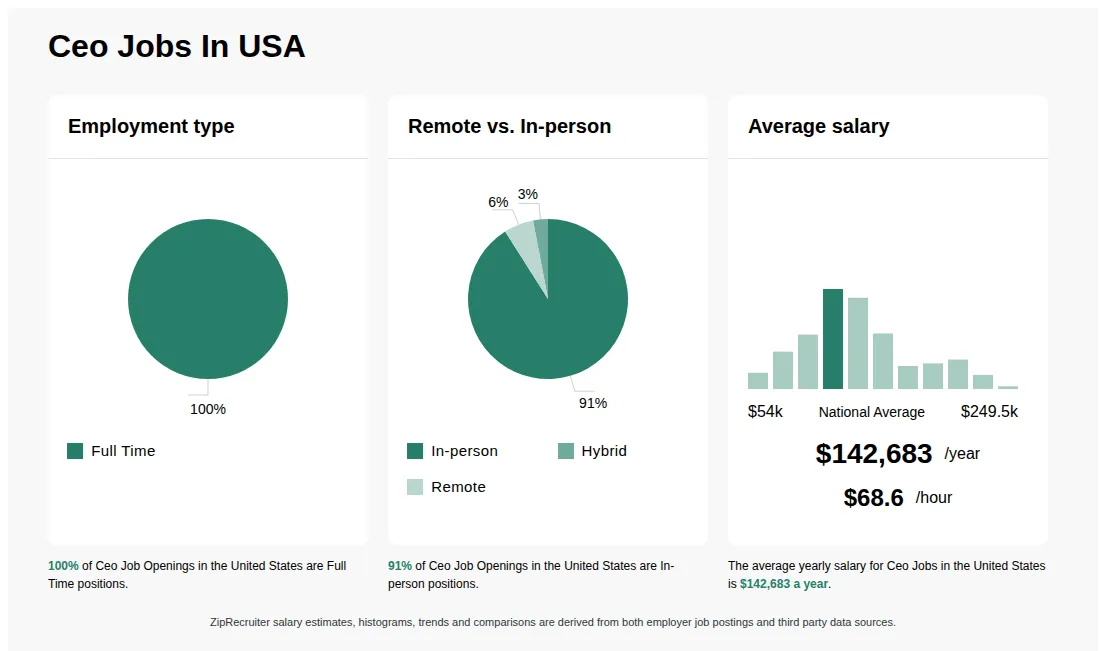
$54K - $71.8K
3% of jobs
$71.8K - $89.5K
8% of jobs
$89.5K - $107.3K
13% of jobs
$108.1K is the 25th percentile. Wages below this are outliers.
$107.3K - $125.1K
23% of jobs
The median wage is $127.8K / yr.
$125.1K - $142.9K
21% of jobs
$153.2K is the 75th percentile. Wages above this are outliers.
$142.9K - $160.6K
13% of jobs
$160.6K - $178.4K
5% of jobs
$178.4K - $196.2K
5% of jobs
$196.2K - $214K
6% of jobs
$214K - $231.7K
3% of jobs
$231.7K - $249.5K
0% of jobs
$54K
$142.7K
$249.5K
How much do ceo jobs pay per year?
As of Sep 12, 2026, the average yearly pay for ceo in the United States is $142,683.00, according to ZipRecruiter salary data. Most workers in this role earn between $108,500.00 and $160,000.00 per year, depending on experience, location, and employer.
What does a CEO do?
A CEO is responsible for the health and success of a company, ensuring that their organization is following a guide or roadmap. In order to lead a company successfully, a CEO must be aware of competitors and market opportunities. This will help accelerate the company’s growth. These executives also need to be up-to-date on the most recent industry standards, trends, and developments to keep or gain an advantage over the competition. CEOs develop and establish a strategic plan that will provide the company with direction. They may also get advice from advisors, or a board of directors. Displaying strong leadership abilities and being able to earn respect is essential. The CEO needs to have a clear vision in mind of what the company will look like, in the immediate future, the near future, and the long-term. In fact, investors often ask CEOs about plans for the company, looking ahead three to five years. The CEO sets key performance indicators and holds their employees accountable to them. Beyond analytics, a CEO’s focus should also be to inspire their team. Ultimately, a CEO has to possess the ability to recognize patterns and know when and how to emulate or adopt what works for their competitors, or how they can take it to the next level.
What are the key skills and qualifications needed to thrive as a CEO, and why are they important?
To thrive as a CEO, you need strong leadership, strategic vision, financial acumen, and often a background in business administration or a related field. Familiarity with enterprise resource planning (ERP) systems, financial modeling tools, and sometimes an MBA or similar advanced degree are commonly expected. Exceptional communication, decision-making, and emotional intelligence set top CEOs apart in guiding teams and fostering organizational culture. These skills and qualities are crucial for driving company growth, ensuring sound decision-making, and effectively navigating complex business challenges.
What are the main challenges a CEO typically faces in balancing short-term performance with long-term company strategy?
CEOs often face the challenge of balancing immediate business goals, such as meeting quarterly targets, with the need to invest in initiatives that ensure long-term growth and sustainability. This can require making tough decisions about resource allocation, prioritizing innovation, and communicating the strategic vision both internally and externally. Successful CEOs must also manage stakeholder expectations, including those of investors, employees, and board members, while fostering a culture that supports both current operations and future development.
What is the difference between Ceo vs Managing Director?
| Aspect | Ceo | Managing Director |
|---|---|---|
| Primary Role | Oversees overall company strategy and vision | Manages daily operations and implements strategies |
| Credentials | Typically requires extensive leadership experience, often an MBA or similar | Requires industry experience, leadership skills, and often an MBA or equivalent |
| Work Environment | Executive office, board meetings, high-level decision making | Operational settings, department oversight, team management |
| Industry Usage | Common in corporations worldwide | Used interchangeably with CEO in some regions, especially in Europe and Asia |
The main difference between a Ceo and a Managing Director lies in their focus: the Ceo sets the company's vision and strategy, while the Managing Director handles daily operations. In many organizations, these roles overlap or are used interchangeably, but understanding their distinctions helps clarify leadership structures.
What jobs can make you a CEO?
Jobs that can lead to becoming a CEO typically include executive roles such as Chief Operating Officer, Chief Financial Officer, or other senior management positions within a company. Gaining experience in leadership, strategic planning, and business management, often supported by an advanced degree like an MBA, is common for those aspiring to become CEOs.
What jobs do CEOs do?
CEOs, or Chief Executive Officers, are responsible for setting the strategic direction of a company, making high-level decisions, and overseeing overall operations. They often work with other executives, communicate with the board of directors, and represent the company publicly. Strong leadership, decision-making skills, and industry knowledge are essential for this role.
More about CEO jobs
What cities are hiring for Ceo jobs?
Cities with the most Ceo job openings:
What are the most commonly searched types of Ceo jobs?
The most popular types of Ceo jobs are:
Who are the top companies hiring for Ceo jobs?
The top employers for Ceo jobs are:
What states have the most Ceo jobs?
States with the most job openings for Ceo jobs include:
What job categories do people searching Ceo jobs look for?
The top searched job categories for Ceo jobs are:
What points of interest are hiring for Ceo jobs?
Points of interest with the most Ceo job openings:
What are popular job titles related to Ceo jobs?
For Ceo jobs, the most frequently searched job titles are:

Chief Executive Officer (CEO)
Sacramento, CA • On-site
Lifepoint Health
• Health Care and Social Assistance • 10K+ employees10,000+ employees
Full-time
Medical, Dental, Vision, Life, Retirement, PTO
Re-posted 13 days ago
LifePoint Health rating

5.9
Based on 273 frontline employees who took The Breakroom Quiz
Job description
Your experience matters
At Lifepoint Health, we are committed to empowering and supporting a diverse and determined workforce who can drive quality, scalability, and significant impact across our hospitals and communities.
UC Davis Rehabilitation Hospital is a state-of-the-art, 52-bed inpatient acute rehabilitation hospital. We are driven by a profound commitment to prioritize your well-being so you can provide exceptional care to others. As a Chief Executive Officer (CEO) joining our team, you're embracing our promise to provide superior patient care that exceeds industry standards as well as patient expectations. Join us on this meaningful journey where your skills, compassion and dedication will make a remarkable difference in the lives of those we serve.
More about our team
UC Davis Rehabilitation Hospital programs provide ongoing care and specialized treatment to patients throughout their recovery journey. We offer customized, individualized rehabiliation tailored to the specific needs of those recovering from a stroke, brain injury, neurological conditions, trauma, spinal cord injury, amputation, and orthopedic injury.
Through a respectful, constructive and energetic style the CEO provides the leadership to effectively grow the hospital by ensuring clinical excellence, operating efficiency and financial strength. This includes CEO leadership in developing strong senior team and partnership with Medical Director and medical staff to ensure the clinical excellence and operational performance of the rehabilitation hospital.
The CEO is also responsible for designing, developing and implementing a strategic plan to ensure the success of the hospital's clinical, financial and overall operating performance and successful growth of the hospital as a whole. The CEO directs, administers and coordinates the overall operations of the hospital, including the goals and objectives established by the Chief Operating Officer for the IRF Division in collaboration with the Managing Partner and Board of Managers.
How you'll contribute
A Chief Executive Officer (CEO)who excels in this role will:
- Provide day-to-day leadership within the organization, including advice, guidance, direction and authorization to achieve the clinical and financial goals and objectives of the organization
- Design, develop and implement a strategic plan that focuses on clinical excellence, financial performance and market and business development in collaboration with the Board of Managers and manages and directs the organization toward the goals of the plan
- Create and maintain proper operational controls, administrative and reporting procedures and systems to meet and exceed the clinical and financial goals of the organization included in the strategic plan
- Oversee the adequacy and soundness of the organization's financial structure, including reviews of operating results of the organization, comparing them to established objectives and take steps to ensure appropriate measures are taken to correct unsatisfactory results
- Motivate and lead a high-performance management team; attract and recruit and retain required members of the team, including physicians, not currently in place and providing mentoring as needed
- Cultivate positive relationships with and maintain an environment of collaboration and cooperation at all levels of the organization, including the Medical Staff and the Board of Managers
- Recruit and retain a professional and highly qualified medical director and medical staff
- Positively and professionally represent the organization with major customers, shareholders, the financial community, and the public
- Ensure adequate provision of services through referral, consultation or contractual agreement and negotiations, enter into, administer and modifies and/or terminate contracts (including contracts with Practitioners for the rendering of services at or to the Hospital) for the Hospital as may be necessary, subject to the rights of the Board of Managers
- Ensure that all activities and operations are carried out in compliance with local, state, and federal regulation, Joint Commission standards, CARF and other rehab specialty accreditations, the Hospital Compliance Plan and all laws governing healthcare operations
- Support the Hospital's Continuous Quality Improvement Plan and measures effectiveness on that plan to demonstrate clinical excellence
- Ensure the implementation of the Hospital-wide policy and patients' rights and responsibilities subject to the approval of the Medical Staff and Board of Managers
- Responsible for establishing and implementing a safe working environment that meets all licensure, regulatory, and accreditation requirements
- Provide timely, accurate and complete reports on the operations of the Hospital, including, but not limited to, measures and effectiveness of achieving operational performance as defined in the strategic plan
Why join us
We believe that investing in our employees is the first step to providing excellent patient care. In addition to your base compensation, this position also offers:
- Comprehensive Benefits: Multiple levels of medical, dental and vision coverage for full-time and part-time employees.
- Financial Protection & PTO: Life, accident, critical illness, hospital indemnity insurance, short- and long-term disability, paid family leave and paid time off.
- Financial & Career Growth: Higher education and certification tuition assistance, loan assistance and 401(k) retirement package and company match.
- Employee Well-being: Mental, physical, and financial wellness programs (free gym memberships, virtual care appointments, mental health services and discount programs).
- Professional Development: Ongoing learning and career advancement opportunities.
What we're looking for
Applicants should possess a bachelor's degree with a preference for business, healthcare operations/management or clinical discipline. Additional requirements include:
- 5 years of successful healthcare management experience preferably as hospital/healthcare facility CEO/COO
- Rehabilitation hospital experience preferred
- Bachelor's Degree required, Master's degree preferred; preferred degree in Business, Healthcare Operations/Management or a clinical discipline
- Med-Surge hospitals and systems (for profit and non-profit) knowledge a plus
- Basic computer knowledge including Outlook, Excel, PowerPoint and Word
- Clinical and Administrative Management experience a plus
- Passion for superior clinical outcomes/programs, superior patient satisfaction and partner relationships required
Salary: $250-300k plus bonus and incentives
EEOC Statement
"Lifepoint Health is an Equal Opportunity Employer. Lifepoint Health is committed to Equal Employment Opportunity for all applicants and employees and complies with all applicable laws prohibiting discrimination and harassment in employment."
You must be authorized to work in the United States without employer sponsorship.
About Us
Lifepoint Health is a leader in community-based care and driven by a mission of Making Communities Healthier. Our diversified healthcare delivery network spans 29 states and includes 63 community hospital campuses, 32 rehabilitation and behavioral health hospitals, and more than 170 additional sites of care across the healthcare continuum, such as acute rehabilitation units, outpatient centers and post-acute care facilities. We believe that success is achieved through talented people. We want to create places where employees want to work, with opportunities to pursue meaningful and satisfying careers that truly make a difference in communities across the country.
About the Team
We employ and provide care to people from all walks of life. We are committed to promoting healing, providing hope, preserving dignity and producing value with an inclusive workforce in which diversity is leveraged, respected, and reflective of the patients, family members, customers and team members we serve.
What LifePoint Health employees say
Pay
Benefits
Hours and flexibility
Workplace
Get the full story on Breakroom

About LifePoint Health
Sourced by ZipRecruiter
Lifepoint Health serves patients, clinicians, communities and partners across the healthcare continuum. Our diversified healthcare delivery network extends from coast to coast, consisting of community hospitals, rehabilitation and behavioral health hospitals, and additional sites of care.
Industry
Health care and social assistance
Company size
10,000+ Employees
Headquarters location
Brentwood, TN, US
Year founded
1999