1

Alternative Dispute Resolution Jobs (NOW HIRING)

next page

Showing results 1-20

Alternative Dispute Resolution information

See salary details

$16

$27

$46

How much do alternative dispute resolution jobs pay per hour?

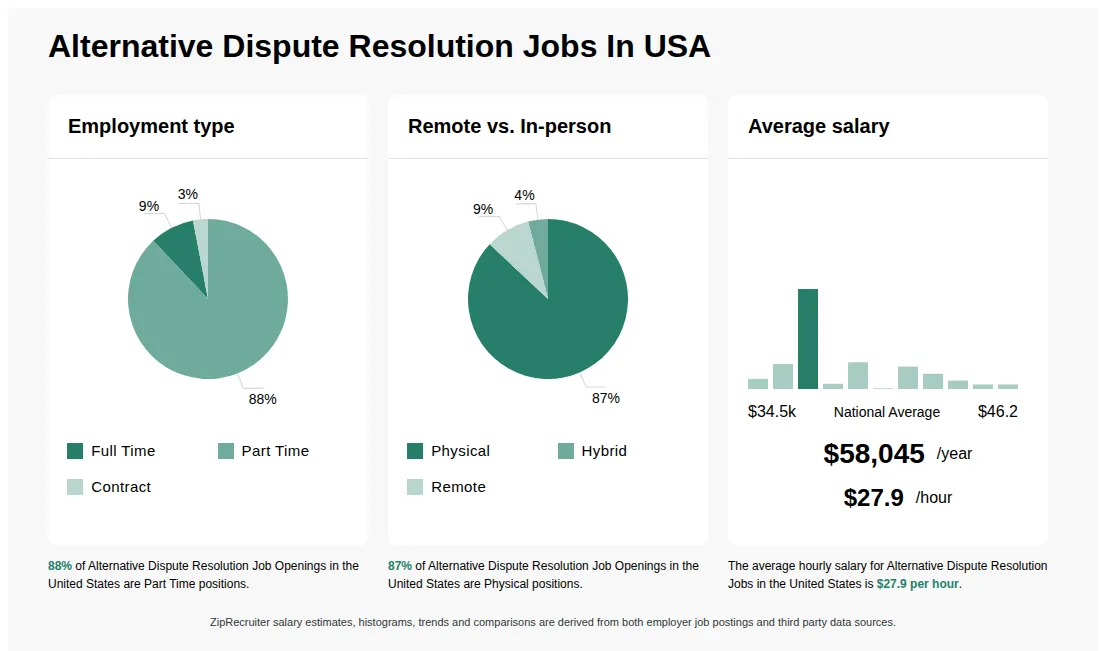
As of Sep 12, 2026, the average hourly pay for alternative dispute resolution in the United States is $27.91, according to ZipRecruiter salary data. Most workers in this role earn between $23.08 and $34.13 per hour, depending on experience, location, and employer.

What is alternative dispute resolution?

Alternative Dispute Resolution (ADR) refers to a range of processes that help parties resolve disputes without the need for traditional litigation in court. Common ADR methods include mediation, arbitration, negotiation, and conciliation. These processes are generally faster, less formal, and more cost-effective than going to trial. ADR can be used for many types of disputes, including commercial, family, employment, and community disagreements. Participants often find that ADR allows for more flexible and creative solutions tailored to their needs.

What are alternative dispute resolution jobs?

Alternative dispute resolution jobs, or ADR careers, focus on resolving legal cases outside of a courtroom. Professionals in this field include mediators, ADR program directors, contract and negotiation specialists, and conciliators. The duties and responsibilities of these positions involve the mediation of disputes and facilitation of communication between parties involved in the conflict. An ADR case can involve consumer or customer service complaints, labor disputes, and arbitration of divorce cases. A mediator might attempt to resolve disagreements to keep the issue out of court. Some ADR specialists, such as arbitrators, can make legally binding judgments in a case.

What are the key skills and qualifications needed to thrive in alternative dispute resolution, and why are they important?

To thrive in Alternative Dispute Resolution (ADR), you need a solid understanding of legal principles, negotiation tactics, and conflict resolution strategies, often supported by a relevant degree and specialized ADR or mediation certification. Familiarity with case management software and online mediation platforms is increasingly important in modern ADR practices. Exceptional communication, impartiality, and active listening are crucial soft skills for building trust and facilitating fair outcomes. These skills ensure effective, efficient, and equitable resolution of disputes outside traditional court systems.

What are common challenges faced by professionals working in alternative dispute resolution?

Professionals in Alternative Dispute Resolution often navigate complex interpersonal dynamics and emotionally charged situations, as parties may have deeply rooted disagreements. Maintaining neutrality and managing power imbalances between participants can be challenging, requiring strong communication and facilitation skills. Additionally, ADR specialists must stay updated on legal frameworks and best practices, as well as adapt their approach to suit various industries or dispute types. Balancing confidentiality with transparency and ensuring all parties feel heard are also crucial aspects of the role.

What is the difference between Alternative Dispute Resolution vs Mediator?

AspectAlternative Dispute ResolutionMediator
CredentialsVaries; often legal or conflict resolution trainingTraining in mediation techniques, certification often preferred
Work EnvironmentLegal, corporate, or community settingsNeutral setting facilitating negotiations
Industry UsageLegal, business, government sectorsLegal, community, and corporate disputes

Alternative Dispute Resolution (ADR) is a broad term encompassing methods like mediation, arbitration, and negotiation to resolve conflicts outside courts. A mediator is a professional who facilitates communication and negotiation between parties in ADR processes, primarily in mediation. While ADR refers to the overall process, mediators are specific practitioners within that process. Both roles require conflict resolution skills and relevant training, but ADR is the umbrella term, and mediators are specialized practitioners within it.

How do I start a career in alternative dispute resolution?

To start a career in alternative dispute resolution (ADR), obtain a relevant bachelor's degree such as in law, conflict resolution, or psychology, and gain experience through internships or entry-level positions. Many ADR professionals pursue certifications like the Certified Dispute Resolution Professional (CDRP) or mediator training to enhance credibility and job prospects.

What cities are hiring for Alternative Dispute Resolution jobs?

Cities with the most Alternative Dispute Resolution job openings:

What are the most commonly searched types of Alternative Dispute Resolution jobs?

The most popular types of Alternative Dispute Resolution jobs are:

What states have the most Alternative Dispute Resolution jobs?

States with the most job openings for Alternative Dispute Resolution jobs include:

Infographic showing various Alternative Dispute Resolution job openings in the United States as of September 2026, with employment types broken down into 1% As Needed, 90% Full Time, 7% Part Time, and 2% Contract. Highlights an 87% Physical, 4% Hybrid, and 9% Remote job distribution, with an average salary of $58,045 per year, or $27.9 per hour.

Attorney (Alternative Dispute Resolution)

Alexandria, VA • On-site, Remote

Office of Inspector General
Public Administration • 11 - 50 employees

$121K - $158K/yr

Full-time

Posted 9 days ago


Job description

Summary
This position is located in the DoW Office of Inspector General (DoW IG), Deputy Inspector General for Administrative Investigations (DIG-AI), Whistleblower Reprisal Investigations (WRI) Directorate. The incumbent serves as a mediator and expert on whistleblower reprisal complaints appropriate for resolution under the Administrative Dispute Resolution Acts of 1990 and 1996 and the Alternative Dispute Resolution Act of 1998.
Learn more about this agency
Duties
Help
  • Reviews and evaluates complaints of whistleblower reprisal in concert with their supervisor and WRI management to determine whether appropriate for the alternative dispute resolution process.
  • Serves as a neutral professional under the confidentiality provision of the Administrative Dispute Resolution Acts of 1990 and 1998 (ADRA) and the Alternative Dispute Resolution Act of 1998 (ADR Act) in reaching resolution of disputed matters.
  • Advises principal parties in the preparation and conduct of ADR processes. Initiates contact with principal parties to the dispute, obtains information pertinent to the issues at question, guides parties through ADR process.
  • Advises on, or prepares legally supportable resolution agreements that fully resolve the open complaint.
  • Participates in the design and implementation of training to ensure Agency attorney, investigative staff, and management effectively use ADR processes and retain neutral professionals.

Requirements
Help
Conditions of employment
  • Must be a U.S. Citizen.
  • Males born after 12/31/1959 must be registered for Selective Service
  • This is an Excepted Service position.
  • Incumbent is required to submit to urinalysis to screen for illegal drug use prior to appointment and is subject to random drug testing for the duration of service with DoW OIG.
  • Current DoW civilian employees are not required to submit to drug testing if moving from one Testing Designated Position (TDP) to another with no break in service, unless deemed appropriate on a case-by-case basis.
  • Position has been designated as security designation level Special Sensitive. Incumbent is required to obtain and maintain a Top Secret / Sensitive Compartmented Information (TS/SCI) security clearance.
  • Federal employees currently serving in the Competitive Service must acknowledge that they will voluntarily leave the Competitive Service by accepting an offer of employment in the Excepted Service.
  • You may be required to complete a financial disclosure (OGE-450).
  • The incumbent must adhere to the DoD Standards of Conduct.

Qualifications
Basic Requirements:
  • To meet the basic requirements, you must possess a J.D., LL.B., or LL.M degree from a law school accredited by the American Bar Association.
  • Applicants must be an active member, in good standing, of the bar of the highest court of a state, U.S. Commonwealth, U.S. Territory, or the District of Columbia, and be permitted to engage in the practice of law.

In addition to the basic requirements noted above, resume must document the specialized experience listed below:
Time in Grade:

For entry at the GS-13 grade level, status applicants must have served 52 weeks as a GS-12 or equivalent or higher grade, in the Federal Service.
Specialized Experience: Applicants must have 52 weeks of specialized experience at the GS-13 level in the Federal service or at an equivalent level. Specialized experience is defined as applying the principles of mediating and drafting legally supportable settlement agreements to resolve matters under the Administrative Dispute Resolution Acts of 1990 and 1996 and the Alternative Dispute Resolution Act of 1998. Experience also includes demonstrated knowledge of and experience with federal whistleblower reprisal statutes, reviewing and evaluating complaints, prioritizing workloads, and developing training.
In addition to the basic qualifications, candidates must have at least five (5) years of specialized legal experience as an attorney in the fields of federal criminal, civil, or administrative law, which demonstrates that candidates can successfully perform the duties of a GS-0905-13 Attorney.
Experience refers to paid and unpaid experience, including volunteer work done through National Service programs (e.g., Peace Corps, AmeriCorps) and other organizations (e.g., professional; philanthropic; religious; spiritual; community; student; social). Volunteer work helps build critical competencies, knowledge, and skills and can provide valuable training and experience that translates directly to paid employment. You will receive credit for all qualifying experience, including volunteer experience.
Additional Information:
PCS costs (moving expenses) WILL NOT be paid.
Recruitment, relocation, or retention incentives WILL NOT be authorized by the hiring official. The Tax Cuts and Jobs Act of 2017 makes certain reimbursements/payments taxable
Education
There is no substitution of education for experience at this level.
Additional information
NOTICE OF VETERANS' PREFERENCE
There is no formal rating system for applying veterans' preference to attorney appointments in the excepted service; however, the Department of War considers veterans' preference eligibility a positive factor for attorney hiring. Applicants eligible for veterans' preference must include that information in their cover letter or resume and attach supporting documentation (see below) to their submissions.
- You must submit a copy of your DD Form-214, Certificate of Release or Discharge from Active Duty", showing the dates of active duty service, type of discharge and the character of service. Alternatively, if you are a current military member in active duty service and do not have a copy of your DD Form-214, you must submit a written documentation (certification) from your branch of service certifying that you are expected to be discharged or released from active duty under honorable conditions no later than 120 days after the date the certification is submitted with your application for this position. The certification should also include your rank, dates of active duty service and what they condition of discharge is thought to be.
- If claiming 10-point preference and/or are a 30% or more Disabled Veteran, you must submit both a DD Form-214 or expected discharge documentation as described above AND a copy of a letter from the Department of Veterans Affairs (VA) or your branch of service certifying the presence of service-connected disability and indicating the percentage of disability
- If you are claiming eligibility based on 10-point derived veterans' preference (i.e. a spouse, widow/widower, or parent of a veteran claiming veterans' preference when the veteran is unable to use it), you must also submit a Standard Form 15 (SF-15) "Application for 10-Point Veteran's Preference" and any required documents indicated on the SF-15 to substantiate the claimed preference.
- If you do not have a copy of your VA letter, you can download it at VA.gov. https://www.va.gov/records/download-va-letters/
Submission of a resume alone is NOT a complete application. This position may require the completion of additional form/s and/or supplemental materials. Failure to provide the required information and/or materials will result in your application not being considered for employment.
Military retirees seeking to enter civil service in the Department of War now require a waiver if they are within 180 days following their official date of retirement (5 United States Code 3326.)
Priority Placement Program (PPP) Military Spouse Preference (MSP) eligible candidates will receive priority consideration at the highest grade level for which they have applied and been determined best qualified up to and including the full performance level.
For grades below the full performance level, only MSP/PPP eligible candidates who currently occupy a formal training program position will be entitled to exercise their priority preference.
PPP Application Based Preference Eligibles (Military Reserve and National Guard technicians, Military Reserve and National Guard technicians receiving disability retirement, and Retained Grade employees) will receive priority consideration at the full performance level only.
All applicants are encouraged to apply electronically. If you are unable to apply on-line, you may contact 317-212-4434 for assistance.
Expand Hide additional information
Candidates should be committed to improving the efficiency of the Federal government, passionate about the ideals of our American republic, and committed to upholding the rule of law and the United States Constitution.
Benefits
Help
A career with the U.S. government provides employees with a comprehensive benefits package. As a federal employee, you and your family will have access to a range of benefits that are designed to make your federal career very rewarding. Opens in a new windowLearn more about federal benefits.
Review our benefits
Eligibility for benefits depends on the type of position you hold and whether your position is full-time, part-time or intermittent. Contact the hiring agency for more information on the specific benefits offered.