The Health IT Informatics Analyst I supports the development of clinical informatics software and health IT solutions by conducting requirements gathering, information modeling, process documentation ...
Quick apply
The Health IT Informatics Analyst I supports the development of clinical informatics software and health IT solutions by conducting requirements gathering, information modeling, process documentation ...
Quick apply
The Health IT Informatics Analyst I supports the development of clinical informatics software and health IT solutions by conducting requirements gathering, information modeling, process documentation ...
Washington, DC · On-site +1
The Health IT Informatics Analyst I supports the development of clinical informatics software and health IT solutions by conducting requirements gathering, information modeling, process documentation ...
Washington, DC · On-site +1
The Health IT Informatics Analyst I supports the development of clinical informatics software and health IT solutions by conducting requirements gathering, information modeling, process documentation ...
Chicago, IL · On-site
$92K - $121K/yr
The Informatics Sales Specialist is a multifaceted and motivated individual responsible for selling Waters enterprise informatics software portfolio of products to the pharmaceutical and life science ...
Chicago, IL · On-site
$92K - $121K/yr
The Informatics Sales Specialist is a multifaceted and motivated individual responsible for selling Waters enterprise informatics software portfolio of products to the pharmaceutical and life science ...
Remote Duration : Direct Hire FTE **Must Have's:** - Bachelor's Degree in Health Information Management or Health Informatics OR B.S. in a clinical field (nursing, etc.) with certification in Health ...
Remote Duration : Direct Hire FTE **Must Have's:** - Bachelor's Degree in Health Information Management or Health Informatics OR B.S. in a clinical field (nursing, etc.) with certification in Health ...
Washington, DC · On-site +1
The Office of Clinical Informatics within the Office of Health Informatics (OHI), Digital Health Office (DHO) advances the enterprise standard of care and patient experience using improved data ...
Washington, DC · On-site +1
The Office of Clinical Informatics within the Office of Health Informatics (OHI), Digital Health Office (DHO) advances the enterprise standard of care and patient experience using improved data ...
The Mid-Level Program Analyst operates within a Veterans Administration healthcare context ... Apply clinical informatics knowledge to assess program operations and recommend improvements ...
The Mid-Level Program Analyst operates within a Veterans Administration healthcare context ... Apply clinical informatics knowledge to assess program operations and recommend improvements ...
The Mid-Level Program Analyst operates within a Veterans Administration healthcare context ... Apply clinical informatics knowledge to assess program operations and recommend improvements ...
Quick apply
The Mid-Level Program Analyst operates within a Veterans Administration healthcare context ... Apply clinical informatics knowledge to assess program operations and recommend improvements ...
$22.75 - $25.25/hr
Registered Health Information Technician from the Commission on Certification for Health Informatics and Information Management (CCHIIM)- AHIMA Registered Health Information Administrator from the ...
$22.75 - $25.25/hr
Registered Health Information Technician from the Commission on Certification for Health Informatics and Information Management (CCHIIM)- AHIMA Registered Health Information Administrator from the ...
New Orleans, LA · On-site +1
$22.75 - $25.25/hr
Registered Health Information Technician from the Commission on Certification for Health Informatics and Information Management (CCHIIM)- AHIMA Registered Health Information Administrator from the ...
New Orleans, LA · On-site +1
$22.75 - $25.25/hr
Registered Health Information Technician from the Commission on Certification for Health Informatics and Information Management (CCHIIM)- AHIMA Registered Health Information Administrator from the ...
Epidemiologist - ELR & Public Health Informatics Client: Tennessee Department of Health (TDH) Work Type: Remote Duration: July 2026 - August 2027 with possible extension. Schedule: Monday-Friday, 8 ...
Epidemiologist - ELR & Public Health Informatics Client: Tennessee Department of Health (TDH) Work Type: Remote Duration: July 2026 - August 2027 with possible extension. Schedule: Monday-Friday, 8 ...
Loma Linda, CA · On-site +1
$87K - $135K/yr
Summary This position serves as a health care professional who uses that knowledge to influence and ... As a primary VHA subject matter expert for Health Informatics, the employee serves as the knowledge ...
Loma Linda, CA · On-site +1
$87K - $135K/yr
Summary This position serves as a health care professional who uses that knowledge to influence and ... As a primary VHA subject matter expert for Health Informatics, the employee serves as the knowledge ...
Remote Work Key Job Responsibilities Interface Implementation: • Assist with the design, testing ... Bachelor's degree in public health informatics, epidemiology, computer science, computer ...
Remote Work Key Job Responsibilities Interface Implementation: • Assist with the design, testing ... Bachelor's degree in public health informatics, epidemiology, computer science, computer ...
Washington, DC · Remote
$75K - $94K/yr
CINQCARE is a provider-led, community-based health and care partner dedicated to improving the ... Overview The Clinical Informatics Specialist will support the implementation, optimization, and ...
Quick apply
Washington, DC · Remote
$75K - $94K/yr
CINQCARE is a provider-led, community-based health and care partner dedicated to improving the ... Overview The Clinical Informatics Specialist will support the implementation, optimization, and ...
S.) in Health Informatics, Medical Informatics, Computer Science, Health Information Management, or a related field required * Master's Degree in Arts/Sciences (M.A./M.S.) in Medical Informatics ...
S.) in Health Informatics, Medical Informatics, Computer Science, Health Information Management, or a related field required * Master's Degree in Arts/Sciences (M.A./M.S.) in Medical Informatics ...
Duluth, MN · On-site +1
$66K - $99K/yr
... Essentia Institute of Rural Health (EIRH), working with Research Scientists, Principal ... Remote Shift Rotation: Day Rotation (United States of America) Shift Start Time: 8:00 AM Shift End ...
Duluth, MN · On-site +1
$66K - $99K/yr
... Essentia Institute of Rural Health (EIRH), working with Research Scientists, Principal ... Remote Shift Rotation: Day Rotation (United States of America) Shift Start Time: 8:00 AM Shift End ...
Duluth, MN · On-site +1
$66K - $99K/yr
... Essentia Institute of Rural Health (EIRH), working with Research Scientists, Principal ... Remote Shift Rotation: Day Rotation (United States of America) Shift Start Time: 8:00 AM Shift End ...
Duluth, MN · On-site +1
$66K - $99K/yr
... Essentia Institute of Rural Health (EIRH), working with Research Scientists, Principal ... Remote Shift Rotation: Day Rotation (United States of America) Shift Start Time: 8:00 AM Shift End ...
Shoreline, WA · On-site +1
$16K - $20K/mo
Remote Only Job Number: PTF-HIIMCyb Department: HIIM Opening Date: 03/18/2026 Position Summary ... Learn more AND The Health Informatics & Information Management (HIIM) Program offers degrees and ...
Shoreline, WA · On-site +1
$16K - $20K/mo
Remote Only Job Number: PTF-HIIMCyb Department: HIIM Opening Date: 03/18/2026 Position Summary ... Learn more AND The Health Informatics & Information Management (HIIM) Program offers degrees and ...
Phoenix, AZ · On-site +1
$71K/yr
REMOTE OPTIONS, PHOENIX Categories: Accounting/Auditing, Healthcare/Medical Professional Level ... Informatics & Prepayment Review Health Consultant Division of Fee for Service Management (DFSM) Job ...
Phoenix, AZ · On-site +1
$71K/yr
REMOTE OPTIONS, PHOENIX Categories: Accounting/Auditing, Healthcare/Medical Professional Level ... Informatics & Prepayment Review Health Consultant Division of Fee for Service Management (DFSM) Job ...
Danville, PA · On-site +1
Responsible for ensuring alignment between nursing practice, clinical operations, digital health ... This position is remote, but will require regular travel throughout the system Education: Bachelor ...
Danville, PA · On-site +1
Responsible for ensuring alignment between nursing practice, clinical operations, digital health ... This position is remote, but will require regular travel throughout the system Education: Bachelor ...
Remote Epic Application Coordinator (Bridges and Data Courier) Spartanburg Regional Healthcare ... Bachelor's degree in Computer Science, Health Informatics, or related field. * 7+ years of ...
Remote Epic Application Coordinator (Bridges and Data Courier) Spartanburg Regional Healthcare ... Bachelor's degree in Computer Science, Health Informatics, or related field. * 7+ years of ...
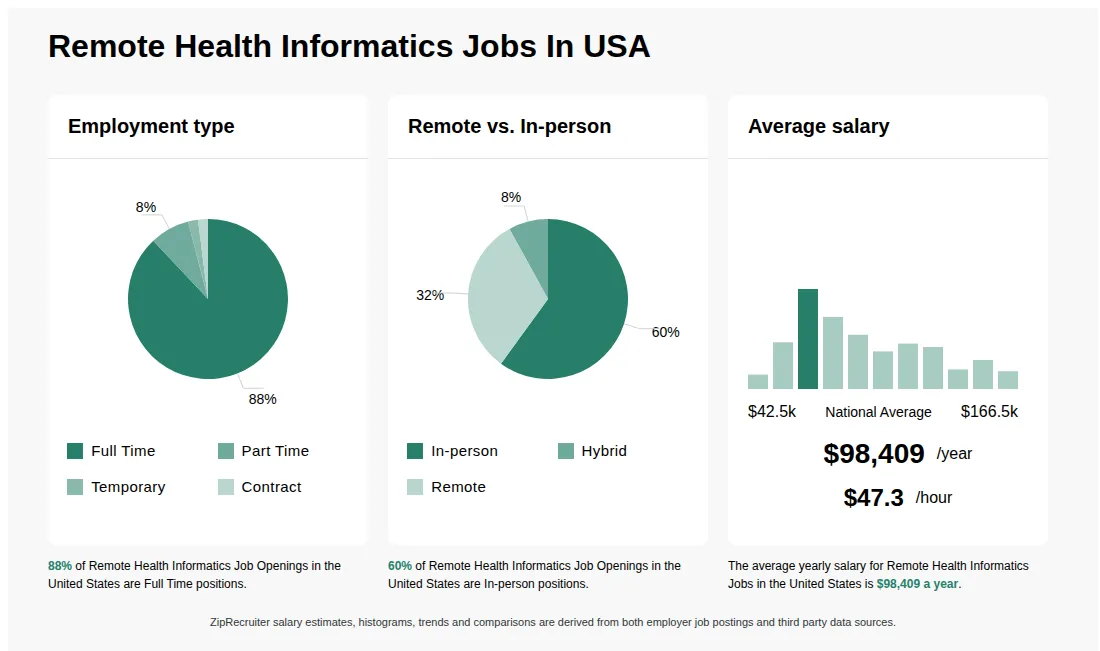
$42.5K - $53.8K
2% of jobs
$53.8K - $65K
10% of jobs
$72.1K is the 25th percentile. Wages below this are outliers.
$65K - $76.3K
21% of jobs
$76.3K - $87.6K
16% of jobs
The median wage is $88.6K / yr.
$87.6K - $98.9K
12% of jobs
$98.9K - $110.1K
7% of jobs
$118.3K is the 75th percentile. Wages above this are outliers.
$110.1K - $121.4K
10% of jobs
$121.4K - $132.7K
9% of jobs
$132.7K - $144K
4% of jobs
$144K - $155.2K
6% of jobs
$155.2K - $166.5K
3% of jobs
$42.5K
$98.4K
$166.5K
A remote health informatics job is a supportive administrative position in health care that allows you to work from home. Your responsibilities involve the development of methods to organize, analyze, and monitor patient records. Your duties are to track patient data, review medical policies and procedures, create and store documents, and work to improve clinical care. Remote health informatics professionals communicate through email and phone calls with IT staff and administrators and have limited direct contact with patients. Opportunities are available in hospitals, medical offices, and health care organizations as directors, managers, and analysts.
| Aspect | Remote Health Informatics | Remote Medical Coding |
|---|---|---|
| Required Credentials | Bachelor's degree in health informatics, IT, or related field; certifications like RHIA or RHIT | Certification such as CPC, CCS, or CCA; high school diploma or equivalent often required |
| Work Environment | Healthcare organizations, hospitals, clinics, or remote settings involving data management | Medical offices, billing companies, or remote coding jobs for healthcare providers |
| Industry Usage | Used across healthcare IT, data analysis, and health information management | Primarily in medical billing, coding, and reimbursement processes |
Remote Health Informatics focuses on managing healthcare data, improving systems, and supporting clinical decision-making, often requiring a background in health information management. Remote Medical Coding involves translating medical records into standardized codes for billing and insurance, requiring coding certifications. While both roles are remote and healthcare-related, they differ in responsibilities, credentials, and industry applications.
Full-time
Posted 13 days ago
Position Overview:
The Health IT Informatics Analyst I supports the development of clinical informatics software and health IT solutions by conducting requirements gathering, information modeling, process documentation, and stakeholder liaison activities. This role works independently or under general direction to ensure health information systems accurately capture, standardize, and exchange clinical data. The analyst bridges clinical and technical teams, translating operational needs into actionable system specifications within a government contracting environment supporting federal healthcare agencies.
Please note this position is contingent upon award (July/Aug 2026)
Key Responsibilities:
· Conduct requirements elicitation sessions with clinical and operational stakeholders to gather, document, and validate functional and non-functional system requirements.
· Perform requirements analysis, including traceability from stakeholder needs through system specifications to acceptance criteria.
· Develop detailed requirements documentation, user stories, use cases, and process models for clinical informatics applications.
· Conduct information modeling activities including data flow diagrams, entity-relationship models, and conceptual data schemas.
· Facilitate and participate in user acceptance testing (UAT), developing test scripts, tracking defects, and documenting test results.
· Develop and maintain artifact documentation for systems capturing or standardizing health information, clinical data, or life sciences data.
· Serve as liaison between clinical subject matter experts and technical development teams to ensure requirements are accurately interpreted and implemented.
· Support continuous improvement of clinical informatics systems by evaluating existing processes and identifying gaps or inefficiencies.
· Assist in the development of training materials, standard operating procedures, and user guides for health IT systems.
· Participate in project status reviews, stakeholder meetings, and deliverable reviews as required by the program.
Required Qualifications:
· Bachelor's Degree in Health Informatics, Information Technology, Computer Science, Health Sciences, or a related field.
· Minimum of 4 years of experience in health IT or informatics-related work, of which at least 3 years must be specialized experience as defined below.
o Specialized experience includes: requirements elicitation, requirements analysis, user acceptance testing, and development/documentation of systems used in the capture or standardization of health information, clinical information, or data related to therapeutic discovery, medical research, or life sciences.
· 6 additional years of specialized experience may substitute for the educational requirement.
Preferred Qualifications:
· Experience working with the Veterans Health Administration or a similar federal health agency (CDC, CMS, DHA, HHS, etc.).
· Active security clearance or ability to obtain one.
· Demonstrated ability to elicit, document, and manage requirements for health information or clinical information systems.
· Experience with requirements management tools and methodologies (e.g., JIRA or similar).
· Knowledge of clinical data standards including HL7, FHIR, SNOMED CT, LOINC, ICD-10, or similar terminologies.
· Familiarity with EHR systems, health information exchange (HIE) platforms, or clinical data repositories.
· Proficiency with process modeling notations (e.g., BPMN, UML use case diagrams) and documentation tools.
· Strong written and verbal communication skills; ability to produce clear, accurate, and complete technical documentation.
· Ability to work independently and under general supervision; manage priorities and meet deadlines in a fast-paced project environment.
Benefits:
· Health, Dental, and Vision Plans
· Short Term Disability / Long Term Disability / Life Insurance / Accidental Death and Dismemberment
· Health Savings Account
· Unlimited Paid Time Off
· 11 Federal Holidays Off
· 401k
We may use artificial intelligence (AI) tools to support parts of the hiring process, such as reviewing applications, analyzing resumes, or assessing responses and identifying potential inconsistencies or verification signals in application materials based on available information. These tools assist our recruitment team but do not replace human judgment. Final hiring decisions are ultimately made by humans. If you would like more information about how your data is processed, please contact us.