2

Remote Health Informatics Jobs (NOW HIRING)

Job Summary Clinical Informaticist III Aptive is seeking an experienced Clinical Informaticist III to support the Veterans Health Administration (VHA) Office of Health Informatics (OHI), Clinical ...

Job Summary Clinical Informaticist III Aptive is seeking an experienced Clinical Informaticist III to support the Veterans Health Administration (VHA) Office of Health Informatics (OHI), Clinical ...

... flexible remote work arrangements. We take pride in our mission to improve public health and ... Experience working on multidisciplinary teams involving public health, informatics, and software ...

Washington, DC Metro Area (Remote), with occasional onsite work required by Government Clearance ... Bachelor's degree in Nursing, Health Informatics, Healthcare Administration, or a related clinical ...

This position will be fully remote and will operate at the enterprise level, coordinating multiple ... Supports strategic planning, analysis, and capture activities for enterprise healthcare informatics ...

Showing results 41-60

Remote Health Informatics information

See salary details

$42.5K

$98.4K

$166.5K

How much do remote health informatics jobs pay per year?

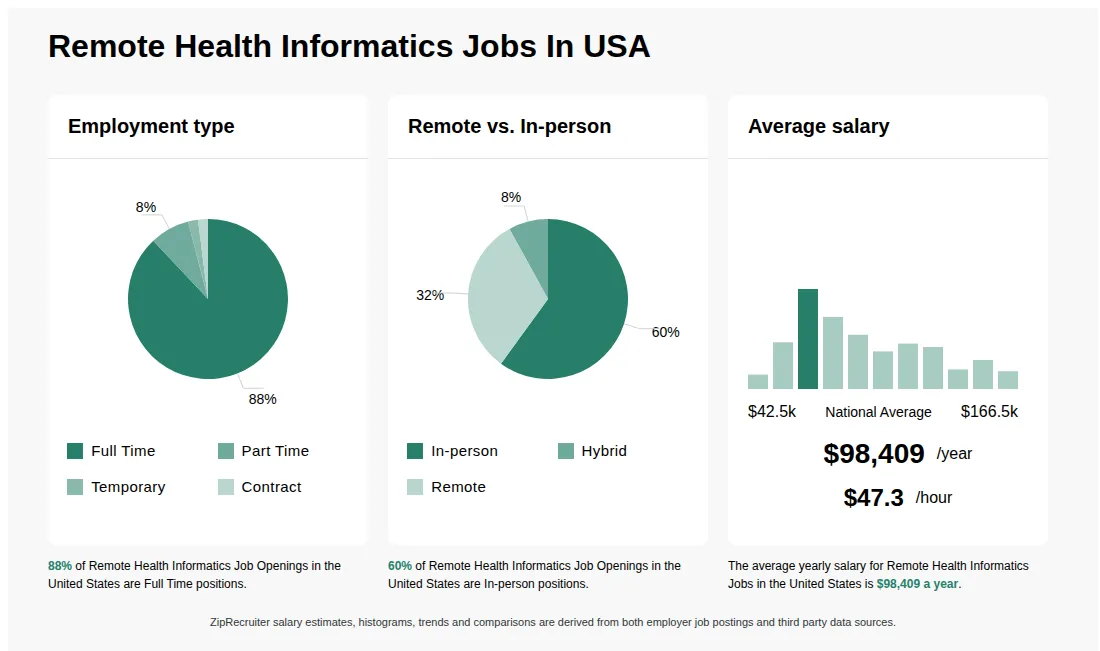
As of Sep 12, 2026, the average yearly pay for remote health informatics in the United States is $98,409.00, according to ZipRecruiter salary data. Most workers in this role earn between $70,000.00 and $122,500.00 per year, depending on experience, location, and employer.

What is remote health informatics?

Remote health informatics is the field of managing and analyzing health information data using technology, often from a location outside of traditional healthcare settings. Professionals in this field work with electronic health records, telemedicine platforms, and health data systems to improve patient care, streamline workflows, and ensure data security. Remote roles in health informatics allow individuals to contribute to healthcare innovation and support clinical decisions from anywhere, leveraging digital tools and cloud-based systems. This flexibility makes it possible for healthcare organizations to access specialized expertise regardless of geographic boundaries.

What are remote health informatics jobs?

A remote health informatics job is a supportive administrative position in health care that allows you to work from home. Your responsibilities involve the development of methods to organize, analyze, and monitor patient records. Your duties are to track patient data, review medical policies and procedures, create and store documents, and work to improve clinical care. Remote health informatics professionals communicate through email and phone calls with IT staff and administrators and have limited direct contact with patients. Opportunities are available in hospitals, medical offices, and health care organizations as directors, managers, and analysts.

What are the key skills and qualifications needed to thrive as a remote health informatics specialist, and why are they important?

To thrive as a Remote Health Informatics Specialist, you need a solid background in health information management, data analysis, and familiarity with healthcare regulations, often supported by a degree in health informatics or a related field. Experience with electronic health record (EHR) systems, health information exchanges, and certifications like RHIA or CAHIMS are typically required. Strong analytical thinking, attention to detail, and effective communication skills are crucial for interpreting complex data and collaborating with remote teams. These skills enable accurate data management, regulatory compliance, and informed decision-making in a technology-driven healthcare environment.

What are some common challenges faced by professionals working in remote health informatics roles, and how can they be overcome?

One common challenge in remote health informatics is ensuring secure and efficient access to sensitive health data while working off-site, which requires strong familiarity with data privacy regulations and cybersecurity protocols. Additionally, remote professionals often need to collaborate closely with clinical teams and IT staff across different locations, necessitating excellent communication and project management skills. To overcome these challenges, it's important to stay current with industry best practices, participate in regular virtual meetings, and leverage secure collaboration platforms to maintain strong teamwork and compliance.

What is the difference between Remote Health Informatics vs Remote Medical Coding?

AspectRemote Health InformaticsRemote Medical Coding
Required CredentialsBachelor's degree in health informatics, IT, or related field; certifications like RHIA or RHITCertification such as CPC, CCS, or CCA; high school diploma or equivalent often required
Work EnvironmentHealthcare organizations, hospitals, clinics, or remote settings involving data managementMedical offices, billing companies, or remote coding jobs for healthcare providers
Industry UsageUsed across healthcare IT, data analysis, and health information managementPrimarily in medical billing, coding, and reimbursement processes

Remote Health Informatics focuses on managing healthcare data, improving systems, and supporting clinical decision-making, often requiring a background in health information management. Remote Medical Coding involves translating medical records into standardized codes for billing and insurance, requiring coding certifications. While both roles are remote and healthcare-related, they differ in responsibilities, credentials, and industry applications.

What cities are hiring for Remote Health Informatics jobs?

Cities with the most Remote Health Informatics job openings:

What are the most commonly searched types of Health Informatics jobs?

The most popular types of Health Informatics jobs are:

What states have the most Remote Health Informatics jobs?

States with the most job openings for Remote Health Informatics jobs include:

Infographic showing various Remote Health Informatics job openings in the United States as of September 2026, with employment types broken down into 94% Full Time, and 6% Part Time. Highlights an 100% Remote job distribution, with an average salary of $98,409 per year, or $47.3 per hour.

Health System Specialist, Clinical Informatics, Mid/Senior (Pending Contract Award) - SBG

Alexandria, VA • On-site, Remote

SBG Technology Solutions, Inc.
51 - 200 employees

$90K - $130K/yr

Full-time

Re-posted 18 days ago


Job description

SBG Technology Solutions, Inc. (SBG), a DSS, Inc. company, offers Systems Engineering, Enterprise Modernization, Artificial Intelligence, Cyber Security, and IT Governance innovation to Federal and commercial clients nationwide.
**Contingent Upon Contract Award**
Overview
SBG is seeking a Health Systems Specialist with clinical informatics, EHR, and healthcare operations experience to support VA enterprise health informatics initiatives, clinical applications, field communications, readiness, training, and continuous improvement activities. This role will work with clinical and operational stakeholders to assess informatics needs, support implementation of clinical tools and processes, develop resources, manage SharePoint or collaboration environments, and help improve clinical workflows and information system use. The ideal candidate has a clinical background, strong VHA knowledge, experience supporting CPRS/VistA or related clinical applications, and the ability to translate field needs into practical tools, guidance, and communications.
The Health System Specialist, Clinical Informatics, Mid/Senior will:
  • Support core functions of enterprise clinical information systems to enable safe, efficient, high-quality patient care.
  • Assist physicians, nurses, and other clinicians with issue resolution related to EHR, CPRS/VistA, clinical applications, and supporting tools.
  • Assess information and knowledge-based needs of healthcare professionals and patients; characterize, evaluate, and refine clinical processes.
  • Develop, implement, evaluate, and improve clinical informatics tools, clinical decision support, templates, reminders, workflows, training materials, and user guidance.
  • Support HITT, CIOC, IRCP, HI CoP, VistA/CPRS training, SharePoint resource development, formal messaging, stakeholder engagement, and field-facing support activities.
  • Develop and maintain SharePoint sites, request forms, issue trackers, resource libraries, SOPs, job aids, office hour materials, and performance dashboards.
  • Collect, analyze, and report performance metrics to support adoption, utilization, quality, and continuous improvement.
  • Facilitate work groups, stakeholder meetings, field user engagement, training sessions, and cross-organizational communications.

Other Duties:
  • Manage diverse BI environments and oversee reporting and knowledge management portfolios using Power BI, Power Apps, SharePoint, and Jira.
  • Develop and manage program tools for planning work and tracking status.
  • Work collaboratively with senior leadership to determine metrics, measures, and data needs. Develop dashboards to communicate key performance measures, status, and trends.
  • Utilize the Agile development process to provide customer focused development approach that delivers value in small, incremental increments through continuous collaboration, rapid feedback, and adaptive planning.

Conditions of Employment:
  • Must be a US Citizen
  • Must be able to pass a Federal background check
  • Must be determined suitable for federal employment

Security and Privacy Duties and Responsibilities:
Individuals working for SBG Technology Solutions, Inc, a DSS, Inc. will be subject to security and privacy requirements as explained in HIPAA, FedRAMP, and NIST 800-53. Additionally, they are required to undergo specific FedRAMP training to ensure compliance with all associated controls and responsibilities in the day-to-day performance of their duties. Individuals working in departments that are considered to be in the high-risk category will be required to undergo advanced training based on their role and level of access. Individuals with access to modify data and the configuration baseline will require further training.
The preceding functions are examples of the work performed by employees assigned to this job classification. Management reserves the right to add, modify, change or rescind work assignments and make a reasonable accommodation as needed.
Required Skills:
  • Clinical background such as RN, nurse informaticist, HIS, CAC, clinical program manager, or healthcare operations leader.
  • Experience supporting VA/VHA, OHI, CIDMO, FIS, HI CoP, HITT, CIOC, IRCP, EHRM, VistA/CPRS, Clinical Reminders, or SharePoint-based field communications.
  • Experience developing formal messaging programs, online communities of practice, training materials, clinical tools, or performance metrics in a large healthcare system.
  • Knowledge of healthcare business and clinical operations, clinical workflows, patient safety, and VHA culture.
  • Experience with Microsoft 365, SharePoint, Power BI, Excel, Power Automate, Microsoft Forms, Teams, or similar collaboration and reporting tools.
  • Experienced in architect end-to-end data pipelines, dimensional data models, and cloud-based warehousing solutions utilizing VA-approved platforms such as Azure Data Factory, Azure Databricks, Python, SQL Server, and Dagster.
  • Ability to transform complex business requirements into scalable data infrastructure, developing CRUD-based applications with Power Apps, and managing CI/CD pipelines through Azure DevOps.
  • Experienced in Agile development process to provide customer focused development approach that delivers value in small, incremental increments through continuous collaboration, rapid feedback, and adaptive planning.
  • Experience with Power BI, Power Apps, SharePoint, and Jira to create, maintain and improve the user experience.
  • Experience with management of data warehouses and use existing VA platforms (as mentioned above) to develop the architecture to create data tables, fact tables, and dimension tables; organizing data sources in appropriate and logical fashion.

Education:
  • Required: Bachelor's degree in nursing, health informatics, healthcare administration, information systems, public health, or related field; additional specialized experience may be considered in lieu of degree when contractually permissible

Certification(s), Licenses:
  • Desired:
    • BI Developer: Microsoft Certified Power BI Data Analyst Associate
    • MD/DO + Informatics Certification or Degree.

Years of experience in a similar role:
  • Required:
    • 4+ years of clinical informatics, healthcare operations, EHR support, clinical applications, or health systems improvement experience; 8+ years preferred for senior/KP-aligned candidates.
  • Desired:
    • 10+ Years of experience obstetrics/gynecology/women's health or other related areas.
    • 5+ years of experience in informatics.

Physical Demands:
Standing
10% per day
Sitting
70% per day
Walking
20% per day
Stooping
10% per day
Lifting
If traveling, ability to lift up to 50 lbs. unassisted (luggage, laptop etc.)
Up to 10 lbs. unassisted, several times a day (laptop, office equipment, office supplies, etc.)
Computer Work
75% per day
Telephone Work
10% per day
Reading
15% per day
Other, please specify
Travel unassisted up to 10% per year, via common carrier and/or personal automobile.
SBGTS, Inc. is an Equal Opportunity Employer
If you need an accommodation seeking employment with SBGTS, Inc., please e-mail jobs@dssinc.com or call (561) 284-7333. Accommodations are made on a case-by-case basis.