... health informatics, data analytics, health information systems, and related areas. This part-time, remote appointment supports the program's mission by delivering high-quality asynchronous ...
... health informatics, data analytics, health information systems, and related areas. This part-time, remote appointment supports the program's mission by delivering high-quality asynchronous ...

Senior Informatics Applications Analyst
Kansas City, MO · Remote
$35.91/hr
As a leader in children's health, we engage in meaningful programs and partnerships throughout the ... Remote Work/Work from Home This is an intermittent remote position, which means that the person ...
Senior Informatics Applications Analyst
Kansas City, MO · Remote
$35.91/hr
As a leader in children's health, we engage in meaningful programs and partnerships throughout the ... Remote Work/Work from Home This is an intermittent remote position, which means that the person ...

Program Analyst (Informatics)
Memphis, TN · On-site +1
$89K - $116K/yr
Cultivates a healthy working relationship between the Office of Information and Technology (OIT) and Health Informatics, allowing for routine dialog to enable the sustainment and optimization of our ...
Program Analyst (Informatics)
Memphis, TN · On-site +1
$89K - $116K/yr
Cultivates a healthy working relationship between the Office of Information and Technology (OIT) and Health Informatics, allowing for routine dialog to enable the sustainment and optimization of our ...
Program Analyst (Informatics)
Saint Cloud, MN · On-site +1
$55K - $126K/yr
Summary The incumbent serves as a Program Analyst (Health Informatics) located at the medical centers, in the Veterans Health Administration (VHA) of the Department of Veterans Affairs (VA). The ...
Program Analyst (Informatics)
Saint Cloud, MN · On-site +1
$55K - $126K/yr
Summary The incumbent serves as a Program Analyst (Health Informatics) located at the medical centers, in the Veterans Health Administration (VHA) of the Department of Veterans Affairs (VA). The ...

Informatics Program Manager
Washington, DC · On-site +1
The Office of Clinical Informatics within the Office of Health Informatics (OHI), Digital Health Office (DHO) advances the enterprise standard of care and patient experience using improved data ...
Informatics Program Manager
Washington, DC · On-site +1
The Office of Clinical Informatics within the Office of Health Informatics (OHI), Digital Health Office (DHO) advances the enterprise standard of care and patient experience using improved data ...

Informatics Program Analyst
Arlington, VA · On-site +1
$90K - $104K/yr
The Informatics Program Analyst will provide analytical support for healthcare informatics programs and initiatives within the Veterans Health Administration (VHA). The Informatics Program Analyst ...
Informatics Program Analyst
Arlington, VA · On-site +1
$90K - $104K/yr
The Informatics Program Analyst will provide analytical support for healthcare informatics programs and initiatives within the Veterans Health Administration (VHA). The Informatics Program Analyst ...
Informatics Program Analyst
Arlington, VA · Remote
$90K - $104K/yr
The Informatics Program Analyst will provide analytical support for healthcare informatics programs and initiatives within the Veterans Health Administration (VHA). The Informatics Program Analyst ...
Quick apply
Informatics Program Analyst
Arlington, VA · Remote
$90K - $104K/yr
The Informatics Program Analyst will provide analytical support for healthcare informatics programs and initiatives within the Veterans Health Administration (VHA). The Informatics Program Analyst ...

Remote Duration: Direct Hire FTE Must Have's: * Bachelor's Degree in Health Information Management or Health Informatics OR B.S. in a clinical field (nursing, etc.) with certification in Health ...
Remote Duration: Direct Hire FTE Must Have's: * Bachelor's Degree in Health Information Management or Health Informatics OR B.S. in a clinical field (nursing, etc.) with certification in Health ...
Program Analyst (Informatics)
Saint Cloud, MN · On-site +1
$81K - $105K/yr
Cloud Health Care System. * Program Management- Uses communication, education, and leadership to ... This includes informatics operations that support activities to address the people, process, and ...
Program Analyst (Informatics)
Saint Cloud, MN · On-site +1
$81K - $105K/yr
Cloud Health Care System. * Program Management- Uses communication, education, and leadership to ... This includes informatics operations that support activities to address the people, process, and ...
The Mid-Level Program Analyst operates within a Veterans Administration healthcare context ... Apply clinical informatics knowledge to assess program operations and recommend improvements ...
The Mid-Level Program Analyst operates within a Veterans Administration healthcare context ... Apply clinical informatics knowledge to assess program operations and recommend improvements ...

Data Science & Informatics Specialist 1 | Medicaid Fraud Control Division | Olympia
Olympia, WA · On-site +1
$7.2K - $9.7K/mo
Thurston County - Olympia, WA Job Type: Full Time - Permanent Remote Employment: Flexible/Hybrid ... With the goal of employee health and wellness, we also offer: * Flexible schedules and part-time ...
Data Science & Informatics Specialist 1 | Medicaid Fraud Control Division | Olympia
Olympia, WA · On-site +1
$7.2K - $9.7K/mo
Thurston County - Olympia, WA Job Type: Full Time - Permanent Remote Employment: Flexible/Hybrid ... With the goal of employee health and wellness, we also offer: * Flexible schedules and part-time ...
Clinical Informatics Director, MD/DO
Washington, DC · On-site +1
The Office of Clinical Informatics within the Office of Health Informatics (OHI), Digital Health Office (DHO) advances the enterprise standard of care and patient experience using improved data ...
Clinical Informatics Director, MD/DO
Washington, DC · On-site +1
The Office of Clinical Informatics within the Office of Health Informatics (OHI), Digital Health Office (DHO) advances the enterprise standard of care and patient experience using improved data ...
Data Science and Informatics Specialist 2 (DSIS2/SPI)
Olympia, WA · On-site +1
$95K - $128K/yr
Remote Optional Job Number: 2026-07262 Department: Health Care Authority Division: SPI Opening Date ... Option 2: * Bachelor's degree in informatics, data science, mathematics, computer science ...
Data Science and Informatics Specialist 2 (DSIS2/SPI)
Olympia, WA · On-site +1
$95K - $128K/yr
Remote Optional Job Number: 2026-07262 Department: Health Care Authority Division: SPI Opening Date ... Option 2: * Bachelor's degree in informatics, data science, mathematics, computer science ...
Data Science and Informatics Specialist 2 (DSIS2/SPI)
Olympia, WA · On-site +1
$95K - $128K/yr
Description Data Science and Informatics Specialist 2 (DSIS2/SPI) 71115476 This data scientist will ... Use health care claims and supplementary data sources to design and develop health care reporting ...
Data Science and Informatics Specialist 2 (DSIS2/SPI)
Olympia, WA · On-site +1
$95K - $128K/yr
Description Data Science and Informatics Specialist 2 (DSIS2/SPI) 71115476 This data scientist will ... Use health care claims and supplementary data sources to design and develop health care reporting ...
Program Analyst (Informatics)
Minneapolis, MN · On-site +1
$81K - $126K/yr
Cultivates a healthy working relationship between the Office of Information and Technology (OIT) and Health Informatics, allowing for routine dialog to enable the sustainment and optimization of our ...
Program Analyst (Informatics)
Minneapolis, MN · On-site +1
$81K - $126K/yr
Cultivates a healthy working relationship between the Office of Information and Technology (OIT) and Health Informatics, allowing for routine dialog to enable the sustainment and optimization of our ...
... program (fully online/remote, accelerated format). Adjunct faculty will engage in online ... The program emphasizes artificial intelligence integration, data literacy, health informatics ...
... program (fully online/remote, accelerated format). Adjunct faculty will engage in online ... The program emphasizes artificial intelligence integration, data literacy, health informatics ...

... program (fully online/remote, accelerated format). Adjunct faculty will engage in online ... The program emphasizes artificial intelligence integration, data literacy, health informatics ...
Quick apply
... program (fully online/remote, accelerated format). Adjunct faculty will engage in online ... The program emphasizes artificial intelligence integration, data literacy, health informatics ...
Data Science & Informatics Specialist 1 | Medicaid Fraud Control Division | Olympia
Olympia, WA · On-site +1
$7.2K - $9.7K/mo
Data Science & Informatics Specialist 1 Salary Range 68: $86,688 - $116,544 The base pay offered ... With the goal of employee health and wellness, we also offer: Flexible schedules and part-time ...
Data Science & Informatics Specialist 1 | Medicaid Fraud Control Division | Olympia
Olympia, WA · On-site +1
$7.2K - $9.7K/mo
Data Science & Informatics Specialist 1 Salary Range 68: $86,688 - $116,544 The base pay offered ... With the goal of employee health and wellness, we also offer: Flexible schedules and part-time ...
Health System Specialist, Clinical Informatics, Mid/Senior (Pending Contract Award) - SBG
Alexandria, VA · On-site +1
$90K - $130K/yr
Overview SBG is seeking a Health Systems Specialist with clinical informatics, EHR, and healthcare operations experience to support VA enterprise health informatics initiatives, clinical applications ...
Health System Specialist, Clinical Informatics, Mid/Senior (Pending Contract Award) - SBG
Alexandria, VA · On-site +1
$90K - $130K/yr
Overview SBG is seeking a Health Systems Specialist with clinical informatics, EHR, and healthcare operations experience to support VA enterprise health informatics initiatives, clinical applications ...

Remote Work Key Job Responsibilities Interface Implementation: • Assist with the design, testing ... Bachelor's degree in public health informatics, epidemiology, computer science, computer ...
Remote Work Key Job Responsibilities Interface Implementation: • Assist with the design, testing ... Bachelor's degree in public health informatics, epidemiology, computer science, computer ...
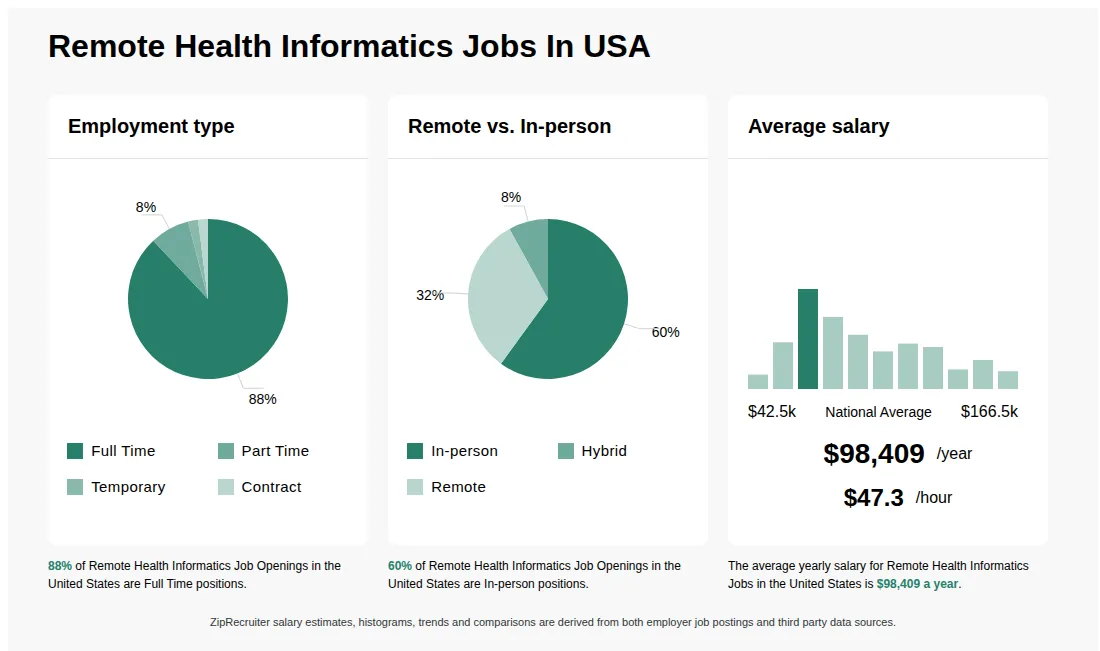
Remote Health Informatics information
See salary details
$42.5K - $53.8K
2% of jobs
$53.8K - $65K
10% of jobs
$72.1K is the 25th percentile. Wages below this are outliers.
$65K - $76.3K
21% of jobs
$76.3K - $87.6K
16% of jobs
The median wage is $88.6K / yr.
$87.6K - $98.9K
12% of jobs
$98.9K - $110.1K
7% of jobs
$118.3K is the 75th percentile. Wages above this are outliers.
$110.1K - $121.4K
10% of jobs
$121.4K - $132.7K
9% of jobs
$132.7K - $144K
4% of jobs
$144K - $155.2K
6% of jobs
$155.2K - $166.5K
3% of jobs
$42.5K
$98.4K
$166.5K
How much do remote health informatics jobs pay per year?
As of Sep 12, 2026, the average yearly pay for remote health informatics in the United States is $98,409.00, according to ZipRecruiter salary data. Most workers in this role earn between $70,000.00 and $122,500.00 per year, depending on experience, location, and employer.
What is remote health informatics?
Remote health informatics is the field of managing and analyzing health information data using technology, often from a location outside of traditional healthcare settings. Professionals in this field work with electronic health records, telemedicine platforms, and health data systems to improve patient care, streamline workflows, and ensure data security. Remote roles in health informatics allow individuals to contribute to healthcare innovation and support clinical decisions from anywhere, leveraging digital tools and cloud-based systems. This flexibility makes it possible for healthcare organizations to access specialized expertise regardless of geographic boundaries.
What are remote health informatics jobs?
A remote health informatics job is a supportive administrative position in health care that allows you to work from home. Your responsibilities involve the development of methods to organize, analyze, and monitor patient records. Your duties are to track patient data, review medical policies and procedures, create and store documents, and work to improve clinical care. Remote health informatics professionals communicate through email and phone calls with IT staff and administrators and have limited direct contact with patients. Opportunities are available in hospitals, medical offices, and health care organizations as directors, managers, and analysts.
What are the key skills and qualifications needed to thrive as a remote health informatics specialist, and why are they important?
To thrive as a Remote Health Informatics Specialist, you need a solid background in health information management, data analysis, and familiarity with healthcare regulations, often supported by a degree in health informatics or a related field. Experience with electronic health record (EHR) systems, health information exchanges, and certifications like RHIA or CAHIMS are typically required. Strong analytical thinking, attention to detail, and effective communication skills are crucial for interpreting complex data and collaborating with remote teams. These skills enable accurate data management, regulatory compliance, and informed decision-making in a technology-driven healthcare environment.
What are some common challenges faced by professionals working in remote health informatics roles, and how can they be overcome?
One common challenge in remote health informatics is ensuring secure and efficient access to sensitive health data while working off-site, which requires strong familiarity with data privacy regulations and cybersecurity protocols. Additionally, remote professionals often need to collaborate closely with clinical teams and IT staff across different locations, necessitating excellent communication and project management skills. To overcome these challenges, it's important to stay current with industry best practices, participate in regular virtual meetings, and leverage secure collaboration platforms to maintain strong teamwork and compliance.
What is the difference between Remote Health Informatics vs Remote Medical Coding?
| Aspect | Remote Health Informatics | Remote Medical Coding |
|---|---|---|
| Required Credentials | Bachelor's degree in health informatics, IT, or related field; certifications like RHIA or RHIT | Certification such as CPC, CCS, or CCA; high school diploma or equivalent often required |
| Work Environment | Healthcare organizations, hospitals, clinics, or remote settings involving data management | Medical offices, billing companies, or remote coding jobs for healthcare providers |
| Industry Usage | Used across healthcare IT, data analysis, and health information management | Primarily in medical billing, coding, and reimbursement processes |
Remote Health Informatics focuses on managing healthcare data, improving systems, and supporting clinical decision-making, often requiring a background in health information management. Remote Medical Coding involves translating medical records into standardized codes for billing and insurance, requiring coding certifications. While both roles are remote and healthcare-related, they differ in responsibilities, credentials, and industry applications.
More about Remote Health Informatics jobs
What cities are hiring for Remote Health Informatics jobs?
Cities with the most Remote Health Informatics job openings:
What are the most commonly searched types of Health Informatics jobs?
The most popular types of Health Informatics jobs are:
What states have the most Remote Health Informatics jobs?
States with the most job openings for Remote Health Informatics jobs include:
What job categories do people searching Remote Health Informatics jobs look for?
The top searched job categories for Remote Health Informatics jobs are:

UNIV-PT MSHI Temporary Instructor - Department of Healthcare Leadership and Management
Remote
Medical University of South Carolina
Part-time
Re-posted 26 days ago
Job description
Job Description Summary
The Adjunct Faculty member for the Master of Science in Health Informatics (MSHI) program will teach graduate-level online courses in health informatics, data analytics, health information systems, and related areas. This part-time, remote appointment supports the program's mission by delivering high-quality asynchronous instruction, evaluating student performance, collaborating with program leadership, and contributing to continuous improvement.Entity
Medical University of South Carolina (MUSC - Univ)Worker Type
EmployeeWorker Sub-Type
TemporaryCost Center
CC000226 CHP - MHIPay Rate Type
SalaryPay Grade
University-00
Pay Range
Scheduled Weekly Hours
3.2Work Shift
Job Description
The MSHI program at MUSC prepares students for advanced roles in health informatics, including data analysts, implementation specialists, information system leaders, and emerging informatics positions across the healthcare industry. The adjunct faculty position is fully remote and designed to support working professionals enrolled in the 100% online, CAHIIM-accredited program. Faculty in this role will provide online instruction, facilitate discussions, mentor students, and maintain alignment with program competencies and accreditation standards.
Key Responsibilities:
Teach one or more graduate-level online courses per academic year (typically 2-3 courses).
Design and deliver high-quality asynchronous instruction and learning activities.
Facilitate discussions and provide timely, constructive feedback on assignments and assessments.
Maintain virtual office hours and respond promptly to student inquiries.
Monitor student engagement, academic progress, and provide interventions or referrals as needed.
Collaborate with the Division Director and program faculty to ensure content is current, evidence-based, and aligned with student learning outcomes.
Participate in faculty orientation and online-teaching training; adhere to academic integrity, accessibility, and online-instruction best practices.
Contribute to ongoing program review, quality improvement, and student mentorship.
Required Qualifications:
Earned doctorate (e.g., Ph.D., DHA, DBA, DSc, etc.) in Informatics, Health Informatics, Biomedical Informatics, Health Data Science, Data Analytics, Information Systems, Computer Science (with healthcare applications), Healthcare Administration with an informatics or analytics concentration (18+ graduate credit hours), or a closely related field involving applied data, technology, or information management in healthcare.
OR, in rare cases:
Master's degree in a relevant discipline plus:
Minimum 18 graduate hours in health informatics or related discipline, and
Significant professional experience (5+ years) in health informatics, health information systems, analytics, clinical decision support, AI in healthcare, data governance, or closely related roles.
Evidence of ongoing professional development (e.g., certifications, presentations, publications).
Preferred Qualifications:
Experience teaching in fully online graduate programs.
Proficiency with learning-management systems (Brightspace, Canvas, Blackboard) and virtual teaching tools.
Active involvement in professional organizations such as HIMSS, AHIMA, AMIA, etc.
Professional certifications (CPHIMS, CHDA, RHIA, CAHIMS, CDIP, or similar).
Experience in healthcare administration, health data analytics, AI implementation, population health informatics, cybersecurity, or clinical informatics.
Record of peer-reviewed publications or conference presentations.
Ability to support curriculum design, accreditation processes, and continuous program improvement.
Required Materials:
Applicants must submit the following documents for full consideration. Please ensure all required materials are attached to your application prior to submission.
1. Cover Letter addressing qualifications, innovative teaching and design strategies, instructional and assessment experiences, and commitment to student success
2. Current Curriculum Vitae (CV) or Resume detailing work history, with emphasis on related experiences and alignment with the position
3. Contact Information for Three Professional References (references will only be contacted after first-round interviews)
At MUSC, remote positions may be filled by candidates residing in the following states: Alabama, Arizona, Arkansas, Connecticut, Delaware, Florida, Georgia, Idaho, Iowa, Kansas, Kentucky, Maine, Maryland, Massachusetts, Michigan, Minnesota, Mississippi, Missouri, Montana, Nebraska, Nevada, New Hampshire, North Carolina, Oklahoma, Pennsylvania, Rhode Island, South Carolina, South Dakota, Tennessee, Texas, Utah, Vermont, Virginia, and Wisconsin.
Note: Candidatesresidingin Hawaii, Indiana, Louisiana, New Jersey, New Mexico, or West Virginia may be considered on a case-by-case basis with institutional approval. Remote positions are not available in U.S. territories or international locations.
Additional Job Description
Physical Requirements: (Note: The following descriptions are applicable to this section: Continuous - 6-8 hours per shift; Frequent - 2-6 hours per shift; Infrequent - 0-2 hours per shift) Ability to perform job functions in an upright position. (Frequent) Ability to perform job functions in a seated position. (Frequent) Ability to perform job functions while walking/mobile. (Frequent) Ability to work indoors. (Continuous) Ability to work outdoors in all weather and temperature extremes. (Infrequent) Ability to work in confined/cramped spaces. (Infrequent) Ability to perform job functions from kneeling positions. (Infrequent) Ability to squat and perform job functions. (Infrequent) Ability to perform 'pinching' operations. (Infrequent) Ability to fully use both hands/arms. (Frequent) Ability to perform repetitive motions with hands/wrists/elbows and shoulders. (Frequent) Ability to reach in all directions. (Frequent) Possess good finger dexterity. (Continuous) Ability to maintain tactile sensory functions. (Continuous) Ability to lift and carry 15 lbs., unassisted. (Infrequent) Ability to lift objects, up to 15 lbs., from floor level to height of 36 inches, unassisted. (Infrequent) Ability to lower objects, up to 15 lbs., from height of 36 inches to floor level, unassisted. (Infrequent) Ability to push/pull objects, up to 15 lbs., unassisted. (Infrequent) Ability to maintain 20/40 vision, corrected, in one eye or with both eyes. (Continuous) Ability to see and recognize objects close at hand. (Frequent) Ability to see and recognize objects at a distance. (Frequent) Ability to determine distance/relationship between objects; depth perception. (Continuous) Good peripheral vision capabilities. (Continuous) Ability to maintain hearing acuity, with correction. (Continuous) Ability to perform gross motor functions with frequent fine motor movements. (Frequent)If you like working with energetic enthusiastic individuals, you will enjoy your career with us!
The Medical University of South Carolina is an Equal Opportunity Employer. MUSC does not discriminate on the basis of race, color, religion or belief, age, sex, national origin, gender identity, sexual orientation, disability, protected veteran status, family or parental status, or any other status protected by state laws and/or federal regulations. All qualified applicants are encouraged to apply and will receive consideration for employment based upon applicable qualifications, merit and business need.
Medical University of South Carolina participates in the federal E-Verify program to confirm the identity and employment authorization of all newly hired employees. For further information about the E-Verify program, please click here: http://www.uscis.gov/e-verify/employees