1

Director Of Workforce Development Jobs (NOW HIRING)

next page

Showing results 1-20

People also search for

Director Of Workforce Development information

See salary details

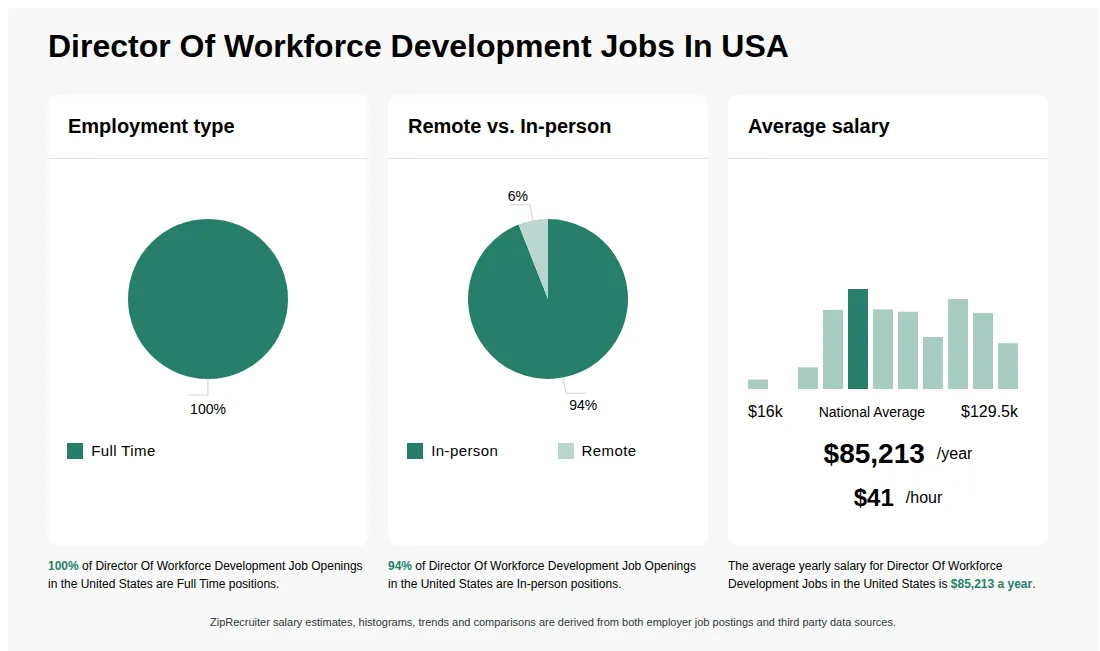
$16K

$85.2K

$129.5K

How much do director of workforce development jobs pay per year?

As of Jun 10, 2026, the average yearly pay for director of workforce development in the United States is $85,213.00, according to ZipRecruiter salary data. Most workers in this role earn between $63,500.00 and $109,500.00 per year, depending on experience, location, and employer.

What are some typical challenges faced by a Director of Workforce Development, and how can they be addressed?

A Director of Workforce Development often encounters challenges such as aligning workforce training initiatives with rapidly changing industry needs and ensuring equitable access to programs across diverse communities. Addressing these challenges requires close collaboration with employers, educational institutions, and community organizations to stay informed about skill gaps and employment trends. Building flexible, data-driven programs and fostering relationships with stakeholders are key strategies for overcoming these obstacles and driving successful workforce outcomes.

What is the difference between Director Of Workforce Development vs Workforce Development Coordinator?

AspectDirector Of Workforce DevelopmentWorkforce Development Coordinator
CredentialsBachelor's degree; often advanced degrees in HR, public administration, or related fieldsAssociate's or Bachelor's degree; relevant certifications may include HR or training certifications
Work EnvironmentLeadership roles in organizations, overseeing programs and teamsSupport roles, assisting in program implementation and coordination
Employer & Industry UsageGovernment agencies, large nonprofits, educational institutionsCommunity organizations, government offices, educational institutions
Search & Comparison IntentUnderstanding senior roles and responsibilities in workforce programsEntry to mid-level roles focusing on program support and coordination

The main difference between a Director Of Workforce Development and a Workforce Development Coordinator lies in their level of responsibility and scope. The director oversees strategic planning and manages teams, while the coordinator handles day-to-day program support. Both roles are vital in workforce development initiatives but differ in seniority and focus.

What does a Director of Workforce Development do?

A Director of Workforce Development oversees programs and initiatives aimed at improving the skills and employability of a community or organization’s workforce. They collaborate with employers, educational institutions, and government agencies to identify workforce needs and develop training programs. Their responsibilities often include strategic planning, managing staff and budgets, and measuring program effectiveness. The goal is to ensure that workers have the skills needed for current and future job opportunities.

What Is the Job of a Director of Workforce Development?

A director of workforce development manages the workforce development programs within an organization. Your responsibilities and duties in this career can drastically differ based upon the needs of the specific company. Typically, your responsibilities are to develop and implement plans for workforce training, supervise the employees within the workforce development department, coordinate with other managers to determine areas that need attention, and administer new training plans and practices for the organization. As director of workforce development, you must stay up to date on current training practices and trends in the labor markets. Additionally, you may be responsible for providing reports on the efficiency of the company’s staff.

What are the key skills and qualifications needed to thrive as a Director Of Workforce Development, and why are they important?

To thrive as a Director Of Workforce Development, you need expertise in workforce planning, program management, and a background in human resources or a related field, often supported by a bachelor’s or master’s degree. Familiarity with labor market analysis tools, learning management systems (LMS), and compliance with employment regulations is typically required. Strong leadership, collaboration, and strategic communication skills help build partnerships and drive organizational initiatives. These skills are crucial for designing effective workforce strategies that address organizational needs and foster talent development.
What cities are hiring for Director Of Workforce Development jobs? Cities with the most Director Of Workforce Development job openings:
What states have the most Director Of Workforce Development jobs? States with the most job openings for Director Of Workforce Development jobs include:
What job categories do people searching Director Of Workforce Development jobs look for? The top searched job categories for Director Of Workforce Development jobs are:
Infographic showing various Director Of Workforce Development job openings in the United States as of June 2026, with employment types broken down into 2% Internship, 3% As Needed, 77% Full Time, 9% Part Time, 2% Temporary, and 7% Contract. Highlights an 96% Physical, 1% Hybrid, and 3% Remote job distribution, with an average salary of $85,213 per year, or $41 per hour.
Director of Workforce Pell Implementation Initiatives

Full-time

Posted 6 days ago


Research Foundation of the City University of New York rating

7.4

Company rating: 7.4 out of 10

Based on 9 frontline employees who took The Breakroom Quiz

205th of 680 rated non-profit organizations


Job description

Thank you for considering a career with the Research Foundation of The City University of New York (RFCUNY).

The team at RFCUNY is made up of dedicated, talented professionals committed to providing the services that allow CUNY researchers, faculty, and staff to focus on their intellectual curiosity and scientific discoveries.

We are pleased that you are interested in exploring opportunities to join RFCUNY.

Primary Location:

LAGUARDIA C. C.

Bargaining Unit:

No

Reporting to the Vice President for Adult and Continuing Education and Workforce Development, the Director of Workforce Pell Implementation Initiatives will serve as the lead architect and project director for LaGuardia Community College's implementation of Workforce Pell under a federally funded FIPSE grant. This is a high-impact leadership role responsible for ensuring that the College is fully prepared to design, launch, and sustain Workforce Pell-eligible programs in alignment with federal regulations and New York State policy.
The Director will be the primary individual accountable for delivering the grant's outcomes, including program development, institutional readiness, compliance infrastructure, and employer alignment. This includes building and operationalizing internal workflows that integrate noncredit workforce programs with financial aid systems, enrollment processes, data reporting, and academic pathways.
The role requires a deep and evolving understanding of Workforce Pell policy at both the federal and state levels. The Director will monitor policy developments, interpret guidance, and translate requirements into actionable institutional processes to ensure compliance and program eligibility. The Director will work directly with New York State agencies to support program approval submissions and respond to state and federal requirements.
The Director will lead cross-functional coordination across the College and engage external stakeholders, including employers, industry partners, and labor unions, to build awareness, validate program design, and support workforce alignment. The role also coordinates with CUNY Central to ensure system-wide alignment.

Duties and Responsibilities

  • Serve as principal lead for the Workforce Pell FIPSE grant, including deliverables, timelines, and outcomes

  • Develop and manage project plans, milestones, and performance tracking systems

  • Interpret Workforce Pell federal and NYS policy and translate into operational workflows

  • Ensure adherence to eligibility metrics including completion, job placement, and earnings outcomes

  • Lead program eligibility submissions and coordination with NYS agencies

  • Design institutional workflows for enrollment, financial aid integration, and program tracking

  • Coordinate across ACE, Financial Aid, Institutional Research, Academic Affairs, Registrar, and Career Services

  • Engage employers, industry partners, and labor unions to align programs with workforce demand

  • Collaborate with CUNY Central to ensure consistency with system-wide implementation

  • Oversee data tracking systems aligned with Title IV-level reporting expectations

  • Represent the College in City, State and Federal Workforce and Higher Education initiatives related to Workforce Pell and noncredit to credit program design

  • Performs other duties as assigned

Minimum Qualifications

  • Bachelor's degree in higher education, public administration, workforce development, or related field.

  • Minimum of 10 years of relevant experience in workforce development, higher education, or related field.

  • Demonstrated experience managing complex initiatives and interpreting policy or regulatory frameworks.

Preferred Qualifications

  • Experience managing federally funded grants (e.g., FIPSE, DOL, NSF)

  • Knowledge of Title IV financial aid and Workforce Pell requirements

  • Experience with noncredit workforce programs and employer engagement

  • Familiarity with labor market data and performance metrics

Required Skills & Competencies

  • Strong policy interpretation and analytical skills

  • Project and grant management expertise

  • Ability to manage multiple priorities and deadlines

  • Strong written and verbal communication skills

  • Cross-functional collaboration and leadership

  • Data-informed decision-making and problem-solving

Supervisory Responsibilities

This position may supervise Workforce Pell Specialist and ACE Workforce Data Specialist roles.

Work Environment / Physical Demands

This is an office-based position with standard professional working conditions. Occasional travel may be required.

Additional Information

This position is funded through a federal grant and is contingent upon continued funding availability and satisfactory performance. The role may be subject to audit and reporting requirements.

About LaGuardia Community College

"Founded in 1971 in Long Island City, Queens, LaGuardia Community College is one of seven community colleges of the City University of New York (CUNY). LaGuardia offers more than sixty associate degree programs and more than fifty workforce training, ESOL, GED, and pre-college programs. In 2023, LaGuardia served approximately 24,000 students. More than one-third of LaGuardia's degree-seeking students are born outside the United States; they come from 136 countries and speak 43 heritage languages. Sixty percent are first-generation college students.

Virtually all LaGuardia students are ethnic minorities (89 percent), 58 percent are women, 27 percent are over the age of 25. Forty-six percent of associate degree students are Hispanic. Upon graduation most students transfer to four-year colleges, typically in CUNY, to complete their baccalaureate degrees. Graduates of career programs such as Nursing, Computer Technology, and Veterinary Technology enter the workforce. LaGuardia ranked fifth among U.S. community colleges in economic mobility - moving low-income students into the middle class and beyond - in studies by Stanford University (2017) and the Brookings Institution (2020). Please visit www.laguardia.edu to learn more."

Pay Range:

$100,000 - $125,000

RFCUNY Benefits
RFCUNY Employee Benefits and Accruals

Equal Employment Opportunity Statement
The Research Foundation of the City University of New York is an Equal Opportunity/Affirmative Action/Americans with Disabilities Act/E-Verify Employer. It is the policy of the Research Foundation of CUNY to provide equal employment opportunities free of discrimination based on race, color, age, religion, sex, pregnancy, childbirth, national origin, disability, marital status, veteran status, sexual orientation, gender identity, genetic information, marital status, domestic violence victim status, arrest record, criminal conviction history, or any other protected characteristic under applicable law.