$125 - $150/hr
The position oversees Business Intelligence standards, reporting governance, stakeholder engagement, analytical delivery, and adoption of enterprise reporting and self-service analytics. Essential ...
New
$125 - $150/hr
The position oversees Business Intelligence standards, reporting governance, stakeholder engagement, analytical delivery, and adoption of enterprise reporting and self-service analytics. Essential ...
New
$125 - $150/hr
The position oversees Business Intelligence standards, reporting governance, stakeholder engagement, analytical delivery, and adoption of enterprise reporting and self-service analytics. Essential ...
New
Build and Lead the Enterprise Business Intelligence Function: * Establish and lead a centralized Business Intelligence and Strategic Finance function that delivers enterprise-wide analytical ...
Build and Lead the Enterprise Business Intelligence Function: * Establish and lead a centralized Business Intelligence and Strategic Finance function that delivers enterprise-wide analytical ...
Cypress, CA · On-site
$150 - $200/hr
Build and Lead the Enterprise Business Intelligence Function: * Establish and lead a centralized Business Intelligence and Strategic Finance function that delivers enterprise-wide analytical ...
Cypress, CA · On-site
$150 - $200/hr
Build and Lead the Enterprise Business Intelligence Function: * Establish and lead a centralized Business Intelligence and Strategic Finance function that delivers enterprise-wide analytical ...
Business Intelligence Analyst A Business Intelligence Analyst, or Business Intelligence Specialist, is responsible for managing data retrieval and analysis within an organization. Their duties ...
Business Intelligence Analyst A Business Intelligence Analyst, or Business Intelligence Specialist, is responsible for managing data retrieval and analysis within an organization. Their duties ...
Chicago, IL · On-site
C., is looking for a Business Intelligence Analyst to join our team in our Chicago office and serve our association management client organization, the International Society of Transport Aircraft ...
Chicago, IL · On-site
C., is looking for a Business Intelligence Analyst to join our team in our Chicago office and serve our association management client organization, the International Society of Transport Aircraft ...
Endicott, NY · On-site
$70 - $100/hr
The Business Intelligence Analyst is responsible for developing, maintaining, and automating business reporting and analytics solutions that support decision-making across the organization. This role ...
Endicott, NY · On-site
$70 - $100/hr
The Business Intelligence Analyst is responsible for developing, maintaining, and automating business reporting and analytics solutions that support decision-making across the organization. This role ...
Fincantieri Marine Group is hiring a Business Intelligence Analyst at our Green Bay, WI location. Fincantieri Marine Group Fincantieri Marine Group (FMG) is a subsidiary of Fincantieri S.p.A. with a ...
Fincantieri Marine Group is hiring a Business Intelligence Analyst at our Green Bay, WI location. Fincantieri Marine Group Fincantieri Marine Group (FMG) is a subsidiary of Fincantieri S.p.A. with a ...
Build and Lead the Enterprise Business Intelligence Function: * Establish and lead a centralized Business Intelligence and Strategic Finance function that delivers enterprise-wide analytical ...
Quick apply
Build and Lead the Enterprise Business Intelligence Function: * Establish and lead a centralized Business Intelligence and Strategic Finance function that delivers enterprise-wide analytical ...
Business Intelligence Analyst A Business Intelligence Analyst, or Business Intelligence Specialist, is responsible for managing data retrieval and analysis within an organization. Their duties ...
Business Intelligence Analyst A Business Intelligence Analyst, or Business Intelligence Specialist, is responsible for managing data retrieval and analysis within an organization. Their duties ...
Business Intelligence Analyst The Business Intelligence Analyst will be responsible for completing profit-driven analysis to provide recommendations on how to increase profits and efficiency on all ...
Business Intelligence Analyst The Business Intelligence Analyst will be responsible for completing profit-driven analysis to provide recommendations on how to increase profits and efficiency on all ...
Business Intelligence Analyst - Hills Machinery Equipment - Charleston, SC (Remote) Business Intelligence Analyst This position will support the business analytics needs of the overall organization.
Quick apply
Business Intelligence Analyst - Hills Machinery Equipment - Charleston, SC (Remote) Business Intelligence Analyst This position will support the business analytics needs of the overall organization.
Santa Monica, CA · On-site
$125 - $150/hr
The Director of Business Intelligence owns the enterprise business intelligence strategy, reporting roadmap, and data governance framework for RBDC, ensuring analytics capabilities scale to support ...
Santa Monica, CA · On-site
$125 - $150/hr
The Director of Business Intelligence owns the enterprise business intelligence strategy, reporting roadmap, and data governance framework for RBDC, ensuring analytics capabilities scale to support ...
Alexandria, VA · On-site
$100K - $120K/yr
Responsibilities The Business Intelligence Analyst will support the Global Investments and Economic Security mission to protect U.S. national security interests and Defense Industrial Base (DIB ...
Alexandria, VA · On-site
$100K - $120K/yr
Responsibilities The Business Intelligence Analyst will support the Global Investments and Economic Security mission to protect U.S. national security interests and Defense Industrial Base (DIB ...
Atlanta, GA · On-site
$49 - $63.75/hr
Business Intelligence (BI) SME Location: Alpharetta, GA / Dallas, TX (Onsite) Note: No H1B We are seeking a Business Intelligence Subject Matter Expert (SME) with strong experience in Palantir and ...
Quick apply
Atlanta, GA · On-site
$49 - $63.75/hr
Business Intelligence (BI) SME Location: Alpharetta, GA / Dallas, TX (Onsite) Note: No H1B We are seeking a Business Intelligence Subject Matter Expert (SME) with strong experience in Palantir and ...
Metron is actively seeking a Business Intelligence Analyst to develop and manage our business analytics tool set built on Power BI. This role will integrate essential enterprise systems including ...
Metron is actively seeking a Business Intelligence Analyst to develop and manage our business analytics tool set built on Power BI. This role will integrate essential enterprise systems including ...
Fincantieri Marine Group is hiring a Business Intelligence Analyst at our Green Bay, WI location. Fincantieri Marine Group Fincantieri Marine Group (FMG) is a subsidiary of Fincantieri S.p.A. with a ...
Fincantieri Marine Group is hiring a Business Intelligence Analyst at our Green Bay, WI location. Fincantieri Marine Group Fincantieri Marine Group (FMG) is a subsidiary of Fincantieri S.p.A. with a ...
Be Seen First
Vienna, VA · On-site
$70 - $80/hr
Senior Business Intelligence Analyst Location: Hybrid reporting to Pensacola, FL , Vienna, VA or Winchester, VA Pay Rate: Open to Both C2C and W2 options Position Type: Multiyear Contract Role focus:
Quick apply
Be Seen First
Vienna, VA · On-site
$70 - $80/hr
Senior Business Intelligence Analyst Location: Hybrid reporting to Pensacola, FL , Vienna, VA or Winchester, VA Pay Rate: Open to Both C2C and W2 options Position Type: Multiyear Contract Role focus:
Alexandria, VA · On-site
$80 - $100/hr
Responsibilities The Business Intelligence Analyst will support the Global Investments and Economic Security mission to protect U.S. national security interests and Defense Industrial Base (DIB ...
Alexandria, VA · On-site
$80 - $100/hr
Responsibilities The Business Intelligence Analyst will support the Global Investments and Economic Security mission to protect U.S. national security interests and Defense Industrial Base (DIB ...
Phoenix, AZ · On-site
Nox Group of Companies seeks an exceptional Business Intelligence Analyst to join our software team and help power smarter decisions across the enterprise. Because we thrive on innovation and ...
Phoenix, AZ · On-site
Nox Group of Companies seeks an exceptional Business Intelligence Analyst to join our software team and help power smarter decisions across the enterprise. Because we thrive on innovation and ...
The Manager of Business Intelligence will assist in leading and developing the organization's data analytics strategy to drive business growth and operational excellence. This role is responsible for ...
New
The Manager of Business Intelligence will assist in leading and developing the organization's data analytics strategy to drive business growth and operational excellence. This role is responsible for ...
New
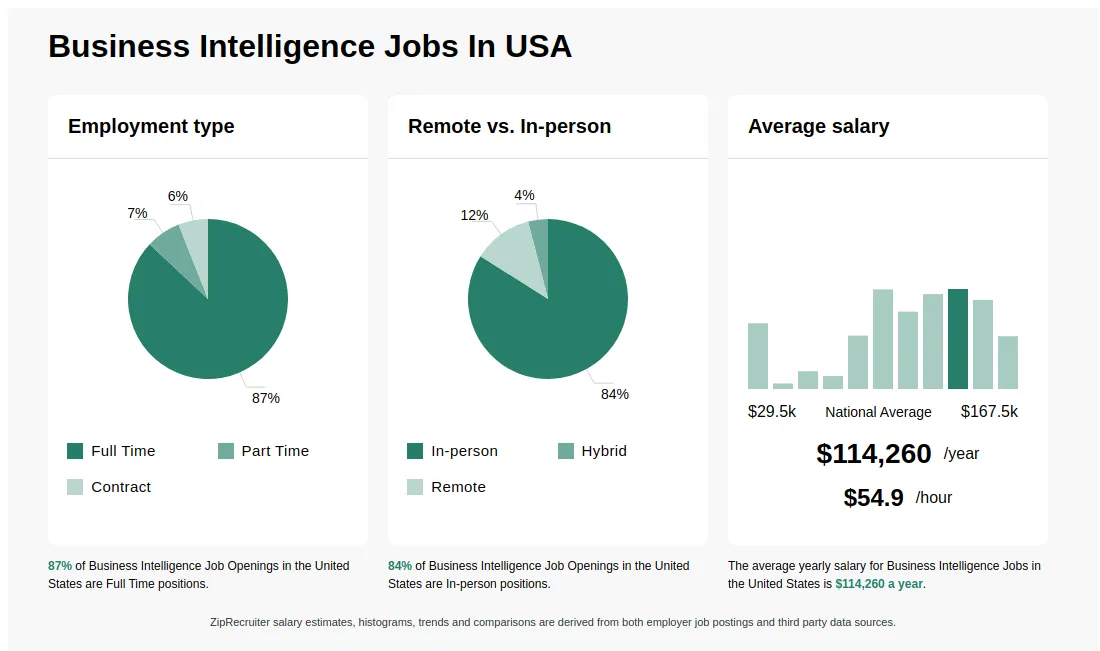
$29.5K - $42K
10% of jobs
$42K - $54.6K
0% of jobs
$54.6K - $67.1K
2% of jobs
$67.1K - $79.7K
1% of jobs
$79.7K - $92.2K
8% of jobs
$95.8K is the 25th percentile. Wages below this are outliers.
$92.2K - $104.8K
15% of jobs
$104.8K - $117.3K
12% of jobs
The median wage is $119.1K / yr.
$117.3K - $129.9K
15% of jobs
$139.7K is the 75th percentile. Wages above this are outliers.
$129.9K - $142.4K
15% of jobs
$142.4K - $155K
14% of jobs
$155K - $167.5K
8% of jobs
$29.5K
$114.3K
$167.5K
Qualifications for a career in business intelligence (BI) include a bachelor’s degree in marketing, business administration, or a related field. A strong background in statistics and computer analysis is also desirable, as most of your duties revolve around interpreting the data and creating reports. Computer proficiency is essential to work with the necessary software. Certification isn’t required, but it can improve your chances of getting hired by a company. The Marketing Research Association offers several certificate programs along with advanced learning opportunities in data analysis. Exceptional analytical and organizational skills are imperative. Critical thinking is also vital for interpreting the trends and making sound decisions.
| Aspect | Business Intelligence | Data Analyst |
|---|---|---|
| Required Credentials | Bachelor's in IT, Business, or related fields; certifications like CBIP or Microsoft BI | Bachelor's in Statistics, Mathematics, or related fields; certifications like CAP or Microsoft Data Analyst |
| Work Environment | BI teams, data warehouses, reporting tools | Data sets, spreadsheets, statistical software |
| Employer & Industry Usage | Business sectors, analytics teams, IT departments | Marketing, finance, healthcare, and other sectors requiring data insights |
Business Intelligence professionals focus on designing and managing systems that collect, analyze, and visualize data to support strategic decisions. Data Analysts interpret data to identify trends and generate reports. While both roles work with data, BI emphasizes system development and dashboards, whereas Data Analysts focus on data interpretation and insights.
Cities with the most Business Intelligence job openings:
The most popular types of Business Intelligence jobs are:
States with the most job openings for Business Intelligence jobs include:
The top searched job categories for Business Intelligence jobs are:
$125 - $150/hr
Other
Posted 3 days ago
New
Bargaining Unit: Non Represented - Manager
Rate of Pay: $128,731 annually + DOE
SummaryThe Manager of Business Intelligence leads the development, governance, and delivery of enterprise dashboards, reports, metrics, scorecards, and analytical products. This role connects clinical, operational, financial, quality, and executive stakeholders with technical teams to translate organizational needs into accurate, standardized, actionable information. The position oversees Business Intelligence standards, reporting governance, stakeholder engagement, analytical delivery, and adoption of enterprise reporting and self-service analytics.
Essential Duties and Responsibilities Enterprise Business Intelligence & ReportingLead development and delivery of enterprise dashboards, reports, scorecards, metrics, and analytical products.
Gather, analyze, and document clinical, operational, financial, executive, quality, regulatory, and strategic reporting requirements.
Translate business requirements into dashboards, reports, scorecards, metrics, analytical products, and technical specifications.
Lead metric definition, business-rule documentation, data-dictionary development, reporting governance, and business data-quality processes.
Establish consistent definitions and methodologies for enterprise performance measures.
Ensure dashboards and reports use approved data sources, business rules, calculations, and reporting standards.
Coordinate validation of reporting outputs with Finance, clinical, operational, quality, and other subject-matter experts.
Identify reporting discrepancies and partner with Data and Engineering and source-system owners to resolve underlying data issues.
Partner with clinical, operational, executive, quality, and departmental leaders to improve the use of data in organizational decision-making.
Train stakeholders and support adoption of enterprise dashboards, analytical tools, and governed self-service reporting.
Supervise, develop, and prioritize the work of assigned Business Intelligence analysts, developers, and other analytical staff.
Demonstrates System Values in performance and behavior.
Complies with System policies and procedures.
Other duties as may be assigned.
QualificationsTo perform this job successfully, an individual must be able to perform each essential duty satisfactorily. The requirements listed below are representative of the knowledge, skill, and/or ability required. Reasonable accommodations may be made to enable individuals with disabilities to perform the essential functions.
Supervisory ResponsibilitiesCarries out supervisory responsibility in accordance with the organization’s policies and applicable laws. Responsibilities include interviewing, hiring, training, assigning, coaching, counseling, and disciplining employees; administering scheduling systems; communicating job expectations; planning, monitoring, appraising, and reviewing job contributions; enforcing policies and procedures.
Minimum Education/ExperienceBachelor's Degree Analytics, business intelligence, information systems, healthcare administration, finance, or a related field and 5 or more years relevant experience
Required Licenses/CertificationsNone
Other Experience/QualificationsRequired
Healthcare analytics experience.
Experience with Epic, SQL, Microsoft Fabric, Axiom, Premier, or healthcare benchmarking systems.
Equal Opportunity Employer
This employer is required to notify all applicants of their rights pursuant to federal employment laws.For further information, please review the Know Your Rights notice from the Department of Labor.