2

Remote Human Systems Engineering Jobs (NOW HIRING)

... human interfaces. NAVAIR is organized into eight "competencies" or communities of practice ... Review and prepare engineering and technical analyses, reports, Use Cases, requirements, OMI design ...

We're launching a program for experienced engineers transitioning into system architecture roles ... Fully remote work with flexible hours * A digital office - we use modern tools (Notion, Miro, Slack ...

Systems Engineer

Hampton, VA · Remote

$80K - $120K/yr

Engineering and Sciences Subcategory: Systems Engineer Schedule: Full-Time Shift: Day Job Travel ... None Potential for Remote Work: ORA_ON_SITE Description SAIC is looking for a Data Integrity ...

Conducts requirements engineering, solutions engineering, scheduling, reliability, resiliency ... Working knowledge of photogrammetry, remote sensing, image science, information sciences ...

Conducts requirements engineering, solutions engineering, scheduling, reliability, resiliency ... Working knowledge of photogrammetry, remote sensing, image science, information sciences ...

Systems Engineer

$116K - $194K/yr

This is a remote position where you will lead the Model-Based Systems Engineering (MBSE) approach to developing systems models for a cutting-edge Proliferated Low Earth Orbit (PLEO) global ...

next page

Showing results 1-20

Remote Human Systems Engineering information

See salary details

$53.5K

$127.2K

$167K

How much do remote human systems engineering jobs pay per year?

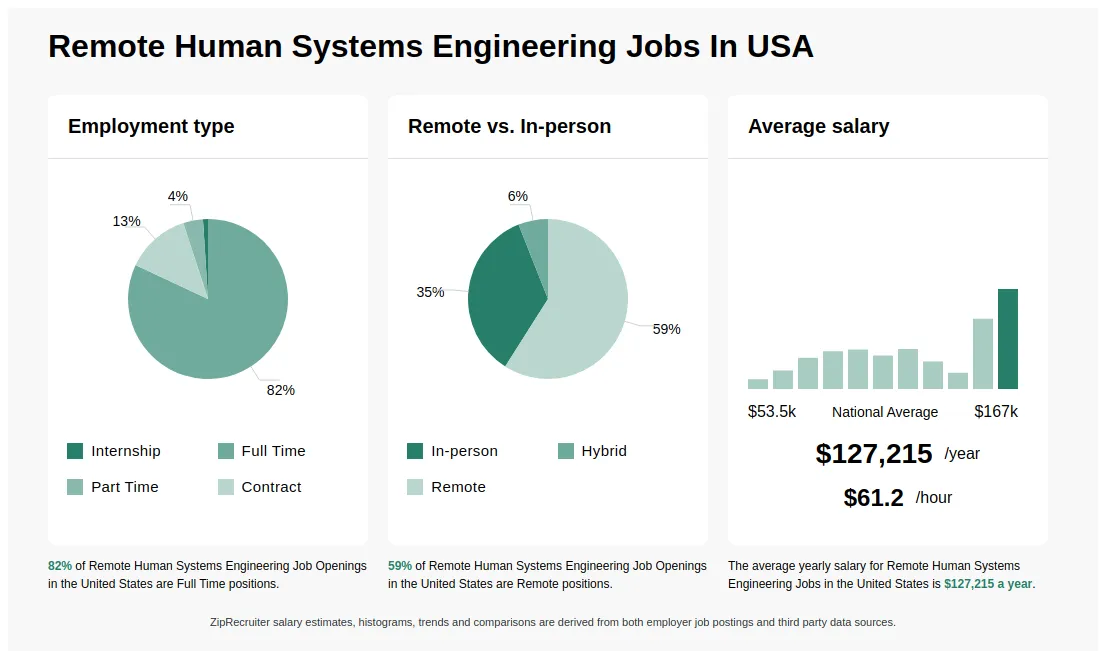
As of Jul 1, 2026, the average yearly pay for remote human systems engineering in the United States is $127,215.00, according to ZipRecruiter salary data. Most workers in this role earn between $98,000.00 and $157,000.00 per year, depending on experience, location, and employer.

What are the key skills and qualifications needed to thrive as a Remote Human Systems Engineer, and why are they important?

To thrive as a Remote Human Systems Engineer, you need a solid background in systems engineering, human factors, and ergonomics, often supported by a degree in engineering, psychology, or a related field. Familiarity with modeling tools (such as MATLAB or SysML), usability testing software, and systems integration platforms is typically required, along with certifications like Certified Professional Ergonomist (CPE) being beneficial. Strong communication, problem-solving, and collaboration skills are crucial for working effectively with multidisciplinary teams in a remote environment. These skills and qualifications ensure that complex systems are designed with user needs in mind, maximizing efficiency, safety, and user satisfaction even when working remotely.

What is Remote Human Systems Engineering?

Remote Human Systems Engineering is a specialized field focused on designing and optimizing the interaction between humans and complex systems, such as machines, software, or processes, from a remote or distributed environment. Professionals in this field analyze how people interact with technology and develop solutions to improve usability, safety, and efficiency, especially in scenarios where users and systems are not co-located. This approach is increasingly important as more organizations shift to remote work and distributed operations, requiring seamless human-technology integration over distances. Typical tasks include user research, system evaluation, interface design, and the implementation of remote collaboration tools. The goal is to ensure that technology supports human performance, regardless of physical location.

How does a Remote Human Systems Engineer typically collaborate with multidisciplinary teams, given the virtual work environment?

As a Remote Human Systems Engineer, you'll frequently collaborate with professionals from fields such as software development, user experience, and product management. Collaboration often takes place through virtual meetings, project management platforms, and shared documentation. Clear communication and proactive engagement are essential for aligning on project goals, sharing feedback, and resolving issues efficiently. Despite being remote, you'll contribute to team discussions, design reviews, and iterative testing cycles to ensure that human-centered design principles are integrated into system solutions.
More about Remote Human Systems Engineering jobs
What cities are hiring for Remote Human Systems Engineering jobs? Cities with the most Remote Human Systems Engineering job openings:
What are the most commonly searched types of Human Systems Engineering jobs? The most popular types of Human Systems Engineering jobs are:
What states have the most Remote Human Systems Engineering jobs? States with the most job openings for Remote Human Systems Engineering jobs include:
Infographic showing various Remote Human Systems Engineering job openings in the United States as of June 2026, with employment types broken down into 93% Full Time, 6% Part Time, and 1% Contract. Highlights an 91% Physical, 2% Hybrid, and 7% Remote job distribution, with an average salary of $127,215 per year, or $61.2 per hour.
Ontology Systems Engineer

$157K - $174K/yr

Full-time

Posted 27 days ago


General Dynamics Mission Systems rating

8.2

Company rating: 8.2 out of 10

Based on 28 frontline employees who took The Breakroom Quiz

83rd of 202 rated software companies


Job description

Basic Qualifications
Bachelor's degree in Systems Engineering, or a related Science, Engineering or Mathematics field, plus a minimum of 8 years of relevant experience; or Master's degree, plus a minimum of 6 years of relevant experience.
CLEARANCE REQUIREMENTS:: Department of Defense Secret security clearance is required at time of hire. Applicants selected will be subject to a U.S. Government security investigation and must meet eligibility requirements for access to classified information. Due to the nature of work performed within our facilities, U.S. citizenship is required.
Responsibilities for this Position
What You'll Own
  • Enterprise knowledge architecture. Define and maintain the overarching structure that connects domain-specific ontologies across pods. Manage the relationships between business vocabularies, taxonomies, and data models at the enterprise level.
  • Cross-domain consistency. Ensure that business concepts defined in one pod are compatible with concepts in other pods. Resolve naming conflicts, semantic overlaps, and definitional inconsistencies before they become integration problems.
  • Metadata and tagging standards. Establish enterprise-wide standards for metadata, tagging, classification, and search structures. Build the knowledge infrastructure that makes enterprise data findable, reusable, and machine-readable.
  • Business glossary governance. Own the enterprise business glossary - the authoritative source for what terms mean across the organization. Work with data owners and business stewards to maintain accuracy.
  • Knowledge repository architecture. Design the structures that store and expose enterprise knowledge - knowledge graphs, semantic catalogs, taxonomy services. Ensure AI agents can discover and traverse enterprise knowledge programmatically.
What You Won't Own
  • Pod-specific data modeling - that's the Data/Ontology Engineer's role within each pod
  • AI application development or engineering
  • Enterprise system administration or data engineering pipelines
What Makes This Role Different
  • You are building the connective tissue between multiple AI modernization efforts. Without your work, each pod builds an island. With it, they build a continent.
  • Your knowledge architecture directly enables cross-domain AI reasoning. An agent that can connect HR data to manufacturing data to supply chain data - that capability starts with your architecture.
  • This role requires both systems thinking and business fluency. You need to understand how manufacturing processes, HR workflows, and CRM systems relate at a business level, not just a data level.
Required Qualifications
  • Bachelor's degree in Systems Engineering, Computer Science, Information Science, or a related field, plus 8 years of experience; or Master's degree plus 6 years of experience
  • Experience designing enterprise-level data architectures, knowledge models, or information taxonomies that span multiple business domains
  • Strong understanding of ontology and semantic modeling concepts - you can work fluently with knowledge graph engineers and data modelers
  • Systems engineering mindset - you think about interfaces, dependencies, integration points, and emergent behavior across interconnected systems
  • Experience working across organizational boundaries - you have built consensus on shared standards across teams that had their own ways of doing things
  • Strong communication skills - you can explain data relationships to business stakeholders and architectural constraints to engineers
  • U.S. citizenship required. Department of Defense Secret security clearance is required at time of hire.
Preferred Qualifications
  • Experience with knowledge graphs, semantic web technologies, or enterprise taxonomy management
  • Experience with enterprise data platforms (Palantir Foundry, Snowflake, or similar) and their ontology or semantic layer capabilities
  • Background in manufacturing, defense, or complex enterprise environments with multiple interacting business systems
  • Experience defining metadata standards, business glossaries, or data governance frameworks at an enterprise level
  • Familiarity with how AI/LLM systems consume structured knowledge - RAG architectures, knowledge-grounded reasoning, semantic search
What Sets You Apart
  • You see the enterprise as a system of systems. You instinctively look for the connections between domains, not just the domains themselves.
  • You have resolved vocabulary conflicts across organizations and made the shared definition stick.
  • You can hold the big picture and the details at the same time - enterprise architecture in the morning, specific field mappings in the afternoon.
  • You build for reuse. Your architectures are designed to accommodate domains that don't exist yet, not just the ones in front of you today.
  • You are known as the person who can explain how everything connects. People come to you when they need to understand the whole.
Details
  • Remote - 100% telework
  • 9/80 schedule
  • Defense industry experience is not required

Salary Note
This estimate represents the typical salary range for this position based on experience and other factors (geographic location, etc.). Actual pay may vary. This job posting will remain open until the position is filled.
Combined Salary Range
USD $157,487.00 - USD $174,713.00 /Yr.
Company Overview
General Dynamics Mission Systems (GDMS) engineers a diverse portfolio of high technology solutions, products and services that enable customers to successfully execute missions across all domains of operation. With a global team of 12,000+ top professionals, we partner with the best in industry to expand the bounds of innovation in the defense and scientific arenas. Given the nature of our work and who we are, we value trust, honesty, alignment and transparency. We offer highly competitive benefits and pride ourselves in being a great place to work with a shared sense of purpose. You will also enjoy a flexible work environment where contributions are recognized and rewarded. If who we are and what we do resonates with you, we invite you to join our high-performance team!
Equal Opportunity Employer / Individuals with Disabilities / Protected Veterans

What General Dynamics Mission Systems employees say

Pay

Benefits

Hours and flexibility

Workplace

Get the full story on Breakroom