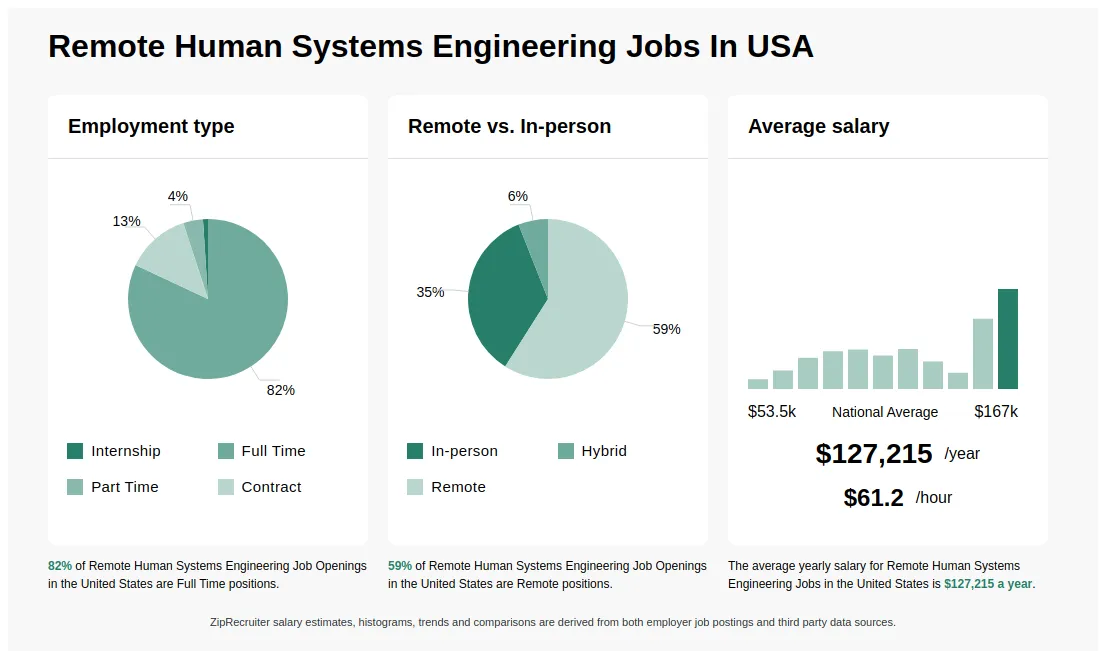
Remote Human Systems Engineering information
See salary details
$53.5K - $63.8K
2% of jobs
$63.8K - $74.1K
4% of jobs
$74.1K - $84.5K
7% of jobs
$84.5K - $94.8K
9% of jobs
$97.6K is the 25th percentile. Wages below this are outliers.
$94.8K - $105.1K
10% of jobs
$105.1K - $115.4K
7% of jobs
$115.4K - $125.7K
10% of jobs
The median wage is $127.4K / yr.
$125.7K - $136K
6% of jobs
$136K - $146.4K
3% of jobs
$156.4K is the 75th percentile. Wages above this are outliers.
$146.4K - $156.7K
17% of jobs
$156.7K - $167K
24% of jobs
How much do remote human systems engineering jobs pay per year?
As of Sep 4, 2026, the average yearly pay for remote human systems engineering in the United States is $127,215.00, according to ZipRecruiter salary data. Most workers in this role earn between $98,000.00 and $157,000.00 per year, depending on experience, location, and employer.
Remote Human Systems Engineering is a specialized field focused on designing and optimizing the interaction between humans and complex systems, such as machines, software, or processes, from a remote or distributed environment. Professionals in this field analyze how people interact with technology and develop solutions to improve usability, safety, and efficiency, especially in scenarios where users and systems are not co-located. This approach is increasingly important as more organizations shift to remote work and distributed operations, requiring seamless human-technology integration over distances. Typical tasks include user research, system evaluation, interface design, and the implementation of remote collaboration tools. The goal is to ensure that technology supports human performance, regardless of physical location.
To thrive as a Remote Human Systems Engineer, you need a solid background in systems engineering, human factors, and ergonomics, often supported by a degree in engineering, psychology, or a related field. Familiarity with modeling tools (such as MATLAB or SysML), usability testing software, and systems integration platforms is typically required, along with certifications like Certified Professional Ergonomist (CPE) being beneficial. Strong communication, problem-solving, and collaboration skills are crucial for working effectively with multidisciplinary teams in a remote environment. These skills and qualifications ensure that complex systems are designed with user needs in mind, maximizing efficiency, safety, and user satisfaction even when working remotely.
As a Remote Human Systems Engineer, you'll frequently collaborate with professionals from fields such as software development, user experience, and product management. Collaboration often takes place through virtual meetings, project management platforms, and shared documentation. Clear communication and proactive engagement are essential for aligning on project goals, sharing feedback, and resolving issues efficiently. Despite being remote, you'll contribute to team discussions, design reviews, and iterative testing cycles to ensure that human-centered design principles are integrated into system solutions.
More about Remote Human Systems Engineering jobs What cities are hiring for Remote Human Systems Engineering jobs?
Cities with the most Remote Human Systems Engineering job openings:
What are the most commonly searched types of Human Systems Engineering jobs?
The most popular types of Human Systems Engineering jobs are:
What states have the most Remote Human Systems Engineering jobs?
States with the most job openings for Remote Human Systems Engineering jobs include:
What job categories do people searching Remote Human Systems Engineering jobs look for?
The top searched job categories for Remote Human Systems Engineering jobs are: