2

Remote Human Systems Engineering Jobs (NOW HIRING)

Define Human System Interface (HIS) requirements for control rooms, local control stations, remote ... Interface with engineering teams and vendors to ensure HFE requirements are integrated early in the ...

Ownership, Energy, Speed & Agility, Service, and Being Human. Each value, and its underlying ... As a Manager, Systems Engineering, you will: * Lead, mentor, and develop a team of systems ...

Manager, Systems Engineering

Lynchburg, VA ยท On-site +1

$127K - $236K/yr

Remote Opportunity Job Schedule: 9/80: Employees work 9 out of every 14 days- totaling 80 hours worked- and have every other Friday off The Manager of System Solution Engineering (SSE) is the ...

Manager, Systems Engineering

Richmond, VA ยท On-site +1

$127K - $236K/yr

Remote Opportunity Job Schedule: 9/80: Employees work 9 out of every 14 days- totaling 80 hours worked- and have every other Friday off The Manager of System Solution Engineering (SSE) is the ...

Director, Systems Engineering

Mountain View, CA ยท On-site +1

$323K - $410K/yr

Waymo's Systems Engineering team works together to blend software and hardware systems in ... remote, the specific salary range for your preferred location, during the hiring process. Waymo ...

Engineered with input from those who have lived the care experience, our technology simplifies ... Remote- Preferred Central or Eastern time Reports To: Global HRIS Manager Role Overview The Global ...

next page

Showing results 1-20

Remote Human Systems Engineering information

See salary details

$53.5K

$127.2K

$167K

How much do remote human systems engineering jobs pay per year?

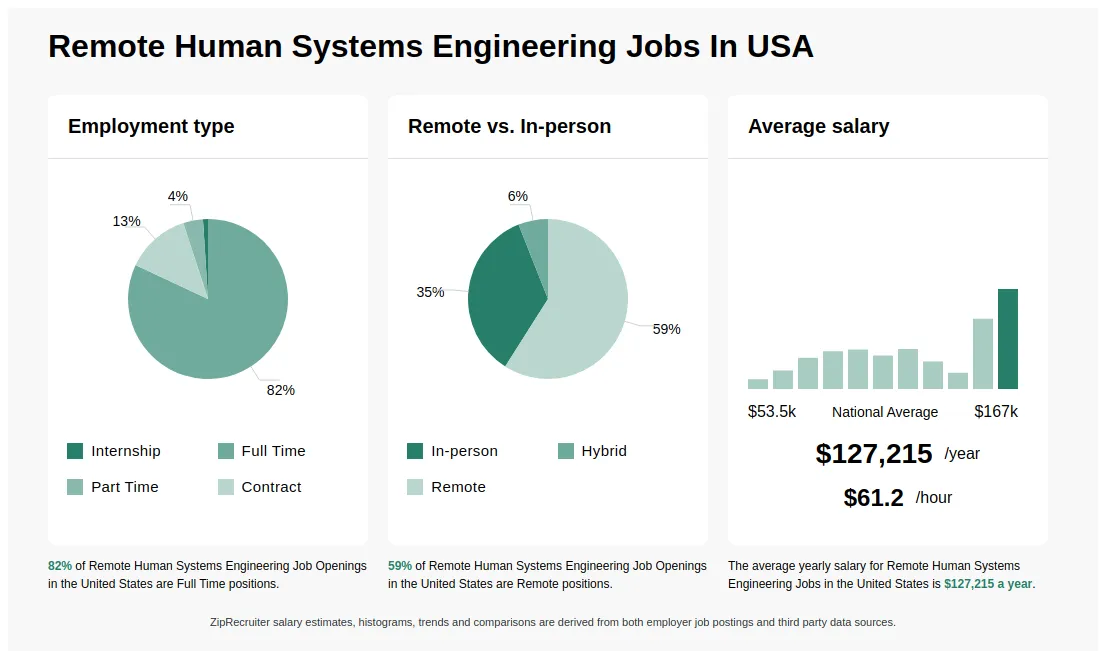
As of Jun 10, 2026, the average yearly pay for remote human systems engineering in the United States is $127,215.00, according to ZipRecruiter salary data. Most workers in this role earn between $98,000.00 and $157,000.00 per year, depending on experience, location, and employer.

What are the key skills and qualifications needed to thrive as a Remote Human Systems Engineer, and why are they important?

To thrive as a Remote Human Systems Engineer, you need a solid background in systems engineering, human factors, and ergonomics, often supported by a degree in engineering, psychology, or a related field. Familiarity with modeling tools (such as MATLAB or SysML), usability testing software, and systems integration platforms is typically required, along with certifications like Certified Professional Ergonomist (CPE) being beneficial. Strong communication, problem-solving, and collaboration skills are crucial for working effectively with multidisciplinary teams in a remote environment. These skills and qualifications ensure that complex systems are designed with user needs in mind, maximizing efficiency, safety, and user satisfaction even when working remotely.

What is Remote Human Systems Engineering?

Remote Human Systems Engineering is a specialized field focused on designing and optimizing the interaction between humans and complex systems, such as machines, software, or processes, from a remote or distributed environment. Professionals in this field analyze how people interact with technology and develop solutions to improve usability, safety, and efficiency, especially in scenarios where users and systems are not co-located. This approach is increasingly important as more organizations shift to remote work and distributed operations, requiring seamless human-technology integration over distances. Typical tasks include user research, system evaluation, interface design, and the implementation of remote collaboration tools. The goal is to ensure that technology supports human performance, regardless of physical location.

How does a Remote Human Systems Engineer typically collaborate with multidisciplinary teams, given the virtual work environment?

As a Remote Human Systems Engineer, you'll frequently collaborate with professionals from fields such as software development, user experience, and product management. Collaboration often takes place through virtual meetings, project management platforms, and shared documentation. Clear communication and proactive engagement are essential for aligning on project goals, sharing feedback, and resolving issues efficiently. Despite being remote, you'll contribute to team discussions, design reviews, and iterative testing cycles to ensure that human-centered design principles are integrated into system solutions.
More about Remote Human Systems Engineering jobs
What cities are hiring for Remote Human Systems Engineering jobs? Cities with the most Remote Human Systems Engineering job openings:
What are the most commonly searched types of Human Systems Engineering jobs? The most popular types of Human Systems Engineering jobs are:

What states have the most Remote Human Systems Engineering jobs? States with the most job openings for Remote Human Systems Engineering jobs include:
Infographic showing various Remote Human Systems Engineering job openings in the United States as of June 2026, with employment types broken down into 64% Full Time, 24% Part Time, 1% Temporary, and 11% Contract. Highlights an 94% Physical, 2% Hybrid, and 4% Remote job distribution, with an average salary of $127,215 per year, or $61.2 per hour.
Systems Engineering

Systems Engineering

Apogee Engineering, LLC

Warner Robins, GA โ€ข Remote

Full-time

Posted 10 days ago


Job description

Apogee has an opportunity forย a Systems Engineerย to provide contractor siteย reachback support for the M-Code Aviation Receivers Joint Program Office (MAR JPO). These positions provide systems engineering support for platform integration, future planning, and Studies & Analysis activities.ย 

These are full-time remote positions with occasional travel to government sites.ย 


Systems Engineeringย Support:

  • Support platform, weapons, andย Multi-GNSSย integration activities
  • Conduct systems engineering analysis and documentation
  • Support requirements development and traceability
  • Assist in the Interface Control Document (ICD) development and reviewย 

Futureย Planning:

  • Support development of comprehensive roadmaps for PNT/NAVWAR capabilities
  • Monitorย plans of the Navy, Coast Guard, and Armyย aircraftย programs
  • Assist in creating resource-loaded integrated master schedules
  • Support technology maturation planningย 

Studies &ย Analysis:

  • Execute assigned Studies & Analysis (S&A) tasks
  • Conduct trade studies and technical research
  • Support technology assessments and evaluations
  • Prepare technical reports and documentationย 

Technicalย Analysis:

  • Translate requirements into design criteria
  • Evaluate alternative design approaches
  • Develop system specifications
  • Support technical reviews and assessmentsย 

Integrationย Support:

  • Support System Integration Lab (SIL) testing coordination
  • Assist in platform integration planning
  • Evaluate integration approaches and risks
  • Support testing and verification activitiesย 

Minimum Experience:

Citizenship: Must be a US citizenย 
Clearance:ย Must have and be able to maintain a TS/SCI level clearanceย 
Education: Bachelor's Degree in Engineering or related technical field
Years of Experience: 7 years of systems engineering experience

Additional experience:

  • Knowledge of GPS/GNSS systems and navigation
  • Experience with avionics or platform integration preferred
  • Understanding of systems engineering processes
  • Proficiency in technical writing and analysis
  • Strong analytical and problem-solving skills
  • Ability to work independently in a remote environment

Preferred Experience:

Education: Master's Degree in Engineering or related technical field
Years of Experience:
5 years of systems engineering experience

Additional Information:
Location:ย Contractor Site (National - Remote)
Remote: This is a full-time remote position

Travel: Travel up to 15% may be required, per the customer's discretion