1

Professional Interviewer Jobs (NOW HIRING)

Podcast Interviewer

Mountain View, CA · Remote

$200 - $300/wk

Super Company is seeking a Podcast Interviewer to help shape engaging, high-quality audio ... Professional judgment, attention to detail, and respect for confidentiality when handling guest ...

As a Field Interviewer, you will help collect data from fellow Hoosiers ages 55+ identifying ... NSG's clients include elite professional services firms, Fortune 500 companies, local, federal and ...

next page

Showing results 1-20

Professional Interviewer information

See salary details

$9

$20

$31

How much do professional interviewer jobs pay per hour?

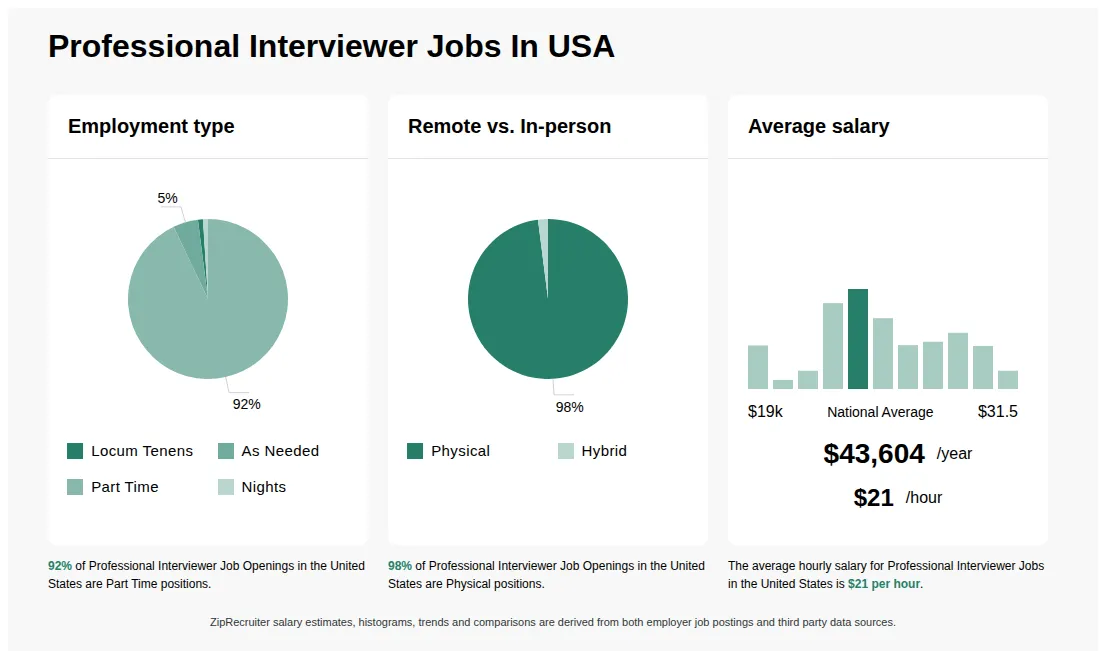
As of Jul 5, 2026, the average hourly pay for professional interviewer in the United States is $20.96, according to ZipRecruiter salary data. Most workers in this role earn between $17.07 and $25.72 per hour, depending on experience, location, and employer.

How do Professional Interviewers typically prepare for interviews to ensure effective and unbiased data collection?

Professional Interviewers spend significant time preparing for interviews by thoroughly reviewing the interview script or questionnaire, familiarizing themselves with the study objectives, and understanding the target demographic. They often participate in training sessions to minimize bias, practice active listening, and learn techniques for handling difficult or unresponsive participants. This preparation helps ensure that interviews are conducted consistently, ethically, and yield reliable data for research or organizational use.

What are the key skills and qualifications needed to thrive as a Professional Interviewer, and why are they important?

To thrive as a Professional Interviewer, you need expertise in research methods, data collection, and strong verbal communication, often supported by a relevant degree or experience in market research or social sciences. Familiarity with survey software, digital recording tools, and data entry systems is typically required. Exceptional listening, adaptability, and rapport-building skills help elicit honest and insightful responses from interviewees. These skills ensure accurate data collection, reliable insights, and a high level of professionalism in research projects.

What is the difference between Professional Interviewer vs Recruiter?

AspectProfessional InterviewerRecruiter
CredentialsTypically no specific certifications required; strong communication skillsOften requires HR or recruiting certifications; experience in talent acquisition
Work EnvironmentConducts interviews, often in office or remote settings, focusing on candidate assessmentSources, screens, and interviews candidates; works closely with hiring managers
Employer & Industry UsageUsed in market research, media, and HR for candidate evaluationPrimarily in HR departments across various industries for hiring

While both roles involve interviewing candidates, a Professional Interviewer mainly focuses on assessing individuals in specific contexts like research or media, whereas a Recruiter specializes in sourcing and hiring talent for organizations. The roles overlap in interview skills but differ in purpose and industry application.

What is the 30-60-90 rule in an interview?

The 30-60-90 rule in an interview refers to a plan where a candidate or new employee sets specific goals for the first 30, 60, and 90 days to demonstrate their progress and integration into the role. For a professional interviewer, understanding this framework helps evaluate a candidate's planning skills and ability to set measurable objectives during onboarding or performance reviews.

How much do interviewers get paid?

Professional interviewers typically earn an hourly wage ranging from $12 to $25, depending on experience, industry, and location. Some may work as freelancers or contractors, which can affect their pay rate, and additional skills like data collection or survey tools can influence earnings.

How to become a professional interviewer?

To become a professional interviewer, develop strong communication and active listening skills, gain experience in research and questioning techniques, and often pursue a background in human resources, psychology, or related fields. Familiarity with interview tools and maintaining professionalism are also important for success in this role.

What is the 80 20 rule for interviews?

The 80/20 rule in interviews suggests that 80% of the value comes from 20% of the questions or efforts, meaning interviewers should focus on the most critical questions to assess a candidate's skills and fit efficiently. For professional interviewers, prioritizing key competencies and behavioral questions helps streamline the process and identify top candidates quickly.

What are professional interviewers?

Professional interviewers are individuals trained to conduct interviews for various purposes, such as market research, journalism, recruitment, or survey data collection. They use structured or semi-structured questions to gather accurate and unbiased information from respondents. Their role is to facilitate effective communication, ensure ethical standards are met, and document responses reliably. Professional interviewers may work in-person, over the phone, or online, depending on the needs of their employer or client.
More about Professional Interviewer jobs
What cities are hiring for Professional Interviewer jobs? Cities with the most Professional Interviewer job openings:
What are the most commonly searched types of Interviewer jobs? The most popular types of Interviewer jobs are:
What states have the most Professional Interviewer jobs? States with the most job openings for Professional Interviewer jobs include:
What job categories do people searching Professional Interviewer jobs look for? The top searched job categories for Professional Interviewer jobs are:
Access Interviewer

Access Interviewer

Osborn Family Health Center

Camden, NJ • On-site

Full-time

Posted 7 days ago


Job description

Title: Access Interviewer

Department: Osborn Family Health Center

Job Summary: The Access Interviewer is responsible for all check-in and check-out activities at the front desk. Appropriately and professionally assisting patients during the scheduling and confirmation of appointments; intake of information; insurance verification; referrals generation; and follow up, handle all physician scheduling and dictation when necessary. The Access Interviewer is responsible for maintaining the inventories for the practice under the direction and guidance of the Practice Manager.

Summary of Accountabilities:

  1. Provides high quality of patient/customer services in person and over the telephone at all times to patients and their families.
  2. Schedules and confirms appointments.
  3. Completes accurately all check-in and check-out activities/procedures.
  4. Assist physician with all requests.
  5. Records patient information accurately on the electronic health record.
  6. Answers telephones and all patient inquiries.
  7. Maintains strict HIPPA compliance at all times.
  8. Verifying all insurance and referrals.
  9. Electronic Health Record Maintenance.
  10. Maintain current information on patients (name change; address; insurance updates)
  11. Obtaining pre-certifications and prescriptions
  12. Responds to families, visitors, and staff in a sensitive manner
  13. Communicate concerns/patient issues with physicians.
  14. Participates in two to three huddles per day, if chosen.
  15. Assists with any additional duties as needed or as directed by leadership.

Minimum Certifications, Registry and/or Licenses Required: NA

Minimum Degree Required and Experience Required:

High school diploma or GED equivalent required; minimum three years experience as a Medical Receptionist/Medical Assistant preferred.

Skill Requirements:

Skill in establishing and maintaining effective working relationships with other employees, patients, hospital departments, organizations and the public. Strong inter-personal and communication skills. Familiarity with ICD10 and CPT coding preferred. Good command of the English language both orally and written. Ability to perform diversified duties with a high degree of accuracy.

Physical Requirements:

Ability to see and hear within normal limits with or without use of corrective devices

Motor dexterity of hands and fingers.

Ability to utilize proper body mechanics

Ability to lift at least 50 pounds (without assistance)

Ability to frequently bend, lift, move and pull. Ability to stand and walk for long periods of time