1

Logging Jobs (NOW HIRING)

Be Seen First

Class A CDL Truck Driver

White Cloud, MI ยท On-site

$60K - $100K/yr

NOW HIRING - Class A CDL Self-Loader Log Truck Driver $25-$30/hour | Home Every Night | Health Insurance | Paid Holidays Tuscola Logging is looking for a dependable Class A CDL driver to join our ...

New

Be Seen First

Class A CDL Truck Driver

White Cloud, MI ยท On-site

$60K - $100K/yr

NOW HIRING - Class A CDL Self-Loader Log Truck Driver $25-$30/hour | Home Every Night | Health Insurance | Paid Holidays Tuscola Logging is looking for a dependable Class A CDL driver to join our ...

New

Be Seen First

Class A CDL Truck Driver

White Cloud, MI ยท On-site

$60K - $100K/yr

NOW HIRING - Class A CDL Self-Loader Log Truck Driver $25-$30/hour | Home Every Night | Health Insurance | Paid Holidays Tuscola Logging is looking for a dependable Class A CDL driver to join our ...

New

Be Seen First

Class A CDL Truck Driver

White Cloud, MI ยท On-site

$60K - $100K/yr

NOW HIRING - Class A CDL Self-Loader Log Truck Driver $25-$30/hour | Home Every Night | Health Insurance | Paid Holidays Tuscola Logging is looking for a dependable Class A CDL driver to join our ...

New

Logger

Shipshewana, IN ยท On-site

Keep logging site free of trash (pop bottles, food containers, oil jugs etc.) * Be definitive of property lines * Daily checking of fluid levels in skidder * Check Air Filter on skidder weekly

next page

Showing results 1-20

Logging information

See salary details

$11

$31

$67

How much do logging jobs pay per hour?

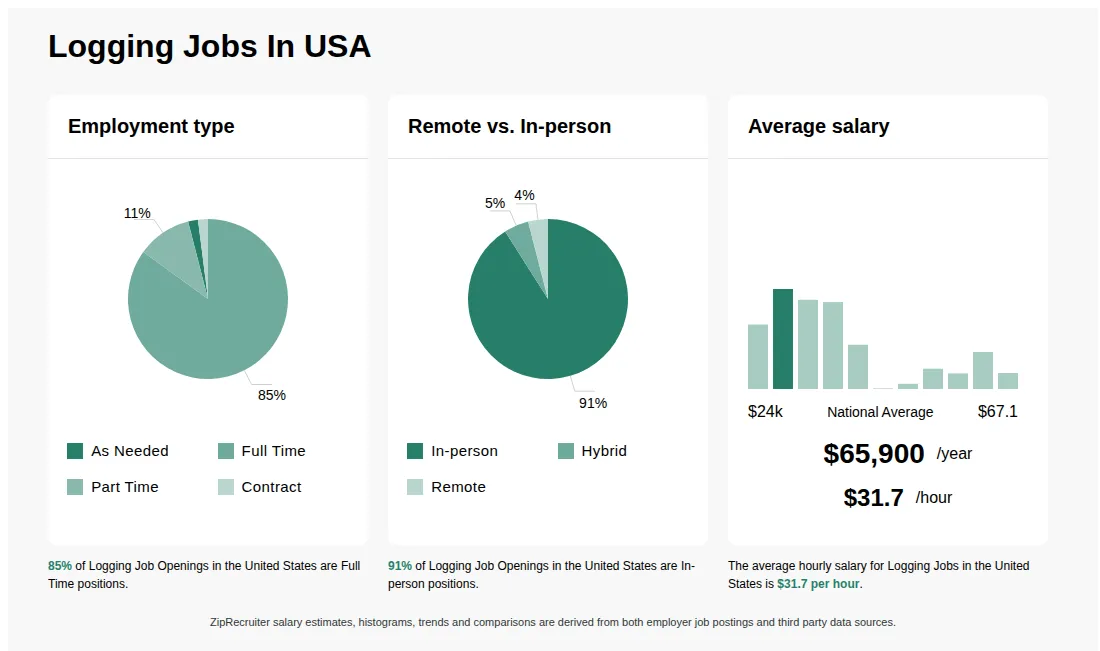
As of Jul 13, 2026, the average hourly pay for logging in the United States is $31.68, according to ZipRecruiter salary data. Most workers in this role earn between $19.47 and $33.89 per hour, depending on experience, location, and employer.

What Are Logging Jobs?

As a logger, your job is to cut down trees and get the logs ready to transport. This frequently includes helping trim and delimb each fallen tree, determining which trees are suitable for use as timber, and doing other forestry work as needed. Logging often requires the use of specialized equipment and machinery, including cranes, boats, and chainsaws, and loggers usually take on several roles to get the job done. Some details of this job vary based on factors like where you work and what sort of wood you're cutting down. You are also responsible for ensuring forests are appropriately managed and cut in a way that guarantees the longevity of the area.

What is the difference between Logging vs Forestry Worker?

AspectLoggingForestry Worker
Required CredentialsHigh school diploma, safety certifications, equipment operation trainingHigh school diploma, safety certifications, environmental knowledge
Work EnvironmentForests, logging sites, heavy machineryForests, conservation areas, outdoor settings
Industry UsagePrimary role in timber harvestingSupporting roles in forest management and conservation

Logging involves the active cutting and harvesting of trees, often using heavy machinery, while forestry workers support forest management, conservation, and reforestation efforts. Both roles require safety certifications and outdoor work, but logging is more focused on timber extraction, whereas forestry workers focus on sustainable practices and environmental protection.

What are the key skills and qualifications needed to thrive as a Logging Worker, and why are they important?

To thrive as a Logging Worker, you need physical stamina, mechanical aptitude, and a basic understanding of forestry practices, often supported by a high school diploma or equivalent. Familiarity with chainsaws, logging machinery, and safety systems, as well as completion of safety training or certification programs, is typically required. Attention to detail, teamwork, and a strong commitment to safety are vital soft skills in this hazardous environment. These skills ensure efficient timber harvesting while minimizing accidents and environmental impact.

What are some common challenges faced by logging professionals in the field, and how can they be addressed?

Logging professionals often encounter challenges such as working in remote or rugged terrain, adhering to strict safety regulations, and dealing with unpredictable weather conditions. These challenges can be managed by using specialized equipment, participating in regular safety training, and maintaining clear communication with team members. Additionally, staying updated on best practices and environmental guidelines helps ensure sustainable and efficient logging operations.

What are logging jobs?

Logging jobs involve the process of cutting down trees, transporting the timber, and processing it for use in industries such as construction, paper, and furniture manufacturing. Workers in logging may include loggers, equipment operators, truck drivers, and supervisors. These roles require operating heavy machinery, maintaining safety standards, and working outdoors in various weather conditions. Logging jobs are physically demanding and often located in remote forested areas.
What cities are hiring for Logging jobs? Cities with the most Logging job openings:
What are the most commonly searched types of Logging jobs? The most popular types of Logging jobs are:
What states have the most Logging jobs? States with the most job openings for Logging jobs include:
Infographic showing various Logging job openings in the United States as of July 2026, with employment types broken down into 100% Full Time. Highlights an 100% In-person job distribution, with an average salary of $65,900 per year, or $31.7 per hour.
Staff Software Engineer, Metrics and Logging

Staff Software Engineer, Metrics and Logging

Databricks

Mountain View, CA โ€ข On-site

Full-time

Re-posted 6 days ago


Job description

Job Summary:
Databricks is a data and AI company passionate about enabling data teams to solve the world's toughest problems. As a Staff Software Engineer, you will drive the next generation of our logging infrastructure, building scalable logging solutions that enhance observability across all Databricks services.
Responsibilities:
โ€ข Build the future of logging at Databricks by designing and scaling our next-generation logging platform that processes petabytes of logs daily.
โ€ข Develop and optimize log delivery pipelines to support low-latency, high-throughput log ingestion and querying, ensuring seamless observability across all Databricks services.
โ€ข Enhance log accessibility and usability, developing tools that enable engineers to efficiently search, analyze, and derive insights from logs.
โ€ข Collaborate with teams across Databricks to define best practices for structured logging, standardizing formats and improving the developer experience.
โ€ข Improve reliability and cost-efficiency by optimizing log retention, indexing, and query performance to reduce operational overhead.
โ€ข Mentor and uplevel engineers, fostering a culture of technical excellence within the team and broader observability community.
Qualifications:
Required:
โ€ข BS (or higher) in Computer Science, or a related field.
โ€ข 7+ years of production-level experience in one of: Scala, Rust, Go, Python, Java, C++, or similar languages.
โ€ข Deep experience in software development, in large-scale distributed systems.
โ€ข Experience driving complex projects involving multiple teams and stakeholders.
โ€ข Familiarity with log collection, health monitoring, and observability tools.
Company:
Databricks is a data and AI platform that unifies data engineering, analytics, and machine learning on a lakehouse architecture. Founded in 2013, the company is headquartered in San Francisco, USA, with a team of 5001-10000 employees. The company is currently Late Stage.