NY · On-site
Cortina is a government contractor providing technical professional services. But we are so much ... Cortina Solutions is seeking an entry-level Cybersecurity Analyst to support the execution of a ...
NY · On-site
Cortina is a government contractor providing technical professional services. But we are so much ... Cortina Solutions is seeking an entry-level Cybersecurity Analyst to support the execution of a ...
NY · On-site
Cortina is a government contractor providing technical professional services. But we are so much ... Cortina Solutions is seeking an entry-level Cybersecurity Analyst to support the execution of a ...
Cortina is a government contractor providing technical professional services. But we are so much ... Cortina Solutions is seeking an entry-level Cybersecurity Analyst to support the execution of a ...
Cortina is a government contractor providing technical professional services. But we are so much ... Cortina Solutions is seeking an entry-level Cybersecurity Analyst to support the execution of a ...
Panama City, FL · On-site
$89K - $118K/yr
Cortina is a government contractor providing technical professional services. But we are so much ... Cortina Solutions is seeking an entry-level Cybersecurity Analyst to support the execution of a ...
Panama City, FL · On-site
$89K - $118K/yr
Cortina is a government contractor providing technical professional services. But we are so much ... Cortina Solutions is seeking an entry-level Cybersecurity Analyst to support the execution of a ...
Manassas, VA · On-site
$77K - $86K/yr
S. Government security investigation and must meet eligibility requirements for access to ... Design cybersecurity capabilities that meet Navy requirements and address evolving threats.
Manassas, VA · On-site
$77K - $86K/yr
S. Government security investigation and must meet eligibility requirements for access to ... Design cybersecurity capabilities that meet Navy requirements and address evolving threats.
Austin, TX · On-site
Internship, project, or coursework experience in computer science, cybersecurity, data analytics ... entry-level opportunity intended for candidates interested in beginning or building a career in ...
Austin, TX · On-site
Internship, project, or coursework experience in computer science, cybersecurity, data analytics ... entry-level opportunity intended for candidates interested in beginning or building a career in ...
Nashville, TN · On-site
Internship, project, or coursework experience in computer science, cybersecurity, data analytics ... entry-level opportunity intended for candidates interested in beginning or building a career in ...
Nashville, TN · On-site
Internship, project, or coursework experience in computer science, cybersecurity, data analytics ... entry-level opportunity intended for candidates interested in beginning or building a career in ...
Colorado Springs, CO · On-site
Internship, project, or coursework experience in computer science, cybersecurity, data analytics ... entry-level opportunity intended for candidates interested in beginning or building a career in ...
Colorado Springs, CO · On-site
Internship, project, or coursework experience in computer science, cybersecurity, data analytics ... entry-level opportunity intended for candidates interested in beginning or building a career in ...
Internship, project, or coursework experience in computer science, cybersecurity, data analytics ... entry-level opportunity intended for candidates interested in beginning or building a career in ...
Internship, project, or coursework experience in computer science, cybersecurity, data analytics ... entry-level opportunity intended for candidates interested in beginning or building a career in ...
Austin, TX · On-site
Internship, project, or coursework experience in computer science, cybersecurity, data analytics ... Professional development From entry-level employees to senior leaders, we believe there's always ...
Austin, TX · On-site
Internship, project, or coursework experience in computer science, cybersecurity, data analytics ... Professional development From entry-level employees to senior leaders, we believe there's always ...
Portland, OR · On-site
Internship, project, or coursework experience in computer science, cybersecurity, data analytics ... entry-level opportunity intended for candidates interested in beginning or building a career in ...
Portland, OR · On-site
Internship, project, or coursework experience in computer science, cybersecurity, data analytics ... entry-level opportunity intended for candidates interested in beginning or building a career in ...
Internship, project, or coursework experience in computer science, cybersecurity, data analytics ... entry-level opportunity intended for candidates interested in beginning or building a career in ...
Internship, project, or coursework experience in computer science, cybersecurity, data analytics ... entry-level opportunity intended for candidates interested in beginning or building a career in ...
Internship, project, or coursework experience in computer science, cybersecurity, data analytics ... entry-level opportunity intended for candidates interested in beginning or building a career in ...
Internship, project, or coursework experience in computer science, cybersecurity, data analytics ... entry-level opportunity intended for candidates interested in beginning or building a career in ...
Waimea, HI · On-site
This entry level position supports accreditation activity efforts by coordinating with Koa Lani IT ... IAM I Security Clearance Must be able to obtain and maintain a Secret US Government Clearance. Note:
Waimea, HI · On-site
This entry level position supports accreditation activity efforts by coordinating with Koa Lani IT ... IAM I Security Clearance Must be able to obtain and maintain a Secret US Government Clearance. Note:
This entry level position supports accreditation activity efforts by coordinating with Koa Lani IT ... IAM I Security Clearance Must be able to obtain and maintain a Secret US Government Clearance. Note:
This entry level position supports accreditation activity efforts by coordinating with Koa Lani IT ... IAM I Security Clearance Must be able to obtain and maintain a Secret US Government Clearance. Note:
... government, energy, and more. Throughout your internship, you'll collaborate with experienced ... entry-level positions. You'll receive a status update email for each application, so be sure to ...
... government, energy, and more. Throughout your internship, you'll collaborate with experienced ... entry-level positions. You'll receive a status update email for each application, so be sure to ...
... government, energy, and more. Throughout your internship, you'll collaborate with experienced ... entry-level positions. You'll receive a status update email for each application, so be sure to ...
... government, energy, and more. Throughout your internship, you'll collaborate with experienced ... entry-level positions. You'll receive a status update email for each application, so be sure to ...
... government, energy, and more. Throughout your internship, you'll collaborate with experienced ... entry-level positions. You'll receive a status update email for each application, so be sure to ...
... government, energy, and more. Throughout your internship, you'll collaborate with experienced ... entry-level positions. You'll receive a status update email for each application, so be sure to ...
... government, energy, and more. Throughout your internship, you'll collaborate with experienced ... entry-level positions. You'll receive a status update email for each application, so be sure to ...
... government, energy, and more. Throughout your internship, you'll collaborate with experienced ... entry-level positions. You'll receive a status update email for each application, so be sure to ...
... government, energy, and more. Throughout your internship, you'll collaborate with experienced ... entry-level positions. You'll receive a status update email for each application, so be sure to ...
... government, energy, and more. Throughout your internship, you'll collaborate with experienced ... entry-level positions. You'll receive a status update email for each application, so be sure to ...
... government, energy, and more. Throughout your internship, you'll collaborate with experienced ... entry-level positions. You'll receive a status update email for each application, so be sure to ...
... government, energy, and more. Throughout your internship, you'll collaborate with experienced ... entry-level positions. You'll receive a status update email for each application, so be sure to ...
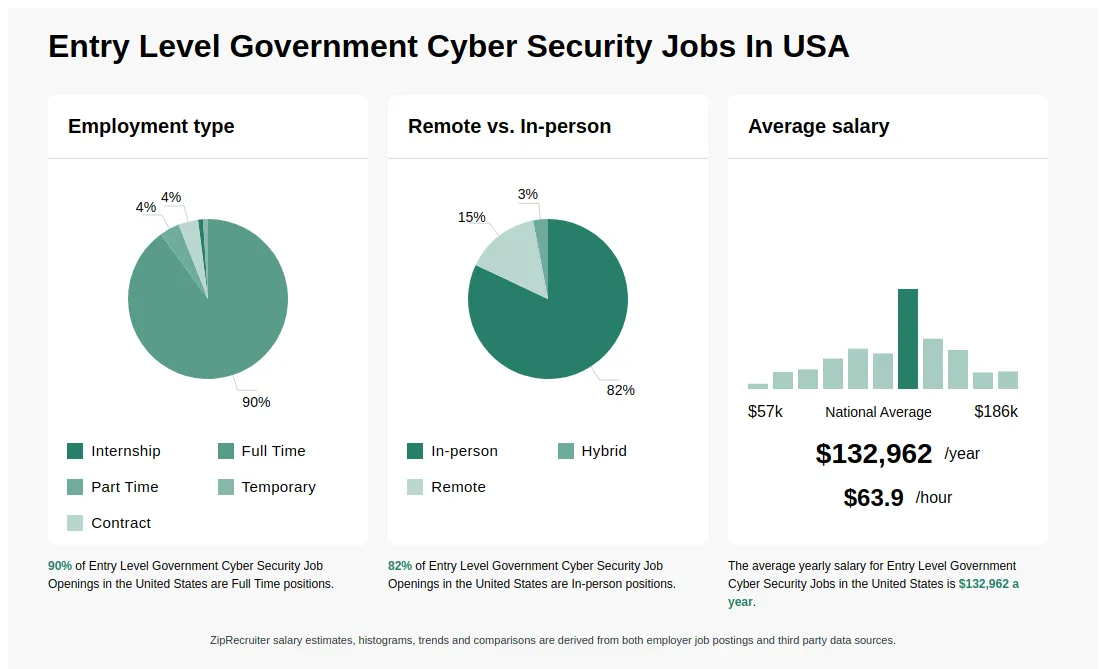
$57K - $68.7K
1% of jobs
$68.7K - $80.5K
4% of jobs
$80.5K - $92.2K
5% of jobs
$92.2K - $103.9K
9% of jobs
$110.4K is the 25th percentile. Wages below this are outliers.
$103.9K - $115.6K
11% of jobs
$115.6K - $127.4K
10% of jobs
The median wage is $131.9K / yr.
$127.4K - $139.1K
28% of jobs
$145.9K is the 75th percentile. Wages above this are outliers.
$139.1K - $150.8K
14% of jobs
$150.8K - $162.5K
11% of jobs
$162.5K - $174.3K
4% of jobs
$174.3K - $186K
4% of jobs
$57K
$133K
$186K
| Aspect | Entry Level Government Cyber Security | Entry Level Cyber Security Analyst |
|---|---|---|
| Certifications | CompTIA Security+, CISSP (entry-level), Security+ | CompTIA Security+, CEH, Security+ |
| Work Environment | Government agencies, federal, state, or local government offices | Private companies, consulting firms, or corporate IT departments |
| Employer & Industry Usage | Primarily government sectors with strict compliance standards | Broad industry use including finance, healthcare, and tech |
| Job Focus | Protecting government systems, compliance, and policy adherence | Identifying vulnerabilities, monitoring networks, incident response |
While both roles involve cybersecurity fundamentals, Entry Level Government Cyber Security focuses on protecting government systems and ensuring compliance within public sector environments. Entry Level Cyber Security Analyst roles are more common in private sectors, emphasizing vulnerability assessment and incident response. Understanding these differences helps candidates target their skills and certifications appropriately.
Cities with the most Entry Level Government Cyber Security job openings:
The most popular types of Government Cyber Security jobs are:
States with the most job openings for Entry Level Government Cyber Security jobs include:
The top searched job categories for Entry Level Government Cyber Security jobs are:
Other pages related to Entry Level Government Cyber Security:

NY • On-site
Other
Medical, Dental, Vision, Life, Retirement, PTO
Posted 8 days ago
Be a part of a winning team that provides technical solutions with integrity. Cortina is a government contractor providing technical professional services. But we are so much more than that! For approximately every three employees brought on to support the government, we hire an individual from an under-resourced, developing community and train them to enter the professional job market.
Cortina is very proud of the reach-back it offers to the local community. Not only that, we LOVE our employees and do all we can to ensure they have a great work experience. Come join a company that believes in being a part of something bigger than themselves!
Cortina Solutions is seeking an entry-level Cybersecurity Analyst to support the execution of a complex contract supporting the Naval Surface Warfare Center Panama City Division (NSWC PCD). You must be ready to support the mission, executing daily monitoring, STIG checks, and scan reviews that shape and protect the future of naval warfare technology. The ideal candidate will be expected to work with Excellence, serve with Integrity, and approach every problem with a drive to Get Things Done.
The Junior Cybersecurity Analyst provides foundational cybersecurity and IT support for Department of the Navy information systems, ensuring compliance, security, and operational readiness. This role supports the implementation and maintenance of cybersecurity controls across enterprise IT environments in accordance with DOD and Navy policies.
Responsibilities include providing cybersecurity and IT support in compliance with SECNAV M-5239.2 for CSWF roles; maintaining required certifications and training for all information systems and operating systems within the scope of duties; assisting with POA&M updates; tracking IAVM/patches; and supporting system authorization and continuous monitoring activities under the Risk Management Framework (RMF) to generate control evidence. The position utilizes DOD-approved cybersecurity tools, including DISA STIG Viewer, DISA SCAP Tool, Tenable ACAS, and McAfee HBSS/ePolicy Orchestrator, to assess, remediate, and report system security posture.
At Cortina, we believe in training and developing our workforce, not just providing a job. The selected candidate will be paired with a senior team lead for structured mentoring, hands‑on training, and professional development in support of your career and our nation’s critical defense workforce.
Cortina Solutions is committed to offering comprehensive and affordable benefits to employees and their families.
As our team members work on government sites, all potential candidates are subject to a background screening that fully complies with the Fair Credit Reporting Act.
Position dependent on contract award.

Sourced by ZipRecruiter
Guided missile and space vehicle manufacturing
1 - 10 Employees
Huntsville, AL, US
2012