Can alternate 3 nights with LPN. A Developmental Disability Nurse (DDN) is a specialized Registered Nurse (RN) who provides medical and behavioral care for individuals with intellectual and ...
Can alternate 3 nights with LPN. A Developmental Disability Nurse (DDN) is a specialized Registered Nurse (RN) who provides medical and behavioral care for individuals with intellectual and ...
Registered Nurse for Developmentally Disabled
Springboro, OH · On-site
$35/hr
Can alternate 3 nights with LPN. A Developmental Disability Nurse (DDN) is a specialized Registered Nurse (RN) who provides medical and behavioral care for individuals with intellectual and ...
Quick apply
Registered Nurse for Developmentally Disabled
Springboro, OH · On-site
$35/hr
Can alternate 3 nights with LPN. A Developmental Disability Nurse (DDN) is a specialized Registered Nurse (RN) who provides medical and behavioral care for individuals with intellectual and ...
Registered Nurse for Developmentally Disabled
Springboro, OH · On-site
$35/hr
Can alternate 3 nights with LPN. A Developmental Disability Nurse (DDN) is a specialized Registered Nurse (RN) who provides medical and behavioral care for individuals with intellectual and ...
Quick apply
Registered Nurse for Developmentally Disabled
Springboro, OH · On-site
$35/hr
Can alternate 3 nights with LPN. A Developmental Disability Nurse (DDN) is a specialized Registered Nurse (RN) who provides medical and behavioral care for individuals with intellectual and ...
Registered Nurse for Developmentally Disabled
Springboro, OH · On-site
$35/hr
Can alternate 3 nights with LPN. A Developmental Disability Nurse (DDN) is a specialized Registered Nurse (RN) who provides medical and behavioral care for individuals with intellectual and ...
Quick apply
Registered Nurse for Developmentally Disabled
Springboro, OH · On-site
$35/hr
Can alternate 3 nights with LPN. A Developmental Disability Nurse (DDN) is a specialized Registered Nurse (RN) who provides medical and behavioral care for individuals with intellectual and ...
Be Seen First
Qualified Developmental Disability Professional
Fairfax, VA · On-site
$52K - $72K/yr
Have hands-on experience supporting individuals with developmental disabilities in community or ... Registered Nurse (RN) licensed in Virginia * Licensed Occupational Therapist * Licensed Physician ...
Quick apply
Be Seen First
Qualified Developmental Disability Professional
Fairfax, VA · On-site
$52K - $72K/yr
Have hands-on experience supporting individuals with developmental disabilities in community or ... Registered Nurse (RN) licensed in Virginia * Licensed Occupational Therapist * Licensed Physician ...
Be Seen First
Qualified Developmental Disability Professional
Fairfax, VA · On-site
$52K - $72K/yr
Have hands-on experience supporting individuals with developmental disabilities in community or ... Registered Nurse (RN) licensed in Virginia * Licensed Occupational Therapist * Licensed Physician ...
Quick apply
Be Seen First
Qualified Developmental Disability Professional
Fairfax, VA · On-site
$52K - $72K/yr
Have hands-on experience supporting individuals with developmental disabilities in community or ... Registered Nurse (RN) licensed in Virginia * Licensed Occupational Therapist * Licensed Physician ...

Developmental Disability Program Manager
Cape Girardeau, MO · On-site
$46K - $49K/yr
As needed, manage a selected caseload of clients with intellectual disabilities/ developmental ... OR * Registered nurse (licensed) * This position requires a valid driver's license, a reliable ...
Developmental Disability Program Manager
Cape Girardeau, MO · On-site
$46K - $49K/yr
As needed, manage a selected caseload of clients with intellectual disabilities/ developmental ... OR * Registered nurse (licensed) * This position requires a valid driver's license, a reliable ...
Agency Nurse- RN High Hope Home The Developmental Disability Nurse - Oversight provides clinical oversight and monitoring to ensure that individuals with intellectual and developmental disabilities ...
New
Agency Nurse- RN High Hope Home The Developmental Disability Nurse - Oversight provides clinical oversight and monitoring to ensure that individuals with intellectual and developmental disabilities ...
New

Nurse Manager
Decatur, GA · On-site
DEVELOPMENTAL DISABILITY - NURSE MANAGER DD RESIDENTIAL STAFF - COMMUNITY RESID STAFF 715 JOB SUMMARY Plans, organizes, and directs all nursing activities for Developmental Disabilities (DD) Services ...
Nurse Manager
Decatur, GA · On-site
DEVELOPMENTAL DISABILITY - NURSE MANAGER DD RESIDENTIAL STAFF - COMMUNITY RESID STAFF 715 JOB SUMMARY Plans, organizes, and directs all nursing activities for Developmental Disabilities (DD) Services ...

Qualified Developmental Disability Professional (Talladega)
Talladega, AL · On-site
$14.25 - $16.75/hr
... Nurse and a minimum of one year experience working with individuals with developmental disabilities ... is required. Must meet Department of Mental Health guidelines for designation as a Qualified ...
Qualified Developmental Disability Professional (Talladega)
Talladega, AL · On-site
$14.25 - $16.75/hr
... Nurse and a minimum of one year experience working with individuals with developmental disabilities ... is required. Must meet Department of Mental Health guidelines for designation as a Qualified ...
Qualified Developmental Disability Professional (Talladega)
Talladega, AL · On-site
$13.75 - $16.75/hr
... Nurse and a minimum of one year experience working with individuals with developmental disabilities ... is required. Must meet Department of Mental Health guidelines for designation as a Qualified ...
Qualified Developmental Disability Professional (Talladega)
Talladega, AL · On-site
$13.75 - $16.75/hr
... Nurse and a minimum of one year experience working with individuals with developmental disabilities ... is required. Must meet Department of Mental Health guidelines for designation as a Qualified ...
Qualified Developmental Disability Professional (Talladega)
Talladega, AL · On-site
$14.25 - $16.75/hr
... Nurse and a minimum of one year experience working with individuals with developmental disabilities ... is required. Must meet Department of Mental Health guidelines for designation as a Qualified ...
Qualified Developmental Disability Professional (Talladega)
Talladega, AL · On-site
$14.25 - $16.75/hr
... Nurse and a minimum of one year experience working with individuals with developmental disabilities ... is required. Must meet Department of Mental Health guidelines for designation as a Qualified ...
DEVELOPMENTAL DISABILITY - NURSE MANAGER DD RESIDENTIAL STAFF - COMMUNITY RESID STAFF 715 JOB SUMMARY Plans, organizes, and directs all nursing activities for Developmental Disabilities (DD) Services ...
DEVELOPMENTAL DISABILITY - NURSE MANAGER DD RESIDENTIAL STAFF - COMMUNITY RESID STAFF 715 JOB SUMMARY Plans, organizes, and directs all nursing activities for Developmental Disabilities (DD) Services ...
DEVELOPMENTAL DISABILITY - NURSE MANAGER DD RESIDENTIAL STAFF - COMMUNITY RESID STAFF 715 JOB SUMMARY Plans, organizes, and directs all nursing activities for Developmental Disabilities (DD) Services ...
DEVELOPMENTAL DISABILITY - NURSE MANAGER DD RESIDENTIAL STAFF - COMMUNITY RESID STAFF 715 JOB SUMMARY Plans, organizes, and directs all nursing activities for Developmental Disabilities (DD) Services ...

DSHS DDA Developmental Disability Case Resource Manager
Olympia, WA · On-site +1
$69K - $93K/yr
The Developmental Disabilities Administration is hiring multiple experienced Resource Case Managers to work in our Vancouver, WA office. This position requires prior professional case management ...
DSHS DDA Developmental Disability Case Resource Manager
Olympia, WA · On-site +1
$69K - $93K/yr
The Developmental Disabilities Administration is hiring multiple experienced Resource Case Managers to work in our Vancouver, WA office. This position requires prior professional case management ...
Developmental Disability and Housing Case Manager
Cape Girardeau, MO · On-site
$18 - $19/hr
... developmental disabilities. • Perform other duties as assigned. Catholic Social Teachings ... OR * Registered nurse (licensed) * This position requires a valid driver's license, a reliable ...
Developmental Disability and Housing Case Manager
Cape Girardeau, MO · On-site
$18 - $19/hr
... developmental disabilities. • Perform other duties as assigned. Catholic Social Teachings ... OR * Registered nurse (licensed) * This position requires a valid driver's license, a reliable ...
DSHS DDA Developmental Disability Case Resource Manager
Olympia, WA · On-site +1
$69K - $93K/yr
The Developmental Disabilities Administration is hiring multiple experienced Resource Case Managers to work in our Vancouver, WA office. This position requires prior professional case management ...
DSHS DDA Developmental Disability Case Resource Manager
Olympia, WA · On-site +1
$69K - $93K/yr
The Developmental Disabilities Administration is hiring multiple experienced Resource Case Managers to work in our Vancouver, WA office. This position requires prior professional case management ...
$15.25 - $18.50/hr
... (CNA) in providing care for the residents of MDH - Holly Center, a residential facility for ... Three years of experience providing direct client services in a developmental disability or similar ...
$15.25 - $18.50/hr
... (CNA) in providing care for the residents of MDH - Holly Center, a residential facility for ... Three years of experience providing direct client services in a developmental disability or similar ...

Intellectual Disability - Registered Nurse
Middlebury, CT · Hybrid
$38.50 - $39.50/hr
As a Registered Nurse, you will provide high quality, person-centered care to adults with intellectual and developmental disabilities. This position is responsible for providing medical oversight ...
Intellectual Disability - Registered Nurse
Middlebury, CT · Hybrid
$38.50 - $39.50/hr
As a Registered Nurse, you will provide high quality, person-centered care to adults with intellectual and developmental disabilities. This position is responsible for providing medical oversight ...
$38.50 - $39.50/hr
As a Registered Nurse, you will provide high quality, person-centered care to adults with intellectual and developmental disabilities. This position is responsible for providing medical oversight ...
$38.50 - $39.50/hr
As a Registered Nurse, you will provide high quality, person-centered care to adults with intellectual and developmental disabilities. This position is responsible for providing medical oversight ...
Developmental Disability Nurse information
See salary details
$17.31 - $21.68
3% of jobs
$21.68 - $26.05
7% of jobs
$29.33 is the 25th percentile. Wages below this are outliers.
$26.05 - $30.42
20% of jobs
The median wage is $34.13 / hr.
$30.42 - $34.79
24% of jobs
$34.79 - $39.16
14% of jobs
$41.84 is the 75th percentile. Wages above this are outliers.
$39.16 - $43.53
11% of jobs
$43.53 - $47.90
7% of jobs
$47.90 - $52.27
5% of jobs
$52.27 - $56.64
3% of jobs
$56.64 - $61.01
3% of jobs
$61.01 - $65.38
2% of jobs
$17
$38
$65
How much do developmental disability nurse jobs pay per hour?
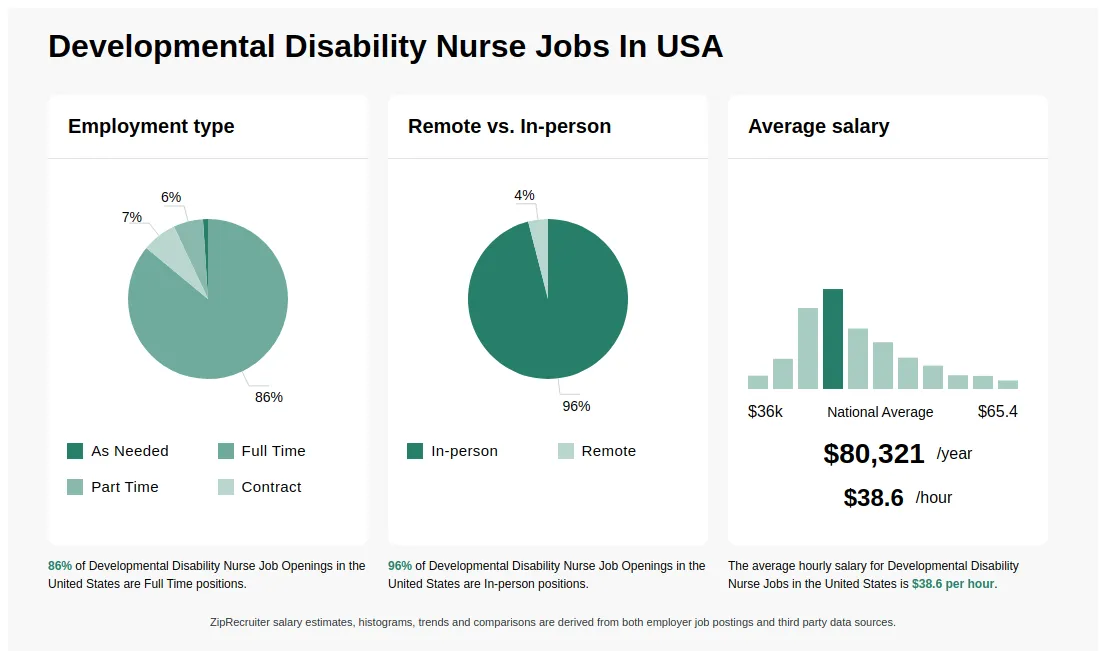
As of Sep 14, 2026, the average hourly pay for developmental disability nurse in the United States is $38.62, according to ZipRecruiter salary data. Most workers in this role earn between $29.57 and $43.27 per hour, depending on experience, location, and employer.
What is a developmental disability nurse?
A Developmental Disability Nurse (DDN) is a specialized nurse who provides care for individuals with developmental disabilities such as autism, cerebral palsy, Down syndrome, and other cognitive or physical impairments. They work in various settings, including group homes, schools, clinics, and private residences, assisting patients with daily living activities, medical treatments, and emotional support. Their role includes assessing health needs, administering medications, coordinating care plans, and educating families and caregivers about managing disabilities. DDNs advocate for their patients' well-being, promoting independence and improving their quality of life. This nursing specialty requires patience, compassion, and strong communication skills to address the unique challenges of each individual.
What are some common challenges faced by developmental disability nurses, and how are they addressed on the job?
Developmental Disability Nurses often encounter challenges such as managing complex behavioral needs, ensuring effective communication with non-verbal patients, and adapting care plans to suit individual abilities. To address these, nurses work closely with interdisciplinary teams that may include therapists, social workers, and family members, utilizing strategies such as behavior support plans and adaptive communication tools. Ongoing training, mentorship from experienced colleagues, and access to resources like crisis intervention protocols help nurses navigate these situations successfully. The supportive teamwork and structured processes in most settings ensure both patient safety and job satisfaction for nurses in this field.
What are the key skills and qualifications needed to thrive as a developmental disability nurse, and why are they important?
To thrive as a Developmental Disability Nurse, you need specialized nursing knowledge in developmental disabilities, state licensure (RN or LPN), and experience in individualized care planning. Familiarity with assistive communication devices, documentation using electronic health records (EHRs), and protocols for behavioral or crisis intervention is often required. Compassion, patience, strong advocacy skills, and the ability to build trust quickly are vital soft skills in this role. These abilities are crucial for providing effective, empathetic care and supporting individuals and families in diverse, challenging situations.
More about Developmental Disability Nurse jobs
What cities are hiring for Developmental Disability Nurse jobs?
Cities with the most Developmental Disability Nurse job openings:
What are the most commonly searched types of Developmental Disability Nurse jobs?
The most popular types of Developmental Disability Nurse jobs are:
What states have the most Developmental Disability Nurse jobs?
States with the most job openings for Developmental Disability Nurse jobs include:
What are popular job titles related to Developmental Disability Nurse jobs?
For Developmental Disability Nurse jobs, the most frequently searched job titles are:
Registered Nurse for Developmentally Disabled
Springboro, OH • On-site
Beulah Home Care LLC
Other
Re-posted 8 days ago
Job description
Position is located in Springboro, OH
Growing company located in Mason, OH is URGENTLY hiring for a Registered Nurse to work with a client located in Springboro, OH. Current hours are 8:00 p.m. to 4:00 a.m., Sunday through Friday, overnight. Can alternate 3 nights with LPN.
A Developmental Disability Nurse (DDN) is a specialized Registered Nurse (RN) who provides medical and behavioral care for individuals with intellectual and developmental disabilities (IDD).
Core Responsibilities Direct Clinical Care: Administering medications, managing medical equipment (like feedings tubes), and monitoring chronic conditions.
Case Management: Developing Individualized Service Plans (ISP"s) and coordinating with interdisciplinary teams, including doctors, occupational therapists, and speech pathologists.
Advocacy: Protecting the rights of patients and ensuring they receive appropriate accommodations in schools, workplaces, and healthcare settings.
Training & Oversight: Educating family members and supervising Direct Support Professionals (DSP"s) who assist with daily living tasks.