1

Compliance Risk Management Jobs (NOW HIRING)

Compliance & Risk Lead

Seattle, WA ยท On-site +1

$105K - $110K/yr

Track and manage risk and compliance issues through resolution, ensuring clear ownership and follow-through. * Serve as a point of contact for risk and compliance-related questions, issues, and ...

Compliance & Risk Lead

Seattle, WA ยท Remote

$105K - $110K/yr

Track and manage risk and compliance issues through resolution, ensuring clear ownership and follow-through. * Serve as a point of contact for risk and compliance-related questions, issues, and ...

next page

Showing results 1-20

Compliance Risk Management information

See salary details

$38.5K

$95.1K

$157K

How much do compliance risk management jobs pay per year?

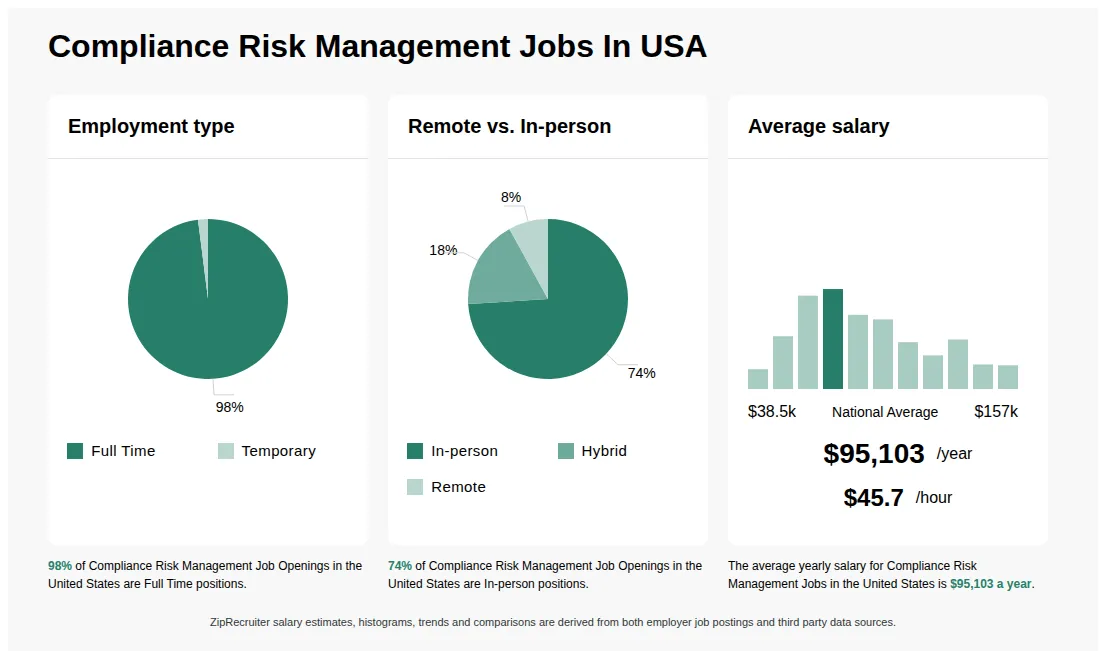
As of Jul 17, 2026, the average yearly pay for compliance risk management in the United States is $95,103.00, according to ZipRecruiter salary data. Most workers in this role earn between $70,000.00 and $116,500.00 per year, depending on experience, location, and employer.

What is the highest paying job in compliance?

The highest paying roles in compliance often include Chief Compliance Officer (CCO) and Director of Compliance, with salaries exceeding $150,000 annually. These positions require extensive experience, leadership skills, and often industry-specific certifications such as Certified Compliance & Ethics Professional (CCEP).

What is the difference between Compliance Risk Management vs Compliance Analyst?

AspectCompliance Risk ManagementCompliance Analyst
CertificationsCertified Compliance & Ethics Professional (CCEP), Certified Risk Management Professional (CRMP)Certified Compliance & Ethics Professional (CCEP), Certified Regulatory Compliance Manager (CRCM)
Work EnvironmentFocuses on risk assessment, policy development, and strategic compliance planningConducts audits, monitors compliance, and reports findings
Employer & Industry UsageUsed in financial, healthcare, and corporate sectors for risk oversightCommon in financial services, healthcare, and regulatory agencies for day-to-day compliance tasks

Compliance Risk Management involves strategic oversight of compliance risks and policy development, while Compliance Analysts focus on executing compliance audits and monitoring. Both roles are essential but differ in scope and responsibilities within organizations.

Will compliance be replaced by AI?

Compliance risk management professionals use AI tools to automate data analysis, monitor regulations, and identify potential risks more efficiently. While AI can augment compliance functions, human oversight remains essential for interpreting complex regulations and making judgment-based decisions. AI is a complement, not a complete replacement, for compliance roles.

How does a Compliance Risk Management professional typically collaborate with other departments within an organization?

Compliance Risk Management professionals work closely with departments such as Legal, Internal Audit, Operations, and IT to ensure company policies and procedures meet regulatory requirements. They often coordinate cross-functional meetings to assess risks, develop mitigation strategies, and implement compliance training. This collaborative approach helps identify potential compliance gaps early and ensures the organization maintains a culture of ethical conduct and regulatory adherence. Effective communication and partnership with various teams are essential to proactively manage risks and respond to regulatory changes.

What are the key skills and qualifications needed to thrive in Compliance Risk Management, and why are they important?

To thrive in Compliance Risk Management, you need a solid understanding of regulatory requirements, risk assessment, and industry standards, often backed by a degree in law, finance, or a related field. Familiarity with compliance management systems, risk analysis tools, and certifications such as Certified Compliance & Ethics Professional (CCEP) or Certified Risk Manager (CRM) are typically required. Strong analytical thinking, attention to detail, and effective communication are vital soft skills for this role. These skills and qualifications help ensure organizations remain compliant, minimize risk exposure, and maintain their reputational integrity.

What is Compliance Risk Management?

Compliance Risk Management refers to the process of identifying, assessing, and mitigating risks that arise from failing to comply with laws, regulations, and internal policies. Professionals in this field ensure that organizations operate within the legal frameworks and ethical standards relevant to their industry. They develop policies, conduct audits, and provide training to reduce the risk of violations, which can lead to legal penalties, financial losses, or reputational damage. Effective compliance risk management helps organizations maintain trust with stakeholders and avoid costly regulatory issues.

Is compliance and risk management a good career?

Compliance risk management is a valuable career that involves ensuring organizations adhere to laws, regulations, and internal policies. It requires strong analytical skills, attention to detail, and often involves certifications like Certified Compliance & Ethics Professional (CCEP). The field offers opportunities across various industries with steady demand and potential for advancement.

What does a compliance risk manager do?

A compliance risk manager is responsible for identifying, assessing, and mitigating risks related to regulatory compliance within an organization. They develop policies, monitor adherence to laws and regulations, and implement controls to prevent violations, often using tools like compliance management software. Strong analytical skills and knowledge of industry regulations are essential for this role.
What cities are hiring for Compliance Risk Management jobs? Cities with the most Compliance Risk Management job openings:
What are the most commonly searched types of Compliance Risk Management jobs? The most popular types of Compliance Risk Management jobs are:
What states have the most Compliance Risk Management jobs? States with the most job openings for Compliance Risk Management jobs include:
Infographic showing various Compliance Risk Management job openings in the United States as of July 2026, with employment types broken down into 1% As Needed, 82% Full Time, 12% Part Time, 1% Temporary, and 4% Contract. Highlights an 93% Physical, 2% Hybrid, and 5% Remote job distribution, with an average salary of $95,103 per year, or $45.7 per hour.
Compliance & Risk Officer

Compliance & Risk Officer

GHS Federal Credit Union

Binghamton, NY โ€ข On-site

$55K - $70K/yr

Full-time

Posted 15 days ago


Job description

Description:


Compliance & Risk Officer

Department: Compliance

Reports to: VP of Operations Support & Compliance

Classification: Exempt, Full-Time, In-Person

Effective: July 2026

Overview:

Compliance & Risk Officer is responsible for building, maintaining, and strengthening GHS Federal Credit Union's Bank Secrecy Act, fraud prevention, and regulatory compliance programs. This is a foundational role for the credit union, stepping into a developing program and expected to formalize, expand, and elevate the organization's risk management posture across all three disciplines. The Officer serves as the designated BSA Officer for the credit union and is the primary internal resource for fraud monitoring, investigation, and prevention, regulatory compliance oversight, and cross-functional risk education and training. While primarily an internal function, this role interacts with members when circumstances require, including fraud disputes and compliance-related inquiries, and does so with professionalism and member focus consistent with GHS service standards.

Essential Functions and Responsibilities

Bank Secrecy Act and Anti-Money Laundering

  • Serve as the designated BSA Officer for GHS Federal Credit Union, maintaining primary accountability for the credit union's BSA and Anti-Money Laundering program.
  • Build, document, and continuously strengthen the BSA program including written policies, procedures, risk assessments, and internal controls.
  • Monitor accounts and transactions for suspicious activity using fraud and BSA monitoring tools and system-generated reports.
  • File Currency Transaction Reports and Suspicious Activity Reports accurately and within required regulatory timeframes.
  • Conduct and document BSA risk assessments on a scheduled and as-needed basis.
  • Maintain BSA recordkeeping in compliance with federal requirements including Customer Identification Program documentation and beneficial ownership records.
  • Coordinate and deliver annual BSA training to all staff and targeted training for higher-risk roles.
  • Stay current on FinCEN guidance, NCUA BSA examination expectations, and evolving AML typologies.

Fraud Prevention, Monitoring, and Investigation

  • Operate and manage fraud monitoring tools and platforms, reviewing alerts, escalating confirmed fraud, and documenting outcomes.
  • Investigate suspected fraud cases involving member accounts, internal processes, or third-party activity. Conduct thorough, documented investigations and escalate findings appropriately.
  • Identify fraud patterns and systemic process vulnerabilities through investigation findings and monitoring data. Collaborate with relevant teams to implement corrective controls.
  • Manage fraud-related member disputes, working directly with members when needed to resolve cases professionally and in accordance with regulatory requirements.
  • Coordinate with law enforcement, regulatory agencies, and external partners on fraud matters as appropriate.
  • Develop and deliver fraud awareness training for staff, covering current fraud typologies, red flags, and internal reporting procedures.
  • Track fraud loss data and prepare periodic reporting on fraud trends, case outcomes, and program effectiveness for leadership.

Regulatory Compliance

  • Serve as the primary internal resource for regulatory compliance oversight, with primary focus on federal and state regulations applicable to credit union lending, deposits, and operations.
  • Maintain and update the credit union's compliance management system, including policy documentation, regulatory change tracking, and examination preparation materials.
  • Monitor regulatory changes from NCUA, CFPB, FinCEN, and other applicable agencies and assess their impact on GHS operations, products, and policies.
  • Conduct periodic internal compliance reviews and risk assessments across lending, deposit, and operational functions. Document findings and track remediation.
  • Support vendor oversight and third-party risk management from a compliance perspective, ensuring vendor relationships meet applicable regulatory expectations.
  • Collaborate on projects from a compliance perspective including vendor review, conversions, and new product implementation and testing.
  • Assist in the revision and/or design of forms, products, website, programs, or promotions to ensure compliance with all State and Federal rules and regulations.
  • Assist with internal and external audits and regulatory examinations, including NCUA examinations, by organizing documentation, responding to examiner requests, and coordinating with relevant departments.
  • Partner with leadership and department managers to build and maintain a culture of compliance across the credit union.

Training and Cross-Functional Collaboration

  • Design and deliver compliance, BSA, and fraud prevention training for all staff on a scheduled basis and in response to identified gaps or emerging risks.
  • Work cross-functionally with lending, member services, IT, and operations to identify process risks, recommend controls, and support implementation of corrective actions.
  • Serve as a resource and subject matter expert for staff with questions related to fraud, BSA, or regulatory compliance.
  • Participate in relevant committees or working groups as assigned.
  • Perform other duties as assigned.

Performance Measurement

  • Achievement of personal, team and business goals as established.
  • Timeliness and accuracy of CTR and SAR filings within all required regulatory deadlines.
  • Completion of scheduled BSA, fraud, and compliance training for all applicable staff on time and with documented attendance.
  • Quality and completeness of BSA program documentation, risk assessments, and internal controls as measured by internal review and examination outcomes.
  • Thoroughness and accuracy of fraud investigations, including documentation standards and resolution timeliness.
  • Effectiveness of compliance monitoring and regulatory change tracking, including timely identification of applicable changes and documented response.
  • Adherence and compliance with credit union procedures and policies. This includes but is not limited to the Internal Controls Policy, Bank Secrecy Act, OFAC and other credit union, state and federal procedures, policies and regulations.
  • Maintain high level of confidentiality regarding credit union staff and member information.
  • Responsiveness to internal and external correspondence and inquiries. Follow through. Ownership and accountability.
  • Maintain a professional work environment and businesslike appearance.


Requirements:

Knowledge, Skills and Abilities

Experience:

Minimum two years of experience in risk management, fraud, BSA, or compliance in a financial services or credit union environment required. Demonstrated experience with BSA program management, fraud monitoring tools, or regulatory compliance oversight strongly preferred. Experience working with or preparing for regulatory examinations including NCUA is a significant advantage. Candidates with experience in one of the three core disciplines who demonstrate strong working knowledge of the others will be considered.

Education:

Associate degree required. Bachelor's degree in finance, business, criminal justice, or a related field preferred. Relevant professional certifications such as CAMS, CFE, CUCE, or NCCO are a strong plus and may be supported through continued education benefits.

Interpersonal:

This role requires the ability to communicate complex regulatory and risk topics clearly to staff at all levels of the organization. Must be able to build cross-functional relationships, influence without direct authority, and navigate sensitive investigations and member interactions with discretion, professionalism, and sound judgment.

Other Skills:

Proficiency in Microsoft Office Suite required. Experience with fraud monitoring platforms, BSA compliance software, or core banking systems is strongly preferred. Strong analytical and investigative skills with the ability to identify patterns, document findings clearly, and develop actionable recommendations. Ability to manage multiple priorities simultaneously in a dynamic regulatory environment.

Physical Demands

Primarily office-based, involving standard physical activity such as sitting, standing, typing, and using the telephone. Periodic lifting of materials up to 20 lbs. Requires focus and attention to detail for close vision, data analysis, and documentation.

Work Environment

Employees are required to contribute to a positive work environment and demonstrate the credit union brand of "The Relationship of a Lifetime" by demonstrating GHS Service Standards of customer focus with positivity, personal ownership and accountability, clear and positive communication and responsiveness. Collaboration, consistency and respect, trust and demonstration of integrity are some of the professional behaviors regularly required.

This job description is intended to be a guide and may not be all encompassing or may amend/modify as business needs change.

GHS is an equal opportunity employer. At GHS, we are committed to providing an environment of mutual respect where equal employment opportunities are available to all applicants and teammates without regard to race, color, religion, sex, pregnancy (including childbirth, lactation and related medical conditions), national origin, age, physical and mental disability, marital status, sexual orientation, gender identity, gender expression, genetic information (including characteristics and testing), military and veteran status, and any other characteristic protected by applicable law. GHS believes that diversity and inclusion among our teammates is critical to our success and we seek to recruit, develop and retain the most talented people from a diverse candidate pool.