Coordinate accessible media and captioning requests by processing service requests, communicating with students, faculty, and vendors, and tracking service delivery. * Support the delivery of ...
Coordinate accessible media and captioning requests by processing service requests, communicating with students, faculty, and vendors, and tracking service delivery. * Support the delivery of ...
Develop user guides, tutorials, and training resources for faculty and students. * Assist with multimedia production (video recording, editing, captioning) * Support accessibility efforts, including ...
Develop user guides, tutorials, and training resources for faculty and students. * Assist with multimedia production (video recording, editing, captioning) * Support accessibility efforts, including ...

Instructional Design Intern
$17 - $19/hr
Develop user guides, tutorials, and training resources for faculty and students. * Assist with multimedia production (video recording, editing, captioning) * Support accessibility efforts, including ...
Instructional Design Intern
$17 - $19/hr
Develop user guides, tutorials, and training resources for faculty and students. * Assist with multimedia production (video recording, editing, captioning) * Support accessibility efforts, including ...

Tailwind Front-end Developer for B2B Platform
New York, NY · Remote
$113K - $132K/yr
Dotsub is building a unique video captioning and translation management tool that enables clients organize their in-house linguists, create and manage custom workflows, take advantage of the power of ...
Tailwind Front-end Developer for B2B Platform
New York, NY · Remote
$113K - $132K/yr
Dotsub is building a unique video captioning and translation management tool that enables clients organize their in-house linguists, create and manage custom workflows, take advantage of the power of ...
Accessible Media Graduate Student Employee - IE
Harrisonburg, VA · On-site
$18.50/hr
Duties and Responsibilities: - Captioning and transcribing course materials - Assist the captioning coordinator in processing, creating, and delivering captioning materials. - Input data into a task ...
Accessible Media Graduate Student Employee - IE
Harrisonburg, VA · On-site
$18.50/hr
Duties and Responsibilities: - Captioning and transcribing course materials - Assist the captioning coordinator in processing, creating, and delivering captioning materials. - Input data into a task ...

This leadership role oversees interpreter and captioning services, coordinates accommodations for classrooms and major campus events, supervises interpreter staff, manages budgets and contracts, and ...
This leadership role oversees interpreter and captioning services, coordinates accommodations for classrooms and major campus events, supervises interpreter staff, manages budgets and contracts, and ...
This leadership role oversees interpreter and captioning services, coordinates accommodations for classrooms and major campus events, supervises interpreter staff, manages budgets and contracts, and ...
This leadership role oversees interpreter and captioning services, coordinates accommodations for classrooms and major campus events, supervises interpreter staff, manages budgets and contracts, and ...
Coordinate accessible media and captioning requests by processing service requests, communicating with students, faculty, and vendors, and tracking service delivery. * Support the delivery of ...
Coordinate accessible media and captioning requests by processing service requests, communicating with students, faculty, and vendors, and tracking service delivery. * Support the delivery of ...
Instructional Design Intern
Manhattan, NY · On-site
$19/hr
Develop user guides, tutorials, and training resources for faculty and students. * Assist with multimedia production (video recording, editing, captioning) * Support accessibility efforts, including ...
Instructional Design Intern
Manhattan, NY · On-site
$19/hr
Develop user guides, tutorials, and training resources for faculty and students. * Assist with multimedia production (video recording, editing, captioning) * Support accessibility efforts, including ...
Accessible Media Graduate Student Employee - IE
Harrisonburg, VA · On-site
$18.50/hr
Duties and Responsibilities: - Captioning and transcribing course materials - Assist the captioning coordinator in processing, creating, and delivering captioning materials. - Input data into a task ...
Accessible Media Graduate Student Employee - IE
Harrisonburg, VA · On-site
$18.50/hr
Duties and Responsibilities: - Captioning and transcribing course materials - Assist the captioning coordinator in processing, creating, and delivering captioning materials. - Input data into a task ...

Photographer (Part-Time)
New York, NY · On-site
Editing & Captioning: Assist the editing team with editing and captioning images from photographers on assignment in real time, as well as post assignment * Image Review & Management: Review images ...
Photographer (Part-Time)
New York, NY · On-site
Editing & Captioning: Assist the editing team with editing and captioning images from photographers on assignment in real time, as well as post assignment * Image Review & Management: Review images ...
Build automated video captioning systems that combine vision-language models and LLMs to produce fine-grained, temporally-grounded descriptions of actions and scenes. * Architect agentic systems and ...
Quick apply
Build automated video captioning systems that combine vision-language models and LLMs to produce fine-grained, temporally-grounded descriptions of actions and scenes. * Architect agentic systems and ...

Production Coordinator, Video
Holland, OH · On-site
This involves ftp ingestion, quality checks, captioning, editing, and DVD authoring. Key Responsibilities * Organize materials for projects including, schedules, art assets, media assets, trailers ...
Production Coordinator, Video
Holland, OH · On-site
This involves ftp ingestion, quality checks, captioning, editing, and DVD authoring. Key Responsibilities * Organize materials for projects including, schedules, art assets, media assets, trailers ...

Scope includes editing videos, captioning, editing PDFs, images and course media to ensure Accessibility and Usability for all learners online.
Scope includes editing videos, captioning, editing PDFs, images and course media to ensure Accessibility and Usability for all learners online.

Digital Events Producer
Santa Clara, CA · On-site
$55 - $57/hr
Familiarity with captioning workflows, video encoding standards, and content management systems. * Experience in an enterprise technology environment. Qualification And Education: * High School ...
Quick apply
Digital Events Producer
Santa Clara, CA · On-site
$55 - $57/hr
Familiarity with captioning workflows, video encoding standards, and content management systems. * Experience in an enterprise technology environment. Qualification And Education: * High School ...

Familiarity with captioning workflows, video encoding standards, and content management systems. * Experience in an enterprise technology environment.
Familiarity with captioning workflows, video encoding standards, and content management systems. * Experience in an enterprise technology environment.

Coordinator for Interpretation Services
Campus, IL · Hybrid
$19.25 - $24.50/hr
Coordinate with vendors to schedule/ facilitate communication services e.g. interpreting, transcription, and captioning services for faculty, staff, and visitors for campus events as needed; manage ...
Coordinator for Interpretation Services
Campus, IL · Hybrid
$19.25 - $24.50/hr
Coordinate with vendors to schedule/ facilitate communication services e.g. interpreting, transcription, and captioning services for faculty, staff, and visitors for campus events as needed; manage ...

... live auto-captioning, audio description, transcription, and subtitling services. Founded in 2007, the company is headquartered in Boston, USA, with a team of 51-200 employees. The company is ...
... live auto-captioning, audio description, transcription, and subtitling services. Founded in 2007, the company is headquartered in Boston, USA, with a team of 51-200 employees. The company is ...

Media Prep Technician
Stamford, CT · On-site
Work with closed captioning tools such as Stanza or CaptionMaker (or similar platforms) * Manage a queue of work and prioritize tasks to meet deadlines and operational requirements * Collaborate ...
Media Prep Technician
Stamford, CT · On-site
Work with closed captioning tools such as Stanza or CaptionMaker (or similar platforms) * Manage a queue of work and prioritize tasks to meet deadlines and operational requirements * Collaborate ...
Hourly Realtime Captioner (Hourly Interpreter/Realtime Captioner/Computer-Aided Transcriber) - DPRC
San Francisco, CA · On-site
$70 - $97.17/hr
Set up of captioning equipment and display device before class. * Provide consumer(s) with an electronic disk, e-mail, or hard copy version of the final, edited transcript. * Work with the Deaf and ...
Hourly Realtime Captioner (Hourly Interpreter/Realtime Captioner/Computer-Aided Transcriber) - DPRC
San Francisco, CA · On-site
$70 - $97.17/hr
Set up of captioning equipment and display device before class. * Provide consumer(s) with an electronic disk, e-mail, or hard copy version of the final, edited transcript. * Work with the Deaf and ...
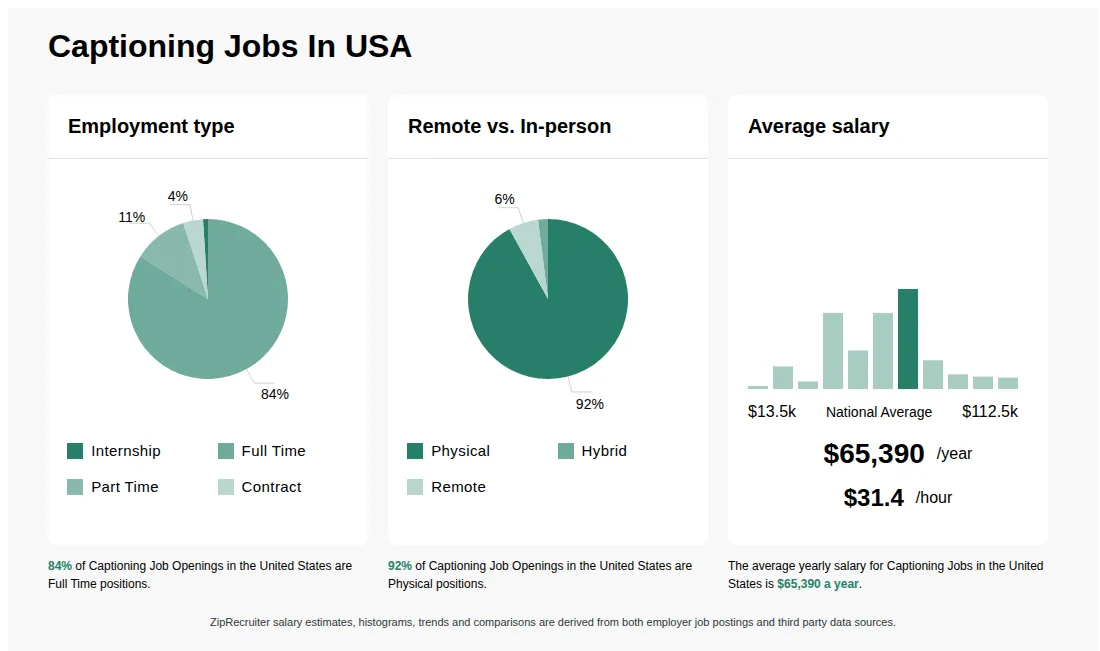
Captioning information
See salary details
$13.5K - $22.5K
0% of jobs
$22.5K - $31.5K
5% of jobs
$31.5K - $40.5K
1% of jobs
$48.7K is the 25th percentile. Wages below this are outliers.
$40.5K - $49.5K
20% of jobs
$49.5K - $58.5K
10% of jobs
The median wage is $64.4K / yr.
$58.5K - $67.5K
20% of jobs
$73.5K is the 75th percentile. Wages above this are outliers.
$67.5K - $76.5K
27% of jobs
$76.5K - $85.5K
8% of jobs
$85.5K - $94.5K
3% of jobs
$94.5K - $103.5K
3% of jobs
$103.5K - $112.5K
2% of jobs
$13.5K
$65.4K
$112.5K
How much do captioning jobs pay per year?
As of Jul 21, 2026, the average yearly pay for captioning in the United States is $65,390.00, according to ZipRecruiter salary data. Most workers in this role earn between $48,500.00 and $75,000.00 per year, depending on experience, location, and employer.
What is captioning and what does a captioner do?
Captioning is the process of converting spoken dialogue and sounds in videos, television programs, or live events into written text that appears on the screen. Captioners listen to audio and transcribe it accurately, often including non-verbal sounds and speaker identification to assist viewers who are deaf or hard of hearing. Their work ensures content is accessible to a wider audience and may involve real-time (live) or offline (pre-recorded) captioning. Captioners must have excellent listening, typing, and language skills.
What Are the Qualifications to Get a Job in Captioning?
The primary qualifications for a job in captioning are a high school diploma or GED certificate and excellent communication skills. Employers prefer applicants who have call center experience, but this is not necessary for most roles. Performing the duties of a captioning job requires excellent short-term memory, fast and accurate typing skills, and the ability to communicate effectively through speech and text. Most captioning jobs are largely independent, so the ability to work well with minimal supervision is essential to success.
Is captioning still a job?
Yes, captioning is still a viable job, with opportunities in live and pre-recorded settings for television, online videos, and accessibility services. Captioners often use specialized software and may need certification or training to ensure accuracy and compliance with accessibility standards.
How much money do captioners make?
Captioners typically earn between $15 and $50 per hour, depending on experience, skill level, and the type of captioning work (such as live or offline). Many work as independent contractors, and rates can vary based on the complexity of the content and the platform used. Experienced captioners with specialized skills or certifications may command higher pay.
What is the difference between Captioning vs Transcription?
| Aspect | Captioning | Transcription |
|---|---|---|
| Required Credentials | Often requires certification in captioning or related training | May require general transcription skills, sometimes certification |
| Work Environment | Live or pre-recorded media, TV, online videos | Audio or video files, various industries |
| Industry Usage | Broadcast, media, education, accessibility services | Legal, medical, business, media |
Captioning and transcription both involve converting audio to text, but captioning focuses on real-time or synchronized text for media accessibility, while transcription involves creating a written record of audio content for various purposes. Captioning typically requires specialized skills and certifications for media synchronization, whereas transcription emphasizes accuracy across different industries.
Can I get paid to caption videos?
Yes, captioning jobs are paid positions where individuals transcribe or create captions for videos, often requiring skills in typing, listening, and familiarity with captioning software. Payment can vary based on the project, employer, and experience level, with some roles offering freelance or full-time opportunities.
How do I become a captioner?
To become a captioner, you typically need strong typing skills, proficiency in captioning software, and a good understanding of grammar and punctuation. Many employers require a high school diploma or equivalent, and some may prefer certification from organizations like the National Court Reporters Association. Gaining experience through training programs or freelance work can also help establish your skills in the field.
What are the key skills and qualifications needed to thrive as a Captioner, and why are they important?
To thrive as a Captioner, you need excellent listening skills, fast and accurate typing abilities, and a strong command of grammar and spelling, often supported by relevant training or coursework. Familiarity with captioning software, speech recognition tools, and transcription systems is commonly required. Attention to detail, time management, and the ability to concentrate for extended periods are crucial soft skills for this role. These skills ensure that captions are accurate, timely, and accessible, which is vital for effective communication and inclusivity.
What are some common challenges faced by captioners, and how can they be managed on the job?
Captioners often face challenges such as keeping up with fast-paced speech, distinguishing between overlapping voices, and ensuring accuracy under tight deadlines. To manage these, strong listening skills, attention to detail, and proficiency with transcription software are essential. Many captioners also develop shorthand techniques and use specialized tools to improve real-time typing speed. Regular practice and staying updated on industry tools can help overcome these hurdles and maintain high-quality captions.
More about Captioning jobs
What cities are hiring for Captioning jobs? Cities with the most Captioning job openings:
What are the most commonly searched types of Captioning jobs? The most popular types of Captioning jobs are:
What states have the most Captioning jobs? States with the most job openings for Captioning jobs include:
What job categories do people searching Captioning jobs look for? The top searched job categories for Captioning jobs are:

Accessible Learning Assistant Coordinator (Student Services Professional IB)
San Diego, CA
Other
Medical, Dental, Vision, Retirement, PTO
Posted 13 days ago
California State University rating

7.7
Based on 44 frontline employees who took The Breakroom Quiz
228th of 555 rated colleges and universities
Job description
Accessible Learning Assistant Coordinator (Student Services Professional IB)
Apply now Job no: 559454
Work type: Staff
Location: San Diego
Categories: Unit 4 - APC - Academic Professionals of California, Administrative, Probationary, Full Time, On-site (work in-person at business location)
Position Description
Position Summary
The Accessible Learning Assistant Coordinator plays an important role in ensuring students with disabilities have timely and equitable access to instructional materials and technology-based accommodations at San Diego State University. Under the general supervision of the Accessible Technology Coordinator, this position supports the coordination and delivery of accessible media services, including captioning, alternative media, audio description, and accessible learning resources. Working collaboratively with Student Disability Services staff, faculty, students, and external vendors, the incumbent assists with service coordination, accessible material preparation, student communication, and technology support that helps remove academic barriers and promotes student success in an inclusive learning environment.
Key Responsibilities
- Coordinate accessible media and captioning requests by processing service requests, communicating with students, faculty, and vendors, and tracking service delivery.
- Support the delivery of alternative media and accessible technology accommodations, including electronic text, assistive technology resources, and accessible learning materials.
- Provide information and support to students and faculty regarding accessible learning services, accommodation processes, and available resources.
- Maintain service records, documentation, inventories, and reports while assisting with quality assurance and tracking of accessible learning services.
- Support Student Disability Services operations by assisting with Deaf and Hard of Hearing (DHH) service scheduling, outreach efforts, student workshops, and continuity of services during peak periods.
Why You Should Apply
- Help create a more accessible and inclusive learning environment by supporting students with disabilities in achieving academic success.
- Gain experience working with accessible technology, alternative media, captioning services, and disability accommodations in higher education.
- Collaborate with dedicated professionals, faculty, and campus partners committed to equity, inclusion, and student success.
- Build expertise in accessibility services, assistive technology, and inclusive educational practices while making a meaningful impact on students' educational experiences.
- Join a mission-driven team dedicated to removing barriers and expanding access to learning opportunities for all students.
As part of the California State University (CSU) system, San Diego State University helps power one of the largest and most impactful public university systems in the nation. See what it's like to work at the CSU-watch our video and imagine your future here: Working at the CSU.
Position Information
- This is a full-time (1.0 time-base), benefits eligible, permanent/probationary position.
- This position is designated as non-exempt under FLSA and is eligible for overtime compensation.
- Standard SDSU work hours are Monday - Friday, 8:00 a.m. to 4:30 p.m., but may vary based on operational needs.
- The individual hired into this role will work on campus at SDSU in San Diego.
Department Summary
Student Disability Services (SDS) in the Division of Student Affairs and Campus Diversity provides a full range of accommodations and services to over 4,500 students with physical, psychological, and learning disabilities, facilitating equal access to the educational process. This is accomplished through direct service support, review of campus accessibility, adaptive technology, assessment, test accommodation, and a variety of other services. Accommodations vary according to types of disabilities and may include sign language interpreting; provision of alternative formats, such as electronic text or Braille; computer-assisted real-time captioning; test accommodations; advising; assistive computer technology; cart transportation services, and numerous other services. Provision of these academic support services, technology and advocacy promotes the retention and graduation of students with disabilities at SDSU.
For more information regarding the Student Disability Services department, click here.
Education and Experience
Equivalent to graduation from a four-year college or university in one of the behavioral sciences, public or business administration, or a job-related field. Additional specialized experience during which the applicant has acquired and successfully applied the knowledge and abilities shown below may be substituted for the required education on a year-for-year basis.
Possession of the required knowledge and abilities is typically demonstrated through the equivalent of one year of experience in professional Student Services work at the entry trainee level. Equivalent amounts of graduate level, job-related education may be substituted for the required experience.
Key Qualifications
- Demonstrated proficiency using Microsoft Office, Google Workspace, and accessible technology, including assistive technology hardware and software (e.g., screen readers, alternative input devices, speech recognition software).
- Knowledge of, or the ability to quickly learn, alternative media production, electronic text conversion, media captioning, and Deaf and Hard of Hearing (DHH) accommodation processes.
- Experience working with individuals with disabilities and applying accessibility principles and best practices to support equitable access.
- Strong organizational skills with the ability to maintain accurate documentation, track accommodation requests, and manage multiple priorities with attention to detail.
- Excellent verbal and written communication skills, with the ability to communicate technical information clearly and maintain effective working relationships with students, faculty, and staff.
- Experience supporting disability services or accessibility initiatives in a postsecondary or similar educational environment.
- Professional certification or specialized training in accessibility standards, assistive technology, or related areas is preferred.
Compensation and Benefits
San Diego State University offers competitive compensation and a comprehensive benefits package designed to support your well-being and professional growth.
Compensation:
Salary is based on your experience, education, and qualifications, within the department's budget and equity guidelines.
- CSU Classification Salary Range: $4,482 - $6,342/month; hiring salary not expected to exceed $4,482/month.
Full Benefits Package Includes:
- Generous Time Off: 15 paid holidays, vacation, and sick leave.
- Retirement: CalPERS pension plan with retiree healthcare, and reciprocal agreements with other California public retirement systems, including the UC.
- Health Coverage: Medical, dental, and vision options at low or no cost.
- Education Support: CSU tuition fee waiver for employees and eligible dependents.
- Optional Offerings: FlexCash, life and disability insurance, legal and pet plans.
- Campus & Community: Access to the library, campus events, employee groups, and volunteer and social activities.
Our benefits are a significant part of total compensation. Learn more at the SDSU Benefits Overview.
SDSU Values
At SDSU, our diversity gives us power and benefits every single member of our community. Consistent with California law and federal civil rights laws, SDSU provides equal opportunity for all in education and employment. We encourage all members of our community to purposefully learn from one another through open and respectful dialogue and responsible engagement. We strongly preserve the right to free expression and encourage difficult conversations that help lead to improved individual and community learning and cohesion.
Principles of Community
At San Diego State University, we are a community of diverse individuals who have and represent many perspectives, beliefs, and identities. This diversity lends our community strength, and we commit to creating and sustaining an inclusive and intellectually vibrant environment that benefits all members of our university.
SDSU's Principles of Community is an aspirational statement that is intended to evolve over time. The statement reflects the ideals we are encouraged to uphold in our interactions with one another.
Equal Opportunity and Excellence in Education and Employment
All university programs and activities are open and available to all regardless of race, sex, color, ethnicity or national origin. Consistent with California law and federal civil rights laws, San Diego State University (SDSU) provides equal opportunity in education and employment without unlawful discrimination or preferential treatment based on race, sex, color, ethnicity, or national origin. Our commitment to equal opportunity means ensuring that every student and employee has access to the resources and support they need to thrive and succeed in a university environment and in their communities. SDSU complies with Title VI of the Civil Rights Act of 1964, Title IX of the Education Amendments of 1972, the Americans with Disabilities Act (ADA), Section 504 of the Rehabilitation Act, the California Equity in Higher Education Act, California's Proposition 209 (Art. I, Section 31 of the California Constitution), other applicable state and federal anti-discrimination laws, and CSU's Nondiscrimination Policy. We prohibit discriminatory preferential treatment, segregation based on race or any other protected status, and all forms of discrimination, harassment, and retaliation in all university programs, policies, and practices.
SDSU is a diverse community of individuals who represent many perspectives, beliefs and identities, committed to fostering an inclusive, respectful, and intellectually vibrant environment. We cultivate a culture of open dialogue, mutual respect, and belonging to support educational excellence and student success. Through academic programs, student organizations and activities, faculty initiatives, and community partnerships, we encourage meaningful engagement with diverse perspectives. As a higher education institution, we are dedicated to advancing knowledge and empowering individuals to reach their full potential by prioritizing inclusive curriculum development, faculty and staff training, student mentorship, and comprehensive support programs. At SDSU, excellence is built on merit, talent, diversity, accessibility, and equal opportunity for all.
Supplemental Information
Apply by July 22, 2026 to ensure full consideration. Applications submitted after this date will be reviewed on an as-needed basis, and the position will remain open until filled.
The person holding this position is considered a 'mandated reporter' under the California Child Abuse and Neglect Reporting Act and is required to comply with the requirements set forth in CSU Executive Order 1083 as a condition of employment.
San Diego State University is not a sponsoring agency for staff or management positions (e.g., H-1B visa). Applicants must currently be authorized to work in the United States on a full-time basis. Offers of employment are contingent upon the presentation of documents that demonstrate a person's identity and authorization to work in the United States, which are consistent with the provisions of the Immigration Reform and Control Act.
Education Code 89521 Requirements: Applicants will be required to disclose whether they have received a final administrative decision or final judicial decision determining that they have committed sexual harassment within the last 7 years only after a determination is made that they meet the minimum qualifications for the position, and before an offer of employment is extended. Applicants who reach the final stages of the application process must also sign a release form that authorizes the release of information by the applicant's current and/or former employers to the CSU concerning any substantiated allegations of misconduct.
A background check (including a criminal records check) must be completed satisfactorily and is required for employment. SDSU will make a conditional offer of employment, which may be rescinded if the background check reveals disqualifying information, and/or it is discovered that the candidate knowingly withheld or falsified information. Failure to satisfactorily complete the background check may affect the continued employment of a current SDSU employee who was conditionally offered the position.
SDSU is a smoke-free campus. For more information, please click here.
Reasonable accommodations will be provided for qualified applicants with disabilities who request an accommodation by contacting Pang Thao at pythao@sdsu.edu.
Advertised: Jul 08 2026 Pacific Daylight Time
Applications close:
Back to search results Apply now Refer a friend
Whatsapp Facebook LinkedIn Email App
What California State University employees say
Pay
Benefits
Hours and flexibility
Workplace
Get the full story on Breakroom

About California State University
Sourced by ZipRecruiter
California State University, Fresno is one of 23 campuses in the California State University System. The University's mission is to boldly educate and empower students for success through our values of Discovery, Diversity and Distinction. The current student population is more than 25,000, including a large percentage of students with diverse and culturally rich backgrounds. The University serves the San Joaquin Valley while maintaining deep involvement with the state, nation, and across the globe.
Industry
Colleges, universities, and professional schools
Company size
1,001 - 5,000 Employees
Headquarters location
Long Beach, CA, US