1

Virtual Engineer Jobs (NOW HIRING)

Virtual Host

Portland, OR · On-site

$21.50/hr

Recording attendance * Assist with troubleshooting for virtual programming (connection issues, camera/microphone issues etc.) Skills and Qualifications The ideal candidate for this position will have ...

New

Virtual Host

Portland, OR · Remote

$21.50/hr

Recording attendance * Assist with troubleshooting for virtual programming (connection issues, camera/microphone issues etc.) Skills and Qualifications The ideal candidate for this position will have ...

Virtual Host

Portland, OR · On-site +1

$21.50/hr

Recording attendance * Assist with troubleshooting for virtual programming (connection issues, camera/microphone issues etc.) Skills and Qualifications The ideal candidate for this position will have ...

next page

Showing results 1-20

Virtual Engineer information

See salary details

$10

$59

$87

How much do virtual engineer jobs pay per hour?

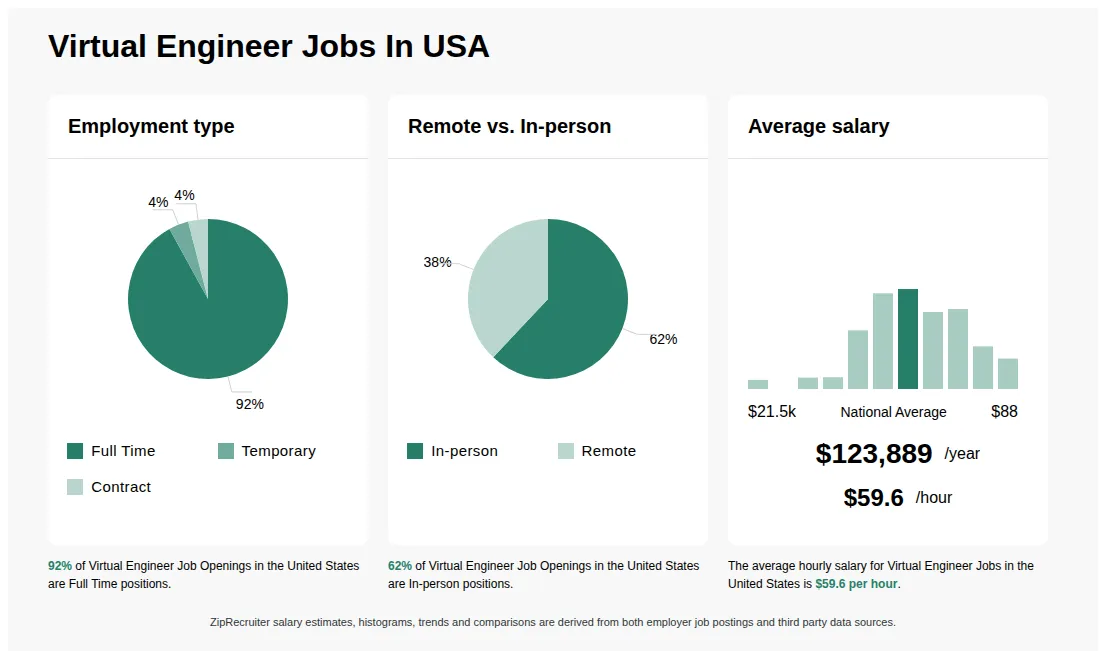
As of Aug 16, 2026, the average hourly pay for virtual engineer in the United States is $59.56, according to ZipRecruiter salary data. Most workers in this role earn between $49.28 and $68.03 per hour, depending on experience, location, and employer.

What is a virtual engineer?

A Virtual Engineer is a professional who provides engineering support, design, or troubleshooting services remotely using digital tools and platforms. They may work in fields like software development, IT infrastructure, mechanical design, or networking. Virtual Engineers collaborate with teams online, leveraging cloud computing, simulations, and remote access technologies to complete their tasks efficiently. This role is increasingly in demand due to the rise of remote work and digital transformation.

What are the key skills and qualifications needed to thrive as a virtual engineer?

To excel as a Virtual Engineer, you need strong technical expertise in systems engineering, software or network infrastructure, and a relevant degree in engineering or computer science. Familiarity with cloud-based platforms, remote collaboration tools, and certifications such as AWS Certified Solutions Architect or Cisco CCNP are often required. Excellent problem-solving, communication, and time management skills are essential for effectively working with distributed teams and clients. These competencies ensure Virtual Engineers can deliver reliable solutions and maintain productivity in a flexible, remote environment.

What are some typical challenges a virtual engineer faces when working remotely?

A common challenge for Virtual Engineers is maintaining effective communication and collaboration with team members and stakeholders across different locations and time zones. They often need to troubleshoot complex technical issues without direct physical access to equipment, which requires creative problem-solving and advanced remote management skills. Adapting to evolving digital tools and workflows is important to stay productive and efficient. Overcoming these challenges enables Virtual Engineers to deliver high-quality work and remain integral contributors to their teams.

More about Virtual Engineer jobs

What cities are hiring for Virtual Engineer jobs?

Cities with the most Virtual Engineer job openings:

What are the most commonly searched types of Engineer jobs?

The most popular types of Engineer jobs are:

What states have the most Virtual Engineer jobs?

States with the most job openings for Virtual Engineer jobs include:

Infographic showing various Virtual Engineer job openings in the United States as of August 2026, with employment types broken down into 92% Full Time, 2% Part Time, and 6% Contract. Highlights an 86% Physical, 5% Hybrid, and 9% Remote job distribution, with an average salary of $123,889 per year, or $59.6 per hour.

3D-CFD-Senior Propulsion System Virtual Engineer - Combustion System

Stellantis

Auburn Hills, MI • On-site, Remote

$98K - $135K/yr

Full-time

Posted 26 days ago


Stellantis rating

7.5

Company rating: 7.5 out of 10

Based on 130 frontline employees who took The Breakroom Quiz

13th of 44 rated automakers


Job description

The Senior Propulsion System Virtual Engineer is responsible for providing guidance to design teams. He/ She will be an integral part of the development team. The engineer is responsible for utilizing commercial and /or internal tools to analyze propulsion components / systems to ensure functional objectives are met.
The responsibility of the senior engineer position will include, but not limited to:
  • The simulation engineer analyzes combustion system designs and concepts to achieve functional requirements
  • Builds and exercises analytical models for internal combustion engines using commercial 3D CFD software tools such as Converge.
  • Provides component-level and/or system-level design recommendations to Design Responsible Engineers based on interpretation of analysis results.
  • Retrieves and modifies CAD models of propulsion system components to support the development of CFD models.
  • Enhances current standard analysis practices and/or tools to improve prediction fidelity and/or execution speed in collaboration with the method development teams
  • Participates in product design and development teams and regularly presents analysis results to engineering peers, Chief engineers and propulsion system management.
  • Documents analysis objectives, results, conclusions and assumptions using a standard report template.
  • Cooperatively works with test engineers to enhance laboratory procedures to support the development of first-time capable analysis techniques and the physical means reduction.
  • Stays abreast of new technology and competitive products.

Basic Qualifications:
  • Bachelor's degree in Computer Science, Computer Engineering, Electrical Engineering, or a related field
  • Minimum 8 years of experience in CFD simulations on propulsion systems with focus on combustion system development
  • Experience with engineering analysis tools for Propulsion systems modeling and simulation (e.g. Converge, Ansa, Star-CCM+)
  • Excellent communication skills, both verbal and written
  • Demonstrated technical problem solving skills

Preferred Qualifications:
  • Master degree in Computer Science, Computer Engineering, Electrical Engineering, or a related field or PhD in Mechanical Engineering, Chemical engineering, Aerospace/Aeronautical Engineering or Applied Physics
  • Good overall knowledge of propulsion system technologies and corresponding energy transformation systems
  • Experience in Combustion system and combustion system simulations
  • Experience with AI and ML algorithms
  • Good skill in programming with commercial software (e.g. Matlab Simulink, Visual Basic, Visual C++)
  • Demonstrated/proven expertise / record of applied knowledge for design / process improvements

What Stellantis employees say

Pay

Benefits

Hours and flexibility

Workplace

Get the full story on Breakroom