2

Entry Level Engineer Jobs (NOW HIRING)

next page

Showing results 1-20

Entry Level Engineer information

See salary details

$30K

$69.4K

$118K

How much do entry level engineer jobs pay per year?

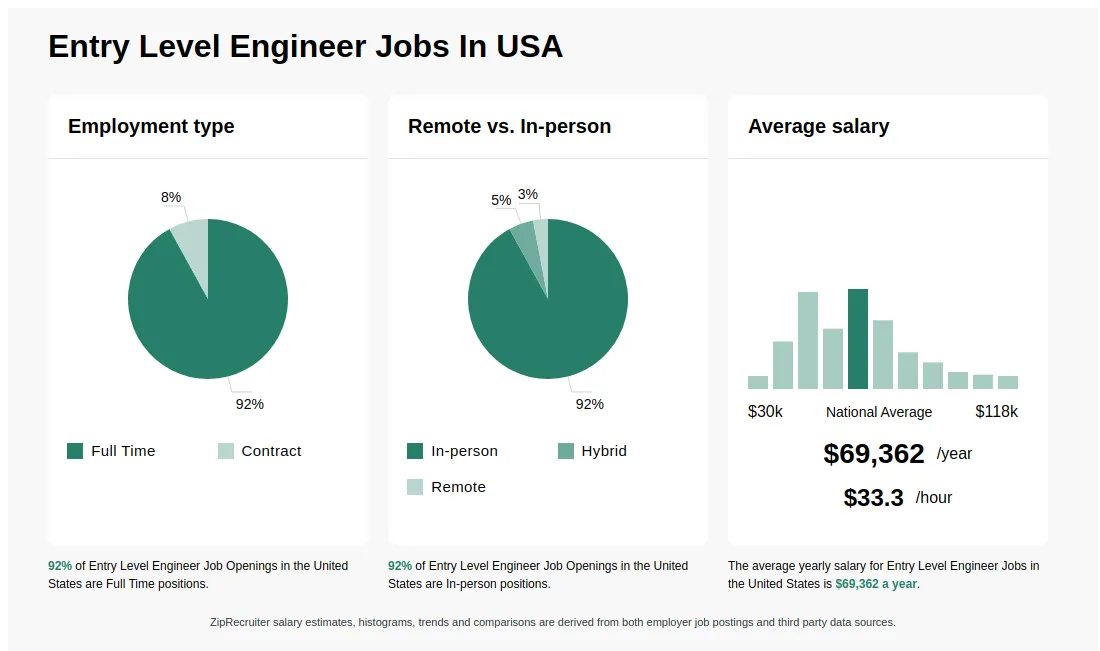
As of Jun 3, 2026, the average yearly pay for entry level engineer in the United States is $69,362.00, according to ZipRecruiter salary data. Most workers in this role earn between $51,500.00 and $78,500.00 per year, depending on experience, location, and employer.

What Is the Job Description for an Entry Level Engineer?

An entry-level engineer designs, builds, and maintains the functional aspects of a product, structure, or system for their specific engineering industry. All engineers start out in an entry-level position with fewer responsibilities until they gain work experience. Many start gaining experience through an internship or apprenticeship before moving into an entry-level position. An entry-level engineer job description relates to all of the education requirements, skills, detailed tasks, responsibilities that a company or organization requires for their specific engineering job. For example, civil engineers design, construct, and maintain large infrastructure projects, such as highways, bridges, and airports. Electrical engineers design, monitor, and test electrical systems.

What are the key skills and qualifications needed to thrive as an Entry Level Engineer, and why are they important?

To thrive as an Entry Level Engineer, you need a foundational understanding of engineering principles, problem-solving abilities, and a relevant bachelor's degree in engineering. Familiarity with industry-standard software such as CAD tools, MATLAB, or project management platforms, as well as relevant internships or certifications, is often expected. Strong communication, teamwork, and adaptability help you collaborate effectively and learn quickly in a dynamic environment. These skills ensure you can contribute to projects, adapt to organizational needs, and grow professionally in the engineering field.

What are some common challenges faced by entry level engineers during their first year on the job?

Entry level engineers often face challenges such as adapting to new tools and technologies, understanding company-specific processes, and translating theoretical knowledge into practical solutions. It's also common to navigate working on multidisciplinary teams and learning effective communication with colleagues from different backgrounds. With guidance from mentors and proactive engagement, these challenges become valuable learning experiences that contribute to professional growth.

What is an entry level engineer?

An entry level engineer is a recent graduate or someone with minimal professional experience who works in engineering roles under supervision. They assist with basic engineering tasks, learn company procedures, and gain practical experience in their field. Entry level engineers often participate in training, collaborate with experienced professionals, and gradually take on more responsibility as they develop their skills.

What is the difference between Entry Level Engineer vs Mechanical Engineer?

AspectEntry Level EngineerMechanical Engineer
Required CredentialsBachelor's degree in engineering or related field; internships helpfulBachelor's degree in mechanical engineering; licensure optional for some roles
Work EnvironmentDesign firms, manufacturing plants, construction sites, labsDesign, testing, manufacturing, research and development
Employer & Industry UsageEntry-level positions across various engineering sectorsMid to senior roles, but entry-level positions are common in manufacturing and design firms

Entry Level Engineers typically have a bachelor's degree and gain hands-on experience through internships. They work in diverse environments like design firms and manufacturing plants. Mechanical Engineers, while often requiring similar credentials, may start in entry-level roles but are more specialized in mechanical systems. Both roles are common in engineering industries, but the term 'Entry Level Engineer' is broader, encompassing various engineering disciplines, including mechanical engineering.

What cities are hiring for Entry Level Engineer jobs? Cities with the most Entry Level Engineer job openings:
What are the most commonly searched types of Engineer jobs? The most popular types of Engineer jobs are:
Who are the top companies hiring for Entry Level Engineer jobs? The top employers for Entry Level Engineer jobs are:
What states have the most Entry Level Engineer jobs? States with the most job openings for Entry Level Engineer jobs include:
Infographic showing various Entry Level Engineer job openings in the United States as of May 2026, with employment types broken down into 4% As Needed, 76% Full Time, 16% Part Time, and 4% Contract. Highlights an 92% Physical, 2% Hybrid, and 6% Remote job distribution, with an average salary of $69,362 per year, or $33.3 per hour.
Entry Level Engineer

Entry Level Engineer

ControlPoint Technologies, Inc

Rockland, MA โ€ข On-site

$68.85K - $93.15K/yr

Full-time

Medical, Dental, Vision, Life, Retirement, PTO

Posted 13 days ago


Job description

About the Entry Level Engineer position
ControlPoint is looking for engineers that are ready to launch their career in the Power & Energy Industry as Entry Level Engineers. The position will include project engineering, field engineering, and detailed design. Projects include renewable energy interconnection, utility system planning, substation engineering, protection & controls engineering, and distribution overhead and underground design.
ControlPoint Technologies is a mid-sized, project engineering and consulting firm to the electric utilities, providing innovative solutions, complex project designs, field support, system analysis, and project management.
We have multiple openings across all of our teams and business units. As an entry level engineer, you will be placed into a comprehensive "on the job" training program and quickly launch your engineering career.
You will be surrounded by industry experts and consultants from the Power & Energy Industry, assisting clients with the challenges of grid modernization, renewable energy integration, and system monitoring and automation.
Engineer skills include:
  • Technical Knowledge and Aptitude
  • Project Management
  • Client Communication
  • Professionalism
  • Teamwork

Engineer requirements are:
  • Bachelor of Science or Master of Science Engineering Degree from ABET accredited program/university.
  • Engineering Majors considered: Electrical Engineering, Mechanical Engineering, Energy Engineering, Multidisciplinary Engineering, Interdisciplinary Engineering, Renewable Energy, Civil Engineering or related major.
  • Ability to travel to office and field locations as needed.
  • Driver's License.
  • Ability to pass background check requirements.
  • Sponsorship not available at this time.

Base Compensation Range: $68,850.00-$93,150.00
The base compensation range for this position is based on education, work experience, licensure, and qualifications.
Comprehensive benefit package includes:
  • Competitive salary
  • Medical, Dental, and Vision Insurance
  • 401(k) and Roth 401(k) Retirement Plans with Company Match
  • Company paid short-term and long-term disability insurance
  • Company paid life insurance policy
  • Company paid training, seminars, and events
  • Tuition reimbursement
  • Professional Licensure reimbursement
  • Paid time off for holidays, vacation, and sick
  • Family medical leave
  • Company events and outings