1

Semiconductor Jobs (NOW HIRING)

As our semiconductor Program Manager, based in Middlefield (CT) , you will serve as the program owner for strategic initiatives focused on advanced memory and semiconductor packaging applications ...

WI · On-site

$99K - $125K/yr

You will work at the heart of advanced semiconductor development, collaborating with cross-functional teams to drive quality and reliability excellence.In this role you will play a key role in:

Semiconductor Assembly Operator

Sunnyvale, CA

$19.25 - $23.25/hr

Pyramid Semiconductor, part of the HEICO group (www.heico.com, NYSE HEI), is a manufacturer of semiconductors components. Pyramid Semiconductor is a complete semiconductor integrated circuit designer ...

New

Be Seen First

Senior Semiconductor Test Engineer Tucson, AZ A growing advanced technology manufacturer is seeking a Senior Semiconductor Test Engineer to lead the development, optimization, and sustainment of ...

Manager - Semiconductor Operations, Risk & Transformation Our Deloitte Regulatory, Risk & Forensic team helps client leaders translate multifaceted risk and an evolving regulatory environment into ...

Showing results 41-60

Semiconductor information

See salary details

$27K

$89.4K

$170K

How much do semiconductor jobs pay per year?

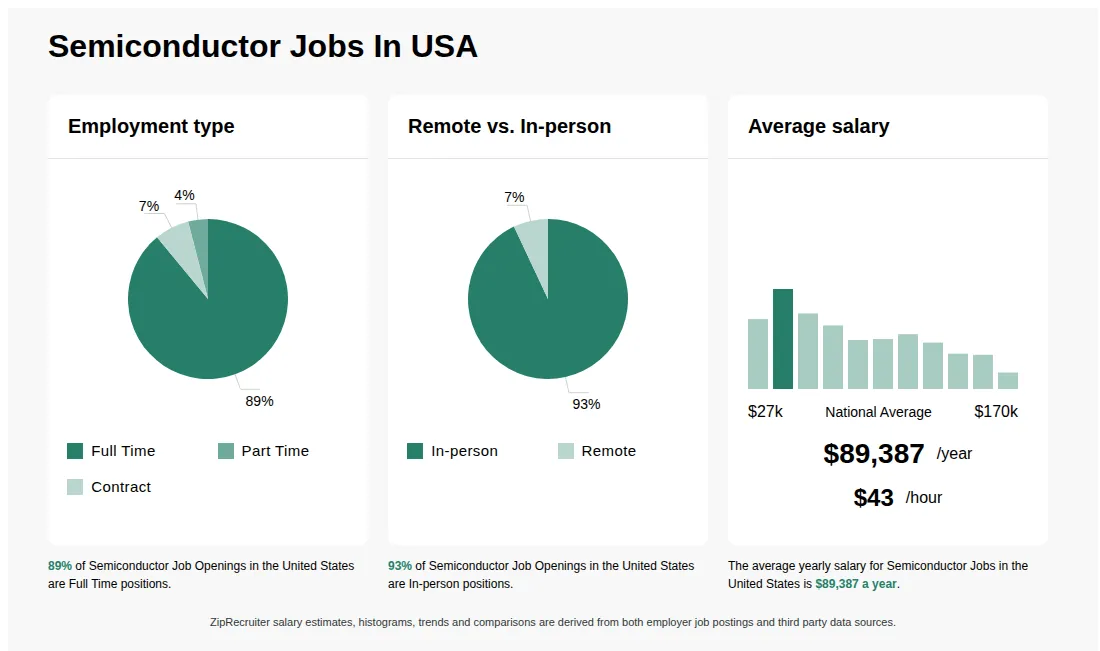
As of Aug 15, 2026, the average yearly pay for semiconductor in the United States is $89,387.00, according to ZipRecruiter salary data. Most workers in this role earn between $51,500.00 and $120,000.00 per year, depending on experience, location, and employer.

Is it hard to get a job in semiconductors?

Securing a job in the semiconductor industry can be competitive due to high demand for specialized skills such as electronics design, fabrication, and testing. Candidates with relevant education, experience, and knowledge of tools like CAD software or cleanroom protocols often have better prospects, but entry-level positions may be available for those with strong technical backgrounds. Overall, the difficulty depends on the specific role and individual qualifications.

What are some common challenges faced by professionals working in the semiconductor industry?

Professionals in the semiconductor industry often face challenges such as keeping up with rapid technological advancements, managing tight production timelines, and maintaining high quality standards in a highly competitive global market. Collaboration across multidisciplinary teams—including design, fabrication, and testing—is essential to ensure product success. Additionally, adapting to evolving industry regulations and supply chain disruptions requires strong problem-solving skills and continuous learning.

Is a semiconductor a good career?

A career in semiconductors involves working with the design, manufacturing, and testing of electronic components like chips and integrated circuits. It offers opportunities in engineering, research, and production, often requiring technical skills and knowledge of tools such as CAD software. The industry is essential to technology development and provides stable employment with ongoing innovation.

What is the difference between Semiconductor vs Electronics Technician?

AspectSemiconductorElectronics Technician
Required CredentialsTypically an associate degree or technical certification in semiconductor manufacturing or engineeringAssociate degree or diploma in electronics or related field
Work EnvironmentCleanroom facilities, manufacturing plants, R&D labsElectronics repair shops, manufacturing floors, technical support environments
Industry UsageSemiconductor manufacturing, chip design, fabricationElectronics repair, testing, installation, and maintenance

Semiconductors focus on the design, fabrication, and testing of semiconductor devices and chips, often within specialized cleanroom environments. Electronics Technicians work on maintaining, repairing, and testing electronic systems and devices across various industries. While both roles require technical skills and certifications, semiconductors are more specialized in chip manufacturing, whereas electronics technicians have broader applications in electronic device support and maintenance.


What are the key skills and qualifications needed to thrive as a semiconductor engineer?

To thrive as a Semiconductor Engineer, you need a solid background in electrical engineering, physics, or materials science, often supported by a relevant bachelor's or master's degree. Familiarity with CAD tools, semiconductor fabrication processes, and industry-standard software like SPICE or MATLAB is typically required. Analytical thinking, attention to detail, and strong problem-solving skills are crucial soft skills for this role. These competencies enable engineers to design, optimize, and troubleshoot semiconductor devices that power modern electronics.

What does a semiconductor job do?

A semiconductor job involves designing, manufacturing, testing, or maintaining semiconductor devices such as microchips and integrated circuits. Roles often require knowledge of electronics, cleanroom environments, and tools like CAD software or fabrication equipment. These jobs support the development of electronic products used in computers, smartphones, and other technology.

What does a semiconductor professional do?

Semiconductors are materials that have electrical conductivity between that of conductors and insulators, commonly used to manufacture electronic components like microchips and transistors. Professionals in the semiconductor industry design, manufacture, test, and improve these components, which are essential for devices such as smartphones, computers, and automotive electronics. Their work involves specialized knowledge in physics, engineering, and technology to innovate and produce reliable, high-performance products.

What cities are hiring for Semiconductor jobs?

Cities with the most Semiconductor job openings:

What are the most commonly searched types of Semiconductor jobs?

The most popular types of Semiconductor jobs are:

What states have the most Semiconductor jobs?

States with the most job openings for Semiconductor jobs include:

Infographic showing various Semiconductor job openings in the United States as of August 2026, with employment types broken down into 92% Full Time, 5% Part Time, 2% Contract, and 1% Nights. Highlights an 89% Physical, 3% Hybrid, and 8% Remote job distribution, with an average salary of $89,387 per year, or $43 per hour.

Semiconductor Process Engineer

Quantum Computing Inc.

Bedford, MA • On-site

Full-time

Re-posted 4 days ago


Job description

Semiconductor Process Engineer
Location: Wilmington, MA
About Us
Quantum Computing Inc. (QCi) (Nasdaq: QUBT) is an innovative, integrated photonics company that provides accessible and affordable quantum machines to the world today. QCi products are designed to operate at room temperature and low power at an affordable cost. The Company's portfolio of core technology and products offer unique capabilities in the areas of high-performance computing, artificial intelligence, cyber security as well as remote sensing applications.
Position Description
The successful applicant will be part of a team that produces world-class sensors based on photodetectors, diode lasers, and other wafer-based optoelectronic devices for various applications including optical communications, remote sensing (e.g., lidar and laser rangefinding), quantum sensing, high-performance imaging, and photonic integrated circuits. Working collaboratively with the rest of our in-house wafer fabrication team, the Semiconductor Process Engineer will oversee the development and production of state-of-the-art III-V avalanche photodetectors, laser diodes, and other optoelectronic devices. This individual will develop and optimize new device fabrication processes, guide process technicians to successfully complete these fabrication process, improve processing procedures, and identify processing issues. This engineer will also be responsible for the operation of all equipment used during fabrication processes that support both new product development and product manufacturing.
Duties and Responsibilities
  • Develop new fabrication processes and define new process flows.
  • Continuously improve existing fabrication processes and process flows.
  • Work with device designers to fabricate and optimize new photonic devices.
  • Develop thin film deposition procedures required for new device structures.
  • Develop thin film wet etching, RIE, and DRIE as required for device development.
  • Perform photolithography mask CAD design and layout.
  • Develop wafer diffusion processes for III-V semiconductors.
  • Implement, document, and maintain process run sheets and work instructions.
  • Analyze correlations between process attributes (e.g., metrology data, process conditions, process variation) and device performance (e.g., functional test results).
  • Track process variation and drive continuous improvement initiatives.
  • Review new device specifications and analyze requirements against existing capabilities to estimate costs and yields for new and existing products.
  • Support the fabrication facility in obtaining and maintaining industry-standard certifications.

Required Skills and Experience
  • MS or BS in Electrical Engineering, Materials Science or a related discipline
  • 4+ years of hands-on experience with compound semiconductor device fabrication
  • Significant experience with semiconductor process technology and understanding of semiconductor device physics.
  • Must be able to work independently with minimal supervision.
  • Strong organizational, analytical, and problem-solving skills.
  • Ability to perform critical clean room processing techniques.
  • Excellent dexterity for handling semiconductor wafers.
  • Comfortable and focused on safety while handling clean room chemicals.
  • Proficiency with DOE and SPC concepts.
  • Ability to document work and accurately update written procedures.
  • Excellent communications skills, both written and oral.

Preferred Qualifications
  • PhD in Electrical Engineering, Materials Science, or a related discipline
  • Strong working knowledge of semiconductor photodetectors, laser diodes, and optoelectronic device fabrication.
  • Experienced with electrical and electro-optical testing, semiconductor device metrology, and data analysis tools.
  • Comprehensive understanding of DOE and SPC concepts.

Incumbent(s) in this position may be required to perform other duties and special assignments not specifically stated above. Statements outlined in this section are designated as essential job functions in accordance with the Americans with Disabilities Act of 1990.