1

Semiconductor Jobs (NOW HIRING)

Semiconductor Chip ExpertJob Title: Semiconductor Chip ExpertLocation: Austin, TX, United States We are seeking a highly skilled Semiconductor Chip Expert to join our team in Austin, TX. The ideal ...

Be Seen First

Semiconductor Process Technician Summary A high‐tech manufacturing organization is seeking a Semiconductor Process Technician to support wafer‐level fabrication, optical device processing, and ...

Lumenci is seeking a Senior Associate - Semiconductor to support high-impact patent litigation, IP strategy, and monetization engagements across advanced semiconductor technologies. This role is ...

Semiconductor Process Engineer Location: Wilmington, MA About Us Quantum Computing Inc. (QCi) (Nasdaq: QUBT) is an innovative, integrated photonics company that provides accessible and affordable ...

Lumenci is seeking a Senior Semiconductor IP Consultant to support high-stakes patent litigation, IP strategy, and patent monetization for leading law firms and global technology companies. This role ...

next page

Showing results 1-20

Semiconductor information

See salary details

$27K

$89.4K

$170K

How much do semiconductor jobs pay per year?

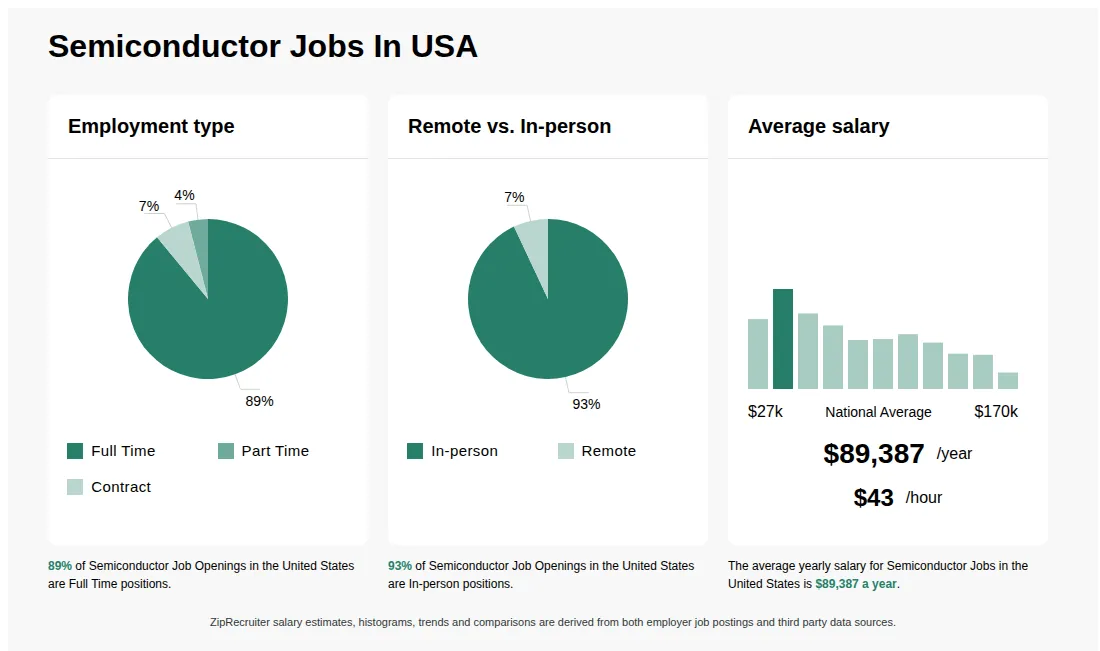
As of Jul 5, 2026, the average yearly pay for semiconductor in the United States is $89,387.00, according to ZipRecruiter salary data. Most workers in this role earn between $51,500.00 and $120,000.00 per year, depending on experience, location, and employer.

What are jobs that have to do with semiconductors?

Jobs related to semiconductors include semiconductor process engineers, device engineers, manufacturing technicians, quality control specialists, and research scientists. These roles involve designing, manufacturing, testing, and improving semiconductor devices and integrated circuits, often requiring knowledge of cleanroom environments, semiconductor fabrication processes, and relevant technical skills.

What Is a Semiconductor?

A semiconductor is a type of material able to conduct electricity in a way similar to, but not the same as, some metals, which are the opposite of insulators like glass. Using a variety of technical means, semiconductors can be engineered to have different levels of conductivity and conduct electricity in one direction more easily than the other. The most common commercial materials used in semiconductor manufacturing are the pure elements silicon, germanium, and other more complex organic and inorganic compounds.

What jobs pay $500,000 a year in the US?

In the semiconductor industry, executive roles such as Vice President or Chief Executive Officer can earn $500,000 or more annually, especially with bonuses and stock options. Highly specialized engineers or technical directors with extensive experience and leadership responsibilities may also reach this compensation level. These roles typically require advanced degrees, significant industry experience, and strong leadership skills.

What are some common challenges faced by professionals working in the semiconductor industry?

Professionals in the semiconductor industry often face challenges such as keeping up with rapid technological advancements, managing tight production timelines, and maintaining high quality standards in a highly competitive global market. Collaboration across multidisciplinary teams—including design, fabrication, and testing—is essential to ensure product success. Additionally, adapting to evolving industry regulations and supply chain disruptions requires strong problem-solving skills and continuous learning.

What is the difference between Semiconductor vs Electronics Technician?

AspectSemiconductorElectronics Technician
Required CredentialsTypically an associate degree or technical certification in semiconductor manufacturing or engineeringAssociate degree or diploma in electronics or related field
Work EnvironmentCleanroom facilities, manufacturing plants, R&D labsElectronics repair shops, manufacturing floors, technical support environments
Industry UsageSemiconductor manufacturing, chip design, fabricationElectronics repair, testing, installation, and maintenance

Semiconductors focus on the design, fabrication, and testing of semiconductor devices and chips, often within specialized cleanroom environments. Electronics Technicians work on maintaining, repairing, and testing electronic systems and devices across various industries. While both roles require technical skills and certifications, semiconductors are more specialized in chip manufacturing, whereas electronics technicians have broader applications in electronic device support and maintenance.

What are the key skills and qualifications needed to thrive as a Semiconductor Engineer, and why are they important?

To thrive as a Semiconductor Engineer, you need a solid background in electrical engineering, physics, or materials science, often supported by a relevant bachelor's or master's degree. Familiarity with CAD tools, semiconductor fabrication processes, and industry-standard software like SPICE or MATLAB is typically required. Analytical thinking, attention to detail, and strong problem-solving skills are crucial soft skills for this role. These competencies enable engineers to design, optimize, and troubleshoot semiconductor devices that power modern electronics.

Is semiconductor a good career?

A career in semiconductors involves working with the design, manufacturing, and testing of electronic components like chips and integrated circuits. It offers opportunities in engineering, research, and production, often requiring technical skills and knowledge of tools such as CAD software. The industry is essential to technology development and tends to have steady demand and competitive salaries.

What does a semiconductor job do?

A semiconductor job involves designing, manufacturing, testing, or maintaining semiconductor devices such as microchips and integrated circuits. These roles require knowledge of electronics, cleanroom environments, and tools like photolithography and testing equipment. Employees often work in labs or manufacturing facilities and may need technical certifications or degrees in engineering or related fields.

What are semiconductors and what do semiconductor professionals do?

Semiconductors are materials that have electrical conductivity between that of conductors and insulators, commonly used to manufacture electronic components like microchips and transistors. Professionals in the semiconductor industry design, manufacture, test, and improve these components, which are essential for devices such as smartphones, computers, and automotive electronics. Their work involves specialized knowledge in physics, engineering, and technology to innovate and produce reliable, high-performance products.
What cities are hiring for Semiconductor jobs? Cities with the most Semiconductor job openings:
What are the most commonly searched types of Semiconductor jobs? The most popular types of Semiconductor jobs are:
What states have the most Semiconductor jobs? States with the most job openings for Semiconductor jobs include:
Infographic showing various Semiconductor job openings in the United States as of June 2026, with employment types broken down into 92% Full Time, 5% Part Time, 1% Temporary, 1% Contract, and 1% Nights. Highlights an 90% Physical, 2% Hybrid, and 8% Remote job distribution, with an average salary of $89,387 per year, or $43 per hour.
Director of Technical Marketing (Semiconductor)

Director of Technical Marketing (Semiconductor)

Elevate Semiconductor

San Diego, CA

Full-time

Medical, Dental, Vision, Retirement, PTO

Posted 3 days ago


Job description

At Elevate Semiconductor, we empower semiconductor and system test customers by creating world class ICs that tackle the industry's most complex automated test equipment challenges. Our innovative team designs the lowest power, highest density solutions to reduce cost of test while pushing performance forward.

We are seeking a highly technical Director of Technical Marketing to serve as a key interface between customers, engineering, and product teams. This is not a traditional marketing role.

This individual will translate complex technical problems into clear product direction, positioning, and customer solutions.

Responsibilities

  • Act as a primary technical interface to customers, supporting both pre sales and post sales engagements
  • Lead deep technical discussions, presentations, and design reviews with customers and internal teams
  • Work closely with customers to understand system level requirements and technical challenges, translating Voice of Customer into actionable product insights
  • Partner with Design, Test, and Applications teams to drive technical alignment between customer needs and product execution
  • Support product bring up, characterization, qualification, and benchmarking activities
  • Troubleshoot customer issues and provide hands on technical guidance during integration, evaluation, and debug
  • Develop and deliver technical training to internal teams, customers, and partners
  • Create high quality technical collateral including presentations, application notes, and whitepapers
  • Collaborate with Sales to support customer opportunities and drive design wins through strong technical engagement
  • Act as a focal point for customer feedback, ensuring accurate and detailed communication back to engineering teams

Requirements

  • Bachelor's degree in Electrical Engineering or related field; PhD in Electrical Engineering or a related field preferred
  • 12+ years of experience in semiconductor product definition, applications, or highly technical marketing roles
  • Strong technical foundation in semiconductor devices and system-level behavior
  • Demonstrated ability to engage in detailed technical discussions with engineers and customers, including debugging, performance analysis, and tradeoff discussions
  • Experience working directly with OEM customers on complex technical integrations
  • Hands on experience with product bring up, characterization, qualification, or system-level validation
  • Experience developing technical presentations, training materials, or documentation
  • Strong cross-functional collaboration with engineering, test, and applications teams
  • Experience supporting global customers or cross-geographical teams

Preferences

  • Experience with semiconductor test, ATE, or related systems

Benefits

  • 100% Employer Paid Health Insurance (Medical, Dental, Vision)
  • Unlimited Paid Time Off
  • Performance Bonuses
  • Free Lunch Catered in by Local Restaurants
  • Private Equity Options
  • Retirement Plans
  • Sabbatical Program
  • Tuition Reimbursement
  • Volunteer Days
  • Relocation Assistance
  • Conference Attendance Support
  • Biweekly Phone Stipend
  • Employee Assistance Program