FORENSIC INTERVIEWER
Charleston, WV · On-site
The Forensic Interviewer interacts with professionals from other disciplines and agencies involved in investigations involving children and/or the provision of services to children and their families.
Charleston, WV · On-site
The Forensic Interviewer interacts with professionals from other disciplines and agencies involved in investigations involving children and/or the provision of services to children and their families.
Charleston, WV · On-site
The Forensic Interviewer interacts with professionals from other disciplines and agencies involved in investigations involving children and/or the provision of services to children and their families.
Charleston, WV · On-site
$75K/yr
Nature of Work The Forensic Interviewer provides forensic interview services to all agency clients who are child victims of abuse, neglect, violence or who are drug-endangered or are a witness to ...
Charleston, WV · On-site
$75K/yr
Nature of Work The Forensic Interviewer provides forensic interview services to all agency clients who are child victims of abuse, neglect, violence or who are drug-endangered or are a witness to ...
Southgate, MI · On-site
$23.82/hr
As a Forensic Interviewer in the Kids-TALK Program, you will be responsible for: * The Forensic Interviewer for the Kids-TALK Children's Advocacy Center (CAC) is responsible for providing ...
Southgate, MI · On-site
$23.82/hr
As a Forensic Interviewer in the Kids-TALK Program, you will be responsible for: * The Forensic Interviewer for the Kids-TALK Children's Advocacy Center (CAC) is responsible for providing ...
Southgate, MI · On-site
$23.82/hr
As a Forensic Interviewer in the Kids-TALK Program, you will be responsible for: * The Forensic Interviewer for the Kids-TALK Children's Advocacy Center (CAC) is responsible for providing ...
Southgate, MI · On-site
$23.82/hr
As a Forensic Interviewer in the Kids-TALK Program, you will be responsible for: * The Forensic Interviewer for the Kids-TALK Children's Advocacy Center (CAC) is responsible for providing ...
Forensic Interviewer - Child Protection Center UnityPoint Health - Allen Shift: Full-time Days Benefits Eligible The Forensic Interviewer is responsible for the interviewing of children and dependent ...
Forensic Interviewer - Child Protection Center UnityPoint Health - Allen Shift: Full-time Days Benefits Eligible The Forensic Interviewer is responsible for the interviewing of children and dependent ...
Overview Forensic Interviewer - Child Protection Center UnityPoint Health - Allen Shift: Full-time Days Benefits Eligible The Forensic Interviewer is responsible for the interviewing of children and ...
Overview Forensic Interviewer - Child Protection Center UnityPoint Health - Allen Shift: Full-time Days Benefits Eligible The Forensic Interviewer is responsible for the interviewing of children and ...
Portland, TX · On-site
Role Description The Forensic Interviewer is a full-time, on-site role based in Portland, TX. This position conducts developmentally appropriate, legally sound, and trauma-informed forensic ...
Portland, TX · On-site
Role Description The Forensic Interviewer is a full-time, on-site role based in Portland, TX. This position conducts developmentally appropriate, legally sound, and trauma-informed forensic ...
Lewisville, TX · On-site
$51K/yr
CHILDREN'S ADVOCACY CENTER FOR NORTH TEXAS is an EEO Employer - M/F/Disability/Protected Veteran Status Forensic Interviewer Salary starting at $51,000/year. Salary is based onyears of experience.
Lewisville, TX · On-site
$51K/yr
CHILDREN'S ADVOCACY CENTER FOR NORTH TEXAS is an EEO Employer - M/F/Disability/Protected Veteran Status Forensic Interviewer Salary starting at $51,000/year. Salary is based onyears of experience.
Provo, UT · On-site
$73K - $84K/yr
Forensic Interviewer II - CJC POSTING #: 2372-0726sr May underfill as Forensic Interviewer I - CJC Forensic Interviewer II - CJC - Applicants must possess and maintain licensure under the Mental ...
Provo, UT · On-site
$73K - $84K/yr
Forensic Interviewer II - CJC POSTING #: 2372-0726sr May underfill as Forensic Interviewer I - CJC Forensic Interviewer II - CJC - Applicants must possess and maintain licensure under the Mental ...
Justice, IL · On-site
$73K - $84K/yr
Forensic Interviewer II - CJC POSTING #: 2372-0726srMay underfill as Forensic Interviewer I - CJC Forensic Interviewer II - CJC - Applicants must possess and maintain licensure under the Mental ...
Justice, IL · On-site
$73K - $84K/yr
Forensic Interviewer II - CJC POSTING #: 2372-0726srMay underfill as Forensic Interviewer I - CJC Forensic Interviewer II - CJC - Applicants must possess and maintain licensure under the Mental ...
Tupelo, MS · On-site
$44K/yr
What You'll Do As a Forensic Interviewer you will work with the Multi-Disciplinary Team investigators to conduct forensic interviews on children ages 3-17 and vulnerable adults with allegations of ...
Tupelo, MS · On-site
$44K/yr
What You'll Do As a Forensic Interviewer you will work with the Multi-Disciplinary Team investigators to conduct forensic interviews on children ages 3-17 and vulnerable adults with allegations of ...
Tupelo, MS · On-site
$44K/yr
What You'll Do As a Forensic Interviewer you will work with the Multi-Disciplinary Team investigators to conduct forensic interviews on children ages 3-17 and vulnerable adults with allegations of ...
Tupelo, MS · On-site
$44K/yr
What You'll Do As a Forensic Interviewer you will work with the Multi-Disciplinary Team investigators to conduct forensic interviews on children ages 3-17 and vulnerable adults with allegations of ...
Tupelo, MS · On-site
$44K/yr
What You'll Do As a Forensic Interviewer you will work with the Multi-Disciplinary Team investigators to conduct forensic interviews on children ages 3-17 and vulnerable adults with allegations of ...
Tupelo, MS · On-site
$44K/yr
What You'll Do As a Forensic Interviewer you will work with the Multi-Disciplinary Team investigators to conduct forensic interviews on children ages 3-17 and vulnerable adults with allegations of ...
Little Flock, AR · On-site
We are seeking a highly skilled and compassionate Forensic Interviewer to join our team. In this role, you will conduct forensic interviews with children and adolescents in a sensitive and neutral ...
Little Flock, AR · On-site
We are seeking a highly skilled and compassionate Forensic Interviewer to join our team. In this role, you will conduct forensic interviews with children and adolescents in a sensitive and neutral ...
Eugene, OR · On-site
$65K - $80K/yr
We're seeking a fluent English/Spanish Bilingual Forensic Interviewer to conduct developmentally appropriate, trauma-informed forensic interviews with children, collaborate with multidisciplinary ...
Quick apply
Eugene, OR · On-site
$65K - $80K/yr
We're seeking a fluent English/Spanish Bilingual Forensic Interviewer to conduct developmentally appropriate, trauma-informed forensic interviews with children, collaborate with multidisciplinary ...
Tupelo, MS · On-site
$44K/yr
What You'll Do As a Forensic Interviewer you will work with the Multi-Disciplinary Team investigators to conduct forensic interviews on children ages 3-17 and vulnerable adults with allegations of ...
Tupelo, MS · On-site
$44K/yr
What You'll Do As a Forensic Interviewer you will work with the Multi-Disciplinary Team investigators to conduct forensic interviews on children ages 3-17 and vulnerable adults with allegations of ...
Tupelo, MS · On-site
$44K/yr
What You'll Do As a Forensic Interviewer you will work with the Multi-Disciplinary Team investigators to conduct forensic interviews on children ages 3-17 and vulnerable adults with allegations of ...
Tupelo, MS · On-site
$44K/yr
What You'll Do As a Forensic Interviewer you will work with the Multi-Disciplinary Team investigators to conduct forensic interviews on children ages 3-17 and vulnerable adults with allegations of ...
Tupelo, MS · On-site
$44K/yr
What You'll Do As a Forensic Interviewer you will work with the Multi-Disciplinary Team investigators to conduct forensic interviews on children ages 3-17 and vulnerable adults with allegations of ...
Tupelo, MS · On-site
$44K/yr
What You'll Do As a Forensic Interviewer you will work with the Multi-Disciplinary Team investigators to conduct forensic interviews on children ages 3-17 and vulnerable adults with allegations of ...
What You'll Do As a Forensic Interviewer you will work with the Multi-Disciplinary Team investigators to conduct forensic interviews on children ages 3-17 and vulnerable adults with allegations of ...
What You'll Do As a Forensic Interviewer you will work with the Multi-Disciplinary Team investigators to conduct forensic interviews on children ages 3-17 and vulnerable adults with allegations of ...
Forensic Interviewer Salary starting at $51,000/year. Salary is based onyears of experience. This position's primary job function is toperform forensic interviews of children. This position works ...
Forensic Interviewer Salary starting at $51,000/year. Salary is based onyears of experience. This position's primary job function is toperform forensic interviews of children. This position works ...
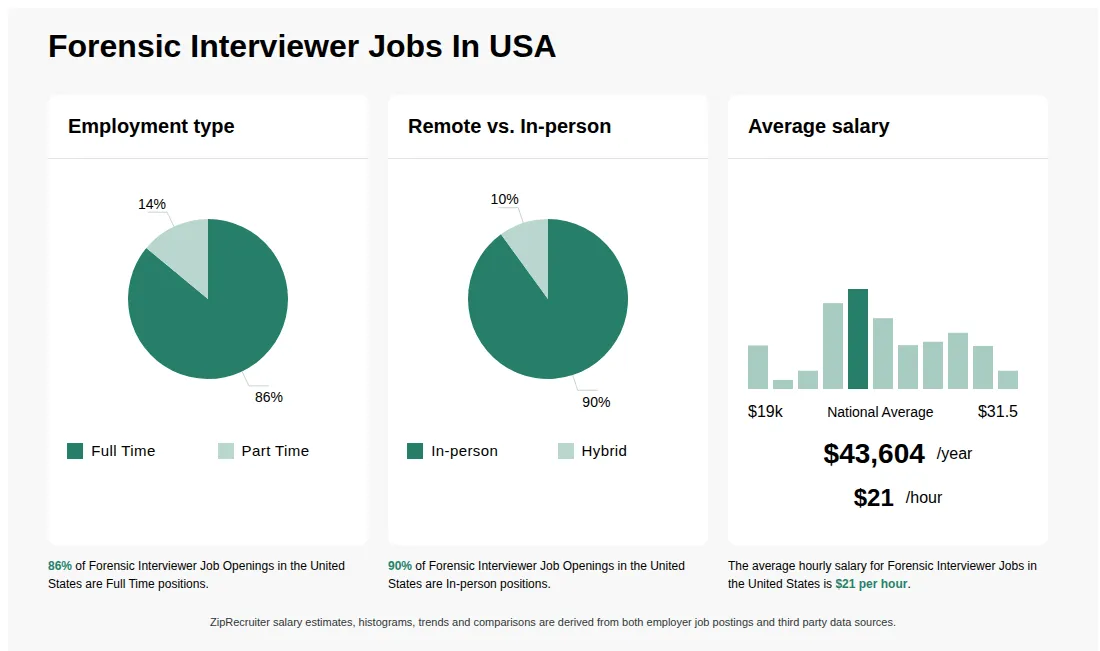
$9.13 - $11.17
8% of jobs
$11.17 - $13.20
1% of jobs
$13.20 - $15.23
3% of jobs
$16.76 is the 25th percentile. Wages below this are outliers.
$15.23 - $17.26
17% of jobs
$17.26 - $19.30
19% of jobs
The median wage is $19.61 / hr.
$19.30 - $21.33
14% of jobs
$21.33 - $23.36
8% of jobs
$24.63 is the 75th percentile. Wages above this are outliers.
$23.36 - $25.39
8% of jobs
$25.39 - $27.43
10% of jobs
$27.43 - $29.46
8% of jobs
$29.46 - $31.49
3% of jobs
$9
$20
$31
A Forensic Interviewer is a trained professional who conducts structured conversations with children or vulnerable individuals involved in abuse, neglect, or other criminal investigations. They use specialized techniques to gather accurate, non-leading information while ensuring the interview is legally sound and trauma-informed. Their work helps law enforcement, child protective services, and legal teams make informed decisions while minimizing retraumatization for the victim.
To thrive as a Forensic Interviewer, you need a strong understanding of investigative interviewing techniques, child development or trauma-informed care, and a relevant degree such as social work, psychology, or criminal justice. Knowledge of specialized protocols like the Child Advocacy Center model, familiarity with digital recording equipment, and relevant certifications such as forensic interviewer training are highly valued. Excellent communication, empathy, and active listening skills help build trust with interviewees and enhance collaboration with multidisciplinary teams. These competencies are critical for gathering accurate information while minimizing trauma for victims and ensuring that interviews hold up under legal scrutiny.
Forensic Interviewers commonly encounter emotionally charged situations, working with vulnerable populations such as children or trauma survivors, which can be both challenging and rewarding. Managing personal resilience and avoiding burnout is crucial, and many workplaces provide ongoing training, supervision, and access to peer support or mental health resources. Interviewers often collaborate closely with law enforcement, social services, and legal professionals, which requires adaptability and strong teamwork skills. These supports and collaborative practices help ensure interviews are conducted ethically and effectively, while also sustaining the well-being of the interviewer.
Cities with the most Forensic Interviewer job openings:
The most popular types of Forensic Interviewer jobs are:
States with the most job openings for Forensic Interviewer jobs include:
The top searched job categories for Forensic Interviewer jobs are:
7.6
Based on 58 frontline employees who took The Breakroom Quiz
29th of 50 rated states
Get the full story on Breakroom

Sourced by ZipRecruiter
Public administration
10,000+ Employees
Charleston, WV, US
2007