1

Forensic Investigator Jobs (NOW HIRING)

The Forensic Investigator responds to death scenes to document, recover and identify human remains, and collect and preserve physical and biological evidence. Answers and records death calls and ...

FORENSIC INVESTIGATOR

Baltimore, MD · On-site

$52K - $67K/yr

Baltimore Street Baltimore, MD 21223 Main Purpose of Job A Forensic Investigator is full performance level work that conducts investigation of cases that are referred to the Office of the Chief ...

The Digital Forensic Investigator uses a variety of highly specialized software and technical skills to forensically analyze computers and other digital / data storage devices such as smart phones ...

Forensic Investigator (Grade 11)

Yuma, AZ · On-site

$24.62 - $30.78/hr

NATURE OF WORK Under general supervision, performs work of moderate difficulty in conducting forensic operations and investigations within the Medical Examiner's section of the Sheriff's Office; this ...

Forensic Investigator (Grade 11)

Yuma, AZ · On-site

$24.62 - $30.78/hr

NATURE OF WORK Under general supervision, performs work of moderate difficulty in conducting forensic operations and investigations within the Medical Examiner's section of the Sheriff's Office; this ...

next page

Showing results 1-20

Forensic Investigator information

See salary details

$33K

$77.4K

$133K

How much do forensic investigator jobs pay per year?

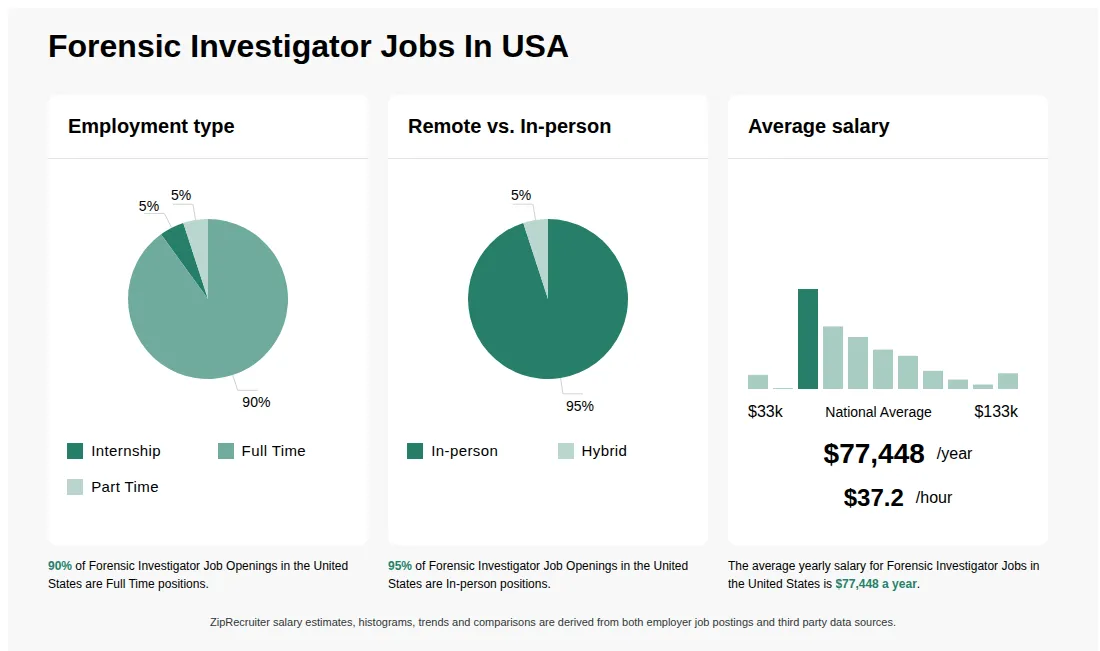
As of Jul 8, 2026, the average yearly pay for forensic investigator in the United States is $77,448.00, according to ZipRecruiter salary data. Most workers in this role earn between $57,000.00 and $89,000.00 per year, depending on experience, location, and employer.

What is the difference between Forensic Investigator vs Crime Scene Technician?

AspectForensic InvestigatorCrime Scene Technician
CredentialsTypically requires a degree in criminal justice, forensic science, or related field; certifications like ASCLD-LAB are commonOften requires a high school diploma or associate degree; specialized training in evidence collection
Work EnvironmentInvestigates crime scenes, analyzes evidence, and collaborates with law enforcementCollects, preserves, and documents evidence at crime scenes
Employer & IndustryLaw enforcement agencies, forensic labs, government agenciesPolice departments, crime labs, forensic units

While both roles work at crime scenes and handle evidence, Forensic Investigators typically have more advanced education and perform detailed analysis and case investigations, whereas Crime Scene Technicians focus on evidence collection and documentation.


What qualifications do you need for a forensic investigator?

A forensic investigator typically needs a bachelor's degree in criminal justice, forensic science, or a related field. Relevant skills include attention to detail, knowledge of laboratory techniques, and proficiency with forensic tools and software; some positions may require certification such as the Certified Forensic Scientist (CFS) or similar credentials.

Can I be a CSI without being a cop?

A forensic investigator or crime scene investigator (CSI) is not necessarily a police officer; many CSIs are civilians with specialized training in evidence collection, fingerprint analysis, and forensic techniques. While some law enforcement agencies require CSIs to be sworn officers, others hire civilians for forensic roles, often requiring certifications and technical skills. The specific requirements vary by agency and jurisdiction.

What are some common challenges faced by forensic investigators in the field?

Forensic investigators often encounter challenges such as working in high-pressure environments where timely and accurate analysis is critical. They may need to process crime scenes that are physically demanding or emotionally difficult, while maintaining strict attention to detail to preserve evidence integrity. Collaboration with law enforcement, legal teams, and sometimes external experts is frequent, requiring strong communication skills. Managing a varied caseload and adapting to rapidly advancing forensic technologies are also key aspects of the job.

What does a forensic investigator do?

A forensic investigator is responsible for collecting, preserving, and analyzing evidence from crime scenes to help solve criminal cases. Their duties include photographing scenes, gathering physical evidence such as fingerprints, biological samples, and trace materials, and preparing detailed reports on their findings. Forensic investigators may also testify in court about the evidence and how it was collected. They work closely with law enforcement, legal teams, and sometimes laboratories to ensure evidence is handled properly and contributes to the justice process.

How do you become a forensic investigator?

To become a forensic investigator, individuals typically need a bachelor's degree in criminal justice, forensic science, or a related field. Gaining experience through internships or entry-level law enforcement roles is common, and obtaining certifications such as the Certified Forensic Science Investigator (CFSI) can enhance job prospects. Strong analytical skills, attention to detail, and proficiency with laboratory tools and evidence handling are essential.

What Is a Forensic Investigator?

A forensic investigator is a crime scene investigator (CSI) who collects and analyzes forensic evidence related to a criminal investigation. Their duties include visiting crime scenes and collecting trace evidence such as hair, blood, and fingerprints. Their job is to collect, test, and process forensic evidence accurately so that it can be used in criminal cases.

What does a forensics investigator do?

A forensic investigator collects, analyzes, and preserves physical evidence from crime scenes to help solve crimes. They use scientific methods, laboratory tools, and documentation skills to support criminal investigations and may work with law enforcement agencies. Certification and attention to detail are important in this role.

What are the key skills and qualifications needed to thrive as a Forensic Investigator, and why are they important?

To thrive as a Forensic Investigator, you need strong analytical skills, attention to detail, and a relevant degree in forensic science, criminal justice, or a related field. Familiarity with evidence collection tools, laboratory analysis techniques, and digital forensics software is typically required, along with certifications such as those from the International Association for Identification (IAI). Excellent written communication, critical thinking, and teamwork skills help you document findings clearly and collaborate with law enforcement and legal professionals. These skills ensure accurate evidence analysis and contribute to the integrity and success of criminal investigations.
What cities are hiring for Forensic Investigator jobs? Cities with the most Forensic Investigator job openings:
What are the most commonly searched types of Forensic Investigator jobs? The most popular types of Forensic Investigator jobs are:
Who are the top companies hiring for Forensic Investigator jobs? The top employers for Forensic Investigator jobs are:
What states have the most Forensic Investigator jobs? States with the most job openings for Forensic Investigator jobs include:
Infographic showing various Forensic Investigator job openings in the United States as of July 2026, with employment types broken down into 1% As Needed, 81% Full Time, 9% Part Time, 1% Temporary, and 8% Contract. Highlights an 87% Physical, 3% Hybrid, and 10% Remote job distribution, with an average salary of $77,448 per year, or $37.2 per hour.
Forensic Investigator

Forensic Investigator

Harris County

Houston, TX • On-site

$33K/yr

Other

This job post has expired today. Applications are no longer accepted.


Harris County rating

7.9

Company rating: 7.9 out of 10

Based on 118 frontline employees who took The Breakroom Quiz

308th of 673 rated public administrative organizations


Job description

Position Description Mission The Mission of the Harris County Institute of Forensic Sciences is to provide medical examiner and crime laboratory services of the highest quality in an unbiased manner with uncompromised integrity. Vision To provide consistent, quality death investigation and laboratory analysis for the benefit of the entire community. To create a technological strongpoint for legal agencies to facilitate justice in criminal and civil proceedings.

To establish an academic environment for training in the field of Forensic Science. Brief Forensic Investigator Overview: The Forensic Investigator responds to death scenes to document, recover and identify human remains, and collect and preserve physical and biological evidence. Answers and records death calls and prepares written and verbal reports in accordance with Sec.

49.25, Texas Code of Criminal Procedure. Consults other HCIFS Divisions (i.e. anthropology, trace) as requested or required by the circumstances of a case

Duties & Responsibilities: Responds to death scenes to document, recover and identify human remains, and collect and preserve physical and biological evidence. While on scene, responsible for directing decedent transport staff in helping with manipulation of the decedent, property collection, and evidence collection at scenes. Locates and notifies family of death, responds to inquiries from families and law enforcement agencies, and provides for complete transition of information from shift to shift and team to team.

Prepares and submits to all designated parties reports covering operations and jurisdictions. Supervises the admission and release of bodies to ensure procedural compliance, protects the integrity of specimens and evidence, and ensures proper identification and storage. This includes supervision of decedent transport staff both at scenes and in the office.

Coordination with Forensic Transporters and Forensic Transporter II's for scene response and decedent recovery from hospitals/scenes. Testifies in court proceedings regarding investigation, observations, and documentation procedures at the scene. Notifies the Supervisor, Director of Forensic Investigations, and/or Assistant Deputy Chief Medical Examiner of special problems or interests.

Performs other duties as assigned by the Supervisor, Director of Forensic Investigations and/or Assistant Deputy Chief Medical Examiner. Other duties as assigned. Harris County is an Equal Opportunity Employer https://hrrm.harriscountytx.gov/Pages/EqualEmploymentOpportunityPlan.aspx If you need special services or accommodations, please call (713) 274-5445 or email ADACoordinator@bmd.hctx.net

This position is subject to a criminal history check. Only relevant convictions will be considered and, even when considered, may not automatically disqualify the candidate. Requirements A COPY OF TRANSCRIPTS MAY BE REQUIRED AT THE TIME OF INTERVIEW; AN OFFICIAL CERTIFIED ORIGINAL WILL BE REQUIRED PRIOR TO ANY JOB OFFER.

THIS POSITION IS CONDITIONAL UPON PASSING A CRIMINAL BACKGROUND CHECK AND A DRUG SCREENING. Education: Bachelor of Arts/Science degree from an accredited college or university in Criminal Justice, Forensic Science, Anthropology, Biological Sciences, or an equivalent field. Licensure: Valid driver's license is required (Texas within two weeks of employment) Knowledge, Skills & Abilities: Knowledge of crime scene investigation, photography, fingerprints and basic human anatomy.

Good written and oral communication skills. Effective organizational and time management skills are all essential to satisfactory job performance. Basic computer skills including computer systems using Microsoft Office and standard applications.

Ability to work independently with minimal supervision, prioritizing and handling multiple tasks simultaneously. Natural ambulation and manual dexterity are required due to the essential physical demands of manipulating bodies as part of the investigation and in loading/unloading bodies, including the ability to climb stairs, industrial and commercial structures; ability to board ships; and the ability to spend whatever time necessary on one's feet to investigate and/or recover human remains NOTE: Qualifying education, experience, knowledge, and skills must be documented on your job application. You may attach a resume to the application as supporting documentation but ONLY information stated on the application will be used for consideration.

"See Resume" will not be accepted for qualifications. Preferences Preferred Education: Graduate degrees in a related field Preferred Experience: Experience (previous employment or internships) in a medical examiner's office Experience with exposure to human remains at some point during schooling or prior work experience Preferred Licensure: Current registry (diplomate) level certification by the American Board of Medicolegal Death Investigators (ABMDI) General Information Location: Harris County Institute of Forensic Sciences - 1861 Old Spanish Trail Houston, TX 77054 Work Environment: Work involves possible exposure to unusual elements, such as extreme temperatures, dirt, dust, fumes, smoke, unpleasant odors, and/or loud noises. May come in contact with blood and/or blood-borne pathogens and will require training in Universal Precautions.

Employment may be contingent on passing a drug screen and meeting other standards. Due to a high volume of applications positions may close prior to the advertised closing date or at the discretion of the Hiring Department.


What Harris County employees say

Pay

Benefits

Hours and flexibility

Workplace

Get the full story on Breakroom


Harris County logo

About Harris County

Sourced by ZipRecruiter

Harris County is the third largest county in the United States with more than 4.7 million residents. There are four precincts in Harris County. The four elected commissioners, along with an elected county judge, serve as members of the Harris County Commissioners Court, the administrative head of the county's government.

Industry

Public administration

Company size

10,000+ Employees

Headquarters location

Houston, TX, US

Year founded

2000

Social media