1

Director Of Workforce Development Jobs (NOW HIRING)

DYCD's newest workforce development initiative CRED NYC (Community Resources for Employment and ... The Director of Strategy will be a key member of Workforce Connect collaborating across all teams.

next page

Showing results 1-20

People also search for

Director Of Workforce Development information

See salary details

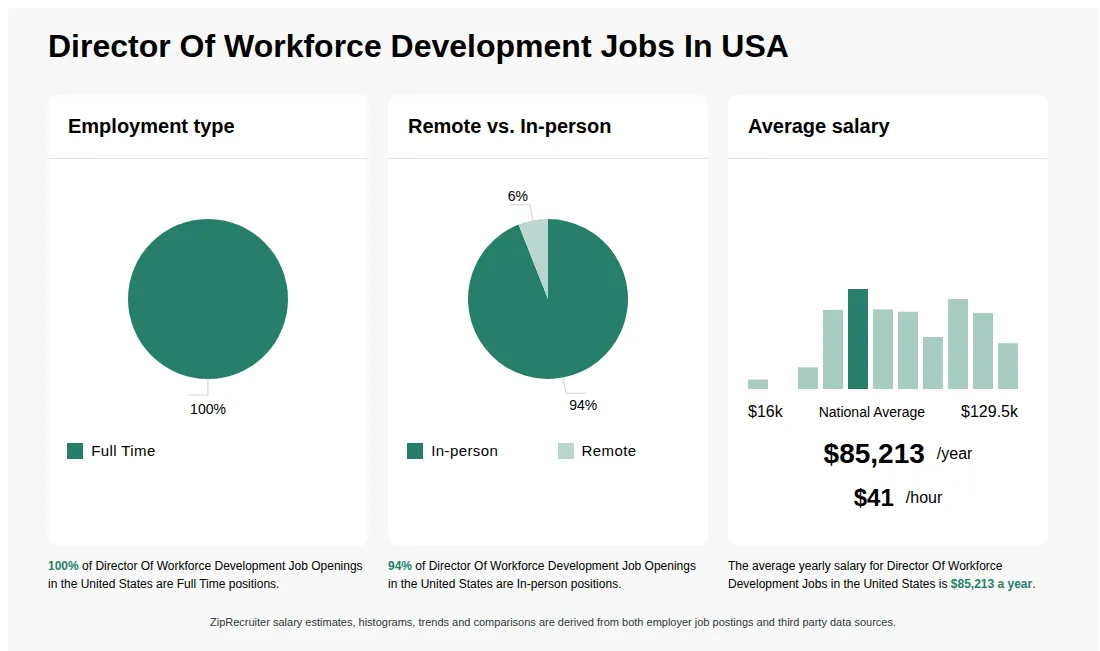
$16K

$85.2K

$129.5K

How much do director of workforce development jobs pay per year?

As of Jun 10, 2026, the average yearly pay for director of workforce development in the United States is $85,213.00, according to ZipRecruiter salary data. Most workers in this role earn between $63,500.00 and $109,500.00 per year, depending on experience, location, and employer.

What are some typical challenges faced by a Director of Workforce Development, and how can they be addressed?

A Director of Workforce Development often encounters challenges such as aligning workforce training initiatives with rapidly changing industry needs and ensuring equitable access to programs across diverse communities. Addressing these challenges requires close collaboration with employers, educational institutions, and community organizations to stay informed about skill gaps and employment trends. Building flexible, data-driven programs and fostering relationships with stakeholders are key strategies for overcoming these obstacles and driving successful workforce outcomes.

What is the difference between Director Of Workforce Development vs Workforce Development Coordinator?

AspectDirector Of Workforce DevelopmentWorkforce Development Coordinator
CredentialsBachelor's degree; often advanced degrees in HR, public administration, or related fieldsAssociate's or Bachelor's degree; relevant certifications may include HR or training certifications
Work EnvironmentLeadership roles in organizations, overseeing programs and teamsSupport roles, assisting in program implementation and coordination
Employer & Industry UsageGovernment agencies, large nonprofits, educational institutionsCommunity organizations, government offices, educational institutions
Search & Comparison IntentUnderstanding senior roles and responsibilities in workforce programsEntry to mid-level roles focusing on program support and coordination

The main difference between a Director Of Workforce Development and a Workforce Development Coordinator lies in their level of responsibility and scope. The director oversees strategic planning and manages teams, while the coordinator handles day-to-day program support. Both roles are vital in workforce development initiatives but differ in seniority and focus.

What does a Director of Workforce Development do?

A Director of Workforce Development oversees programs and initiatives aimed at improving the skills and employability of a community or organization’s workforce. They collaborate with employers, educational institutions, and government agencies to identify workforce needs and develop training programs. Their responsibilities often include strategic planning, managing staff and budgets, and measuring program effectiveness. The goal is to ensure that workers have the skills needed for current and future job opportunities.

What Is the Job of a Director of Workforce Development?

A director of workforce development manages the workforce development programs within an organization. Your responsibilities and duties in this career can drastically differ based upon the needs of the specific company. Typically, your responsibilities are to develop and implement plans for workforce training, supervise the employees within the workforce development department, coordinate with other managers to determine areas that need attention, and administer new training plans and practices for the organization. As director of workforce development, you must stay up to date on current training practices and trends in the labor markets. Additionally, you may be responsible for providing reports on the efficiency of the company’s staff.


What jobs pay 2000 a day?

Jobs that can pay $2,000 a day often include high-level executive roles such as Chief Executive Officers, specialized consultants, or certain legal and medical professionals with extensive experience. These positions typically require advanced skills, certifications, and significant responsibility, and may involve freelance or contract work with high hourly rates. For a Director of Workforce Development, such pay is uncommon unless combined with consulting or executive-level responsibilities.

What job makes $10,000 a month without a degree?

A Director of Workforce Development typically earns a salary that can reach or exceed $10,000 per month, especially with experience and in larger organizations. This role involves strategic planning, leadership, and workforce management skills, often requiring relevant experience but not necessarily a formal degree. High-level managerial or executive positions in certain industries may also offer similar compensation without a degree requirement.

What are the key skills and qualifications needed to thrive as a Director Of Workforce Development, and why are they important?

To thrive as a Director Of Workforce Development, you need expertise in workforce planning, program management, and a background in human resources or a related field, often supported by a bachelor’s or master’s degree. Familiarity with labor market analysis tools, learning management systems (LMS), and compliance with employment regulations is typically required. Strong leadership, collaboration, and strategic communication skills help build partnerships and drive organizational initiatives. These skills are crucial for designing effective workforce strategies that address organizational needs and foster talent development.

What jobs will no longer exist in 2030?

The role of certain manual and repetitive jobs, such as data entry clerks and assembly line workers, is expected to decline due to automation and AI advancements. In workforce development, roles that rely heavily on routine tasks may diminish, emphasizing the need for skills in technology, problem-solving, and adaptability to stay relevant in the evolving job market.

What is a workforce development director?

A workforce development director is a professional responsible for creating and managing programs that improve employment opportunities and skills for a community or organization. They often collaborate with educational institutions, government agencies, and employers to align training initiatives with labor market needs and may oversee staff, budgets, and program evaluation.
What cities are hiring for Director Of Workforce Development jobs? Cities with the most Director Of Workforce Development job openings:
What states have the most Director Of Workforce Development jobs? States with the most job openings for Director Of Workforce Development jobs include:
What job categories do people searching Director Of Workforce Development jobs look for? The top searched job categories for Director Of Workforce Development jobs are:
Infographic showing various Director Of Workforce Development job openings in the United States as of June 2026, with employment types broken down into 2% Internship, 3% As Needed, 77% Full Time, 9% Part Time, 2% Temporary, and 7% Contract. Highlights an 96% Physical, 1% Hybrid, and 3% Remote job distribution, with an average salary of $85,213 per year, or $41 per hour.
Workforce Development Specialist

Workforce Development Specialist

City of Pontiac

Pontiac, MI • On-site

$55K - $96K/yr

Full-time

Posted 8 days ago


Job description


Workforce Development Specialist

FLSA Status: Full Time, Exempt

Pay Grade: M-10

SUPERVISION

Supervision Received: Reports to the Economic Vitality Manager

Supervision Given: Does not have direct supervision

Under the supervision of the Economic Vitality Manager, the Workforce Development Specialist leads workforce development efforts that connect residents to employment, training, and career advancement opportunities aligned with local economic priorities. This position builds partnerships with employers, training providers, educational institutions, and community organizations; coordinates workforce initiatives and supportive programming; and helps strengthen talent pipelines that support both resident success and broader economic vitality.

ESSENTIAL FUNCTIONS:

  • Leads workforce development efforts that connect residents to employment, training, and career advancement opportunities aligned with local economic priorities.
  • Builds and maintains partnerships with employers, workforce agencies, training providers, educational institutions, community organizations, and other stakeholders to strengthen local talent pipelines and address workforce needs.
  • Coordinates workforce initiatives, recruitment events, job fairs, training opportunities, and supportive programming designed to expand access to quality jobs and skills development for residents.
  • Assists in identifying workforce gaps, barriers to employment, and emerging opportunities in order to support responsive strategies and program development.
  • Tracks program participation, outcomes, employer engagement, and other relevant data to support reporting, evaluation, and continuous improvement.
  • Collaborates with internal staff and external partners to align workforce programming with business attraction, retention, community development, and economic vitality goals.
  • Provides information and assistance to residents regarding training programs, job readiness resources, career pathways, and available workforce support services.
  • Prepares reports, correspondence, outreach materials, presentations, and updates related to workforce activities, partnerships, and program outcomes.
  • Supports meetings, events, and community engagement efforts related to workforce planning, employer outreach, and resident opportunity development.
  • Performs other related duties as assigned in support of departmental, organizational, and community priorities.

MINIMUM QUALIFICATIONS: Bachelor’s degree in public administration, human services, workforce development, education, business administration, community development, or a related field; supplemented by 5 years of experience in workforce programming, employment services, training coordination, community engagement, program administration, or a related area; or an equivalent combination of education, training, and experience that provides the required knowledge, skills, and abilities.

PREFERRED QUALIFICATIONS: Experience working with employers, training providers, educational institutions, workforce boards, community organizations, or public sector programs that support employment and career advancement. Familiarity with workforce systems, job readiness programming, career pathway development, employer engagement, and performance tracking is preferred.

KNOWLEDGE, SKILLS, AND ABILITIES: Knowledge of workforce development practices, employment barriers, community engagement strategies, and program coordination principles; ability to build partnerships and work effectively with residents, employers, educators, service providers, and community stakeholders; ability to organize initiatives, track outcomes, and manage multiple priorities; skill in research, reporting, presentation development, and written communication; ability to analyze needs and support practical solutions; and proficiency in standard office software, database systems, and program tracking tools.

WORKING CONDITIONS: Work is performed in both office and community settings and requires regular interaction with residents, employers, training partners, educational institutions, and the public. The position may require local travel for meetings, events, recruitment activities, site visits, and community engagement efforts, as well as occasional attendance at functions outside of regular business hours.