1

Business Intelligence Jobs (NOW HIRING)

Business Intelligence (W2)

Atlanta, GA · On-site

$49 - $63.75/hr

Business Intelligence (BI) SME Location: Alpharetta, GA / Dallas, TX (Onsite) Note: No H1B We are seeking a Business Intelligence Subject Matter Expert (SME) with strong experience in Palantir and ...

The Director of Business Intelligence owns the enterprise business intelligence strategy, reporting roadmap, and data governance framework for RBDC, ensuring analytics capabilities scale to support ...

Job Purpose The Leader of Business Intelligence Aftermarket leads the global strategy for how data, analytics, and market insights are used to guide commercial decisions across the Aftermarket ...

Business Intelligence Engineer

Westlake, TX · On-site

$49 - $63.50/hr

Description: The Business Intelligence Engineer is responsible for the development, maintenance, and adoption of business intelligence solutions. These responsibilities include working with ...

Business Intelligence Engineer

Westlake, TX · On-site +1

$49 - $63.50/hr

The Business Intelligence Engineer is responsible for the development, maintenance, and adoption of business intelligence solutions. These responsibilities include working with operational leaders to ...

Business Intelligence Analyst

Newark, NJ · Hybrid

$52.64 - $88.94/hr

Business Intelligence Analyst Location: Newark, NJ Onsite Flexibility: Hybrid Contract Details * Position Type: Contract * Contract Duration: 9 months * Start: June 29, 2026 * Pay Rate: $52.64 $88.94 ...

... business intelligence solutions that inform strategic and tactical decision-making. This role will work closely with cross-functional stakeholders (Operations, RCM, Finance, Clinical Quality ...

next page

Showing results 1-20

Business Intelligence information

See salary details

$29.5K

$114.3K

$167.5K

How much do business intelligence jobs pay per year?

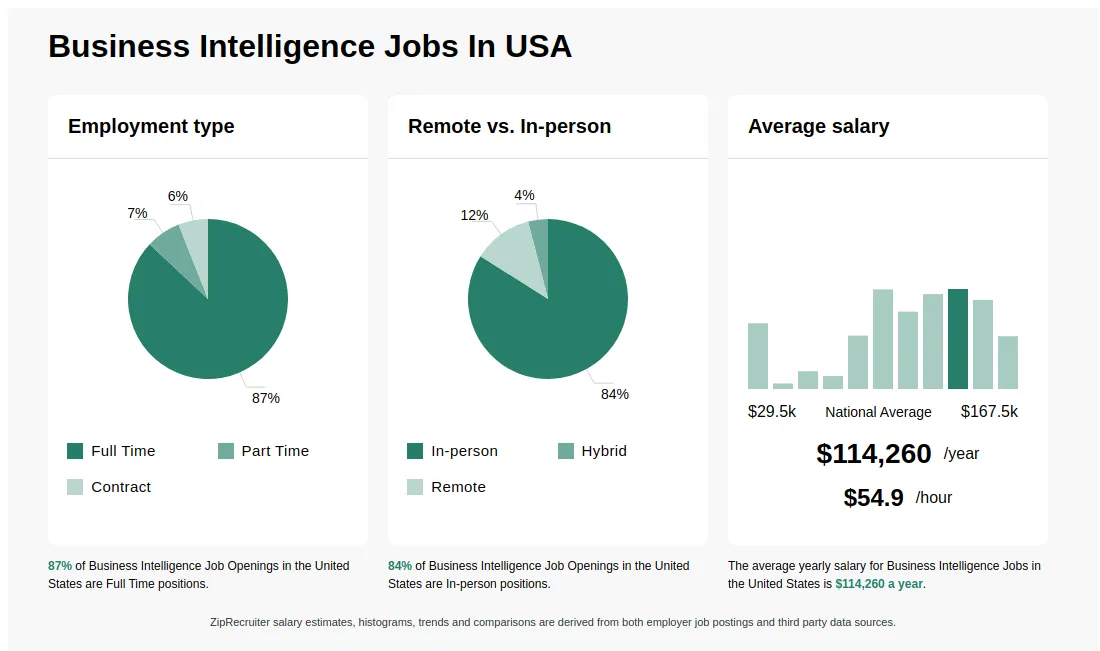
As of Jun 29, 2026, the average yearly pay for business intelligence in the United States is $114,260.00, according to ZipRecruiter salary data. Most workers in this role earn between $94,000.00 and $142,500.00 per year, depending on experience, location, and employer.

How does a Business Intelligence professional typically collaborate with other departments within an organization?

Business Intelligence professionals frequently work cross-functionally, partnering with departments such as marketing, sales, finance, and operations to understand their data needs and provide actionable insights. They often translate business questions into data-driven analyses and present findings in clear, accessible formats. Collaboration may include attending regular meetings, gathering requirements for dashboards or reports, and offering guidance on data interpretation, making strong communication skills essential for success in this role.

What is the work of business intelligence?

Business intelligence professionals analyze data to help organizations make informed decisions. They use tools like data visualization and reporting software to identify trends, generate insights, and support strategic planning. Strong analytical skills and knowledge of databases are essential in this role.

Is a business intelligence degree worth IT?

A business intelligence degree can be valuable for roles involving data analysis, reporting, and decision-making, as it provides skills in data management, analytics tools, and visualization. However, practical experience, certifications, and proficiency with tools like SQL, Tableau, or Power BI are often equally important for employment in this field.

Are intelligence jobs high paying?

Business intelligence jobs typically offer competitive salaries that vary based on experience, education, and location. Roles such as BI analysts and data engineers often have above-average pay compared to other IT positions, especially with skills in SQL, data visualization tools, and analytics. Advanced certifications and experience can lead to higher compensation in this field.

What is the difference between Business Intelligence vs Data Analyst?

AspectBusiness IntelligenceData Analyst
Required CredentialsBachelor's in IT, Business, or related fields; certifications like CBIP or Microsoft BIBachelor's in Statistics, Mathematics, or related fields; certifications like CAP or Microsoft Data Analyst
Work EnvironmentBI teams, data warehouses, reporting toolsData sets, spreadsheets, statistical software
Employer & Industry UsageBusiness sectors, analytics teams, IT departmentsMarketing, finance, healthcare, and other sectors requiring data insights

Business Intelligence professionals focus on designing and managing systems that collect, analyze, and visualize data to support strategic decisions. Data Analysts interpret data to identify trends and generate reports. While both roles work with data, BI emphasizes system development and dashboards, whereas Data Analysts focus on data interpretation and insights.

What Are the Qualifications to Get a Job in Business Intelligence?

Qualifications for a career in business intelligence (BI) include a bachelor’s degree in marketing, business administration, or a related field. A strong background in statistics and computer analysis is also desirable, as most of your duties revolve around interpreting the data and creating reports. Computer proficiency is essential to work with the necessary software. Certification isn’t required, but it can improve your chances of getting hired by a company. The Marketing Research Association offers several certificate programs along with advanced learning opportunities in data analysis. Exceptional analytical and organizational skills are imperative. Critical thinking is also vital for interpreting the trends and making sound decisions.

What are the key skills and qualifications needed to thrive as a Business Intelligence professional, and why are they important?

To thrive as a Business Intelligence professional, you need strong analytical skills, proficiency in data analysis, and a background in statistics or computer science, often supported by a relevant degree. Familiarity with BI tools like Tableau, Power BI, SQL, and data warehousing systems, along with certifications such as Microsoft Certified: Data Analyst Associate, is highly beneficial. Critical thinking, problem-solving abilities, and effective communication are essential soft skills for interpreting data and presenting insights to stakeholders. These competencies enable BI professionals to transform complex data into actionable strategies that drive informed business decisions.

What is business intelligence?

Business intelligence (BI) refers to the processes, technologies, and tools that organizations use to collect, analyze, and present business data. The goal of BI is to help decision-makers make more informed business choices by turning raw data into actionable insights. This often involves data mining, reporting, dashboards, and predictive analytics. BI professionals work with databases, visualization tools, and statistical methods to support strategic and operational decision-making.

What are business intelligence jobs?

Business intelligence jobs involve analyzing data to help organizations make informed decisions. Roles typically include data analysts, BI analysts, and BI developers who use tools like SQL, Tableau, or Power BI to gather, interpret, and present data insights.
What cities are hiring for Business Intelligence jobs? Cities with the most Business Intelligence job openings:
What are the most commonly searched types of Business Intelligence jobs? The most popular types of Business Intelligence jobs are:
What states have the most Business Intelligence jobs? States with the most job openings for Business Intelligence jobs include:
Infographic showing various Business Intelligence job openings in the United States as of June 2026, with employment types broken down into 81% Full Time, 15% Part Time, 1% Temporary, and 3% Contract. Highlights an 92% Physical, 2% Hybrid, and 6% Remote job distribution, with an average salary of $114,260 per year, or $54.9 per hour.
Business Intelligence Manager

Business Intelligence Manager

Meritrust Credit Union

Wichita, KS • On-site

Full-time

Posted 9 days ago


Key responsibilities

  • Lead and manage the Business Intelligence team, providing direction, guidance, and mentorship.

  • Develop and implement a comprehensive BI strategy that aligns with the credit union's business goals.

  • Oversee the creation and management of dashboards, reports, and data visualizations that provide actionable insights to various stakeholders.


Job description

Job Summary:
Meritrust Credit Union is seeking a Business Intelligence Manager to lead their BI initiatives and transform data into actionable insights for business decisions. The role involves managing the BI team, developing data analysis strategies, and collaborating with various business units to enhance data-driven decision-making.
Responsibilities:
• Lead and manage the Business Intelligence team, providing direction, guidance, and mentorship.
• Develop and implement a comprehensive BI strategy that aligns with the credit union’s overall business goals.
• Oversee the creation and management of dashboards, reports, and data visualizations that provide actionable insights to various stakeholders.
• Collaborate with senior management and department heads to identify business intelligence needs and opportunities for process improvements.
• Analyze large datasets to identify trends, patterns, and opportunities for operational improvements, member engagement, and cost savings.
• Develop and maintain performance metrics, KPIs, and business intelligence reports to track and evaluate credit union operations.
• Provide ad-hoc analysis and insights to assist with strategic decision-making.
• Lead efforts to ensure data accuracy and integrity in reporting and analytics.
• Lead, develop, and mentor a team of BI analysts, fostering a collaborative and results-driven culture.
• Conduct performance reviews, provide feedback, and manage team development.
• Encourage professional growth and development within the BI team, ensuring they are trained on the latest BI tools, techniques, and best practices.
• Work with business users across departments (e.g., Marketing, Operations, Finance) to understand their needs and translate them into data-driven solutions.
• Partner with IT and other stakeholders to ensure that the data infrastructure supports the BI strategy.
• Communicate BI results and insights effectively to non-technical stakeholders, ensuring clarity and understanding of the findings.
• Stay up-to-date with the latest BI trends, tools, and technologies to continually improve the credit union’s BI capabilities.
• Identify opportunities to automate reporting and data analysis processes to increase efficiency.
• Ensure that the BI platform evolves to meet the changing needs of the credit union.
• Perform other duties as assigned.
Qualifications:
Required:
• Bachelor's degree in Business, Information Technology, Data Science, Statistics, or a related field.
• Strong understanding of Business Intelligence concepts, data warehousing, and data governance.
• In-depth knowledge of data visualization principles and tools (e.g., Tableau, Power BI).
• Knowledge of data analysis techniques, statistical methods, and reporting.
• Familiarity with industry regulations (e.g., financial regulations, data privacy laws) and their impact on data management practices in the financial services industry.
• Understanding of data integration techniques, ETL processes, and database management.
• 5+ years of experience in business intelligence, data analysis, or data science roles, with at least 3 years in a management or leadership capacity.
• Proven track record of leading BI initiatives and teams, from strategy formulation to execution and post-implementation analysis.
• Experience with BI tools and platforms, including Power BI, Tableau, or other relevant tools.
• Experience with data modeling, SQL, and data warehousing concepts.
• Experience in managing and collaborating with cross-functional teams to meet organizational goals.
• Advanced knowledge of BI and analytics platforms, such as Power BI or Tableau. Ability to design, develop, and maintain interactive dashboards and reports.
• Proficiency in analyzing large datasets, identifying trends, and deriving actionable insights. Familiarity with statistical tools and techniques.
• Strong skills in SQL for data extraction, data manipulation, and reporting from relational databases (e.g., SQL Server, Oracle).
• Experience with data warehousing, ETL processes, and ensuring data accuracy and quality.
• Ability to design and implement data integration solutions and automate reporting processes.
• Excellent verbal and written communication skills, with the ability to present complex data insights in a clear, actionable manner to non-technical stakeholders.
• Strong organizational and project management skills, with experience managing multiple BI initiatives and projects simultaneously.
• Proven ability to lead and mentor a team of data analysts and BI professionals.
Preferred:
• Relevant certifications such as Microsoft Certified: Data Analyst Associate, Tableau Desktop Certified Professional, or Certified Business Intelligence Professional (CBIP) are highly desirable.
• Experience working in the financial services industry, particularly with credit unions or banks, is highly preferred.
• Proficiency in Python, R, or similar scripting languages for data analysis and automation tasks is a plus.
Company:
Meritrust Credit Union offers loans, insurance, financial education, digital banking, and other services. Founded in 1935, the company is headquartered in Wichita, USA, with a team of 201-500 employees. The company is currently Growth Stage.