1

Water Science Jobs (NOW HIRING)

The CTO will serve as the custodian of VVater's scientific integrity, ensuring the company remains the benchmark for sustainable, physics-based, electrochemical water purification and next-generation ...

WATER RESOURCES ENGINEER II

San Francisco, CA · On-site

$93K - $127K/yr

Lotus Water is seeking a mid-level design engineer, with 3-5 years of experience, to support our ... Bachelor of Science in Civil Engineering * Proficient in AutoCAD and set up of plan sheets

Lotus Water is seeking a mid-level design engineer, with 3-5 years of experience, to support our ... Bachelor of Science in Civil Engineering * Proficient in AutoCAD and set up of plan sheets

WATER RESOURCES ENGINEER II

San Francisco, CA · On-site

$93K - $127K/yr

DOE Lotus Water is seeking a mid-level design engineer, with 3-5 years of experience, to support ... Bachelor of Science in Civil Engineering * Proficient in AutoCAD and set up of plan sheets

Apply Early

next page

Showing results 1-20

Water Science information

See salary details

$24.5K

$48.4K

$79K

How much do water science jobs pay per year?

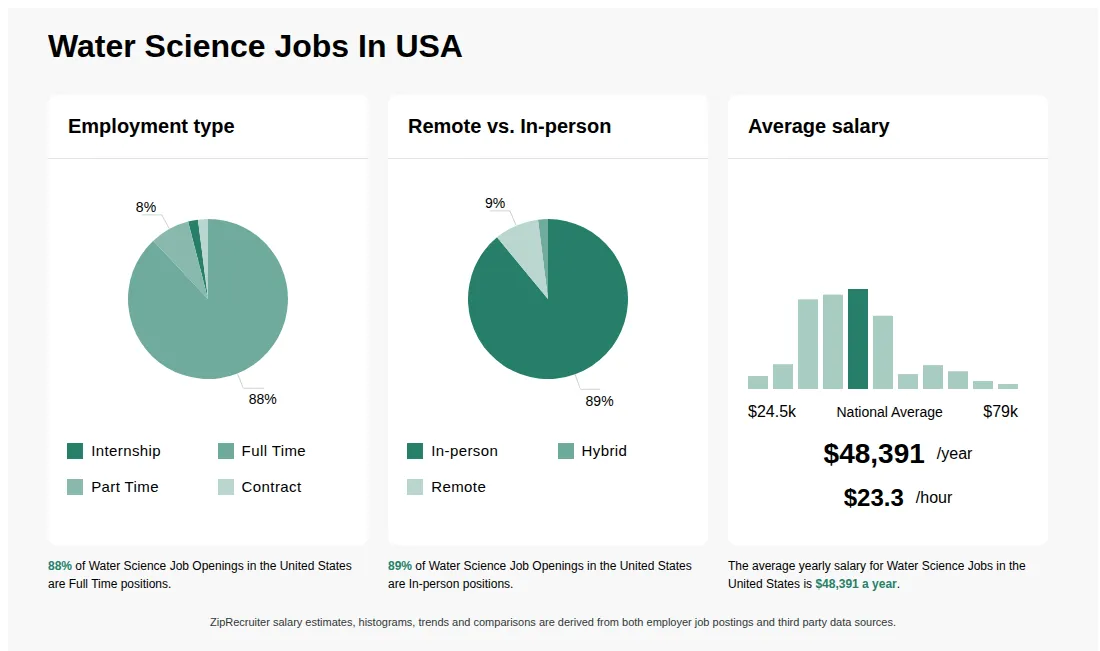
As of Jul 4, 2026, the average yearly pay for water science in the United States is $48,391.00, according to ZipRecruiter salary data. Most workers in this role earn between $38,500.00 and $52,000.00 per year, depending on experience, location, and employer.

What is the difference between Water Science vs Water Quality Technician?

AspectWater ScienceWater Quality Technician
Required CredentialsBachelor's degree in environmental science, hydrology, or related fieldAssociate's or bachelor's degree in environmental science, chemistry, or related field
Work EnvironmentResearch labs, field sites, environmental agenciesWater treatment plants, laboratories, field sampling sites
Employer & Industry UsageEnvironmental consulting, government agencies, research institutionsMunicipal water treatment facilities, environmental testing labs

Water Science involves studying water systems, conducting research, and analyzing water data, often in research or policy roles. Water Quality Technicians focus on testing and monitoring water quality at treatment plants or field sites. While both roles require knowledge of water analysis, Water Science emphasizes research and data interpretation, whereas Water Quality Technicians concentrate on sample collection and lab testing.

What does a water scientist do?

A water scientist studies the properties, distribution, and quality of water resources. They analyze water samples, develop models, and assess environmental impacts to support water management and conservation efforts, often using tools like GIS and laboratory equipment.

What are some common challenges faced by water scientists when conducting field research?

Water scientists often encounter challenges such as unpredictable weather conditions, difficult terrain, and limited access to remote sampling sites during field research. Additionally, ensuring the accuracy and reliability of samples can be complex due to contamination risks or equipment malfunctions. Collaboration with local authorities and stakeholders is frequently necessary to gain site access and gather comprehensive data. These challenges require adaptability, strong problem-solving skills, and effective communication to ensure successful research outcomes.

What can I do with a water science degree?

A water science degree prepares individuals for careers in environmental consulting, water resource management, research, and policy development. Graduates can work for government agencies, environmental organizations, or private companies, often utilizing skills in data analysis, field sampling, and environmental regulations.

What are jobs that work with water?

Jobs that work with water include water resource specialists, environmental engineers, hydrologists, water treatment plant operators, and aquatic biologists. These roles often require knowledge of water systems, environmental regulations, and sometimes certifications such as water treatment licenses or environmental degrees.

What are the key skills and qualifications needed to thrive as a Water Scientist, and why are they important?

To thrive as a Water Scientist, you need a strong background in environmental science, hydrology, chemistry, or a related field, typically with at least a bachelor's or master's degree. Familiarity with water quality testing equipment, GIS software, and data analysis tools is often required, along with certifications such as Certified Hydrologist or equivalent. Strong analytical thinking, problem-solving abilities, and effective communication skills help distinguish top performers in this role. These qualifications ensure accurate assessment of water resources, inform policy decisions, and support sustainable water management practices.

What is water science?

Water science is the study of water, including its properties, distribution, movement, and quality in the environment. It encompasses disciplines such as hydrology, hydrogeology, and water resource management. Water scientists analyze water samples, monitor water systems, and develop solutions for water conservation and pollution prevention. Their work is crucial for ensuring safe drinking water, sustainable water use, and protecting aquatic ecosystems.

What careers are in aquatic science?

Careers in aquatic science include roles such as aquatic biologist, marine scientist, water quality analyst, and environmental consultant. These positions often require knowledge of ecology, water chemistry, and fieldwork skills, and may involve working in laboratories, research vessels, or field sites.
More about Water Science jobs
What cities are hiring for Water Science jobs? Cities with the most Water Science job openings:
What states have the most Water Science jobs? States with the most job openings for Water Science jobs include:
Infographic showing various Water Science job openings in the United States as of June 2026, with employment types broken down into 67% Full Time, and 33% Part Time. Highlights an 100% In-person job distribution, with an average salary of $48,391 per year, or $23.3 per hour.
Laboratory Technician I

Laboratory Technician I

University of Florida

Gainesville, FL • On-site

$17 - $19/hr

Full-time

Posted 5 days ago


University Of Florida rating

7.2

Company rating: 7.2 out of 10

Based on 108 frontline employees who took The Breakroom Quiz

337th of 544 rated colleges and universities


Job description

Laboratory Technician I
Job no: 539917
Work type: Staff Full-Time
Location: Main Campus (Gainesville, FL)
Categories: Biology/Life Science, Grant or Research Administration, Veteran's Preference Eligible, Agricultural Sciences
Department:60210000 - AG-SOIL AND WATER SCIENCE
Classification Title:
Laboratory Technician I
Classification Minimum Requirements:
Associate's degree in an appropriate area of specialization or a high school diploma and two years of related experience. Appropriate college course work or vocational/technical training may substitute at an equivalent rate for the required experience.
Job Description:
-As per QA/QC protocols, conducts analytical procedures on laboratory instrumentation, such as autoanalyzers (AA500), carbon/nitrogen analyzers (TN/TC and TOC/TN), spectrophotometer (UV-1800), and troubleshoots malfunctions when needed. Compiles results and tabulates data.
-Participates in implementation and integration of laboratory accreditation and certification program including 1) maintaining up-to-date sample receipt, equipment usage, reagent preparation, and standard logs, 2) maintains labware and chemical inventory used for assigned instrument(s), and 3) training other lab personnel in the techniques and operation and use of various equipment involved in the analysis of chemical and nutrient parameters for water, soil, and plant tissue samples.
-As necessary, coordinates and participates in field/greenhouse experiments and sampling including the gathering of supplies, operation of equipment, processing and preservation of collected samples, and the operation and maintenance of vehicles/boats/trailers.
-Collects, prepares, and processes water/tissue/soil samples following established procedures. Prepares standard volumetric solutions or reagents to be combined with samples, following standardized formulas or experimental procedures.
-Maintains, cleans, and sterilizes laboratory instruments, equipment, and work areas. Keeps detailed logs of all work-related data and activities.
Expected Salary:
$17-$19 per hour; commensurate with education and experience
Required Qualifications:
Associate's degree in an appropriate area of specialization or a high school diploma and two years of related experience. Appropriate college course work or vocational/technical training may substitute at an equivalent rate for the required experience.
Preferred:
- a bachelor's degree with experience in analytical methodologies and procedures such as extractions, digestions, fumigations, filtrations, and carbon/nitrogen/phosphorus analyses.
- ability to conduct laboratory procedures with high accuracy, precision, organize data and perform QA/QC analyses on the data as per the protocols.
- experience and familiarity with NELAC QA/QC type protocols and implementation
- basic training of the operation and maintenance of the labortaory instruments
- ability to keep track of several experiments running simultaneously
- ability to interact with laboratory personnel professionally
- working knowledge of boats and general water safety
Special Instructions to Applicants:
In order to be considered, you must upload your cover letter and resume
Application must be submitted by 11:55 p.m. (ET) of the posting end date.
This is a time-limited position.
This position is eligible for veteran's preference. If you are claiming veteran's preference, please upload a copy of your DD 214 Member Copy 4 with your application for consideration. See our Veteran's Preference Page for more specific information.
Health Assessment Required:No
Advertised: 29 Jun 2026 Eastern Daylight Time
Applications close: 13 Jul 2026 Eastern Daylight Time
Whatsapp Facebook LinkedIn Email App

What University Of Florida employees say

Pay

Benefits

Hours and flexibility

Workplace

Get the full story on Breakroom


University of Florida logo

About University of Florida

Sourced by ZipRecruiter

The University of Florida is one of the top ranked public universities in the United States (ranked top 5 amongst public universities in 2023 US news and world report). It is one of only a few comprehensive universities, having medical, veterinary, dental, nursing, public health, and engineering disciplines all co-localized on the same, contiguous campus to facilitate interdisciplinary collaboration. Gainesville is located in the northern region of Florida, within 1-1.5 hours of each coast, and just 1.5-2 hours to Orlando and Tampa. It is a small to medium-sized city with a low cost of living, excellent public and private schools, and southern hospitality. While Gainesville is widely recognized as the home of the Gators, it is quickly becoming known as a center for innovation and a place with a lifestyle that's comfortable for families, yet attractive for young professionals.

Industry

Colleges, universities, and professional schools

Company size

5,001 - 10,000 Employees

Headquarters location

Gainesville, FL, US

Year founded

1853