Posting Details Position Information Position Title Assistant Professor (Water Science) - 9 month appointment Work Location Springfield Campus Out-of-State Employment Out-of-state employment is ...
Posting Details Position Information Position Title Assistant Professor (Water Science) - 9 month appointment Work Location Springfield Campus Out-of-State Employment Out-of-state employment is ...

Temporary Water Education & Outreach Instructor
Concord, CA · On-site
$28.76 - $34.97/hr
Present information about water science, water supply, water treatment, stewardship and careers. Adapt instruction and activities to each age, grade level, learning need, and background of ...
Temporary Water Education & Outreach Instructor
Concord, CA · On-site
$28.76 - $34.97/hr
Present information about water science, water supply, water treatment, stewardship and careers. Adapt instruction and activities to each age, grade level, learning need, and background of ...

Minimum Qualifications Master's degree in Environmental Science, Biology, Botany, Water Management, Zoology, Geology, Geospatial Science, Civil or Environmental Engineering, Urban or Regional ...
Minimum Qualifications Master's degree in Environmental Science, Biology, Botany, Water Management, Zoology, Geology, Geospatial Science, Civil or Environmental Engineering, Urban or Regional ...

Instructor in Environmental Technologies, Initial focus: Water Science (Part-Time Pool)
Camarillo, CA · On-site
Water Science (Part-Time Pool) at Ventura County Community College District Share on X Print Application Deadline 10/4/2026 11:55 PM Pacific Date Posted 4/7/2026 Contact VCCCD Human Resources Number ...
Instructor in Environmental Technologies, Initial focus: Water Science (Part-Time Pool)
Camarillo, CA · On-site
Water Science (Part-Time Pool) at Ventura County Community College District Share on X Print Application Deadline 10/4/2026 11:55 PM Pacific Date Posted 4/7/2026 Contact VCCCD Human Resources Number ...
Minimum Qualifications Master's degree in Environmental Science, Biology, Botany, Water Management, Zoology, Geology, Geospatial Science, Civil or Environmental Engineering, Urban or Regional ...
Minimum Qualifications Master's degree in Environmental Science, Biology, Botany, Water Management, Zoology, Geology, Geospatial Science, Civil or Environmental Engineering, Urban or Regional ...
Minimum Qualifications Master's degree in Environmental Science, Biology, Botany, Water Management, Zoology, Geology, Geospatial Science, Civil or Environmental Engineering, Urban or Regional ...
Minimum Qualifications Master's degree in Environmental Science, Biology, Botany, Water Management, Zoology, Geology, Geospatial Science, Civil or Environmental Engineering, Urban or Regional ...
Instructor in Environmental Technologies, Initial focus: Water Science (Part-Time Pool)
Camarillo, CA · On-site
Water Science (Part-Time Pool) at Ventura County Community College District Share on X Print Application Deadline 8/31/2026 11:59 PM Pacific Date Posted 3/4/2026 Contact VCCCD Human Resources Number ...
Instructor in Environmental Technologies, Initial focus: Water Science (Part-Time Pool)
Camarillo, CA · On-site
Water Science (Part-Time Pool) at Ventura County Community College District Share on X Print Application Deadline 8/31/2026 11:59 PM Pacific Date Posted 3/4/2026 Contact VCCCD Human Resources Number ...
Minimum Qualifications Master's degree in Environmental Science, Biology, Botany, Water Management, Zoology, Geology, Geospatial Science, Civil or Environmental Engineering, Urban or Regional ...
Minimum Qualifications Master's degree in Environmental Science, Biology, Botany, Water Management, Zoology, Geology, Geospatial Science, Civil or Environmental Engineering, Urban or Regional ...
Water Sciences Laboratory Director
Lincoln, NE · On-site
$90 - $130/hr
Specialty in environmental sciences, water quality, and/or analytical method developmentcommensuratewith a research assistant professor or higher. Preferred Qualifications * Experience managing ...
Water Sciences Laboratory Director
Lincoln, NE · On-site
$90 - $130/hr
Specialty in environmental sciences, water quality, and/or analytical method developmentcommensuratewith a research assistant professor or higher. Preferred Qualifications * Experience managing ...

Wastewater Maintenance Operator
Cedarburg, WI · On-site
$54K - $76K/yr
A high school diploma or GED is required 2-year or 4-year degree in water science related field or any combination of training and experience is desirable Must have or be able to obtain a Wisconsin ...
Wastewater Maintenance Operator
Cedarburg, WI · On-site
$54K - $76K/yr
A high school diploma or GED is required 2-year or 4-year degree in water science related field or any combination of training and experience is desirable Must have or be able to obtain a Wisconsin ...
Wastewater Recycling Center - Operator
Cedarburg, WI · On-site
$54K - $76K/yr
A high school diploma or GED is required 2-year or 4-year degree in water science related field or any combination of training and experience is desirable Must have or be able to obtain a Wisconsin ...
Wastewater Recycling Center - Operator
Cedarburg, WI · On-site
$54K - $76K/yr
A high school diploma or GED is required 2-year or 4-year degree in water science related field or any combination of training and experience is desirable Must have or be able to obtain a Wisconsin ...

Director of Operations
Joshua Tree, CA · On-site
... water science, or closely related field. Certificates, Licenses, Registration: Must possess and maintain : * Grade IV or higher SWRCB Water Distribution Operator Certificate. Grade V highly desired.
Quick apply
Director of Operations
Joshua Tree, CA · On-site
... water science, or closely related field. Certificates, Licenses, Registration: Must possess and maintain : * Grade IV or higher SWRCB Water Distribution Operator Certificate. Grade V highly desired.

Water Systems Technician I/II (DOQ)
Chino, CA · On-site
$85K - $114K/yr
Whether you are beginning your career in water science or bringing seasoned field experience, this position offers the opportunity to serve your community, develop deep technical expertise, and ...
Water Systems Technician I/II (DOQ)
Chino, CA · On-site
$85K - $114K/yr
Whether you are beginning your career in water science or bringing seasoned field experience, this position offers the opportunity to serve your community, develop deep technical expertise, and ...
Water Sciences Ops/Dive Technician - Part Time, $34.56/Hour
Kapolei, HI · On-site
$34.56/hr
Water Sciences Operator/Dive Technician is an hourly role. Duties will include, but are not limited to, operating Water Sciences water treatment systems, monitoring animal habitats, and diving to ...
Water Sciences Ops/Dive Technician - Part Time, $34.56/Hour
Kapolei, HI · On-site
$34.56/hr
Water Sciences Operator/Dive Technician is an hourly role. Duties will include, but are not limited to, operating Water Sciences water treatment systems, monitoring animal habitats, and diving to ...

Superivsory Hydrologic Technician
Moab, UT · On-site
$89K/yr
You will serve as a Superivsory Hydrologic Technician within the Utah Water Science Center. You may be required to travel overnight away from home up to 5 nights per month. You must obtain a ...
Superivsory Hydrologic Technician
Moab, UT · On-site
$89K/yr
You will serve as a Superivsory Hydrologic Technician within the Utah Water Science Center. You may be required to travel overnight away from home up to 5 nights per month. You must obtain a ...
The position reports to the Nebraska Water Center director and leads all WSL activities ... D. in Analytical Chemistry, Engineering, Environmental, Geological, or Materials Science.
The position reports to the Nebraska Water Center director and leads all WSL activities ... D. in Analytical Chemistry, Engineering, Environmental, Geological, or Materials Science.
... water science and management. We are seeking a Research Scientist with expertise in hydrogeology and numerical groundwater flow modeling (including Modflow) with interests in co-production of ...
... water science and management. We are seeking a Research Scientist with expertise in hydrogeology and numerical groundwater flow modeling (including Modflow) with interests in co-production of ...

Research Scientist I, Hydrogeology
Moscow, ID · On-site
$90K/yr
... water science and management. We are seeking a Research Scientist with expertise in hydrogeology and numerical groundwater flow modeling (including Modflow) with interests in co-production of ...
Research Scientist I, Hydrogeology
Moscow, ID · On-site
$90K/yr
... water science and management. We are seeking a Research Scientist with expertise in hydrogeology and numerical groundwater flow modeling (including Modflow) with interests in co-production of ...
Supervisory Hydrologic Technician
Billings, MT · On-site +1
$89K - $116K/yr
Geological Survey, Wyoming-Montana Water Science Center, Billings Field Office, in Billings, Montana. As Field Office Chief, you will supervise employees who collect, process, review, and publish ...
Supervisory Hydrologic Technician
Billings, MT · On-site +1
$89K - $116K/yr
Geological Survey, Wyoming-Montana Water Science Center, Billings Field Office, in Billings, Montana. As Field Office Chief, you will supervise employees who collect, process, review, and publish ...
You will serve as a Superivsory Hydrologic Technician within the Utah Water Science Center. You may be required to travel overnight away from home up to 5 nights per month. You must obtain a ...
You will serve as a Superivsory Hydrologic Technician within the Utah Water Science Center. You may be required to travel overnight away from home up to 5 nights per month. You must obtain a ...
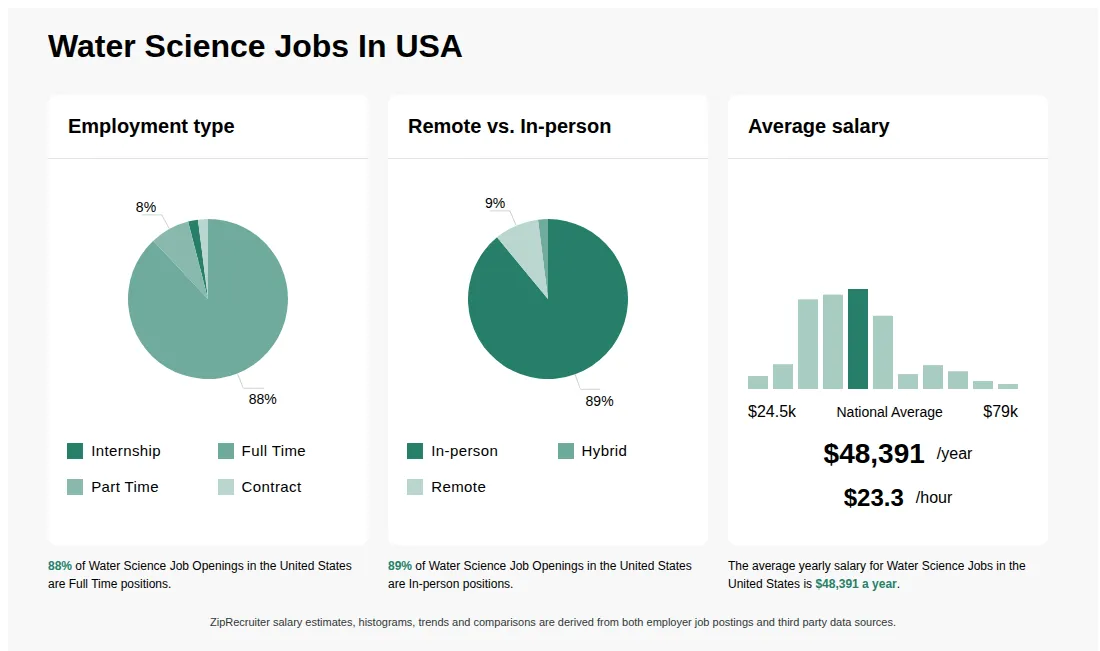
Water Science information
See salary details
$24.5K - $29.5K
2% of jobs
$29.5K - $34.4K
5% of jobs
$38.8K is the 25th percentile. Wages below this are outliers.
$34.4K - $39.4K
20% of jobs
$39.4K - $44.3K
21% of jobs
The median wage is $44.7K / yr.
$44.3K - $49.3K
22% of jobs
$50.7K is the 75th percentile. Wages above this are outliers.
$49.3K - $54.2K
16% of jobs
$54.2K - $59.2K
3% of jobs
$59.2K - $64.1K
5% of jobs
$64.1K - $69.1K
3% of jobs
$69.1K - $74K
1% of jobs
$74K - $79K
1% of jobs
$24.5K
$48.4K
$79K
How much do water science jobs pay per year?
As of Sep 6, 2026, the average yearly pay for water science in the United States is $48,391.00, according to ZipRecruiter salary data. Most workers in this role earn between $38,500.00 and $52,000.00 per year, depending on experience, location, and employer.
What is water science?
Water science is the study of water, including its properties, distribution, movement, and quality in the environment. It encompasses disciplines such as hydrology, hydrogeology, and water resource management. Water scientists analyze water samples, monitor water systems, and develop solutions for water conservation and pollution prevention. Their work is crucial for ensuring safe drinking water, sustainable water use, and protecting aquatic ecosystems.
What are some common challenges faced by water scientists when conducting field research?
Water scientists often encounter challenges such as unpredictable weather conditions, difficult terrain, and limited access to remote sampling sites during field research. Additionally, ensuring the accuracy and reliability of samples can be complex due to contamination risks or equipment malfunctions. Collaboration with local authorities and stakeholders is frequently necessary to gain site access and gather comprehensive data. These challenges require adaptability, strong problem-solving skills, and effective communication to ensure successful research outcomes.
What are the key skills and qualifications needed to thrive as a water scientist, and why are they important?
To thrive as a Water Scientist, you need a strong background in environmental science, hydrology, chemistry, or a related field, typically with at least a bachelor's or master's degree. Familiarity with water quality testing equipment, GIS software, and data analysis tools is often required, along with certifications such as Certified Hydrologist or equivalent. Strong analytical thinking, problem-solving abilities, and effective communication skills help distinguish top performers in this role. These qualifications ensure accurate assessment of water resources, inform policy decisions, and support sustainable water management practices.
What is the difference between Water Science vs Water Quality Technician?
| Aspect | Water Science | Water Quality Technician |
|---|---|---|
| Required Credentials | Bachelor's degree in environmental science, hydrology, or related field | Associate's or bachelor's degree in environmental science, chemistry, or related field |
| Work Environment | Research labs, field sites, environmental agencies | Water treatment plants, laboratories, field sampling sites |
| Employer & Industry Usage | Environmental consulting, government agencies, research institutions | Municipal water treatment facilities, environmental testing labs |
Water Science involves studying water systems, conducting research, and analyzing water data, often in research or policy roles. Water Quality Technicians focus on testing and monitoring water quality at treatment plants or field sites. While both roles require knowledge of water analysis, Water Science emphasizes research and data interpretation, whereas Water Quality Technicians concentrate on sample collection and lab testing.
What can I do with a water science degree?
A water science degree prepares individuals for careers in environmental consulting, water resource management, research, and regulatory agencies. Graduates often work as hydrologists, water quality specialists, or environmental scientists, utilizing skills in data analysis, field sampling, and environmental regulations.
What does a water scientist do?
A water scientist studies the properties, distribution, and quality of water resources. They analyze water samples, develop models, and assess environmental impacts to support water management and conservation efforts, often using tools like GIS and laboratory equipment. Their work may involve fieldwork, data analysis, and reporting to inform policy and sustainable practices.
More about Water Science jobs
What cities are hiring for Water Science jobs?
Cities with the most Water Science job openings:
What states have the most Water Science jobs?
States with the most job openings for Water Science jobs include:
What job categories do people searching Water Science jobs look for?
The top searched job categories for Water Science jobs are:
Assistant Professor (Water Science) - 9 month appointment
Springfield, MO • On-site
Full-time
Posted 6 days ago
Key responsibilities
Teach General Education courses in physical geography, including Earth's Natural Environment, and upper-level undergraduate and graduate courses in physical geography.
Develop an active, externally funded research program and mentor graduate and undergraduate students.
Support water science and policy initiatives, collaborate within the department and externally, and contribute to expanding research and educational programs in water science.
Missouri State University rating

6.4
Based on 24 frontline employees who took The Breakroom Quiz
532nd of 631 rated colleges and universities
Job description
Posting Details
Position Information
Position Title
Assistant Professor (Water Science) - 9 month appointment
Work Location
Springfield Campus
Out-of-State Employment
Out-of-state employment is limited to Arkansas, Virginia, Maryland, and Washington, D.C., and subject to supervisor approval.
Department
School of Earth, Environment, and Sustainability
HR Home Department
020717 SCHOOL OF EARTH, ENVIRONMENT AND SUSTAINABILITY
Pay Grade
Unclassified
Sponsorship Information
Applicants must be currently authorized to work for ANY employer in the United States on a full-time basis. This position may not be eligible for work visa sponsorship.
Position only available to current, regular, full-time Missouri State University employees?
No, Position is available to all applicants.
Faculty Appointment Type
Tenure Track
Term (if applicable)
9 month
Begin Date of Appointment
08/02/2027
Exempt/Non-Exempt
Exempt
General Function
The Assistant Professor is a member of the ranked faculty with an intermediate academic rank who has demonstrated achievement in the areas of teaching, research, and professional service appropriate to the discipline. The Assistant Professor's teaching responsibilities are assigned by the academic department head and may include serving as an academic advisor. The Assistant Professor engages in scholarly activities beyond those associated with teaching and is expected to demonstrate professional productivity in research, based upon the availability of resources and consistent with the mission of the University.
Description of Primary Duties
The new faculty member will be responsible for teaching General Education courses in physical geography, including GRY145 Earth's Natural Environment, upper-level undergraduate and graduate courses in physical geography, and other specialty courses in the faculty member's specialty. The new hire will be expected to develop an active, externally funded research program and mentor graduate and undergraduate students. The ideal candidate will complement current SEES strengths in water science and policy, support geography and sustainability majors, and develop collaborations both within SEES and with other programs across MSU and externally. We seek forward-thinking colleagues to help us expand collaboration in vital areas of research and deliver exciting and relevant programs to train next-generation scientists.
Minimum Acceptable Qualifications
The minimum acceptable qualifications for the position of Assistant Professor are prescribed in the Faculty Handbook.
Additional Qualifications
A Ph.D. in Physical Geography, Geology, or closely related field is required at time of appointment (August 1, 2027). Expertise in Fluvial Geomorphology, Hydrology, or Watershed Science at a level adequate to supervise master's level graduate students, develop an aggressive research agenda documented by a detailed research plan, demonstrated potential for recruitment of undergraduate and graduate research students, and a commitment to undergraduate- and master's-level teaching and research mentorship are required. Candidates who have the ability to teach upper-level courses in more than one subdiscipline of water science are encouraged to apply.
Link to Job Description
http://www.missouristate.edu/human/jobdescriptions/21377.htm
Open Date
08/31/2026
Close Date (If Close Date is blank then the posting is considered open until filled)
Special Instructions to Applicants
The first date of consideration is November 2, 2026, and review of applications will continue until position is filled.
Applicants must upload the following documents: (i) a current curriculum vitae, (ii) a cover letter of no more than two pages which addresses teaching and research qualifications/interests, (iii) a statement on teaching philosophy, (iv) a research statement, (v) unofficial transcripts, and (vi) contact information for three professional references.
Please attach an unofficial transcript to your application. Please note that documents that contain passwords, digital signatures, and other artifacts such as watermarks may not convert properly. If your document contains any of these items, please print and scan the document, then upload the scanned version to your application. Official transcripts required at time of hire.
Equal Opportunity Statement
Non-Discrimination Statement
Missouri State University is a community of people with respect for diversity. The University emphasizes the dignity and equality common to all persons and adheres to a strict non-discrimination policy regarding the treatment of individual faculty, staff, and students. In accord with federal law and applicable Missouri statutes, the University does not discriminate on the basis of race, color, national origin (including ancestry, or any other subcategory of national origin recognized by applicable law), religion, sex (including marital status, family status, pregnancy, sexual orientation, gender identity, gender expression, or any other subcategory of sex recognized by applicable law), age, disability, veteran status, genetic information, or any other basis protected by applicable law in employment or in any program or activity offered or sponsored by the University. Sex discrimination encompasses sexual harassment, which includes sexual violence, and is strictly prohibited by Title IX of the Education Amendments of 1972.
This policy shall not be interpreted in a manner as to violate the legal rights of religious organizations or of military organizations associated with the Armed Forces of the United States of America.
The University maintains a grievance procedure incorporating due process available to any person who believes he or she has been discriminated against. Missouri State University is an Equal Opportunity employer. Inquiries concerning the complaint/grievance procedure related to discrimination on the basis of a protected class, including sexual harassment and sexual assault, or compliance with federal and state laws and guidelines, should be addressed to the Director, Office for Institutional Compliance, Carrington Hall 205, 901 S. National Ave., Springfield, Missouri 65897, Compliance@MissouriState.edu, 417-836-4252.
Background Check Statement
Employment will require a criminal background check at University expense.
Posting Detail
Posting Number
20260048FTF
Quicklink for Posting
https://jobs.missouristate.edu/postings/87493
Position Information
Position Title
Assistant Professor (Water Science) - 9 month appointment
Work Location
Springfield Campus
Out-of-State Employment
Out-of-state employment is limited to Arkansas, Virginia, Maryland, and Washington, D.C., and subject to supervisor approval.
Department
School of Earth, Environment, and Sustainability
HR Home Department
020717 SCHOOL OF EARTH, ENVIRONMENT AND SUSTAINABILITY
Pay Grade
Unclassified
Sponsorship Information
Applicants must be currently authorized to work for ANY employer in the United States on a full-time basis. This position may not be eligible for work visa sponsorship.
Position only available to current, regular, full-time Missouri State University employees?
No, Position is available to all applicants.
Faculty Appointment Type
Tenure Track
Term (if applicable)
9 month
Begin Date of Appointment
08/02/2027
Exempt/Non-Exempt
Exempt
General Function
The Assistant Professor is a member of the ranked faculty with an intermediate academic rank who has demonstrated achievement in the areas of teaching, research, and professional service appropriate to the discipline. The Assistant Professor's teaching responsibilities are assigned by the academic department head and may include serving as an academic advisor. The Assistant Professor engages in scholarly activities beyond those associated with teaching and is expected to demonstrate professional productivity in research, based upon the availability of resources and consistent with the mission of the University.
Description of Primary Duties
The new faculty member will be responsible for teaching General Education courses in physical geography, including GRY145 Earth's Natural Environment, upper-level undergraduate and graduate courses in physical geography, and other specialty courses in the faculty member's specialty. The new hire will be expected to develop an active, externally funded research program and mentor graduate and undergraduate students. The ideal candidate will complement current SEES strengths in water science and policy, support geography and sustainability majors, and develop collaborations both within SEES and with other programs across MSU and externally. We seek forward-thinking colleagues to help us expand collaboration in vital areas of research and deliver exciting and relevant programs to train next-generation scientists.
Minimum Acceptable Qualifications
The minimum acceptable qualifications for the position of Assistant Professor are prescribed in the Faculty Handbook.
Additional Qualifications
A Ph.D. in Physical Geography, Geology, or closely related field is required at time of appointment (August 1, 2027). Expertise in Fluvial Geomorphology, Hydrology, or Watershed Science at a level adequate to supervise master's level graduate students, develop an aggressive research agenda documented by a detailed research plan, demonstrated potential for recruitment of undergraduate and graduate research students, and a commitment to undergraduate- and master's-level teaching and research mentorship are required. Candidates who have the ability to teach upper-level courses in more than one subdiscipline of water science are encouraged to apply.
Link to Job Description
http://www.missouristate.edu/human/jobdescriptions/21377.htm
Open Date
08/31/2026
Close Date (If Close Date is blank then the posting is considered open until filled)
Special Instructions to Applicants
The first date of consideration is November 2, 2026, and review of applications will continue until position is filled.
Applicants must upload the following documents: (i) a current curriculum vitae, (ii) a cover letter of no more than two pages which addresses teaching and research qualifications/interests, (iii) a statement on teaching philosophy, (iv) a research statement, (v) unofficial transcripts, and (vi) contact information for three professional references.
Please attach an unofficial transcript to your application. Please note that documents that contain passwords, digital signatures, and other artifacts such as watermarks may not convert properly. If your document contains any of these items, please print and scan the document, then upload the scanned version to your application. Official transcripts required at time of hire.
Equal Opportunity Statement
Non-Discrimination Statement
Missouri State University is a community of people with respect for diversity. The University emphasizes the dignity and equality common to all persons and adheres to a strict non-discrimination policy regarding the treatment of individual faculty, staff, and students. In accord with federal law and applicable Missouri statutes, the University does not discriminate on the basis of race, color, national origin (including ancestry, or any other subcategory of national origin recognized by applicable law), religion, sex (including marital status, family status, pregnancy, sexual orientation, gender identity, gender expression, or any other subcategory of sex recognized by applicable law), age, disability, veteran status, genetic information, or any other basis protected by applicable law in employment or in any program or activity offered or sponsored by the University. Sex discrimination encompasses sexual harassment, which includes sexual violence, and is strictly prohibited by Title IX of the Education Amendments of 1972.
This policy shall not be interpreted in a manner as to violate the legal rights of religious organizations or of military organizations associated with the Armed Forces of the United States of America.
The University maintains a grievance procedure incorporating due process available to any person who believes he or she has been discriminated against. Missouri State University is an Equal Opportunity employer. Inquiries concerning the complaint/grievance procedure related to discrimination on the basis of a protected class, including sexual harassment and sexual assault, or compliance with federal and state laws and guidelines, should be addressed to the Director, Office for Institutional Compliance, Carrington Hall 205, 901 S. National Ave., Springfield, Missouri 65897, Compliance@MissouriState.edu, 417-836-4252.
Background Check Statement
Employment will require a criminal background check at University expense.
Posting Detail
Posting Number
20260048FTF
Quicklink for Posting
https://jobs.missouristate.edu/postings/87493
What Missouri State University employees say
Pay
Benefits
Hours and flexibility
Workplace
Get the full story on Breakroom

About Missouri State University
Sourced by ZipRecruiter
Industry
Colleges, universities, and professional schools
Company size
1,001 - 5,000 Employees
Headquarters location
Springfield, MO, US
Year founded
1905