1

Water Science Jobs (NOW HIRING)

The CTO will serve as the custodian of VVater's scientific integrity, ensuring the company remains the benchmark for sustainable, physics-based, electrochemical water purification and next-generation ...

The CTO will serve as the custodian of VVater's scientific integrity, ensuring the company remains the benchmark for sustainable, physics-based, electrochemical water purification and next-generation ...

next page

Showing results 1-20

Water Science information

See salary details

$24.5K

$48.4K

$79K

How much do water science jobs pay per year?

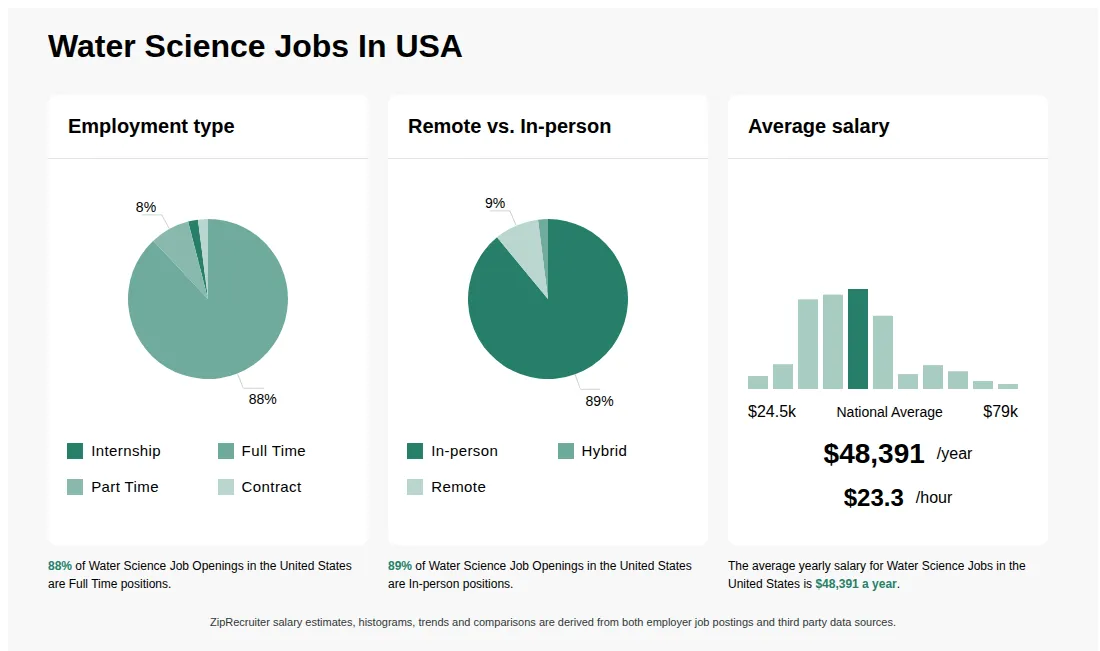
As of Jul 4, 2026, the average yearly pay for water science in the United States is $48,391.00, according to ZipRecruiter salary data. Most workers in this role earn between $38,500.00 and $52,000.00 per year, depending on experience, location, and employer.

What is the difference between Water Science vs Water Quality Technician?

AspectWater ScienceWater Quality Technician
Required CredentialsBachelor's degree in environmental science, hydrology, or related fieldAssociate's or bachelor's degree in environmental science, chemistry, or related field
Work EnvironmentResearch labs, field sites, environmental agenciesWater treatment plants, laboratories, field sampling sites
Employer & Industry UsageEnvironmental consulting, government agencies, research institutionsMunicipal water treatment facilities, environmental testing labs

Water Science involves studying water systems, conducting research, and analyzing water data, often in research or policy roles. Water Quality Technicians focus on testing and monitoring water quality at treatment plants or field sites. While both roles require knowledge of water analysis, Water Science emphasizes research and data interpretation, whereas Water Quality Technicians concentrate on sample collection and lab testing.

What does a water scientist do?

A water scientist studies the properties, distribution, and quality of water resources. They analyze water samples, develop models, and assess environmental impacts to support water management and conservation efforts, often using tools like GIS and laboratory equipment.

What are some common challenges faced by water scientists when conducting field research?

Water scientists often encounter challenges such as unpredictable weather conditions, difficult terrain, and limited access to remote sampling sites during field research. Additionally, ensuring the accuracy and reliability of samples can be complex due to contamination risks or equipment malfunctions. Collaboration with local authorities and stakeholders is frequently necessary to gain site access and gather comprehensive data. These challenges require adaptability, strong problem-solving skills, and effective communication to ensure successful research outcomes.

What can I do with a water science degree?

A water science degree prepares individuals for careers in environmental consulting, water resource management, research, and policy development. Graduates can work for government agencies, environmental organizations, or private companies, often utilizing skills in data analysis, field sampling, and environmental regulations.

What are jobs that work with water?

Jobs that work with water include water resource specialists, environmental engineers, hydrologists, water treatment plant operators, and aquatic biologists. These roles often require knowledge of water systems, environmental regulations, and sometimes certifications such as water treatment licenses or environmental degrees.

What are the key skills and qualifications needed to thrive as a Water Scientist, and why are they important?

To thrive as a Water Scientist, you need a strong background in environmental science, hydrology, chemistry, or a related field, typically with at least a bachelor's or master's degree. Familiarity with water quality testing equipment, GIS software, and data analysis tools is often required, along with certifications such as Certified Hydrologist or equivalent. Strong analytical thinking, problem-solving abilities, and effective communication skills help distinguish top performers in this role. These qualifications ensure accurate assessment of water resources, inform policy decisions, and support sustainable water management practices.

What is water science?

Water science is the study of water, including its properties, distribution, movement, and quality in the environment. It encompasses disciplines such as hydrology, hydrogeology, and water resource management. Water scientists analyze water samples, monitor water systems, and develop solutions for water conservation and pollution prevention. Their work is crucial for ensuring safe drinking water, sustainable water use, and protecting aquatic ecosystems.

What careers are in aquatic science?

Careers in aquatic science include roles such as aquatic biologist, marine scientist, water quality analyst, and environmental consultant. These positions often require knowledge of ecology, water chemistry, and fieldwork skills, and may involve working in laboratories, research vessels, or field sites.
More about Water Science jobs
What cities are hiring for Water Science jobs? Cities with the most Water Science job openings:
What states have the most Water Science jobs? States with the most job openings for Water Science jobs include:
Infographic showing various Water Science job openings in the United States as of June 2026, with employment types broken down into 67% Full Time, and 33% Part Time. Highlights an 100% In-person job distribution, with an average salary of $48,391 per year, or $23.3 per hour.
Executive Director Alabama Water Institute - 529700

Executive Director Alabama Water Institute - 529700

University of Alabama

Tuscaloosa, AL • On-site

$127K - $184K/yr

Full-time

Posted 17 days ago


University Of Alabama rating

7.1

Company rating: 7.1 out of 10

Based on 59 frontline employees who took The Breakroom Quiz

358th of 544 rated colleges and universities


Job description

Pay Grade/Pay Range: Minimum: $127,300 - Midpoint: $184,600 (Salaried E17)
Department/Organization: 750501 - Alabama Water Institute (AWI)
Normal Work Schedule: Monday - Friday 8:00am to 5:00pm
Job Summary: The Executive Director of the Alabama Water Institute provides a vision for collaborative water research through effective leadership that embraces the full range of disciplines represented by Alabama Water Institute (AWI). Develops and elevates AWI's national and international profile. Coordinates closely with federal water agencies. Partners with University staff to identify, promote, and contribute resources to strengthen AWI and manage its portfolio. Stimulates the development of new research centers consistent with the AWI research focus. Fosters and supports high quality research and scholarly activities within AWI by ensuring a stimulating, collegial, and well-managed environment. Engages a range of internal and external stakeholders to identify research opportunities and partnerships.
Additional Department Summary: The Alabama Water Institute (AWI) stands as a cornerstone of the University of Alabama's research enterprise. AWI's mission is to develop and implement transformative, interdisciplinary solutions that ensure water security for communities, industries, and ecosystems in Alabama, the nation, and the world. Through partnerships with federal agencies, academic collaborators, and private-sector innovators, AWI promotes research and technology development in areas such as hydrologic forecasting, water quality, groundwater and surface water assessment, hydroinformatics, and risk communication. The institute supports the University's broader commitment to resilience, environmental stewardship, and sustainable economic development.
The scope and impact of AWI are both broad and deep. In 2022, the institute led a national consortium to secure a $360M, five-year Cooperative Institute award from the National Oceanic and Atmospheric Administration (NOAA). The Cooperative Institute for Research to Operations in Hydrology (CIROH) unites more than two dozen academic and agency partners to advance the nation's hydrologic modeling, forecasting, and decision-support capabilities. Also in 2022, the Global Water Security Center, operating under AWI's umbrella, received significant Department of War support to expand its work at the intersection of national security, environmental intelligence, and data science. Building on this foundation, AWI also leads the Community Oriented Nature-based Science for Ecosystem Restoration and Versatile Engineering (CONSERVE), a strategic initiative that advances integrated research and education to improve the resilience of coupled human-natural systems. CONSERVE strengthens UA's leadership in global sustainability by connecting water research to the critical interdependencies of agriculture, energy, and environmental stewardship. These landmark accomplishments underscore AWI's growing influence as a trusted partner to government, industry, and research organizations worldwide. The Institute's success is amplified by the unparalleled ecosystem for water research on UA's campus. The National Water Center (NWC) develops and delivers state-of-the-science hydrologic analyses and forecasts from a facility located on the University's campus. The United States Geological Survey (USGS) recently opened the new Hydrological Instrumentation Facility (HIF), a state-of-the-art laboratory and testing complex that anchors collaborations in measurement science, modeling, and field instrumentation. Together, these two federal centers, combined with UA's world-class faculty and facilities, create a research environment unmatched in the nation for innovation in hydrology and water resources.
The University of Alabama (UA) invites nominations and applications for the position of Executive Director of the Alabama Water Institute (AWI). This is a singular opportunity for a visionary leader to shape the future of water research, innovation, and impact at one of the nation's fastest-growing and most dynamic flagship universities.
This position serves as the chief architect of AWI's vision, strategy, and operations. Works closely with the Vice President for Research and the leaders of UA's other signature research institutes to advance the institute's national and international reputation for excellence in water science and policy. Strengthens and expands relationships with NOAA, USGS, NASA, the Army Corps of Engineers, NSF, and other federal and state partners. Fosters multi-disciplinary collaborations that connect UA's faculty expertise to emerging global water challenges. Develops sustainable funding models that ensure the long-term growth and stability of AWI. Champions a culture of innovation and impact that aligns with UA's mission as the state's flagship public research university.
As The University of Alabama continues to expand its research and innovation enterprise, the Alabama Water Institute represents a defining opportunity to shape the next generation of water science and technology. The Executive Director will join a campus community driven by excellence, innovation, and public service and ensures that The University of Alabama leads the way in building a resilient and water-secure future for all.
Required Minimum Qualifications: Bachelor's degree and eight (8) years of cross-disciplinary research team(s) leadership experience in a research-intensive academic, industrial, or government setting; OR master's degree and six (6) years of cross-disciplinary research team(s) leadership experience in a research-intensive academic, industrial, or government setting.
Skills and Knowledge: Ability to cultivate and sustain partnerships across the public, private, and nonprofit sectors, fostering innovation and translating research into societal and economic benefits.
Preferred Qualifications: Bachelor's degree and twelve (12) years of progressively responsible experience; OR master's degree and ten (10) years of directly relevant experience in research administration, scientific leadership, or program management. Record of excellence in research leadership, strategic vision, and collaborative accomplishment that reflects the breadth and ambition of The University of Alabama's research enterprise. Record of success and experience directing cross-disciplinary research teams and initiatives, with achievements recognized at the national level and, ideally, international level. Demonstrated success in government relations, including the development of competitive proposals, the establishment of interagency collaborations, and the acquisition of federal and/or state appropriations to advance research priorities. Experience working with major federal agencies engaged in water and environmental research, including-but not limited to-NOAA, the U.S. Geological Survey, the U.S. Army Corps of Engineers, NASA, the National Science Foundation, the U.S. Fish and Wildlife Service, and the Environmental Protection Agency. Significant experience leading research and operational programs within an academic, industrial, and/or government environment, with a demonstrated ability to connect science, policy, and practice. Deep understanding of various scientific, engineering, and policy disciplines represented within the Alabama Water Institute and the ability to integrate these perspectives into a cohesive vision A reputation as a trusted and effective colleague and leader, known for fostering collaboration, transparency, and accountability within complex organizations. Documented success in managing and developing staff and research professionals, with a proven capacity to recruit, mentor, and retain top talent. Clear understanding of research funding landscapes and demonstrated success in developing, securing, and managing externally sponsored grants and contracts. Demonstrated record of success in research management, program development, and partnership building.
Background Investigation Statement: Prior to hiring, the final candidate(s) must successfully pass a pre-employment background investigation and information obtained from social media and other internet sources. A prior conviction reported as a result of the background investigation DOES NOT automatically disqualify a candidate from consideration for this position. A candidate with a prior conviction or negative behavioral red flags will receive an individualized review of the prior conviction or negative behavioral red flags before a hiring decision is made.
Equal Employment Opportunity: The University of Alabama is an Equal Employment/Equal Educational Opportunity Institution. All qualified applicants will receive consideration for employment or volunteer status without regard to any legally protected basis and will not be discriminated against because of their protected status. Applicants and employees of this institution are protected under Federal law from discrimination on several bases. More information is available in the EEOC's Know Your Rights: Workplace discrimination is illegal poster.
The University of Alabama affirms its longstanding commitment to institutional neutrality, free speech, and academic freedom.

What University Of Alabama employees say

Pay

Benefits

Hours and flexibility

Workplace

Get the full story on Breakroom