
Athletics Summary The Head Indoor Track & Field coach creates and sustains a vision that embodies the purpose and the goals of athletics at Mercersburg. The primary focus for every coach at ...
Athletics Summary The Head Indoor Track & Field coach creates and sustains a vision that embodies the purpose and the goals of athletics at Mercersburg. The primary focus for every coach at ...

TRACK & FIELD - ASSISTANT COACH Pace Academy is an independent college preparatory school in Atlanta, Ga., with an enrollment of 1,115 students in Pre-First through 12th grade. The school strives to ...
Quick apply
TRACK & FIELD - ASSISTANT COACH Pace Academy is an independent college preparatory school in Atlanta, Ga., with an enrollment of 1,115 students in Pre-First through 12th grade. The school strives to ...

Assistant Track Coach
Saint Louis, MO · On-site
The Assistant Track & Field Coach is responsible for the structure and direction of the track and field program at Jennings School District Reports to: Athletic Director Responsibilities Regular ...
Assistant Track Coach
Saint Louis, MO · On-site
The Assistant Track & Field Coach is responsible for the structure and direction of the track and field program at Jennings School District Reports to: Athletic Director Responsibilities Regular ...

Head Track & Field Coach
Ontario, CA · On-site
We are currently hiring for a Head Track & Field Coach to lead our talented high school program. We are looking for candidates who are passionate about: * Developing student-athletes in skill ...
Quick apply
Head Track & Field Coach
Ontario, CA · On-site
We are currently hiring for a Head Track & Field Coach to lead our talented high school program. We are looking for candidates who are passionate about: * Developing student-athletes in skill ...
Athletics Summary The Head Indoor Track & Field coach creates and sustains a vision that embodies the purpose and the goals of athletics at Mercersburg. The primary focus for every coach at ...
Athletics Summary The Head Indoor Track & Field coach creates and sustains a vision that embodies the purpose and the goals of athletics at Mercersburg. The primary focus for every coach at ...
We are currently hiring for a Head Track & Field Coach to lead our talented high school program. We are looking for candidates who are passionate about: * Developing student-athletes in skill ...
We are currently hiring for a Head Track & Field Coach to lead our talented high school program. We are looking for candidates who are passionate about: * Developing student-athletes in skill ...
Head Track & Field Coach
Ontario, CA · On-site
$16.90 - $20/hr
We are currently hiring for a Head Track & Field Coach to lead our talented high school program. We are looking for candidates who are passionate about: * Developing student-athletes in skill ...
Head Track & Field Coach
Ontario, CA · On-site
$16.90 - $20/hr
We are currently hiring for a Head Track & Field Coach to lead our talented high school program. We are looking for candidates who are passionate about: * Developing student-athletes in skill ...

Assistant Track & Field Coach
Aurora, IL · On-site
Overview Overview Illinois Mathematics & Science Academy (IMSA) is seeking an individual to fill the role of " Assistant Coach " for the high school Boys and Girls Track and Field upcoming Spring ...
Assistant Track & Field Coach
Aurora, IL · On-site
Overview Overview Illinois Mathematics & Science Academy (IMSA) is seeking an individual to fill the role of " Assistant Coach " for the high school Boys and Girls Track and Field upcoming Spring ...

This position will assist the Head Women's Track & Field Coach in all aspects of coaching the throws events and contribute to the continued growth and success of the program. The Volunteer Assistant ...
This position will assist the Head Women's Track & Field Coach in all aspects of coaching the throws events and contribute to the continued growth and success of the program. The Volunteer Assistant ...
BOYS/GIRLS TRACK & FIELD - ASSISTANT COACH Pace Academy is an independent college preparatory school in Atlanta, Ga., with an enrollment of 1,115 students in Pre-First through 12th grade. The school ...
Quick apply
BOYS/GIRLS TRACK & FIELD - ASSISTANT COACH Pace Academy is an independent college preparatory school in Atlanta, Ga., with an enrollment of 1,115 students in Pre-First through 12th grade. The school ...
Assistant Track Coach
Jennings, MO · On-site
Athletics/Activities Date Posted: 2/11/2026 Closing Date: 02/20/2026The Assistant Track & Field Coach is responsible for the structure and direction of the track and field program at Jennings School ...
Assistant Track Coach
Jennings, MO · On-site
Athletics/Activities Date Posted: 2/11/2026 Closing Date: 02/20/2026The Assistant Track & Field Coach is responsible for the structure and direction of the track and field program at Jennings School ...
Peotone CUSD 207U is seeking qualified candidates for the position of Special Olympics Track & Field Coach at Peotone Junior High School for the Spring 2027 season. Interested candidates should apply ...
Peotone CUSD 207U is seeking qualified candidates for the position of Special Olympics Track & Field Coach at Peotone Junior High School for the Spring 2027 season. Interested candidates should apply ...
Assistant Track & Field Coach
Aurora, IL · On-site
Overview Overview Illinois Mathematics & Science Academy (IMSA) is seeking an individual to fill the role of " Assistant Coach " for the high school Boys and Girls Track and Field upcoming Spring ...
Assistant Track & Field Coach
Aurora, IL · On-site
Overview Overview Illinois Mathematics & Science Academy (IMSA) is seeking an individual to fill the role of " Assistant Coach " for the high school Boys and Girls Track and Field upcoming Spring ...

Serve as the Assistant Cross Country and Track & Field Coach, Men's Distance under the direction of the Director of Cross Country and Track and Field. Coaching proficiency in the distance events is ...
Serve as the Assistant Cross Country and Track & Field Coach, Men's Distance under the direction of the Director of Cross Country and Track and Field. Coaching proficiency in the distance events is ...

Assistant Coaches ESSENTIAL DUTIES * Administers and oversees all levels and functions of the boys and girls track and field programs * Develops and maintains a high-quality program founded on sound ...
Assistant Coaches ESSENTIAL DUTIES * Administers and oversees all levels and functions of the boys and girls track and field programs * Develops and maintains a high-quality program founded on sound ...

The Assistant Track & Field coach for throws will provide leadership, mentorship, instruction, motivation, and support to the Bob Jones University Track & Field Program. The goal and objective of the ...
The Assistant Track & Field coach for throws will provide leadership, mentorship, instruction, motivation, and support to the Bob Jones University Track & Field Program. The goal and objective of the ...

Department Athletics Men's Track and Field Job Summary The Assistant Track & Field Coach assists the Head Men's & Women's Track & Field/Cross Country Coach with instruction, development, preparation ...
Department Athletics Men's Track and Field Job Summary The Assistant Track & Field Coach assists the Head Men's & Women's Track & Field/Cross Country Coach with instruction, development, preparation ...

Assistant Coach for Track and Field - Throws Coe College seeks qualified candidates for the role of Assistant Coach for Track and Field - Throws. This position will provide assistant track/field ...
Assistant Coach for Track and Field - Throws Coe College seeks qualified candidates for the role of Assistant Coach for Track and Field - Throws. This position will provide assistant track/field ...
Department Athletics Men's Track and Field Job Summary The Assistant Track & Field Coach assists the Head Men's & Women's Track & Field/Cross Country Coach with instruction, development, preparation ...
Department Athletics Men's Track and Field Job Summary The Assistant Track & Field Coach assists the Head Men's & Women's Track & Field/Cross Country Coach with instruction, development, preparation ...
Overview Illinois Mathematics & Science Academy (IMSA) is seeking an individual to fill the role of " Assistant Coach " for the high school Boys and Girls Track and Field upcoming Spring 2027 season.
Overview Illinois Mathematics & Science Academy (IMSA) is seeking an individual to fill the role of " Assistant Coach " for the high school Boys and Girls Track and Field upcoming Spring 2027 season.
Track And Field Coach information
See salary details
$5.29 - $7.60
0% of jobs
$7.60 - $9.92
0% of jobs
$9.92 - $12.24
0% of jobs
$12.24 - $14.55
0% of jobs
$15.77 is the 25th percentile. Wages below this are outliers.
$14.55 - $16.87
47% of jobs
The median wage is $17.06 / hr.
$16.87 - $19.19
31% of jobs
$19.19 - $21.50
0% of jobs
$21.50 - $23.82
0% of jobs
$23.82 - $26.14
0% of jobs
$26.14 - $28.45
0% of jobs
$28.45 - $30.77
21% of jobs
$5
$20
$30
How much do track and field coach jobs pay per hour?
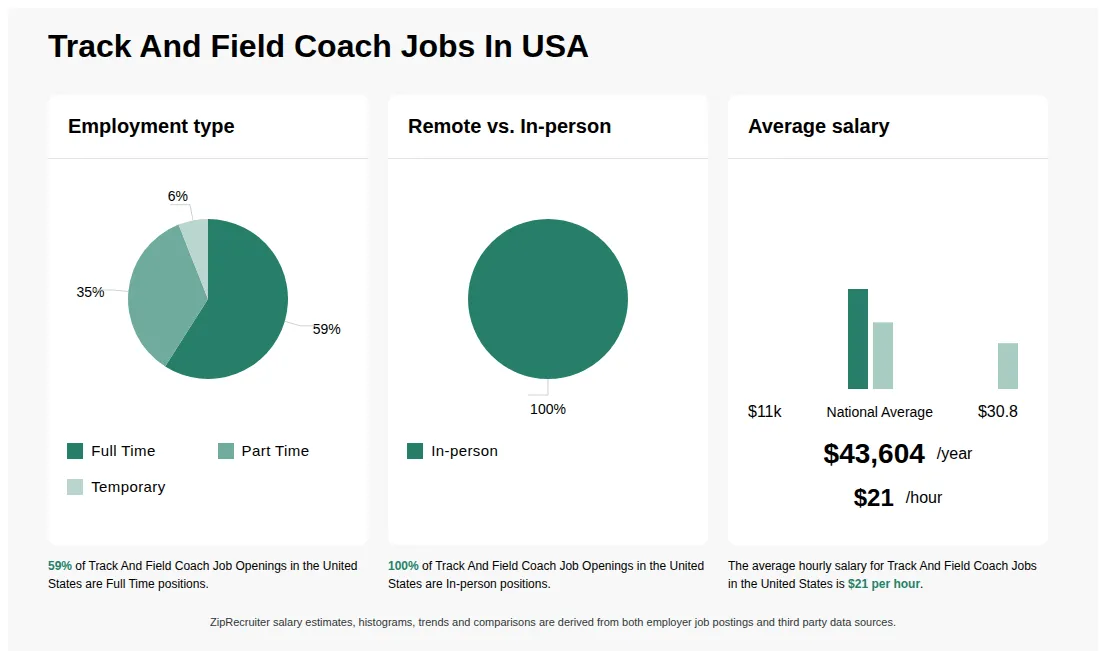
As of Jul 24, 2026, the average hourly pay for track and field coach in the United States is $20.96, according to ZipRecruiter salary data. Most workers in this role earn between $15.87 and $30.77 per hour, depending on experience, location, and employer.
What are the key skills and qualifications needed to thrive as a Track and Field Coach, and why are they important?
To thrive as a Track and Field Coach, you need expertise in sports science, knowledge of training methodologies, and often a bachelor's degree in physical education or a related field, along with relevant coaching certifications. Familiarity with performance analysis software, timing systems, and injury prevention tools is typically required. Strong leadership, motivational abilities, and effective communication set outstanding coaches apart. These skills ensure athletes develop optimally, remain safe, and achieve peak performance in a competitive environment.
What Does a Track and Field Coach Do?
Track and field coaches work in high schools and colleges, training athletes. You recruit and train students, helping them improve their performance in a variety of events, oversee track meets, and travel with your team during the season. You must be physically fit since, as part of your job, you may demonstrate some of the events, to show proper form and prepare the students for competition.
What does a Track and Field Coach do?
A Track and Field Coach is responsible for training and developing athletes in various events such as sprints, distance running, jumps, and throws. They design training programs, teach proper techniques, oversee practices and competitions, and help athletes set and achieve performance goals. Additionally, coaches provide motivation, monitor athletes' progress, and ensure safety during training sessions. They may also scout talent, manage equipment, and coordinate team logistics for meets.
What is the difference between Track And Field Coach vs Cross Country Coach?
| Aspect | Track And Field Coach | Cross Country Coach |
|---|---|---|
| Certifications | Coaching certifications, possibly specific to track and field | Similar coaching certifications, often including endurance training |
| Work Environment | Indoor and outdoor tracks, stadiums | Outdoor courses, varied terrains |
| Industry Usage | High school, college, club teams | High school, college, running clubs |
Both roles require coaching certifications and involve working with athletes in competitive environments. The main difference lies in the setting: Track And Field Coaches focus on sprinting, jumping, and throwing events on tracks, while Cross Country Coaches specialize in long-distance running over outdoor courses. Understanding these distinctions helps athletes and employers find the right coaching expertise for their needs.
What are the main challenges Track and Field Coaches face when working with athletes of varying skill levels?
Track and Field Coaches often work with athletes ranging from beginners to elite competitors, which presents the challenge of designing training plans that meet individual needs while fostering a cohesive team environment. Coaches must balance time and resources, ensuring each athlete receives appropriate attention, technical instruction, and motivation. Effective communication and adaptability are essential, as coaches need to modify drills, provide tailored feedback, and set realistic goals for athletes at different performance levels. Building trust and maintaining athlete engagement across a diverse group is key to overall team success.
More about Track And Field Coach jobs
What cities are hiring for Track And Field Coach jobs? Cities with the most Track And Field Coach job openings:
What are the most commonly searched types of Track And Field Coach jobs? The most popular types of Track And Field Coach jobs are:
Who are the top companies hiring for Track And Field Coach jobs? The top employers for Track And Field Coach jobs are:
What states have the most Track And Field Coach jobs? States with the most job openings for Track And Field Coach jobs include:
What job categories do people searching Track And Field Coach jobs look for? The top searched job categories for Track And Field Coach jobs are:
What are popular job titles related to Track And Field Coach jobs? For Track And Field Coach jobs, the most frequently searched job titles are:
Job description
Description
Job Classification: Seasonal
Reports to: Director of Athletics
Department: Athletics
Summary
The Head Indoor Track & Field coach creates and sustains a vision that embodies the purpose and the goals of athletics at Mercersburg. The primary focus for every coach at Mercersburg is to provide a transformative experience for every participant in their program, regardless of level of play or area of contribution. The head coach is responsible for managing daily operations and other program-related duties.
The head coach manages an indoor track and field program that competes in the Mid-Atlantic Prep League (MAPL). The coach is highly active in admission recruiting for the school, works with families on college recruiting opportunities, and engages in clinics, camps, and conferences in the off-season.
Responsibilities and Duties
The Indoor Track & Field coach is responsible for leading the boys and girls' indoor track & field program and mentoring student-athletes in athletic and personal development. This role requires a passion for indoor track and field and the ability to create a positive and inclusive team culture that fosters growth and success.
Leadership
- Establish a vision for the program and demonstrate a commitment to the mission and the purpose of the program. Communicate and embody the competitive and cooperative nature of athletics, the need for teaching and learning, and the drive for achievement and improvement.
- Effectively set and communicate short, intermediate, and long-term goals and execute action steps with the coaching staff and team(s).
- Create and maintain an atmosphere of trust and respect for, and between, athletes and coaches through demonstration and application of integrity and high ideals in the sport and in relationships with athletes and coaches.
- Exercise self-control and sound judgment when engaged with staff and athletes during practices and competitive events, as well as beyond the athletic venue.
- Consistently apply and strongly adhere to the rules of competition relative to the sport and a respectful approach to both victory and defeat.
Organization and Instruction
- Prepare and execute practices, contests, and other components of team operations effectively and efficiently.
- Demonstrate proficient technical knowledge and strategies. Effectively convey these skills in teaching and guiding athletes of all abilities in the sport.
Community
- Promote and support all athletic teams. Emphasize, encourage, and recognize academic endeavors and other areas of school life beyond the athletic sphere.
- Explore and encourage participation by athletes and coaches in charitable and community oriented activities.
Administrative/Program Management
- Adhere to athletic department philosophy, policies, guidelines, and calendar items.
- Work with the athletic leadership to effectively administer and monitor team operations, including preseason preparations and post-season assessments, coaching assignments, scheduling, team travel, and team inventory maintenance.
Admission
Independent schools rely on an admission process for enrollment, an exercise that involves all faculty to some extent and specifically involves athletic coaches in many instances. The basic expectations of head coaches are:
- Participate in Admission Open Houses and Revisit Days.
- Respond to inquiries from prospective students who express interest in the coach's sport.
- Respond to inquiries from prospective students who are referred to the coach by the admission office.
- Meet prospective students who visit campus (outside of open house and revisit days) or arrange for assistant coaches to contact and/or meet with prospective students, when needed.
- Communicate on a regular basis with admission officers during the admission process regarding prospective students.
- Coaches are encouraged to initiate interest in the school and their sport by also cultivating appropriate relationships with college coaches, youth clubs and organizations, and other connections that can result in admission inquiries and applications. Any outreach is guided by
- school admission parameters and Mid-Atlantic Prep League recruiting rules.
Sports Communication
- Facilitate submission of contest results to designated media outlets.
- Submit cumulative and individual statistics to the athletic department for archiving at the end of each season.
Coaching Development, Advancement, and Training
- Engage in sport specific associations, attend clinics/conferences, and embrace opportunities that bring development in coaching methods, strategies, and approaches beyond workshops and seminars provided by the school. Head coaches should engage in these extended advancement opportunities at least once each two years.
Note: All coaches complete mandated courses relative to athlete health and safety on a consistent basis, as directed by the Department of Athletics, in concurrence with applicable state and national rules and laws.
College Recruiting
- Provide appropriate and accurate guidance to athletes who desire to compete on the collegiate level. This involves knowledge of opportunities and NCAA rules, coordinating recruiting video production, communicating with college coaches, and generally being active in the advising process for athletes and their families.
Reflection and Review
- All coaches engage in reflection and provide feedback about their experience and their contributions to the program after each season. Coaches also receive feedback from athletic leadership and from student-athlete surveys.
Physical Demands
The conditions herein are representative of those that must be met by an employee to successfully perform the essential functions of this job. Reasonable accommodations may be made to enable individuals with disabilities to perform the essential job functions.
- Environment: Work is performed in both indoor and outdoor environments with exposure to all weather.
- Physical: Primary functions require sufficient physical ability and mobility to sit, walk or stand for prolonged periods of time; in some aspects of the job the requirement to balance, stoop, kneel, crouch, crawl, reach, may be required; will use repetitive motions on a computer; may frequently lift up 20 lbs. or up to 10 pounds constantly and occasionally up to 50 lbs.; to travel in all modes of transportation; sufficient manual dexterity and eye-hand coordination to grasp, finger, and feel.
- Vision: See in the normal visual range with or without correction.
- Hearing: Hear in the normal audio range with or without correction.
This description is intended to provide a general scope of the position. This job description may include other duties as assigned by the manager.
Requirements
Knowledge, Skills and Abilities
- Mentoring student-athletes in athletic and personal development.
- Demonstrates integrity and sound judgment at all times.
- Ability to establish and execute a cohesive program vision by setting and communicating goals.
- Ability to foster a positive and inclusive team culture.
- A disciplined, results-oriented, self-starter, demonstrating initiative and the ability to work independently with minimal supervision.
- Outstanding listening, analytical skills and strong interpersonal skills.
- Exceptional organizational skills and attention to detail.

About Mercersburg Academy
Sourced by ZipRecruiter
Company size
51 - 200 Employees
Headquarters location
Mercersburg, PA, US
Year founded
1893