Reviews moderately complex medical records to identify sequence, code diagnoses and procedures according to established coding, CMS and hospital guidelines. * Responsible for accurately coding ...
Reviews moderately complex medical records to identify sequence, code diagnoses and procedures according to established coding, CMS and hospital guidelines. * Responsible for accurately coding ...
Reviews moderately complex medical records to identify sequence, code diagnoses and procedures according to established coding, CMS and hospital guidelines. * Responsible for accurately coding ...
Reviews moderately complex medical records to identify sequence, code diagnoses and procedures according to established coding, CMS and hospital guidelines. * Responsible for accurately coding ...
Reviews moderately complex medical records to identify sequence, code diagnoses and procedures according to established coding, CMS and hospital guidelines. * Responsible for accurately coding ...
Reviews moderately complex medical records to identify sequence, code diagnoses and procedures according to established coding, CMS and hospital guidelines. * Responsible for accurately coding ...

LEAD MEDICAL BILLING SPEC-REMOTE
Moraine, OH · On-site +1
$16.50 - $21/hr
In addition the team lead, will review coding & charges, ensure the completion of team members ... The Medical Billing Specialist Team Leader is responsible for the entry of all data processed ...
LEAD MEDICAL BILLING SPEC-REMOTE
Moraine, OH · On-site +1
$16.50 - $21/hr
In addition the team lead, will review coding & charges, ensure the completion of team members ... The Medical Billing Specialist Team Leader is responsible for the entry of all data processed ...
LEAD MEDICAL BILLING SPEC-REMOTE
Moraine, OH · On-site +1
$16.50 - $21/hr
In addition the team lead, will review coding & charges, ensure the completion of team members ... The Medical Billing Specialist Team Leader is responsible for the entry of all data processed ...
LEAD MEDICAL BILLING SPEC-REMOTE
Moraine, OH · On-site +1
$16.50 - $21/hr
In addition the team lead, will review coding & charges, ensure the completion of team members ... The Medical Billing Specialist Team Leader is responsible for the entry of all data processed ...
LEAD MEDICAL BILLING SPEC-REMOTE
Moraine, OH · On-site +1
$16.50 - $21/hr
In addition the team lead, will review coding & charges, ensure the completion of team members ... The Medical Billing Specialist Team Leader is responsible for the entry of all data processed ...
LEAD MEDICAL BILLING SPEC-REMOTE
Moraine, OH · On-site +1
$16.50 - $21/hr
In addition the team lead, will review coding & charges, ensure the completion of team members ... The Medical Billing Specialist Team Leader is responsible for the entry of all data processed ...
LEAD MEDICAL BILLING SPEC-REMOTE
Moraine, OH · On-site +1
$16.50 - $21/hr
In addition the team lead, will review coding & charges, ensure the completion of team members ... The Medical Billing Specialist Team Leader is responsible for the entry of all data processed ...
LEAD MEDICAL BILLING SPEC-REMOTE
Moraine, OH · On-site +1
$16.50 - $21/hr
In addition the team lead, will review coding & charges, ensure the completion of team members ... The Medical Billing Specialist Team Leader is responsible for the entry of all data processed ...

Orthopedic Coding Specialist- Work-From-Home Eligible in Ohio
Westerville, OH · On-site +1
$18.25 - $23.25/hr
This position is eligible for a remote work arrangement after completion of an onboarding period ... Previous medical billing experience, preferably in an orthopedic surgery specialty is required.
Orthopedic Coding Specialist- Work-From-Home Eligible in Ohio
Westerville, OH · On-site +1
$18.25 - $23.25/hr
This position is eligible for a remote work arrangement after completion of an onboarding period ... Previous medical billing experience, preferably in an orthopedic surgery specialty is required.
A Brief Overview Responsible for accurately and timely coding of outpatient and professional medical records following established coding, CMS regulations and hospital guidelines. Reviews all types ...
A Brief Overview Responsible for accurately and timely coding of outpatient and professional medical records following established coding, CMS regulations and hospital guidelines. Reviews all types ...
A Brief Overview Responsible for accurately and timely coding of outpatient and professional medical records following established coding, CMS regulations and hospital guidelines. Reviews all types ...
A Brief Overview Responsible for accurately and timely coding of outpatient and professional medical records following established coding, CMS regulations and hospital guidelines. Reviews all types ...
A Brief Overview Responsible for accurately and timely coding of outpatient and professional medical records following established coding, CMS regulations and hospital guidelines. Reviews all types ...
A Brief Overview Responsible for accurately and timely coding of outpatient and professional medical records following established coding, CMS regulations and hospital guidelines. Reviews all types ...

Health System Shared Services | MIM CDI and Coding Remote Position Scope of Position After inpatient medical records are coded within Medical Information Management (MIM), the Inpatient Coding ...
Health System Shared Services | MIM CDI and Coding Remote Position Scope of Position After inpatient medical records are coded within Medical Information Management (MIM), the Inpatient Coding ...
Continued remote work is contingent upon demonstrated ability to perform all assigned duties ... Annual training, the UH Code of Conduct and UH policies and procedures are in place to address ...
Continued remote work is contingent upon demonstrated ability to perform all assigned duties ... Annual training, the UH Code of Conduct and UH policies and procedures are in place to address ...
Continued remote work is contingent upon demonstrated ability to perform all assigned duties ... Annual training, the UH Code of Conduct and UH policies and procedures are in place to address ...
Continued remote work is contingent upon demonstrated ability to perform all assigned duties ... Annual training, the UH Code of Conduct and UH policies and procedures are in place to address ...

Medical Science Liaison, Oncology - Great Lakes (IL, WI, MN, IA, MI, OH, MO)
Columbus, OH · On-site +1
This is a remote position open to applicants authorized to work for any employer within the United ... Adheres to the US "Compliance Code of Conduct" and all LMI policies and procedures, the OIG ...
Quick apply
Medical Science Liaison, Oncology - Great Lakes (IL, WI, MN, IA, MI, OH, MO)
Columbus, OH · On-site +1
This is a remote position open to applicants authorized to work for any employer within the United ... Adheres to the US "Compliance Code of Conduct" and all LMI policies and procedures, the OIG ...
Medical Science Liaison, Oncology - Great Lakes (IL, WI, MN, IA, MI, OH, MO)
Cleveland, OH · On-site +1
This is a remote position open to applicants authorized to work for any employer within the United ... Adheres to the US "Compliance Code of Conduct" and all LMI policies and procedures, the OIG ...
Quick apply
Medical Science Liaison, Oncology - Great Lakes (IL, WI, MN, IA, MI, OH, MO)
Cleveland, OH · On-site +1
This is a remote position open to applicants authorized to work for any employer within the United ... Adheres to the US "Compliance Code of Conduct" and all LMI policies and procedures, the OIG ...

Medical Administration Specialist
Cleveland, OH · On-site +1
$52K - $83K/yr
... DOAs), homicides, code blue, cost recovery matters, and facility or community disasters, etc ... HCP include all VA licensed and unlicensed, clinical and administrative, remote and onsite, paid ...
Medical Administration Specialist
Cleveland, OH · On-site +1
$52K - $83K/yr
... DOAs), homicides, code blue, cost recovery matters, and facility or community disasters, etc ... HCP include all VA licensed and unlicensed, clinical and administrative, remote and onsite, paid ...

Remote FACS Cache Developer
Columbus, OH · On-site +1
$90K - $110K/yr
Comprehensive benefits package available: including medical, dental and vision, 401k retirement ... Participate in code reviews to ensure quality, maintainability, and adherence to development ...
Remote FACS Cache Developer
Columbus, OH · On-site +1
$90K - $110K/yr
Comprehensive benefits package available: including medical, dental and vision, 401k retirement ... Participate in code reviews to ensure quality, maintainability, and adherence to development ...
Medical Science Liaison, Oncology - Great Lakes (IL, WI, MN, IA, MI, OH, MO)
Cleveland, OH · On-site +1
This is a remote position open to applicants authorized to work for any employer within the United ... Adheres to the US "Compliance Code of Conduct" and all LMI policies and procedures, the OIG ...
Medical Science Liaison, Oncology - Great Lakes (IL, WI, MN, IA, MI, OH, MO)
Cleveland, OH · On-site +1
This is a remote position open to applicants authorized to work for any employer within the United ... Adheres to the US "Compliance Code of Conduct" and all LMI policies and procedures, the OIG ...
Medical Science Liaison, Oncology - Great Lakes (IL, WI, MN, IA, MI, OH, MO)
Columbus, OH · On-site +1
This is a remote position open to applicants authorized to work for any employer within the United ... Adheres to the US "Compliance Code of Conduct" and all LMI policies and procedures, the OIG ...
Medical Science Liaison, Oncology - Great Lakes (IL, WI, MN, IA, MI, OH, MO)
Columbus, OH · On-site +1
This is a remote position open to applicants authorized to work for any employer within the United ... Adheres to the US "Compliance Code of Conduct" and all LMI policies and procedures, the OIG ...
Remote Medical Coder information
See Ohio salary details
$16.45 - $17.02
7% of jobs
$17.55 is the 25th percentile. Wages below this are outliers.
$17.02 - $17.58
19% of jobs
$17.58 - $18.14
5% of jobs
$18.14 - $18.70
3% of jobs
$18.70 - $19.26
14% of jobs
The median wage is $19.40 / hr.
$19.26 - $19.82
6% of jobs
$19.82 - $20.38
0% of jobs
$20.38 - $20.94
0% of jobs
$20.94 - $21.50
0% of jobs
$21.95 is the 75th percentile. Wages above this are outliers.
$21.50 - $22.06
26% of jobs
$22.06 - $22.62
20% of jobs
$16
$20
$22
How much do remote medical coder jobs pay per hour?
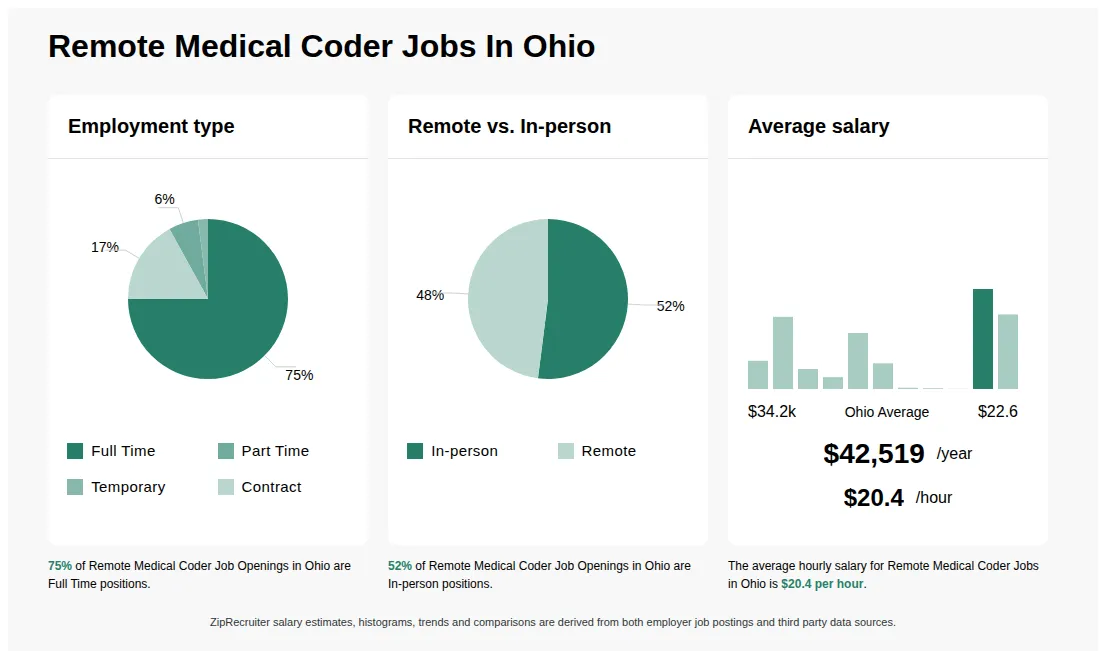
As of Sep 3, 2026, the average hourly pay for remote medical coder in Ohio is $20.44, according to ZipRecruiter salary data. Most workers in this role earn between $17.16 and $21.73 per hour, depending on experience, location, and employer.
What is a remote medical coder?
A remote medical coder is a healthcare professional who reviews clinical documents and assigns standardized codes for diagnoses, procedures, and medical services, all while working from a remote location such as their home. These codes are essential for billing, insurance claims, and maintaining patient records. Remote medical coders typically use electronic health records (EHR) and must have a strong understanding of medical terminology, coding systems like ICD-10 and CPT, and relevant regulations. Working remotely offers flexibility but still requires attention to detail, confidentiality, and adherence to industry standards.
What does a remote medical coder do?
Remote medical coders are medical coders who work from home or locations outside of healthcare facilities. They process patient information, such as diagnosis, services rendered, and equipment used to conduct tests, in order to translate it into medical codes consisting of numbers and letters. Billing and coding specialists manage this information so that patients or their insurance companies can be billed appropriately. Remote medical coders may be self-employed or work for large coding firms that contract with hospitals or healthcare facilities.
What are the key skills and qualifications needed to thrive as a remote medical coder, and why are they important?
To thrive as a Remote Medical Coder, you need a solid understanding of medical terminology, anatomy, and coding systems such as ICD-10 and CPT, usually supported by a coding certification (e.g., CPC, CCS). Familiarity with electronic health records (EHRs) and coding software like 3M or Epic is essential for accurate and efficient work. Attention to detail, time management, and strong written communication skills help remote coders excel in independent, deadline-driven environments. These abilities ensure accurate billing, compliance with regulations, and minimal claim denials, which are critical for healthcare organizations' operational and financial success.
How do remote medical coders typically communicate and collaborate with healthcare providers and team members?
Remote Medical Coders often collaborate with healthcare providers, billing teams, and other coders through secure digital platforms, email, and scheduled video conferences. Clear communication is essential to clarify documentation, resolve coding discrepancies, and ensure accurate billing. Many employers use specialized health information systems and project management tools to streamline workflow and maintain HIPAA compliance. Frequent virtual meetings and messaging help foster teamwork and keep everyone aligned, even when working from different locations.
What is the difference between Remote Medical Coder vs Remote Medical Biller?
| Aspect | Remote Medical Coder | Remote Medical Biller |
|---|---|---|
| Certifications | Certified Professional Coder (CPC), CCS | Certified Medical Reimbursement Specialist (CMRS), CPC |
| Work Environment | Analyzing medical records, coding diagnoses and procedures | Submitting claims, following up on payments |
| Industry Usage | Healthcare providers, hospitals, clinics | Insurance companies, billing services, healthcare providers |
Remote Medical Coders and Remote Medical Billers often work together but focus on different tasks. Coders assign codes based on medical records, while Billers handle claims submission and payment follow-up. Both roles require similar certifications and are essential in healthcare revenue cycle management.
How to get a remote job as a remote medical coder?
To secure a remote medical coder position, obtain relevant certifications such as CPC or CCS, gain experience with coding software and electronic health records, and build a strong resume highlighting your coding skills. Job seekers should search for openings on healthcare job boards and company websites, and demonstrate attention to detail and knowledge of medical terminology during the application process.
Is remote medical coding worth it?
Remote medical coding is a viable career option that offers flexibility and the ability to work from home. It requires certification, attention to detail, and proficiency with coding software, making it suitable for those seeking a flexible schedule and independent work environment.
More about Remote Medical Coder jobs
What are the most commonly searched types of Medical Coder jobs in Ohio?
The most popular types of Medical Coder jobs in Ohio are:
What are popular job titles related to Remote Medical Coder jobs in Ohio?
For Remote Medical Coder jobs in Ohio, the most frequently searched job titles are:
What job categories do people searching Remote Medical Coder jobs in Ohio look for?
The top searched job categories for Remote Medical Coder jobs in Ohio are:
What cities in Ohio are hiring for Remote Medical Coder jobs?
Cities in Ohio with the most Remote Medical Coder job openings:
What are popular job titles related to Remote Medical Coder jobs in OH?
For Remote Medical Coder jobs in OH, the most frequently searched job titles are:

Full-time
Re-posted 13 days ago
University Hospitals rating

7.3
Based on 626 frontline employees who took The Breakroom Quiz
303rd of 898 rated healthcare providers
Job description
A Brief Overview
Responsible for accurately and timely coding of moderately complex encounters following established coding, CMS regulations and hospital guidelines. Accurately codes diagnostic and procedural information following official coding guidelines, facility specific guidelines and federal regulations.
What You Will Do
Additional Responsibilities
Qualifications:
Education
Work Experience
Knowledge, Skills, & Abilities
Licenses and Certifications
Physical Demands
Travel Requirements
Responsible for accurately and timely coding of moderately complex encounters following established coding, CMS regulations and hospital guidelines. Accurately codes diagnostic and procedural information following official coding guidelines, facility specific guidelines and federal regulations.
What You Will Do
- Reviews moderately complex medical records to identify sequence, code diagnoses and procedures according to established coding, CMS and hospital guidelines.
- Responsible for accurately coding hospital same day surgery, observations, ancillary, ED encounters and/or professional services.
- Ensures optimal CPT, ASC, APC, APG assignment as applicable.
- Understanding and ability to resolve coding specific edits such as CCI, LCD, NCD, and MUE.
- Supports OP Clinical Documentation Improvement program.
- Maintains productivity and quality rate according to established standards.
- Works within UH Billing time frames.
- Maintains coding knowledge and skills via written coding resources, clinical information and educational webinars. Maintains knowledge of guidelines and regulations affecting the UHHS Coding Department. Maintains up to date credentials.
- Abides by the Standards of Ethical Coding as set forth by the American Health Information Management Association (AHIMA).
Additional Responsibilities
- Participates in educational and informational activities as required.
- Performs other duties as assigned.
- Complies with all policies and standards.
- For specific duties and responsibilities, refer to documentation provided by the department during orientation.
- Must abide by all requirements to safely and securely maintain Protected Health Information (PHI) for our patients. Annual training, the UH Code of Conduct and UH policies and procedures are in place to address appropriate use of PHI in the workplace.
Qualifications:
Education
- High School Equivalent / GED (Required)
- Associate's Degree preferably in HIM (Preferred) or Bachelor's Degree (Preferred)
Work Experience
- 2+ years ICD-10 CM, PCS and/or CPT coding experience (Required)
Knowledge, Skills, & Abilities
- Medical terminology, anatomy/physiology, pathophysiology and pharmacology knowledge (Required proficiency)
- Detail-oriented and organized, with good analytic and problem solving ability. (Required proficiency)
- Self-motivated with ability to function independently and as a team player in a fast-paced environment. (Required proficiency)
- Strong written and verbal communication skills. (Required proficiency)
- Demonstrated ability to use PCs, Microsoft Office suite, and general office equipment (i.e. printers, copy machine, FAX machine, etc.). Must be able to proficiently work within with multiple systems. (Required proficiency)
Licenses and Certifications
- Certified Professional Coder (CPC) (Required Upon Hire) or
- Certified Coding Specialist (CCS) (Required Upon Hire) or
- Registered Health Information Technologist (RHIT) (Required Upon Hire) or
- Registered Health Information Administration (RHIA) (Required Upon Hire) or
- Certified Coding Associate (CCA) (Required Upon Hire) or
- Radiology Coding Certification (RCC) (Required Upon Hire) or
- Radiation Oncology Certified Coder (ROCC) (Required Upon Hire) or
- Certified Hematology and Oncology Coder (CHONC) (Required Upon Hire)
Physical Demands
- Standing Occasionally
- Walking Occasionally
- Sitting Constantly
- Lifting Rarely up to 20 lbs
- Carrying Rarely up to 20 lbs
- Pushing Rarely up to 20 lbs
- Pulling Rarely up to 20 lbs
- Climbing Rarely up to 20 lbs
- Balancing Rarely
- Stooping Rarely
- Kneeling Rarely
- Crouching Rarely
- Crawling Rarely
- Reaching Rarely
- Handling Occasionally
- Grasping Occasionally
- Feeling Rarely
- Talking Constantly
- Hearing Constantly
- Repetitive Motions Frequently
- Eye/Hand/Foot Coordination Frequently
Travel Requirements
- 10%
What University Hospitals employees say
Pay
Benefits
Hours and flexibility
Workplace
Get the full story on Breakroom

About University Hospitals
Sourced by ZipRecruiter
For more than 155 years, University Hospitals has been on a mission to heal, teach and discover. As a renowned academic medical center and community hospital network, we’ve expanded across Northeast Ohio to deliver what matters most to our patients: personalized, compassionate care; medical discovery and breakthroughs; and high-quality, affordable care close to home.
Industry
Health care and social assistance
Company size
10,000+ Employees
Headquarters location
Cleveland, OH, US
Year founded
1866