2

Remote Ediscovery Jobs (NOW HIRING)

next page

Showing results 1-20

Remote Ediscovery information

See salary details

$23.5K

$94.2K

$172K

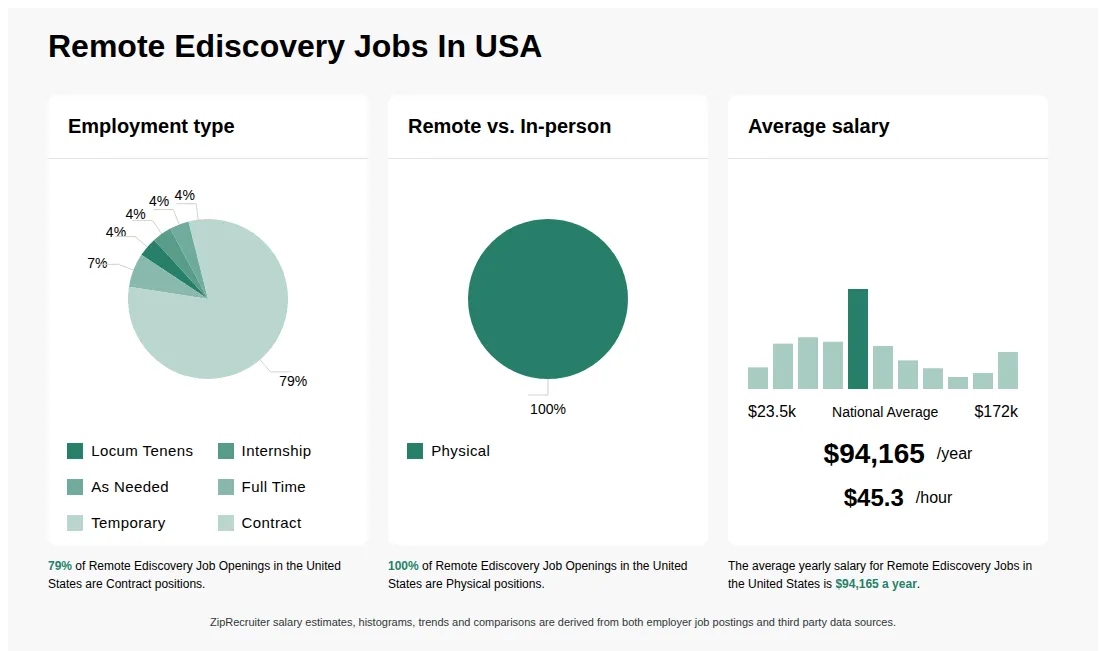
How much do remote ediscovery jobs pay per year?

As of Jun 4, 2026, the average yearly pay for remote ediscovery in the United States is $94,165.00, according to ZipRecruiter salary data. Most workers in this role earn between $62,000.00 and $118,000.00 per year, depending on experience, location, and employer.

What Are the Qualifications to Get a Remote eDiscovery Job?

Required qualifications depend in part on the particular eDiscovery position. Those working as discovery analysts need at least a bachelor’s degree, but a graduate degree is beneficial. Necessary skills include strong logic, analytical, and communication skills. eDiscovery project managers need a bachelor’s degree and prior experience in the legal field, especially as related to eDiscovery. An associate consultant may need advanced legal or technical certifications or education. Employers prefer applicants with prior experience, familiarity with various email archive platforms, and excellent written and oral communication skills.

What are the key skills and qualifications needed to thrive as a Remote Ediscovery Specialist, and why are they important?

To thrive as a Remote Ediscovery Specialist, you need a solid understanding of electronic discovery processes, legal procedures, and data management, usually supported by a degree in law, information technology, or a related field. Familiarity with eDiscovery platforms (such as Relativity or Logikcull), document review software, and certifications like CEDS (Certified E-Discovery Specialist) are often required. Excellent attention to detail, strong analytical thinking, and clear communication skills are vital for success in a remote environment. These competencies ensure accurate, efficient handling of sensitive legal data, compliance with regulations, and effective collaboration with legal teams.

What are the typical collaboration challenges faced by remote eDiscovery professionals, and how can they be addressed?

Remote eDiscovery professionals often collaborate with legal teams, IT staff, and external vendors across different locations and time zones. Common challenges include coordinating workflows, maintaining secure and efficient communication, and ensuring the integrity of sensitive data. These can be addressed by using secure project management platforms, establishing clear protocols for information sharing, and scheduling regular virtual check-ins to keep all stakeholders aligned. Adapting to these practices helps foster teamwork and ensures a smooth eDiscovery process even in a fully remote setting.

What is a Remote Ediscovery professional?

A Remote Ediscovery professional is someone who manages the identification, collection, processing, and analysis of electronic data for legal cases, all while working from a remote location. These professionals support law firms, corporations, or government agencies in handling electronically stored information (ESI) relevant to litigation, investigations, or regulatory matters. Their work often involves using specialized software to organize, review, and produce digital evidence, ensuring compliance with legal standards and data privacy laws.

What is the difference between Remote Ediscovery vs Remote Litigation Support Specialist?

AspectRemote EdiscoveryRemote Litigation Support Specialist
CredentialsLegal or IT certifications, e.g., Certified Ediscovery Specialist (CEDS)Legal or IT certifications, e.g., Certified Litigation Support Professional (CLSP)
Work EnvironmentLegal firms, e-discovery vendors, corporate legal departmentsLaw firms, courts, legal departments, e-discovery vendors
Industry UsagePrimarily in legal and e-discovery sectorsLegal industry, litigation support services

Remote Ediscovery focuses on managing electronic data for legal cases, including data collection, review, and production. Remote Litigation Support Specialists assist with case preparation, document management, and trial support. While both roles involve legal data, Ediscovery is more specialized in electronic data processing, whereas Litigation Support covers broader case support tasks.

What cities are hiring for Remote Ediscovery jobs? Cities with the most Remote Ediscovery job openings:
What are the most commonly searched types of Ediscovery jobs? The most popular types of Ediscovery jobs are:
What states have the most Remote Ediscovery jobs? States with the most job openings for Remote Ediscovery jobs include:
eDiscovery Document Review Attorney - Remote

eDiscovery Document Review Attorney - Remote

Dauntless Discovery

Houston, TX • On-site, Remote

$23/hr

Temporary

Posted 26 days ago


Job description

Experienced Document Review Attorney - Remote
Great opportunity for licensed attorneys interested in getting started with document review. Please apply to get on our roster for future matters! Excellent work environment and corporate culture.
JOB REQUIREMENTS:
  1. Must be actively licensed and in good standing with any state bar.
  2. Must be able to provide your own computer and secure high speed internet connection.
JOB DETAILS
  • Project-based eDiscovery document review
  • Fully remote work environment*
  • Variable hours and flexible schedule
  • Starting pay rate for licensed attorneys meeting the above requirements is $23.00/hour.

Dauntless Discovery is an e-Discovery company that leverages technology to optimize accuracy and increase efficiency to provide our clients with world class e-Discovery services. We cover the entire Electronic Discovery Reference Model while focusing on innovation, cost control, and predictability through innovative technology and proven best practices and protocols.
*Remote workers must physically reside in and work from one of the following states: AZ, CO, CT, FL, GA, IL, IN, KS, KY, LA, MA, MD, MI, MN, MO, MT, NC, NH, NJ, NV, OH, PA, SC, TN, TX or VA.