2

Remote Code Enforcement Officer Jobs (NOW HIRING)

LEAD POLICE OFFICER

Bridgeport, CA · On-site +1

$55K - $80K/yr

You will provide technical advice and guidance to police officers on the enforcement of laws, rules ... States Code 3326. * Males born after 12-31-59 must be registered for Selective Service. * Work ...

POLICE OFFICER

Twentynine Palms, CA · On-site +1

$42K - $61K/yr

You will perform law enforcement duties at fixed posts throughout the installation. * You will ... Code 3326. * Males born after 12-31-59 must be registered for Selective Service. * You will be ...

LEAD POLICE OFFICER

Jacksonville, FL · On-site +1

$58K - $80K/yr

The DON does not employ individuals for Law Enforcement Officer positions who have been convicted ... Code 3326. * Males born after 12-31-59 must be registered for Selective Service. * You will be ...

New

Remote or Hybrid Start Date Is: ASAP Duration: 6 Months Contract (potential to extend) Compensation ... Review customer signals, user interactions, and code to identify potential policy violations

Senior Accountant

$90K - $100K/yr

Senior Accountant - Remote SAFEbuilt has the technical expertise to provide Community Development ... Zoning, Code Enforcement, Fire Prevention, and Engineering, as well as full-service and ...

Come join our amazing team and work remote from home! The Asset Manager will be responsible for the ... matters, and code enforcement issues as they arise. Assures resolution of matter by the party ...

next page

Showing results 1-20

Remote Code Enforcement Officer information

See salary details

$28.5K

$60K

$94K

How much do remote code enforcement officer jobs pay per year?

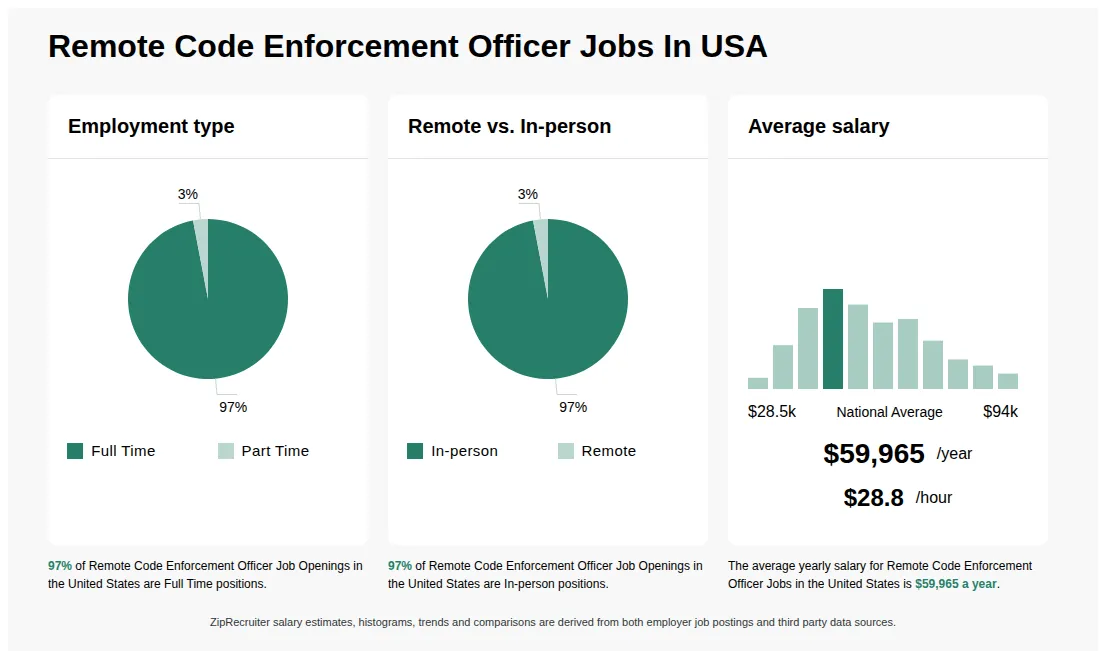
As of Jul 13, 2026, the average yearly pay for remote code enforcement officer in the United States is $59,965.00, according to ZipRecruiter salary data. Most workers in this role earn between $47,000.00 and $69,000.00 per year, depending on experience, location, and employer.

What is a Remote Code Enforcement Officer job?

A Remote Code Enforcement Officer is responsible for ensuring compliance with local building, zoning, and safety regulations while working remotely. They review complaints, conduct virtual inspections, and issue notices or citations for violations. Using digital tools, they communicate with property owners, investigate potential infractions, and follow up on corrective actions. This role requires knowledge of municipal codes, attention to detail, and strong communication skills to enforce regulations effectively.

How much do code enforcement officers make?

In Florida, code enforcement officers typically earn an average annual salary of around $45,000 to $55,000. Salaries can vary based on experience, location, and the size of the municipality, with some officers earning higher with specialized training or certifications. The role often requires knowledge of local codes, inspection tools, and report writing.

What does a typical workday look like for a Remote Code Enforcement Officer?

As a Remote Code Enforcement Officer, your typical day involves reviewing digital complaints or reports about potential code violations, conducting virtual property inspections using photos, videos, or live video calls, and documenting your findings in specialized software. You’ll regularly communicate with property owners, tenants, and city departments through email, phone, or video conferencing to explain violations and discuss solutions. Collaboration with other enforcement officers or municipal staff is common, especially for complex cases or when coordinating field visits. This remote role requires excellent time management and organization, as you’ll often handle multiple cases simultaneously while maintaining detailed records. The role is ideal for those who are self-motivated and comfortable working independently in a virtual environment.

What are some remote law enforcement jobs?

Remote law enforcement jobs include roles such as remote code enforcement officers, cybersecurity analysts, and digital forensics specialists. These positions often require strong communication skills, knowledge of legal regulations, and proficiency with specialized software or tools, and may involve remote investigations, compliance monitoring, or virtual inspections.

What are career paths in code enforcement?

Career paths in code enforcement typically start with entry-level roles such as Code Enforcement Officer, focusing on inspecting properties and ensuring compliance. Advancement can lead to supervisory positions like Senior Code Enforcement Officer or Code Enforcement Supervisor, and eventually to management roles such as Code Enforcement Manager or Director. Developing skills in inspection procedures, local regulations, and obtaining relevant certifications can support career progression in this field.

Do you have to be certified to be a code enforcement officer?

Certification requirements for a remote code enforcement officer vary by jurisdiction, but many positions require relevant certifications such as building inspector or code enforcement certifications. Some roles may also require a valid driver's license and knowledge of local codes and regulations. It is advisable to check specific employer or local government requirements for certification and training.

What are the key skills and qualifications needed to thrive in the Remote Code Enforcement Officer position, and why are they important?

To thrive as a Remote Code Enforcement Officer, you need a solid understanding of municipal codes, zoning laws, and regulatory compliance, typically backed by relevant experience or formal training in public administration or a related field. Familiarity with code enforcement management software, geographic information systems (GIS), and virtual inspection tools is often required. Strong communication, problem-solving, and attention to detail are essential soft skills, especially when coordinating with property owners and government officials remotely. These skills and qualities ensure regulations are effectively enforced, community standards are upheld, and issues are resolved efficiently from a distance.

More about Remote Code Enforcement Officer jobs
What cities are hiring for Remote Code Enforcement Officer jobs? Cities with the most Remote Code Enforcement Officer job openings:
What are the most commonly searched types of Code Enforcement Officer jobs? The most popular types of Code Enforcement Officer jobs are:
What states have the most Remote Code Enforcement Officer jobs? States with the most job openings for Remote Code Enforcement Officer jobs include:
What job categories do people searching Remote Code Enforcement Officer jobs look for? The top searched job categories for Remote Code Enforcement Officer jobs are:
Infographic showing various Remote Code Enforcement Officer job openings in the United States as of July 2026, with employment types broken down into 50% Full Time, and 50% Part Time. Highlights an 100% Remote job distribution, with an average salary of $59,965 per year, or $28.8 per hour.

US Probation Officer - Court Services

U.S. Courts

Miami, FL • On-site, Remote

$62K - $122K/yr

Full-time

Medical, Dental, Vision, Life, Retirement, PTO

Re-posted yesterday


Job description

Summary
The U.S. Probation Officer - Court Services conducts investigations and prepares presentence reports and/or pretrial services reports for U.S. Magistrate Judges and U.S. District Court Judges. Probation Officers serve in a judiciary law enforcement capacity and assist in the fair administration of justice, provide community safety, conduct objective investigations, interact with outside agencies and community members and prepare reports and present recommendations to the court.
Learn more about this agency
Duties
Help
  • Conducts investigations and prepare reports for the Court with recommendations for release/detention or sentencing of individuals charged or convicted of federal offenses.
  • Performs thorough and independent investigations of the charges, offense conduct and victim impact and contacts law enforcement agencies and attorneys. Interviews defendants and their families; summarizes defendants' prior criminal records; investigates personal history, including education, physical and mental health conditions, alcohol and substance abuse history, employment, sources of income, lifestyle, and associates of defendants to assess and identify mitigating and aggravating sentencing factors, risk and likely future compliance under supervision and the need for correctional treatment, monitoring and counseling, and financial status.
  • Interviews victim(s) and provides victim impact statements to the Court.
  • Conducts home inspections and collects and verifies background data from various sources. The purpose of these activities is to gather the information needed to present factual reports to the Court for purposes of sentencing.
  • Interprets and applies policies and procedures, statutes, Federal Rules of Criminal Procedure, U.S. Sentencing Guidelines, and relevant case law and demonstrate thorough knowledge of these sources through accurate calculations and correct selection of sentencing options in the presentence report.
  • Analyzes and responds to any objections related to the presentence investigation. This may include resolving disputed issues and presenting unresolved issues to the Court for resolution.
  • Responds to judicial officers' requests for information and advice.
  • Testifies in court as to the basis for factual findings and guideline applications.
  • Serves as a resource to the Court and maintains detailed written records of case activity.
  • Complies with the Code of Conduct for Judicial Employees and Court confidentiality requirements and consistently demonstrates sound ethics and judgment.
  • Other duties, as directed.

Requirements
Help
Conditions of employment
Prior to appointment, the incumbent must undergo an extensive medical examination and drug screening. Upon successful completion of the medical examination and drug screening, the incumbent may then be provisionally appointed, pending a suitability determination by the Court. The incumbent will undergo an extensive Office of Personnel Management (OPM) background investigation. Continued employment will be contingent on successful completion of the OPM investigation. In addition, as condition of employment, the incumbent will be subject to ongoing random drug screening, updated background investigations every five years and as deemed necessary by management for reasonable cause, may be subject to subsequent fitness-for-duty evaluations and drug screening.
Background Investigation & The Fair Chance to Compete Act (FCA):
This is a High-Sensitive position within the Judiciary. This position is not covered under the FCA. Therefore, candidates will be asked to provide verbal or written statements about criminal history prior to receiving a conditional job offer. When applying for this position, completion of Questions 18, 19, and 20 on Form AO-78, "Application for Employment" is mandatory.
Medical Requirements:
Probation/pretrial services officers must meet the medical requirements for law enforcement officer (LEO) positions. The essential job functions derived from the medical guidelines for probation officers, pretrial services officers and officer assistants are available for public review at US Courts.
Maximum Entry Age:
Probation and pretrial services officers and assistants must not have reached their 37th birthday at a time of appointment. For an applicant with previous LEO experience under the CSRS or the FERS and either a subsequent break in service or intervening service in a non-LEO position, the maximum entry age is increased by adding the number of years of previous law enforcement experience to 37.
Specialized Training:
Newly appointed officers to the position of U.S. Probation Officer will be required to attend and successfully complete up to six (6) weeks of training at the Federal Law Enforcement Training Center (FLETC) in Charleston, South Carolina.
After three years of service, officers will be required to complete the Southern District of Florida's Leadership Development Program.
Qualifications
QUALIFICATION REQUIREMENTS:
  • Bachelor's degree from an accredited college or university preferably in a field of academic study such as criminal justice, criminology, psychology, sociology, human relations, business, or public administration, which provided evidence of the capacity to understand and apply the legal requirements and human relations skills involved in the position.
  • Two years of *specialized experience, including at least one-year equivalent to work at the CL-25; or Completion of a master's degree in a field of study closely related to the position, or a Juris Doctor (JD) degree.

*Progressively responsible experience, gained after completion of a bachelor's in such fields as probation, pretrial services, parole, corrections, criminal investigations, or work in substance/addiction treatment. Experience as a police, custodial, or security officer, other than any criminal investigative experience, is not creditable.
COURT PREFERRED QUALIFICATIONS:
  • Ability to communicate well orally and in writing.
  • Proficiency working in automated environments with a significant knowledge of computer programs such as Adobe, Word, Microsoft Word, and Windows as well as other software programs is preferred.
  • Fluency in Spanish highly desirable.
  • Knowledge of Evidence Based Practices, risk and needs principles, cognitive behavioral therapy programming preferred.
  • A thorough knowledge of the philosophy, theories, and practices of the correctional field with a knowledge of law, psychology, sociology, and criminology as these disciplines are related to the duties and responsibilities of the correctional profession; a devotion to the principles of public welfare; a knowledge and understanding of both normal and abnormal behavior; unquestioned integrity; maturity of judgement and tact.
  • Knowledge of the Federal Criminal Code and sentencing procedures; the ability to conduct thorough investigations and make sound evaluations and recommendations; a knowledge of all available community resources and the understanding and skill necessary to use them.
  • The desire and ability to work harmoniously with others in a total quality team-based organization, and the desire/willingness to collaborate with defendants, community partners and others to reduce recidivism.

Education
Bachelor's degree from an accredited college or university preferably in a field of academic study such as criminal justice, criminology, psychology, sociology, human relations, business, or public administration, which provided evidence of the capacity to understand and apply the legal requirements and human relations skills involved in the position.
Additional information
  • Applicants must be a United States Citizen or eligible to work in the United States.
  • Employees of the United States District Court are Excepted Appointments and considered "at-will" judicial employees.
  • Federal Government Civil Service classifications or regulations do not apply.
  • Electronic direct deposit of salary payments is mandatory.
  • Only qualified applicants will be considered.
  • Incomplete applications may not be considered.
  • The Court reserves the right to modify the conditions of this job announcement or to withdraw the announcement without prior written or other notice.

THE UNITED STATES DISTRICT COURT IS AN EQUAL OPPORTUNITY EMPLOYER.
Expand Hide additional information
Candidates should be committed to improving the efficiency of the Federal government, passionate about the ideals of our American republic, and committed to upholding the rule of law and the United States Constitution.
Benefits
Help
Full-time employees are eligible for a full range of benefits such as paid vacation and sick leave, paid holidays, retirement benefits that include a defined contribution program and the Thrift Savings Plan (TSP). TSP is a 401(k) equivalent program that includes matching contributions.
Additional benefits include health and life insurance, disability and long-term care insurance, dental and vision insurance and a Flexible Benefits Program which includes medical and dependent care reimbursement.
Review our benefits