As the Lead Process Automation Engineer, you will serve as a subject matter expert and technical leader for process automation, project execution, advanced control, and optimization initiatives ...
As the Lead Process Automation Engineer, you will serve as a subject matter expert and technical leader for process automation, project execution, advanced control, and optimization initiatives ...

Process Automation Engineer II
Morenci, AZ · On-site
$87K - $120K/yr
As the Process Automation Engineer II, you maintain the performance of ICS hardware and software, identify opportunities for process improvement and optimization through automation to enhance ...
Process Automation Engineer II
Morenci, AZ · On-site
$87K - $120K/yr
As the Process Automation Engineer II, you maintain the performance of ICS hardware and software, identify opportunities for process improvement and optimization through automation to enhance ...

Automation Engineer (RPA)
Charlotte, NC · On-site
The RPA Engineer will be responsible for analyzing business processes, gathering requirements, translating them into technical specifications, and working closely with the RPA development team to ...
Automation Engineer (RPA)
Charlotte, NC · On-site
The RPA Engineer will be responsible for analyzing business processes, gathering requirements, translating them into technical specifications, and working closely with the RPA development team to ...
RPA Developer (Robotic Process Automation, Associate)
Arlington, VA · On-site
$122K - $130K/yr
RPA Developer (Robotic Process Automation, Associate) Position Location Arlington, VA The MIL Corporation seeks an RPA Developer (Robotic Process Automation, Associate) with process automation ...
RPA Developer (Robotic Process Automation, Associate)
Arlington, VA · On-site
$122K - $130K/yr
RPA Developer (Robotic Process Automation, Associate) Position Location Arlington, VA The MIL Corporation seeks an RPA Developer (Robotic Process Automation, Associate) with process automation ...
Process Automation Engineer II
Morenci, AZ · On-site
$87K - $120K/yr
As the Process Automation Engineer II, you maintain the performance of ICS hardware and software, identify opportunities for process improvement and optimization through automation to enhance ...
Process Automation Engineer II
Morenci, AZ · On-site
$87K - $120K/yr
As the Process Automation Engineer II, you maintain the performance of ICS hardware and software, identify opportunities for process improvement and optimization through automation to enhance ...
$87K - $120K/yr
As the Process Automation Engineer II, you maintain the performance of ICSe hardware and software, identify opportunities for process improvement and optimization through automation to enhance ...
$87K - $120K/yr
As the Process Automation Engineer II, you maintain the performance of ICSe hardware and software, identify opportunities for process improvement and optimization through automation to enhance ...
As the Lead Process Automation Engineer, you will serve as a subject matter expert and technical leader for process automation, project execution, advanced control, and optimization initiatives ...
As the Lead Process Automation Engineer, you will serve as a subject matter expert and technical leader for process automation, project execution, advanced control, and optimization initiatives ...
Process Automation Engineer II
Morenci, AZ · On-site
$87K - $120K/yr
As the Process Automation Engineer II, you maintain the performance of ICS hardware and software, identify opportunities for process improvement and optimization through automation to enhance ...
Process Automation Engineer II
Morenci, AZ · On-site
$87K - $120K/yr
As the Process Automation Engineer II, you maintain the performance of ICS hardware and software, identify opportunities for process improvement and optimization through automation to enhance ...

Automation Engineer (RPA)
Charlotte, NC · On-site
The RPA Engineer will be responsible for analyzing business processes, gathering requirements, translating them into technical specifications, and working closely with the RPA development team to ...
Automation Engineer (RPA)
Charlotte, NC · On-site
The RPA Engineer will be responsible for analyzing business processes, gathering requirements, translating them into technical specifications, and working closely with the RPA development team to ...
Automation Engineer (RPA)
Charlotte, NC · On-site
The RPA Engineer will be responsible for analyzing business processes, gathering requirements, translating them into technical specifications, and working closely with the RPA development team to ...
Automation Engineer (RPA)
Charlotte, NC · On-site
The RPA Engineer will be responsible for analyzing business processes, gathering requirements, translating them into technical specifications, and working closely with the RPA development team to ...

Automation Engineer (RPA)
Charlotte, NC · On-site
The RPA Engineer will be responsible for analyzing business processes, gathering requirements, translating them into technical specifications, and working closely with the RPA development team to ...
Automation Engineer (RPA)
Charlotte, NC · On-site
The RPA Engineer will be responsible for analyzing business processes, gathering requirements, translating them into technical specifications, and working closely with the RPA development team to ...
Automation Engineer (RPA)
Charlotte, NC · On-site
The RPA Engineer will be responsible for analyzing business processes, gathering requirements, translating them into technical specifications, and working closely with the RPA development team to ...
Automation Engineer (RPA)
Charlotte, NC · On-site
The RPA Engineer will be responsible for analyzing business processes, gathering requirements, translating them into technical specifications, and working closely with the RPA development team to ...
$122K - $130K/yr
RPA Developer (Robotic Process Automation, Associate) Position Location Arlington, VA The MIL Corporation seeks an RPA Developer (Robotic Process Automation, Associate) with process automation ...
$122K - $130K/yr
RPA Developer (Robotic Process Automation, Associate) Position Location Arlington, VA The MIL Corporation seeks an RPA Developer (Robotic Process Automation, Associate) with process automation ...

Lead (Automation - RPA)
Austin, TX · On-site
Automation Lead- RPA(Must be Local to AUSTIN) Duration: 12-month duration Work hours and Location: 8AM 5PM, Austin, TX 78744 This position requires candidates to be in onsite 4-5 days a week.
Lead (Automation - RPA)
Austin, TX · On-site
Automation Lead- RPA(Must be Local to AUSTIN) Duration: 12-month duration Work hours and Location: 8AM 5PM, Austin, TX 78744 This position requires candidates to be in onsite 4-5 days a week.

Rated as a top System Integrator Giant We have a Process Automation Engineer position open in Calabasas, CA. This position is responsible for designs, implements, and maintains process automation ...
Quick apply
Rated as a top System Integrator Giant We have a Process Automation Engineer position open in Calabasas, CA. This position is responsible for designs, implements, and maintains process automation ...

RPA Developer (Robotic Process Automation, Associate)
Arlington, VA · On-site
$122K - $130K/yr
Required Summary The MIL Corporation seeks an RPA Developer (Robotic Process Automation, Associate) with process automation experience to support multiple federal government clients in the Arlington ...
RPA Developer (Robotic Process Automation, Associate)
Arlington, VA · On-site
$122K - $130K/yr
Required Summary The MIL Corporation seeks an RPA Developer (Robotic Process Automation, Associate) with process automation experience to support multiple federal government clients in the Arlington ...

Robotic Process Automation Engineer IV
Norfolk, VA · On-site +1
Job Title Robotic Process Automation Engineer IV Location Norfolk, VA TELEWORK - VA US (Primary) Founded in 1995, ESN is a Small Disadvantaged Business (SDB), Service-Disabled Veteran-Owned Small ...
Robotic Process Automation Engineer IV
Norfolk, VA · On-site +1
Job Title Robotic Process Automation Engineer IV Location Norfolk, VA TELEWORK - VA US (Primary) Founded in 1995, ESN is a Small Disadvantaged Business (SDB), Service-Disabled Veteran-Owned Small ...
Robotics Process Automation Developer
Fort Knox, KY · On-site
$95K - $110K/yr
Robotics Process Automation (RPA) Developer Location: REMOTE Citizenship: US Citizens or Permanent Resident Clearance: Ability to obtain a Public Trust Security Clearance AttainX, Inc. is in search ...
Robotics Process Automation Developer
Fort Knox, KY · On-site
$95K - $110K/yr
Robotics Process Automation (RPA) Developer Location: REMOTE Citizenship: US Citizens or Permanent Resident Clearance: Ability to obtain a Public Trust Security Clearance AttainX, Inc. is in search ...
Robotics Process Automation Developer
Montgomery, AL · Remote
$95K - $110K/yr
Robotics Process Automation (RPA) Developer Location: REMOTE Citizenship: US Citizens or Permanent Resident Clearance: Ability to obtain a Public Trust Security Clearance AttainX, Inc. is in search ...
Robotics Process Automation Developer
Montgomery, AL · Remote
$95K - $110K/yr
Robotics Process Automation (RPA) Developer Location: REMOTE Citizenship: US Citizens or Permanent Resident Clearance: Ability to obtain a Public Trust Security Clearance AttainX, Inc. is in search ...
Robotic Process Automation Analyst Duration: Full-Time Direct Hire Location: Philadelphia, PA 19103 What you are good at: * Process Evaluation: Ability to break a complex process into its component ...
Quick apply
Robotic Process Automation Analyst Duration: Full-Time Direct Hire Location: Philadelphia, PA 19103 What you are good at: * Process Evaluation: Ability to break a complex process into its component ...
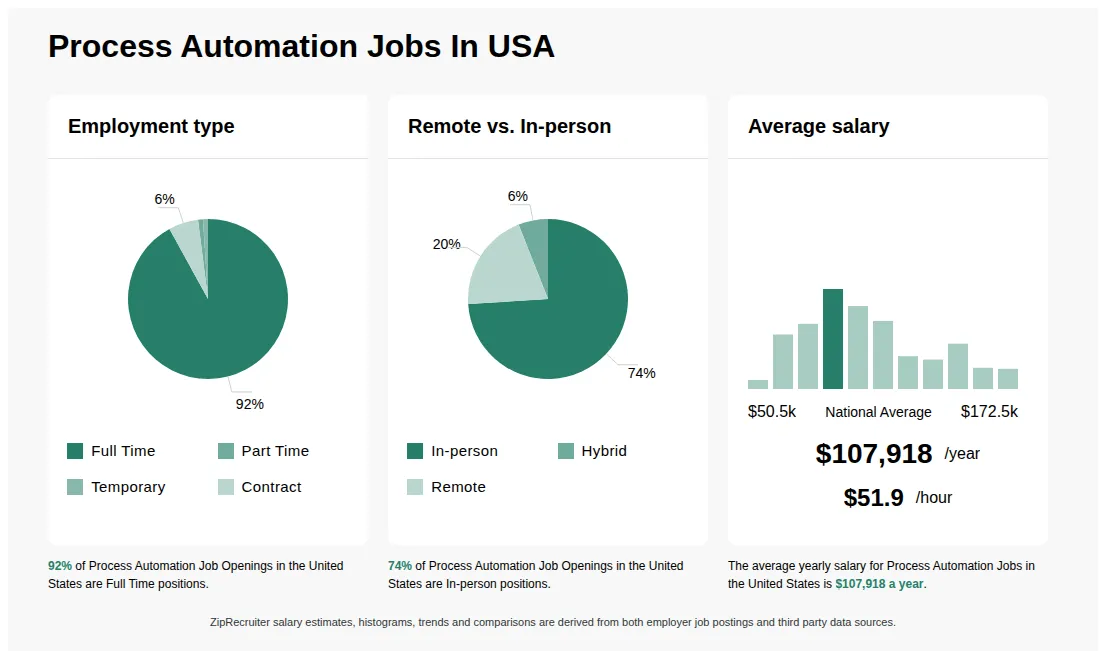
Process Automation information
See salary details
$50.5K - $61.6K
1% of jobs
$61.6K - $72.7K
11% of jobs
$72.7K - $83.8K
13% of jobs
$84.1K is the 25th percentile. Wages below this are outliers.
$83.8K - $94.9K
19% of jobs
The median wage is $99.3K / yr.
$94.9K - $106K
16% of jobs
$106K - $117K
13% of jobs
$121.7K is the 75th percentile. Wages above this are outliers.
$117K - $128.1K
6% of jobs
$128.1K - $139.2K
5% of jobs
$139.2K - $150.3K
9% of jobs
$150.3K - $161.4K
4% of jobs
$161.4K - $172.5K
3% of jobs
$50.5K
$107.9K
$172.5K
How much do process automation jobs pay per year?
As of Sep 14, 2026, the average yearly pay for process automation in the United States is $107,918.00, according to ZipRecruiter salary data. Most workers in this role earn between $84,500.00 and $130,500.00 per year, depending on experience, location, and employer.
What is a process automation?
A Process Automation job involves designing, implementing, and optimizing automated systems to improve business efficiency. Professionals in this role use technologies like robotic process automation (RPA), workflow automation, and AI to streamline repetitive tasks, reduce errors, and enhance productivity. They collaborate with various departments to analyze processes, identify automation opportunities, and develop solutions. This role requires knowledge of automation tools, programming skills, and an understanding of business operations.
What do process automation professionals do?
Professionals in Process Automation often work on projects such as automating repetitive manual tasks, streamlining data entry processes, and integrating disparate systems to reduce errors and improve efficiency. Their daily responsibilities might include designing automation workflows, developing and testing bots or scripts, analyzing current processes to identify automation opportunities, and collaborating closely with IT and business teams to ensure successful implementation. The work environment is usually collaborative, with regular cross-functional meetings and problem-solving sessions. These roles offer significant opportunities for growth, as process automation is increasingly central to digital transformation initiatives across many industries.
What are the key skills and qualifications needed for process automation?
To thrive in Process Automation, you need a strong background in process analysis, workflow optimization, and programming or scripting, often supported by a degree in engineering, computer science, or a related field. Familiarity with automation platforms such as RPA tools (e.g., UiPath, Blue Prism), PLC programming, and relevant certifications like Certified Automation Professional (CAP) are frequently required. Analytical thinking, creative problem-solving, and effective collaboration skills are essential for communicating solutions and driving continuous improvement. These capabilities are crucial for successfully designing, implementing, and maintaining automation systems that enhance efficiency and reduce operational costs.
More about Process Automation jobs
What cities are hiring for Process Automation jobs?
Cities with the most Process Automation job openings:
What are the most commonly searched types of Process Automation jobs?
The most popular types of Process Automation jobs are:
What states have the most Process Automation jobs?
States with the most job openings for Process Automation jobs include:
What job categories do people searching Process Automation jobs look for?
The top searched job categories for Process Automation jobs are:
What other helpful pages are available for Process Automation?
Other pages related to Process Automation:
Lead Process Automation Engineer
Metropolis, IL • On-site
Solstice Advanced Materials
Other
Medical, Dental, Vision, Life, Retirement, PTO
This job post has expired 3 days ago. Applications are no longer accepted.
Job description
As the Lead Process Automation Engineer, you will serve as a subject matter expert and technical leader for process automation, project execution, advanced control, and optimization initiatives across Solstice Advanced Materials facilities.
You will lead automation engineering from early project development through design, testing, commissioning, startup, and stabilization. You will perform engineering directly when needed and guide vendors, system integrators, and site resources when work is externally executed.
This position also leads assessments and improvements for advanced control applications. It ensures solutions deliver sustained gains in throughput, yield, energy use, quality, reliability, and operating cost.
This role will report to the Process Automation Engineering Manager.
ResponsibilitiesKey Responsibilities:-
Provide subject matter expertise for Honeywell Experion PKS, C300, Control Execution Environment, operator graphics, Rockwell PLC systems, and supporting control applications.
-
Lead process automation engineering for greenfield and brownfield projects from early development through startup.
-
Develop the Basis of Design, estimates, technical scopes, execution plans, control narratives, Functional Design Specifications, Cause and Effect documents, and acceptance requirements.
-
Perform control design and configuration directly or guide vendors and system integrators. Review and approve designs, configurations, test procedures, and technical deliverables.
-
Lead control-system migrations, Factory Acceptance Testing, Site Acceptance Testing, cutovers, commissioning, startup, stabilization, and closure of technical deficiencies.
-
Review field installation quality, resolve construction questions, support plant shutdowns and turnarounds, and participate in project reviews and lessons learned.
-
Lead the assessment, maintenance, configuration, and improvement of Honeywell Profit Suite applications using Advanced Process Control and Real-Time Optimization methods.
-
Apply multivariable control, inferential measurements, process economics, operating constraints, and dynamic process behavior to develop and sustain optimization solutions.
-
Assess advanced control availability, usage, model condition, performance, and value. Define required updates, restore underused applications, or recommend retirement when justified.
-
Identify and prioritize optimization opportunities. Complete feasibility, control readiness, instrumentation adequacy, and regulatory control performance assessments.
-
Develop optimization roadmaps, estimates, vendor scopes, and technical recommendations. Review vendor models, claims, and configurations through application acceptance.
-
Partner with operators and Site Process Control Engineers during design, testing, training, deployment, troubleshooting, and monthly or quarterly performance reviews.
-
Establish lasting performance and value measures. Verify improvements with site and Finance representatives and report results to site and central leadership.
-
Perform recurring assessments of control-system condition, capacity, lifecycle, architecture, loop performance, alarm performance, backup readiness, site practices, and vendor performance.
-
Apply working knowledge of industrial networks, cybersecurity practices, servers, virtualization, firewalls, backups, Uniformance PHD, and AVEVA PI.
-
Participate in team-owned technical governance by developing and enforcing standards, reviewing exceptions, evaluating technologies and vendors, and escalating unresolved risks.
-
Partner with Operations, Process Engineering, Process Safety, Reliability, Digitalization, and site engineering teams while mentoring other technical resources.
-
Bachelor's degree in Chemical Engineering, Electrical Engineering, Computer Science, Computer Engineering, or a related field.
-
8+ years of process automation and controls experience within chemical manufacturing and hazardous process facilities.
-
Demonstrated expertise with Honeywell Experion PKS, C300, Control Execution Environment, operator graphics, and Rockwell PLC systems.
-
Experience with Honeywell Profit Suite, Advanced Process Control, Real-Time Optimization, and sustained application performance.
-
Experience leading brownfield automation projects, control-system migrations, vendor execution, testing, commissioning, and startup.
-
Working knowledge of continuous and batch control, industrial networks, servers, virtualization, firewalls, backup, and recovery practices.
-
Willingness to travel approximately 25%, including possible international travel and increased travel during commissioning and startup.
-
Due to compliance with U.S. export control laws and regulations, candidate must be a U.S. Person, which is defined as, a U.S. citizen, a U.S. permanent resident, or have protected status in the U.S. under asylum or refugee status or have the ability to obtain an export authorization.
-
Model Predictive Control design and deployment experience, including dynamic process model development.
-
Experience with Honeywell HC900, SCADA, Uniformance PHD, AVEVA PI, and other DCS, PLC, historian, or optimization platforms.
-
Experience with burner management, Honeywell Safety Manager, Safety Instrumented Systems, Fire and Gas, or Emergency Shutdown Systems.
-
Knowledge of alarm management, industrial cybersecurity, and applicable ISA and IEC standards.
-
Honeywell Certified Engineer training or other relevant Honeywell technical certifications.
-
Demonstrated delivery of measurable improvements in throughput, yield, energy, quality, reliability, or operating cost.
-
Experience developing persistent value calculations with site and Finance representatives.
-
Professional Engineer registration or Six Sigma Green Belt, Black Belt, or equivalent improvement experience.
-
Strong technical writing, communication, collaboration, judgment, and presentation skills across global teams.
In addition to a competitive salary, leading-edge work, and developing solutions side-by-side with dedicated experts in their fields, Solstice Advanced Materials employees are eligible for a comprehensive benefits package. This package includes employer-subsidized Medical, Dental, Vision, and Life Insurance; Short-Term and Long-Term Disability; 401(k) match, Flexible Spending Accounts, Health Savings Accounts, EAP, and Educational Assistance; Parental Leave, Paid Time Off (for vacation, personal business, sick time, and parental leave), and 12 Paid Holidays.
The annual base salary range for this position is $146,976 - $183,425. Please note that this salary information serves as a general guideline. Solstice considers various factors when extending an offer, including but not limited to the scope and responsibilities of the position, the candidate's work experience, education and training, key skills, as well as market and business considerations. This position is incentive plan eligible
Solstice Advanced Materials is an equal opportunity employer. Qualified applicants will be considered without regard to age, race, creed, color, national origin, ancestry, marital status, affectional or sexual orientation, gender identity or expression, disability, nationality, sex, religion, or veteran status.
About UsAbout Solstice Advanced MaterialsSolstice Advanced Materials is a leading global specialty materials company that advances science for smarter outcomes. Solstice offers high-performance solutions that enable critical industries and applications, including refrigerants, semiconductor manufacturing, data center cooling, nuclear power, protective fibers, healthcare packaging and more. Solstice is recognized for developing next-generation materials through some of the industry's most renowned brands such as Solstice, Genetron, Aclar, Spectra, Fluka, and Hydranal. Partnering with over 3,000 customers across more than 120 countries and territories and supported by a robust portfolio of over 5,700 patents, Solstice's approximately 4,000 employees worldwide drive innovation in materials science. For more information, visit Advanced Materials (https://advancedmaterials.honeywell.com/us/en) .