1

Evidence Technician Jobs (NOW HIRING)

Evidence Technician

Denton, TX ยท On-site

$22.27 - $28.96/hr

... Evidence Inventory Technicians (TAPEIT) Property/Evidence Certification program, or equivalent. TCIC/TLETS Certification Conditions of Employment: Must have a valid Class "C" Driver License and valid ...

Evidence Technician

Denton, TX ยท On-site

$22.27 - $28.96/hr

Completion of Texas Association of Property and Evidence Inventory Technicians (TAPEIT) Property/Evidence Certification program, or equivalent. * TCIC/TLETS Certification Conditions of Employment:

Property/Evidence Technician

Salinas, CA ยท On-site

$4.4K - $5.6K/mo

This is the entry-level class of the Evidence Technician series. It is distinguished from the Senior Property/Evidence Technician in that positions in this class perform less than the full range of ...

This is the entry-level class of the Evidence Technician series. It is distinguished from the Senior Property/Evidence Technician in that positions in this class perform less than the full range of ...

Property Evidence Technician

Greeley, CO ยท On-site

$21.96 - $31.84/hr

The Property Evidence Technician will be responsible for receiving, storing, releasing, and disposing of property obtained by the Greeley Police Department. The Technician will maintain security and ...

Video Evidence Technician

Conroe, TX ยท On-site

$21.17/hr

Certification through the Texas Association of Property and Evidence Inventory Technicians (TAPEIT) within one year of hire. Knowledge, Skills and Abilities: * Knowledge of computerized inventory ...

next page

Showing results 1-20

Evidence Technician information

See salary details

$30.5K

$45.6K

$68K

How much do evidence technician jobs pay per year?

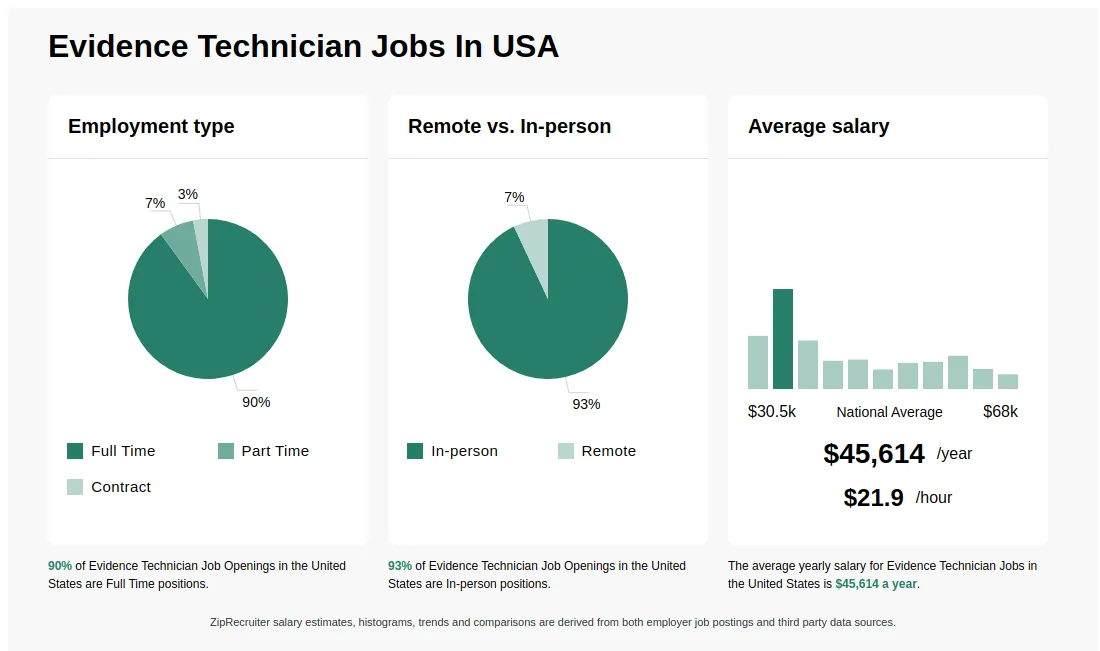
As of Sep 6, 2026, the average yearly pay for evidence technician in the United States is $45,614.00, according to ZipRecruiter salary data. Most workers in this role earn between $35,000.00 and $56,000.00 per year, depending on experience, location, and employer.

What is an evidence technician?

Evidence Technicians are professionals who are responsible for collecting, preserving, cataloging, and maintaining physical evidence related to criminal investigations. They work closely with law enforcement officers and crime scene investigators to ensure that evidence is handled properly and remains admissible in court. Their duties often include documenting evidence, maintaining chain of custody, and sometimes assisting with forensic analysis. Evidence Technicians play a critical role in the justice system by ensuring the integrity and security of all collected evidence.

What does an evidence technician do?

As an evidence technician, your job is to use forensic techniques to investigate a crime scene and provide information for law enforcement agents. As part of this, you may conduct a computer analysis of debris and damage, collect DNA, test a sample of a product, and otherwise support efforts to track and stop further criminal activity. Evidence technicians are also responsible for receiving, storing, and disposing of evidence in line with local regulations. Most evidence technicians work for police departments or other law enforcement agencies, but you can also find work in private security or support positions. If you work outside of a police force, you may focus on handling evidence, creating a chain of custody document, and creating records of all evidence so it can be retrieved as needed.

What are the key skills and qualifications needed to thrive as an evidence technician, and why are they important?

To thrive as an Evidence Technician, you need attention to detail, organizational skills, and knowledge of legal procedures, usually supported by a high school diploma or degree in criminal justice. Familiarity with evidence management systems, chain-of-custody software, and digital imaging tools is typically required. Strong communication, integrity, and the ability to work under pressure are crucial soft skills for this role. These competencies ensure accurate evidence handling, maintain legal integrity, and support successful criminal investigations.

What are some common challenges faced by evidence technicians when maintaining chain of custody, and how can they be addressed?

Evidence Technicians often face challenges such as high volumes of incoming evidence, strict documentation requirements, and the need to prevent contamination or loss. Maintaining an unbroken chain of custody is crucial, which requires meticulous attention to detail and adherence to protocols for logging, labeling, and storing evidence. Regular training, use of digital tracking systems, and clear communication with law enforcement personnel help address these challenges and ensure evidence integrity.

What is the difference between Evidence Technician vs Crime Scene Technician?

AspectEvidence TechnicianCrime Scene Technician
Required CredentialsHigh school diploma or equivalent; some roles may require certifications in evidence handlingHigh school diploma; specialized training or certifications in crime scene processing
Work EnvironmentLaw enforcement agencies, forensic labs, police departmentsCrime scenes, forensic labs, law enforcement agencies
Employer & Industry UsageUsed primarily in law enforcement for evidence collection and preservationUsed in law enforcement for scene processing and documentation

Evidence Technicians focus on collecting, preserving, and cataloging evidence, often working in labs or police facilities. Crime Scene Technicians typically process crime scenes directly, documenting and collecting evidence on-site. Both roles support law enforcement but differ mainly in their work setting and specific responsibilities.

Is it hard to be an evidence technician?

Being an evidence technician requires attention to detail, knowledge of proper evidence handling procedures, and often involves working in a forensic or law enforcement environment. The job may involve physical tasks, documentation, and sometimes working irregular hours, but it generally requires specific training and certifications to ensure evidence integrity.

What degree do you need to be an evidence technician?

Evidence technicians typically need at least a high school diploma or equivalent, but many employers prefer candidates with an associate's or bachelor's degree in criminal justice, forensic science, or a related field. Relevant skills include attention to detail, knowledge of evidence handling procedures, and familiarity with forensic tools and documentation. Certifications in evidence management or forensic techniques can also enhance job prospects.

What cities are hiring for Evidence Technician jobs?

Cities with the most Evidence Technician job openings:

What are the most commonly searched types of Evidence Technician jobs?

The most popular types of Evidence Technician jobs are:

What states have the most Evidence Technician jobs?

States with the most job openings for Evidence Technician jobs include:

What job categories do people searching Evidence Technician jobs look for?

The top searched job categories for Evidence Technician jobs are:

Infographic showing various Evidence Technician job openings in the United States as of August 2026, with employment types broken down into 1% As Needed, 82% Full Time, 13% Part Time, 3% Contract, and 1% Nights. Highlights an 99% Physical, and 1% Remote job distribution, with an average salary of $45,614 per year, or $21.9 per hour.

Evidence Technician

Houston Forensic Science Center

Houston, TX โ€ข On-site

Full-time

Re-posted 22 hours ago


Job description

Under the direction of the Supervisor, CS/CM Analyst (Evidence Technician) performs tasks related to the handling of evidence. Generally, they utilize standard operating procedures to perform tasks; however, the CS/CM Analyst is expected to exercise independent judgement in resolving issues and concerns related to the roles and responsibilities listed below, consulting with the Training/Accessioning Coordinator or Supervisor as needed.
ROLES AND RESPONSIBILITIES

  • Requests, receives, transports, returns/releases evidence from outside agencies as well as from the Houston Police Department.
  • Screens, photographically documents, and corrects evidence seals when appropriate.
  • Issues rejection notifications for evidence discrepancies.
  • Maintains the integrity of evidence during various stages of evidence handling.
  • Performs evidence transfers and staging in all scientific disciplines.
  • Performs monthly evidence storage location audits; documents and corrects issues found.
  • Creates cases from outside agencies and/or the Houston Police Department in the Laboratory Information Management System (LIMS) via submission forms and/or other systems.
  • Screens, accessions (inventories and prepares samples for testing), and repackages toxicology evidence.
  • Writes, administratively reviews, and issues accessioning and rejection reports.
  • Maintains expected target error rates and throughput for evidence handling.
  • Compiles data for use in a variety of reports, surveys, inventories, studies, projects, etc.
  • Provides courtroom testimony.
  • Participates in special projects.
  • Complies with all applicable policies, procedures, and accreditation standards.
  • Performs other duties as requested.

QUALIFICATIONS

Experience
* Evidence handling experience preferred.
* Excellent verbal and written communication skills with both internal and external stakeholders.
* Demonstrated ability to work in different software systems including, but not limited to: all Microsoft Office applications, Laboratory Information Management Systems (LIMS), and Evidence Management System (EMS).
* Ability to use basic analytical skills to select and execute duties.
* Demonstrated ability to think critically, troubleshoot effectively, and make timely decisions.
* Demonstrated ability to work with frequent interruptions and changing priorities.

Education, Training & Certifications
* Bachelor's degree Criminal Justice or a science degree required
* Certification required as mandated by career ladder.

Competencies
* Accountability - Ability to accept responsibility and account for their actions.
* Accuracy - Ability to perform work accurately and thoroughly.
* Analytical Skills - Ability to use thinking and reasoning to solve a problem.
* Communication, Oral and Written - Ability to communicate effectively with others using the spoken word; ability to communicate in writing clearly and concisely.
* Detail Oriented - Ability to pay attention to minute details of a project or task.
* Ethical - Ability to demonstrate conduct conforming to a set of values and accepted standards.
* Honesty / Integrity - Ability to be truthful and credible in the workplace.
* Initiative - Ability to make decisions or take actions to solve a problem or reach a goal.
* Motivation - Ability to inspire oneself to reach a goal and/or perform to the best of their ability.
* Organized - Ability to be structured and methodical in working skills.
* Problem Solving - Ability to find a solution for or to deal proactively with work-related problems.
* Relationship Building - Ability to effectively build relationships with stakeholders and co-workers.
* Reliability - The trait of being dependable and trustworthy.
Physical Demands
* Job incumbent must be able to walk and stand for long periods of time and may need to squat or bend, reach outward or upward to effectively discharge job duties.
* Job incumbent must be able to lift/carry and/or push/pull up to 40 lbs.
* Job incumbent must be willing to travel to off-site locations