1

Forensic Science Technician Jobs (NOW HIRING)

The Iowa Department of Public Safety is seeking to fill a Forensic Science Technician position specializing in Drug Chemistry within the Division of Criminal Investigation's Criminalistics Laboratory.

Institute of Forensic Sciences Division: Forensic Genetics Opening Date: 08/06/2026 Closing Date: 9 ... The Sero/Ops Technician may be called to provide expert testimony in court. This position will ...

Forensic Investigator

Garland, TX · On-site

$55K - $59K/yr

Establish and maintain liaisons with police department personnel, laboratory technicians and court ... Experience and/or certification in the forensic science field (pay commensurate accordingly ...

next page

Showing results 1-20

Forensic Science Technician information

See salary details

$35.5K

$52.4K

$78.5K

How much do forensic science technician jobs pay per year?

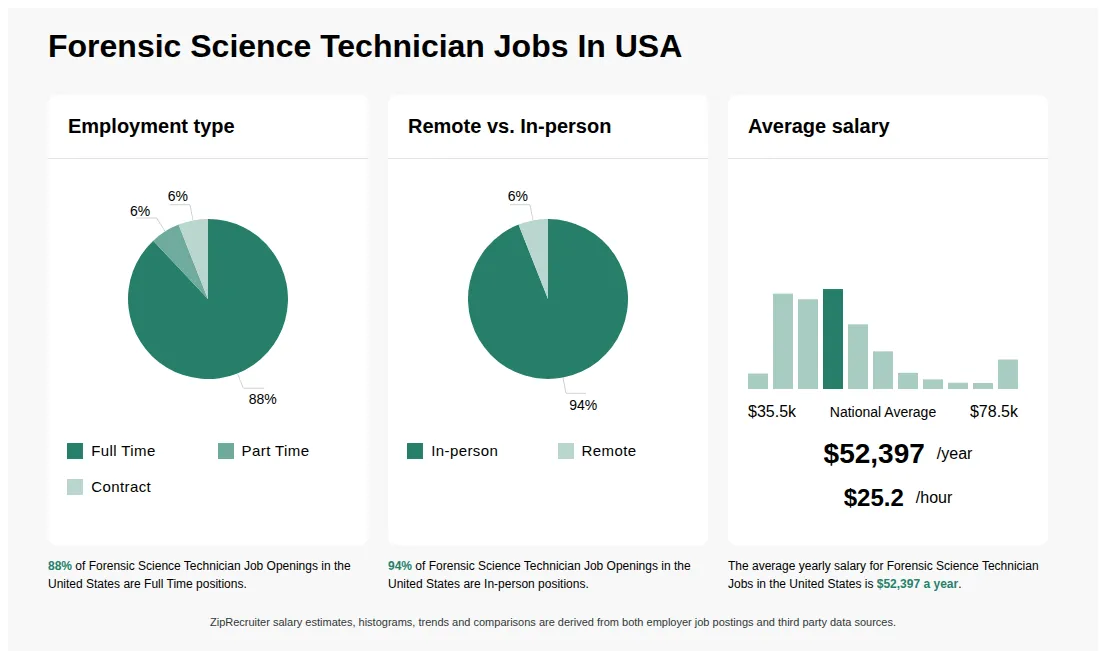
As of Aug 18, 2026, the average yearly pay for forensic science technician in the United States is $52,397.00, according to ZipRecruiter salary data. Most workers in this role earn between $43,500.00 and $55,500.00 per year, depending on experience, location, and employer.

What is a forensic science technician?

Forensic science technicians are professionals who collect, analyze, and interpret physical evidence from crime scenes to help solve criminal cases. They often work in laboratories or at crime scenes, using scientific methods and specialized equipment to examine evidence such as fingerprints, DNA, weapons, and substances. Their findings play a crucial role in criminal investigations and can be used in court to support legal proceedings. Forensic science technicians collaborate closely with law enforcement and other experts to ensure accurate and thorough analysis.

What are the key skills and qualifications needed to thrive as a forensic science technician?

To thrive as a Forensic Science Technician, you need a solid background in biology, chemistry, and criminal justice, typically supported by a bachelor’s degree in forensic science or a related field. Competence with laboratory equipment, evidence collection protocols, and familiarity with specialized software for analyzing DNA, fingerprints, and other evidence are crucial. Keen attention to detail, analytical thinking, and strong written and verbal communication skills are essential soft skills for this role. These abilities ensure accurate evidence analysis, effective collaboration with law enforcement, and the integrity of legal investigations.

What are some common challenges faced by forensic science technicians during the evidence collection process?

Forensic science technicians often encounter challenges such as working in unpredictable or hazardous environments, ensuring strict adherence to chain of custody protocols, and avoiding contamination of evidence. They must pay meticulous attention to detail while collecting, preserving, and documenting evidence, often under time constraints or in stressful situations. Additionally, technicians regularly collaborate with law enforcement and other forensic experts to ensure accuracy and integrity in their findings.

What is the difference between Forensic Science Technician vs Crime Scene Investigator?

AspectForensic Science TechnicianCrime Scene Investigator
CredentialsForensic science degree, certification often preferredLaw enforcement training, crime scene processing certification
Work EnvironmentLaboratories, crime labs, research facilitiesCrime scenes, outdoor and indoor locations
Employer & IndustryFederal, state, or private labs; law enforcement agenciesPolice departments, law enforcement agencies
Job FocusAnalyzing evidence, lab work, report writingCollecting evidence, documenting crime scenes

While both roles support criminal investigations, Forensic Science Technicians primarily analyze evidence in labs, whereas Crime Scene Investigators focus on collecting evidence at crime scenes. Both require specialized training and often work within law enforcement or forensic labs, but their daily tasks and work environments differ.


What do you do as a forensic science technician?

A forensic science technician collects, analyzes, and preserves physical evidence from crime scenes. They use laboratory tools and techniques such as fingerprint analysis, DNA testing, and chemical analysis to help solve crimes and support investigations. The job often requires attention to detail, knowledge of scientific methods, and adherence to safety protocols.

What cities are hiring for Forensic Science Technician jobs?

Cities with the most Forensic Science Technician job openings:

What are the most commonly searched types of Forensic Science Technician jobs?

The most popular types of Forensic Science Technician jobs are:

What states have the most Forensic Science Technician jobs?

States with the most job openings for Forensic Science Technician jobs include:

What are popular job titles related to Forensic Science Technician jobs?

For Forensic Science Technician jobs, the most frequently searched job titles are:

Infographic showing various Forensic Science Technician job openings in the United States as of August 2026, with employment types broken down into 1% As Needed, 85% Full Time, 10% Part Time, 3% Contract, and 1% Nights. Highlights an 99% Physical, and 1% Remote job distribution, with an average salary of $52,397 per year, or $25.2 per hour.

Forensic Science Technician

DC Government Careers

Washington, DC • On-site

$62K - $80K/yr

Full-time

Re-posted 11 days ago


Job description

Job Summary
This position is located in the Department of Forensic Sciences (DFS), Forensic Science Laboratory (FSL). The mission of DFS is to provide high-quality, timely, accurate, and reliable forensic science services through best practices and the best available technology; focusing on unbiased science and transparency, to enhance public safety and health.
Forensic Science Technicians are responsible for assisting with technical laboratory work, which includes casework, accreditation, quality assurance, and control programs, within the Forensic Science Laboratory (FSL).
Duties and Responsibilities
As a technician, performs a variety of operations in a laboratory setting, e.g., basic testing and troubleshooting for casework, and accreditation; responds to requests from the various Forensic Science Laboratory Units to support quality assurance records in accordance with laboratory, accreditation and statutory requirements; assists with audit preparation and administration; demonstrates continuous efforts to improve operations; and works cooperatively and jointly to provide seamless customer service.
Applies non-routine or specialized and challenging procedures as instructed, and takes corrective action; accepts and resolves referrals of abnormal or unusual specimens; establishes and monitors quality control procedures and coordinates the laboratory program with overall quality control program of the laboratory. Utilizes experience and/or training to assist with the day-to-day processes within the Forensic Science Laboratory; and receives comprehensive training in reagent preparation, laboratory decontamination, instrument setup and troubleshooting, equipment maintenance, temperature monitoring, materials and evidence handling and storage, documentation, and report writing.
Qualifications and Education
Degree: biological sciences, agriculture, natural resource management, chemistry, or related disciplines appropriate to the position. Or
Combination of education and experience: Courses equivalent to a major, as shown in A above, plus appropriate experience or additional education.
Specialized Experience: Experience that equipped the applicant with the particular knowledge, skills, and abilities to perform successfully the duties of the position, and that is typically in or related to the work of the position to be filled. To be creditable, one (1) year of specialized experience must have been equivalent to at least the next lower grade level in the normal line of progression.
Licensure and Certification
None
Work Conditions/Environment
The work is performed in an office and laboratory. The office setting is when preparing documentation, and the laboratory setting is during the testing and analysis phase.
The incumbent may be exposed to hazardous materials, toxic substance, blood borne pathogens, and electric current and electrostatic discharge and is required to follow safe laboratory practices and wear protective clothing including facial masks, safety glasses, gloves, ear protection, etc.
Other Significant Facts
Tour of Duty: Monday-Friday, 8:30 a.m. - 5:00 p.m.
Pay Plan, Series and Grade: CS-0401-09
Promotion Potential: No known promotion potential
Duration of Appointment: Career Service - Term Appointment (Not-to-Exceed 13-months)
Collective Bargaining Unit: This position is covered under a collective bargaining agreement, National Association of Government Employees (NAGE) Local R3-05, and subject to pay an agency service fee (union dues) through direct payroll deduction.
Position Designation: This position has been deemed Safety Sensitive under the guidelines of the DC Personnel Manual. Incumbents of this position are subject to enhanced suitability screening pursuant to Chapter 4 of DC personnel regulations. Accordingly, you must successfully pass a criminal background and drug and alcohol screening as a condition of employment and will be subject to periodic criminal background checks and drug tests for the duration of your tenure.
Essential Designation: This position has been designated as Emergency and acceptance of this offer confirms you agree to adhere to the policies in sections 1271 and 1274 of DPM Chapter 12, regarding essential/emergency employees. As an essential employee, you will be required to either report to work, stay at work, or telework (if directed to do so) during a declared emergency or during a period of non-emergency where your duties have been deemed as critical District government functions/operations. You may be required to perform other duties outside of your position description during a period of a declared emergency (such as manual labor, shelter services, etc.).
Residency Preference: Applicants claiming Residency Preference will be required to maintain residency in the District of Columbia for a minimum of seven (7) years. Failure to do so may result in forfeiture of employment.
EEO Statement: The District of Columbia Government is an Equal Opportunity Employer. All qualified candidates will receive consideration without regard to race, color, religion, national origin, sex, age, marital status, personal appearance, sexual orientation, family responsibilities, matriculation, physical handicap, or political affiliation.