1

Forensic Science Technician Jobs (NOW HIRING)

Position Description Mission The Mission of the Harris County Institute of Forensic Sciences is to provide medical examiner and crime laboratory services of the highest quality in an unbiased manner ...

Position Description Mission The Mission of the Harris County Institute of Forensic Sciences is to provide medical examiner and crime laboratory services of the highest quality in an unbiased manner ...

Position Description Mission The Mission of the Harris County Institute of Forensic Sciences is to ... Brief IBIS Support Technician Overview: The IBIS Support Technician is an entry-level position ...

Institute of Forensic Sciences Division: Firearms Laboratory Opening Date: 05/07/2026 Closing Date ... Brief IBIS Support Technician Overview: The IBIS Support Technician is an entry-level position ...

Position Description Mission The Mission of the Harris County Institute of Forensic Sciences is to ... Brief IBIS Support Technician Overview: The IBIS Support Technician is an entry-level position ...

Showing results 21-40

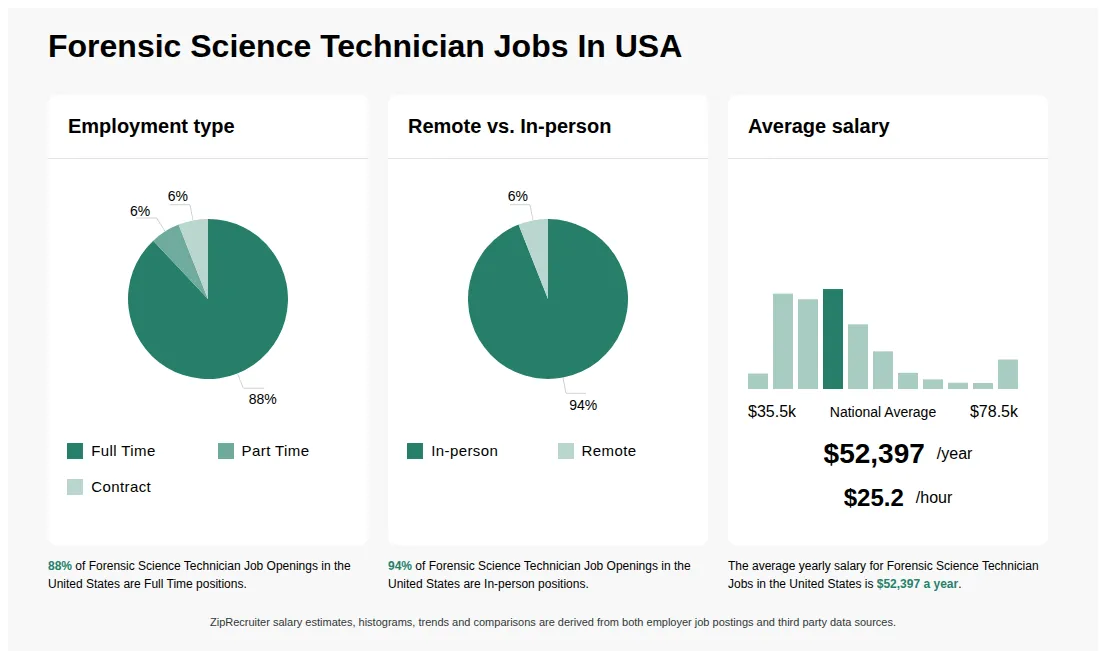
Forensic Science Technician information

See salary details

$35.5K

$52.4K

$78.5K

How much do forensic science technician jobs pay per year?

As of Sep 7, 2026, the average yearly pay for forensic science technician in the United States is $52,397.00, according to ZipRecruiter salary data. Most workers in this role earn between $43,500.00 and $55,500.00 per year, depending on experience, location, and employer.

What is a forensic science technician?

Forensic science technicians are professionals who collect, analyze, and interpret physical evidence from crime scenes to help solve criminal cases. They often work in laboratories or at crime scenes, using scientific methods and specialized equipment to examine evidence such as fingerprints, DNA, weapons, and substances. Their findings play a crucial role in criminal investigations and can be used in court to support legal proceedings. Forensic science technicians collaborate closely with law enforcement and other experts to ensure accurate and thorough analysis.

What are the key skills and qualifications needed to thrive as a forensic science technician?

To thrive as a Forensic Science Technician, you need a solid background in biology, chemistry, and criminal justice, typically supported by a bachelor’s degree in forensic science or a related field. Competence with laboratory equipment, evidence collection protocols, and familiarity with specialized software for analyzing DNA, fingerprints, and other evidence are crucial. Keen attention to detail, analytical thinking, and strong written and verbal communication skills are essential soft skills for this role. These abilities ensure accurate evidence analysis, effective collaboration with law enforcement, and the integrity of legal investigations.

What are some common challenges faced by forensic science technicians during the evidence collection process?

Forensic science technicians often encounter challenges such as working in unpredictable or hazardous environments, ensuring strict adherence to chain of custody protocols, and avoiding contamination of evidence. They must pay meticulous attention to detail while collecting, preserving, and documenting evidence, often under time constraints or in stressful situations. Additionally, technicians regularly collaborate with law enforcement and other forensic experts to ensure accuracy and integrity in their findings.

What is the difference between Forensic Science Technician vs Crime Scene Investigator?

AspectForensic Science TechnicianCrime Scene Investigator
CredentialsForensic science degree, certification often preferredLaw enforcement training, crime scene processing certification
Work EnvironmentLaboratories, crime labs, research facilitiesCrime scenes, outdoor and indoor locations
Employer & IndustryFederal, state, or private labs; law enforcement agenciesPolice departments, law enforcement agencies
Job FocusAnalyzing evidence, lab work, report writingCollecting evidence, documenting crime scenes

While both roles support criminal investigations, Forensic Science Technicians primarily analyze evidence in labs, whereas Crime Scene Investigators focus on collecting evidence at crime scenes. Both require specialized training and often work within law enforcement or forensic labs, but their daily tasks and work environments differ.
What do you do as a forensic science technician?

A forensic science technician collects, analyzes, and preserves physical evidence from crime scenes. They use laboratory tools and techniques such as fingerprint analysis, DNA testing, and chemical analysis to help solve crimes and support investigations. The job often requires attention to detail, knowledge of scientific methods, and adherence to safety protocols.

What cities are hiring for Forensic Science Technician jobs?

Cities with the most Forensic Science Technician job openings:

What are the most commonly searched types of Forensic Science Technician jobs?

The most popular types of Forensic Science Technician jobs are:

What states have the most Forensic Science Technician jobs?

States with the most job openings for Forensic Science Technician jobs include:

What are popular job titles related to Forensic Science Technician jobs?

For Forensic Science Technician jobs, the most frequently searched job titles are:

Infographic showing various Forensic Science Technician job openings in the United States as of August 2026, with employment types broken down into 1% As Needed, 82% Full Time, 13% Part Time, 3% Contract, and 1% Nights. Highlights an 99% Physical, and 1% Remote job distribution, with an average salary of $52,397 per year, or $25.2 per hour.

Forensic Technician/Photographer

Broward County

Fort Lauderdale, FL • On-site

$52K - $84K/yr

Full-time

Posted 19 days ago


Key responsibilities

  • Photographs autopsies, death scenes, and related forensic cases, and prepares images for case files and reports.

  • Handles medical instruments, operates photographic equipment, and performs minor repairs to photographic tools.

  • Assists medical examiners in autopsy procedures, body releases, and collection of specimens.


Broward County rating

8.9

Company rating: 8.9 out of 10

Based on 36 frontline employees who took The Breakroom Quiz

127th of 856 rated public administrative organizations


Job description

REQUIREMENTS AND PREFERENCES The Broward County Board of County Commissioners is seeking qualified candidates for Forensic Technician/Photographer. The Forensic Technician/Photographer handles medical instruments, operates equipment including digital cameras and specialized photographic equipment and techniques; processes and preserves pictures of autopsies and death scenes; preserves evidentiary images for use in investigations and/or as evidence in court. Photographs death scenes, autopsies, external examinations, toxicology photography as needed, and disasters.

Inventories, stores and maintains photographic supplies and equipment for the Medical Examiner's office; makes minor repairs to photographic equipment. Works with histology specimens. Prepares and submits images for case files and reports for photographic assignments.

Receives corpses and assists pathologists in completion of autopsies. Releases bodies to approved authorities. Preserves specimens for legal or training demonstration purposes.

Assists medical examiners in the collection of cultures. Maintains records using a personal computer with basic office software and Division specific applications.Performs other related work as required General Description Skilled work in the day-to-day operations of the forensic section. Works under general supervision, independently developing work methods and sequences

Minimum Education and Experience Requirements Requires 6 months experience assisting with autopsies, crime scene, biomedical photography or currently enrollment in an accredited college or university pursuing a Bachelor's degree in biology/pre-med or other health care field, or closely related field of study. Special Certifications and Licenses None. Preferences Graduated from an accredited college or university with an associate degree in forensic science, Biology, Chemistry, Criminal Justice or a related field Bachelor's degree Forensic Science, Biology, Chemistry, Criminal Justice or related filed Six months-one years of Crime Scene Investigation, Forensic Photography and or latent Fingerprint Examinations.

Experience in preservation and collection of physical, biological and trace evidence 1+ years experience in the preservation and collection of physical, biological, and trace evidence 1+ years experience in Forensic Photography or postmortem photography Experience in the development, collection and preservation of latent prints for case file and or law enforcement Postmortem (Autopsy) Photography experience SCOPE OF WORK Duties and Responsibilities The functions listed below are those that represent the majority of the time spent working in this class. Management may assign additional functions related to the type of work of the job as necessary. Performs autopsies, fingerprinting, x-rays, and body releases.

Photographs autopsy cases and toxicological blood kits for criminal cases; places images into case files on computer for doctors to review in order to determine cause of death; coordinates with and provides records management image request CDs (compact discs); watermarks each image and places onto a CD for attorneys and police departments. Reviews and performs requisition of supplies for photographic operations, equipment, and distribution; resolves technical camera equipment, hardware, software and administrative problems. Acts as a liaison between photography staff and doctors, attorneyas offices and police departments in order to ensure photographic needs are being met; provides photographic technical assistance to doctors, investigators, and law enforcement agencies.

Performs related work as assigned. Competencies Tech Savvy: Anticipates and adopts innovations in business-building digital and technology applications. Investigates technologies to learn some cutting-edge best practices.

Uses digital/social media to benefit the team and add value to the work being done; understands how to avoid misuse of these tools. Plans and Aligns: Plans and prioritizes work to meet commitments aligned with organizational goals. Outlines clear plans that put actions in a logical sequence; conveys some time frames.

Aligns own work with relevant workgroups. Takes some steps to reduce bottlenecks and speed up the work. Optimizes Work Processes: Knows the most effective and efficient processes to get things done, with a focus on continuous improvement.

Generally follows defined and communicated standards, methods, and procedures. Seeks advice and finds ways to work better within processes. Makes some reasonable suggestions to improve work methods.

Drives Results: Consistently achieves results, even under tough circumstances. Does what is necessary to meet goals and deliver expected results with acceptable quality. Shows consistent effort to complete even unpleasant or routine tasks in a timely manner; maintains work focus despite obstacles or setbacks.

WORK ENVIRONMENT Physical Demands Physical demands refer to the requirements for physical exertion and coordination of limb and body movement. Performs medium to heavy work that involves walking, standing, stooping and also involves exerting between 20 to 50 pounds of force on a regular and recurring basis and 50 to 100 pounds of force on an occasional basis. Unavoidable Hazards (Work Environment) Unavoidable hazards refer to the job conditions that may lead to injury or health hazards even though precautions have been taken.

Involves routine and frequent exposure to disease/pathogens. SPECIAL INFORMATION County Core Values All Broward County employees strive to demonstrate the County's four core behavioral competencies. Collaborates: Building partnerships and working collaboratively with others to meet shared objectives.

Customer focus: Building strong customer relationships and delivering customer-centric solutions. Instills trust: Gaining the confidence and trust of others through honesty, integrity, and authenticity. Values differences: Recognizing the value that different perspectives and cultures bring to an organization.

Copyright 2025 Korn Ferry. ALL RIGHTS RESERVED Americans with Disabilities Act (ADA) Compliance Broward County is an Equal Opportunity Employer committed to inclusion. Broward County is committed to providing equal opportunity and reasonable accommodations to qualified persons with disabilities.

We support the hiring of people with disabilities; therefore, if you require assistance due to a disability, please contact the Professional Standards Section in advance at 954-357-6500 or email Profstandards@broward.org to make an accommodation request. County-wide Emergency Responsibilities Note: During emergency conditions, all County employees are automatically considered emergency service workers. County employees are subject to being called to work in the event of a disaster, such as a hurricane, or other emergency situation and are expected to perform emergency service duties, as assigned

County-wide Employee Responsibilities All Broward County employees must serve the public and fellow employees with honesty and integrity in full accord with the letter and spirit of Broward County's Employee Code of Ethics, gift, and conflict of interest policies. All Broward County employees must establish and maintain effective working relationships with the general public, co-workers, elected and appointed officials and members of diverse cultural and linguistic backgrounds, regardless of race, color, religion, sex, national origin, age, disability, marital status, political affiliation, familial status, sexual orientation, pregnancy, or gender identity and expression.


What Broward County employees say

Pay

Benefits

Hours and flexibility

Workplace

Get the full story on Breakroom