
... computer networking in corporate environments • Availability for short notice or weekend travel when necessary Preferred Attributes: • EDiscovery experience with relevant forensic collection and ...
... computer networking in corporate environments • Availability for short notice or weekend travel when necessary Preferred Attributes: • EDiscovery experience with relevant forensic collection and ...

Digital Forensics Lab Technician
$30 - $38/hr
Technicians are expected to maintain a high level of accuracy, chain-of-custody integrity, and ... IACIS Certified Mobile Device Examiner (ICMDE), and/or National Computer Forensics Institute (NCFI ...
Digital Forensics Lab Technician
$30 - $38/hr
Technicians are expected to maintain a high level of accuracy, chain-of-custody integrity, and ... IACIS Certified Mobile Device Examiner (ICMDE), and/or National Computer Forensics Institute (NCFI ...
Digital Forensics Lab Technician
Birmingham, AL · On-site
$30 - $38/hr
Technicians are expected to maintain a high level of accuracy, chain-of-custody integrity, and ... IACIS Certified Mobile Device Examiner (ICMDE), and/or National Computer Forensics Institute (NCFI ...
Digital Forensics Lab Technician
Birmingham, AL · On-site
$30 - $38/hr
Technicians are expected to maintain a high level of accuracy, chain-of-custody integrity, and ... IACIS Certified Mobile Device Examiner (ICMDE), and/or National Computer Forensics Institute (NCFI ...
Digital Forensics Lab Technician
$30 - $38/hr
Technicians are expected to maintain a high level of accuracy, chain-of-custody integrity, and ... IACIS Certified Mobile Device Examiner (ICMDE), and/or National Computer Forensics Institute (NCFI ...
Digital Forensics Lab Technician
$30 - $38/hr
Technicians are expected to maintain a high level of accuracy, chain-of-custody integrity, and ... IACIS Certified Mobile Device Examiner (ICMDE), and/or National Computer Forensics Institute (NCFI ...
Principal, Digital Forensics
Chicago, IL · On-site
... technicians across all aspects of the digital forensics lifecycle. The Principal will support a ... Perform computer forensic investigations with no oversight * Produce finalized drafts of ...
Principal, Digital Forensics
Chicago, IL · On-site
... technicians across all aspects of the digital forensics lifecycle. The Principal will support a ... Perform computer forensic investigations with no oversight * Produce finalized drafts of ...
... technicians across all aspects of the digital forensics lifecycle. The Principal will support a ... Perform computer forensic investigations with no oversight * Produce finalized drafts of ...
... technicians across all aspects of the digital forensics lifecycle. The Principal will support a ... Perform computer forensic investigations with no oversight * Produce finalized drafts of ...
... technicians across all aspects of the digital forensics lifecycle. The Principal will support a ... Perform computer forensic investigations with no oversight * Produce finalized drafts of ...
... technicians across all aspects of the digital forensics lifecycle. The Principal will support a ... Perform computer forensic investigations with no oversight * Produce finalized drafts of ...
Principal, Digital Forensics
Manhattan, NY · On-site
$200 - $250/hr
... technicians across all aspects of the digital forensics lifecycle. The Principal will support a ... Perform computer forensic investigations with no oversight * Produce finalized drafts of ...
Principal, Digital Forensics
Manhattan, NY · On-site
$200 - $250/hr
... technicians across all aspects of the digital forensics lifecycle. The Principal will support a ... Perform computer forensic investigations with no oversight * Produce finalized drafts of ...
Principal, Digital Forensics
New York, NY · On-site
... technicians across all aspects of the digital forensics lifecycle. The Principal will support a ... Perform computer forensic investigations with no oversight * Produce finalized drafts of ...
Principal, Digital Forensics
New York, NY · On-site
... technicians across all aspects of the digital forensics lifecycle. The Principal will support a ... Perform computer forensic investigations with no oversight * Produce finalized drafts of ...
Principal, Digital Forensics
San Francisco, CA · On-site
$200 - $250/hr
... technicians across all aspects of the digital forensics lifecycle. The Principal will support a ... Perform computer forensic investigations with no oversight * Produce finalized drafts of ...
Principal, Digital Forensics
San Francisco, CA · On-site
$200 - $250/hr
... technicians across all aspects of the digital forensics lifecycle. The Principal will support a ... Perform computer forensic investigations with no oversight * Produce finalized drafts of ...
Principal, Digital Forensics
Chicago, IL · On-site
... technicians across all aspects of the digital forensics lifecycle. The Principal will support a ... Perform computer forensic investigations with no oversight * Produce finalized drafts of ...
Principal, Digital Forensics
Chicago, IL · On-site
... technicians across all aspects of the digital forensics lifecycle. The Principal will support a ... Perform computer forensic investigations with no oversight * Produce finalized drafts of ...
Principal, Digital Forensics
New York, NY · On-site
... technicians across all aspects of the digital forensics lifecycle. The Principal will support a ... Perform computer forensic investigations with no oversight * Produce finalized drafts of ...
Principal, Digital Forensics
New York, NY · On-site
... technicians across all aspects of the digital forensics lifecycle. The Principal will support a ... Perform computer forensic investigations with no oversight * Produce finalized drafts of ...
... technicians across all aspects of the digital forensics lifecycle. The Principal will support a ... Perform computer forensic investigations with no oversight * Produce finalized drafts of ...
... technicians across all aspects of the digital forensics lifecycle. The Principal will support a ... Perform computer forensic investigations with no oversight * Produce finalized drafts of ...
Principal, Digital Forensics
Washington, IL · On-site
$200 - $250/hr
... technicians across all aspects of the digital forensics lifecycle. The Principal will support a ... Perform computer forensic investigations with no oversight * Produce finalized drafts of ...
Principal, Digital Forensics
Washington, IL · On-site
$200 - $250/hr
... technicians across all aspects of the digital forensics lifecycle. The Principal will support a ... Perform computer forensic investigations with no oversight * Produce finalized drafts of ...
Principal, Digital Forensics
New York, NY · On-site
... technicians across all aspects of the digital forensics lifecycle. The Principal will support a ... Perform computer forensic investigations with no oversight * Produce finalized drafts of ...
Principal, Digital Forensics
New York, NY · On-site
... technicians across all aspects of the digital forensics lifecycle. The Principal will support a ... Perform computer forensic investigations with no oversight * Produce finalized drafts of ...
... technicians across all aspects of the digital forensics lifecycle. The Principal will support a ... Perform computer forensic investigations with no oversight * Produce finalized drafts of ...
... technicians across all aspects of the digital forensics lifecycle. The Principal will support a ... Perform computer forensic investigations with no oversight * Produce finalized drafts of ...

Forensic Technician/Photographer
Fort Lauderdale, FL · On-site
$52K - $84K/yr
The Forensic Technician/Photographer handles medical instruments, operates equipment including ... Maintains records using a personal computer with basic office software and Division specific ...
Forensic Technician/Photographer
Fort Lauderdale, FL · On-site
$52K - $84K/yr
The Forensic Technician/Photographer handles medical instruments, operates equipment including ... Maintains records using a personal computer with basic office software and Division specific ...

Forensic Technician IV
Austin, TX · On-site
Incumbent must meet the forensic technician requirements specified by the Texas Forensic Science ... Required to enter data and write reports by typing on a computer. Will have potential contact with ...
Forensic Technician IV
Austin, TX · On-site
Incumbent must meet the forensic technician requirements specified by the Texas Forensic Science ... Required to enter data and write reports by typing on a computer. Will have potential contact with ...
Incumbent must meet the forensic technician requirements specified by the Texas Forensic Science ... Required to enter data and write reports by typing on a computer. Will have potential contact with ...
Quick apply
Incumbent must meet the forensic technician requirements specified by the Texas Forensic Science ... Required to enter data and write reports by typing on a computer. Will have potential contact with ...
Forensic Technician IV
Austin, TX · On-site
$50K/yr
Incumbent must meet the forensic technician requirements specified by the Texas Forensic Science ... Required to enter data and write reports by typing on a computer. Will have potential contact with ...
Forensic Technician IV
Austin, TX · On-site
$50K/yr
Incumbent must meet the forensic technician requirements specified by the Texas Forensic Science ... Required to enter data and write reports by typing on a computer. Will have potential contact with ...
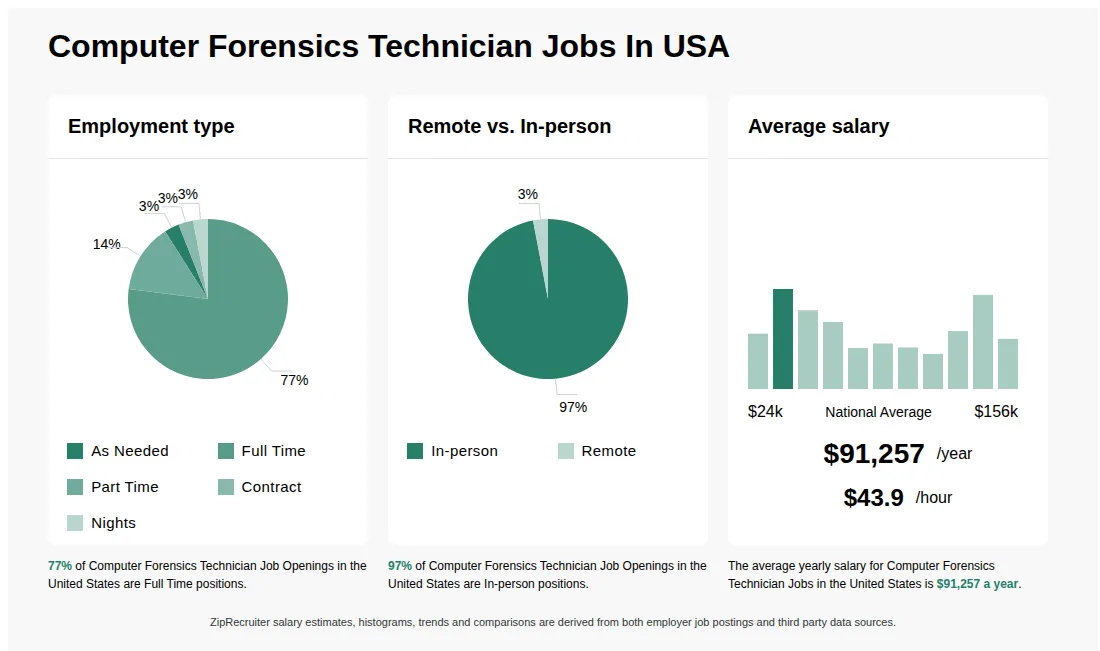
Computer Forensics Technician information
See salary details
$24K - $36K
8% of jobs
$36K - $48K
16% of jobs
$49.1K is the 25th percentile. Wages below this are outliers.
$48K - $60K
11% of jobs
$60K - $72K
10% of jobs
The median wage is $80K / yr.
$72K - $84K
6% of jobs
$84K - $96K
6% of jobs
$96K - $108K
6% of jobs
$108K - $120K
5% of jobs
$127.5K is the 75th percentile. Wages above this are outliers.
$120K - $132K
8% of jobs
$132K - $144K
15% of jobs
$144K - $156K
7% of jobs
$24K
$91.3K
$156K
How much do computer forensics technician jobs pay per year?
As of Sep 8, 2026, the average yearly pay for computer forensics technician in the United States is $91,257.00, according to ZipRecruiter salary data. Most workers in this role earn between $50,000.00 and $133,500.00 per year, depending on experience, location, and employer.
What does a computer forensics technician do?
A computer forensics technician, also referred to as a computer forensic tech, looks for information that is relevant to an investigation. They examine cell phones, tablets, electronic notebooks, computer hard drives, flash drives, video game consoles, and other electronics that could supply significant evidence. They may also analyze the data, using software programs or other tools to determine relevant information. A computer forensics technician must follow all legal policies and procedures. A computer forensic tech often works with cyber crime and security but may be brought in on other cases that require technical knowledge.
What does a computer forensics technician do?
A Computer Forensics Technician is responsible for identifying, collecting, analyzing, and preserving digital evidence from computers and other electronic devices. They often work with law enforcement agencies to investigate cybercrimes, data breaches, and other incidents involving digital data. Their work is crucial in both criminal and civil investigations, ensuring that electronic evidence is handled properly and can be presented in court. Additionally, they use specialized tools and techniques to recover deleted or encrypted data and prepare detailed reports of their findings.
What are the key skills and qualifications needed to thrive as a computer forensics technician, and why are they important?
To thrive as a Computer Forensics Technician, you need expertise in digital evidence collection, data recovery, and operating system knowledge, typically supported by a degree in computer science or a related field. Familiarity with forensic tools like EnCase, FTK, and certification such as CFCE or GCFA is highly valued. Attention to detail, analytical thinking, and strong written communication skills help you stand out in this role. These skills and qualifications are essential for ensuring the integrity of digital investigations and providing reliable evidence in legal and corporate contexts.
What are some common challenges computer forensics technicians face when collecting and preserving digital evidence?
Computer Forensics Technicians often encounter challenges such as ensuring the integrity and admissibility of digital evidence, especially when dealing with encrypted or damaged devices. Maintaining a strict chain of custody and following proper protocols is critical to prevent data tampering or contamination. Additionally, staying updated with rapidly evolving technology and cyber threats requires continuous learning and adaptability. Collaboration with law enforcement and legal teams is also essential to effectively communicate findings and support investigations.
What is the difference between Computer Forensics Technician vs Digital Forensics Analyst?
| Aspect | Computer Forensics Technician | Digital Forensics Analyst |
|---|---|---|
| Certifications | EnCE, CFCE | EnCE, CFCE, GIAC certifications |
| Work Environment | Law enforcement, corporate security, consulting firms | Law enforcement agencies, cybersecurity firms, legal teams |
| Job Focus | Collecting, imaging, and analyzing digital evidence | Interpreting digital evidence, reporting, and expert testimony |
While both roles involve digital evidence analysis, Computer Forensics Technicians primarily focus on collecting and preserving digital data, whereas Digital Forensics Analysts interpret findings and provide expert insights for legal or security purposes. The roles often overlap but differ in scope and responsibilities.
More about Computer Forensics Technician jobs
What states have the most Computer Forensics Technician jobs?
States with the most job openings for Computer Forensics Technician jobs include:
What are popular job titles related to Computer Forensics Technician jobs?
For Computer Forensics Technician jobs, the most frequently searched job titles are:
Job description
Overview
The Forensic Analyst leads, conducts, and assists in data preservation and digital investigations in complex litigation cases by leveraging knowledge of digital forensic tools, technology and protocols related to the collection and management of electronically stored information (ESI) from a wide variety of data sources. The analyst performs investigative work and data collections as part of a forensics and collections team.
Responsibilities
Qualifications
Minimum Education Requirements:
• Bachelor's degree in forensic computing or equivalent relevant experience
Minimum Experience Requirements:
1 to 3 years of progressively responsible experience in related roles
Other Requirements:
• Excellent communication skills - both written and verbal
• Ability to thrive in a highly collaborative team environment
• Ability to work on multiple projects concurrently
• Demonstrate working knowledge and understanding of evidence management
• Proficient in the usage of forensic acquisition tools and working with various file formats
• Ability to collect data from a wide array of ESI, including: computers, mobile devices, media storage devices, servers, networks, social media, and cloud-based services.
• Familiarity with rules of evidence, ACPO guidelines, ISO17025 and Chain of Custody
• Good understanding of computer networking in corporate environments
• Availability for short notice or weekend travel when necessary
Preferred Attributes:
• EDiscovery experience with relevant forensic collection and analysis software
• Certifications in EnCase, FTK, Cellebrite, Nuix, CFE or similar
• SQL or scripting
The Forensic Analyst leads, conducts, and assists in data preservation and digital investigations in complex litigation cases by leveraging knowledge of digital forensic tools, technology and protocols related to the collection and management of electronically stored information (ESI) from a wide variety of data sources. The analyst performs investigative work and data collections as part of a forensics and collections team.
Responsibilities
- Works internally with colleagues in the planning and execution of data preservation using the most appropriate and legally defensible solutions
- Performs investigative analysis activities for a variety of digital devices, computers, storage media, servers, networks, and cloud-based services, including seizure and retention of mobile phones and handheld devices where needed.
- Performs data restoration and data conversion to prepare data for processing and hosting
- Displays sound knowledge and expertise of common operating systems and applications and exhibits an aptitude for problem solving in a methodical manner consistent with forensic protocols
- Follows Digital Forensic good practice methodologies (ISO17025 standard and ACPO Principles of Digital Evidence) in all aspects of the forensic and eDiscovery workflow
- Assists with and independently conducts the forensic examination of data and prepares expert reports and other expert witness documentation related to investigations
- Displays competence in oral delivery of complex technical information to non-technical clients
- Displays high degree of comfort operating in a client-facing environment and meeting the needs of clients
- Ability to be responsive to internal and external communications
- Has the ability to make well-reasoned decisions "on the spot" and execute on the plan
Qualifications
Minimum Education Requirements:
• Bachelor's degree in forensic computing or equivalent relevant experience
Minimum Experience Requirements:
1 to 3 years of progressively responsible experience in related roles
Other Requirements:
• Excellent communication skills - both written and verbal
• Ability to thrive in a highly collaborative team environment
• Ability to work on multiple projects concurrently
• Demonstrate working knowledge and understanding of evidence management
• Proficient in the usage of forensic acquisition tools and working with various file formats
• Ability to collect data from a wide array of ESI, including: computers, mobile devices, media storage devices, servers, networks, social media, and cloud-based services.
• Familiarity with rules of evidence, ACPO guidelines, ISO17025 and Chain of Custody
• Good understanding of computer networking in corporate environments
• Availability for short notice or weekend travel when necessary
Preferred Attributes:
• EDiscovery experience with relevant forensic collection and analysis software
• Certifications in EnCase, FTK, Cellebrite, Nuix, CFE or similar
• SQL or scripting