1

Computer Forensics Technician Jobs (NOW HIRING)

Institute of Forensic Sciences Division: Firearms Laboratory Opening Date: 05/07/2026 Closing Date ... Basic computer skills including Microsoft Office NOTE : Qualifying education, experience, knowledge ...

Position Description Mission The Mission of the Harris County Institute of Forensic Sciences is to ... simultaneously Basic computer skills including Microsoft Office NOTE: Qualifying education ...

Position Description Mission The Mission of the Harris County Institute of Forensic Sciences is to ... simultaneously Basic computer skills including Microsoft Office NOTE: Qualifying education ...

Responsibilities Peraton is looking for an Imaging & Extraction Technician to process digital ... Formalized technical training in the areas of digital forensics, computer science, etc.

Position Description Mission The Mission of the Harris County Institute of Forensic Sciences is to ... computer skills, including Microsoft Office NOTE: Qualifying education, experience, knowledge and ...

Position Description Mission The Mission of the Harris County Institute of Forensic Sciences is to ... computer skills, including Microsoft Office NOTE: Qualifying education, experience, knowledge and ...

next page

Showing results 1-20

Computer Forensics Technician information

See salary details

$24K

$91.3K

$156K

How much do computer forensics technician jobs pay per year?

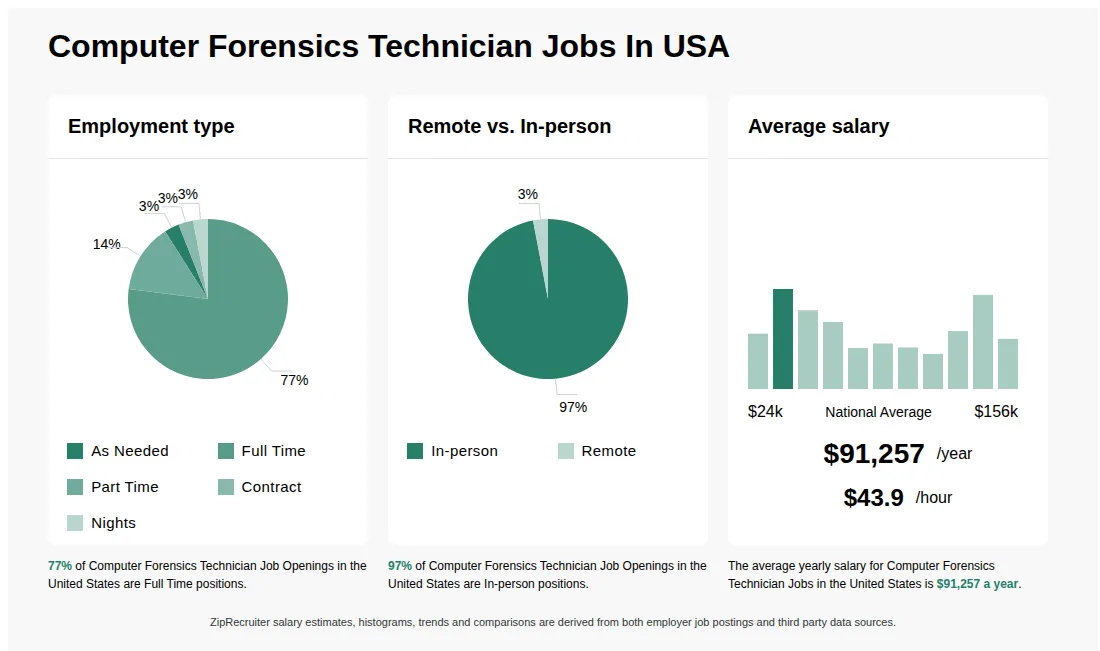
As of May 29, 2026, the average yearly pay for computer forensics technician in the United States is $91,257.00, according to ZipRecruiter salary data. Most workers in this role earn between $50,000.00 and $133,500.00 per year, depending on experience, location, and employer.

What Does a Computer Forensics Technician Do?

A computer forensics technician, also referred to as a computer forensic tech, looks for information that is relevant to an investigation. They examine cell phones, tablets, electronic notebooks, computer hard drives, flash drives, video game consoles, and other electronics that could supply significant evidence. They may also analyze the data, using software programs or other tools to determine relevant information. A computer forensics technician must follow all legal policies and procedures. A computer forensic tech often works with cyber crime and security but may be brought in on other cases that require technical knowledge.
What are the key skills and qualifications needed to thrive as a Computer Forensics Technician, and why are they important?

To thrive as a Computer Forensics Technician, you need expertise in digital evidence collection, data recovery, and operating system knowledge, typically supported by a degree in computer science or a related field. Familiarity with forensic tools like EnCase, FTK, and certification such as CFCE or GCFA is highly valued. Attention to detail, analytical thinking, and strong written communication skills help you stand out in this role. These skills and qualifications are essential for ensuring the integrity of digital investigations and providing reliable evidence in legal and corporate contexts.

What are some common challenges Computer Forensics Technicians face when collecting and preserving digital evidence?

Computer Forensics Technicians often encounter challenges such as ensuring the integrity and admissibility of digital evidence, especially when dealing with encrypted or damaged devices. Maintaining a strict chain of custody and following proper protocols is critical to prevent data tampering or contamination. Additionally, staying updated with rapidly evolving technology and cyber threats requires continuous learning and adaptability. Collaboration with law enforcement and legal teams is also essential to effectively communicate findings and support investigations.

What is the difference between Computer Forensics Technician vs Digital Forensics Analyst?

AspectComputer Forensics TechnicianDigital Forensics Analyst
CertificationsEnCE, CFCEEnCE, CFCE, GIAC certifications
Work EnvironmentLaw enforcement, corporate security, consulting firmsLaw enforcement agencies, cybersecurity firms, legal teams
Job FocusCollecting, imaging, and analyzing digital evidenceInterpreting digital evidence, reporting, and expert testimony

While both roles involve digital evidence analysis, Computer Forensics Technicians primarily focus on collecting and preserving digital data, whereas Digital Forensics Analysts interpret findings and provide expert insights for legal or security purposes. The roles often overlap but differ in scope and responsibilities.

What states have the most Computer Forensics Technician jobs? States with the most job openings for Computer Forensics Technician jobs include:
What job categories do people searching Computer Forensics Technician jobs look for? The top searched job categories for Computer Forensics Technician jobs are:
Infographic showing various Computer Forensics Technician job openings in the United States as of May 2026, with employment types broken down into 1% As Needed, 70% Full Time, 24% Part Time, and 5% Contract. Highlights an 100% Physical job distribution, with an average salary of $91,257 per year, or $43.9 per hour.

Chief Forensic Pathologist

Buffkin / Baker

Charlotte, NC

Other

Medical, Dental, Vision, Life, Retirement

Posted 12 days ago


Job description

Position Summary
This position provides Medical Examiner and Forensic Pathology services to the residents of Mecklenburg County and 2 additional regional counties for cases under E jurisdiction. The successful candidate will join 3 current full time forensic pathologists in performing approximately 700 autopsies and 850 external examinations annually, issuing reports, completing death certificates, and testifying in court. Reporting to the Deputy County Manager and Chief of Staff, this position further serves as the department director of an independent County office developing and implementing policies and procedures in compliance with state statutes and contracts. Office support staff includes the business manager and 2 administrative positions, an investigations manager and 11 death investigators, and 5 forensic autopsy/morgue technicians. The position is open due to the current Chief's planned retirement at the end of 2025.
Essential Functions
  • Performs autopsies and physical examination to determine the cause and manner of death. Prepares clear, concise narrative descriptions of autopsy findings.
  • Proper completion of death certificates and supplements as required to accurately reflect cause and manner of death on assigned cases.
  • Maintains Medical Examiner records and establishes policies for the documentation of the chain of custody for decedents' person effects, evidence and human remains. Interprets histological, toxicological, chemical, hematological and microbiological laboratory results.
  • Responsible for the review of all group work to ensure the quality and consistency of reports necessary for trial and prosecution purposes.
  • Provides guidance, direction and work review to the support staff.
  • Testifies in court as an expert witness. Maintains cooperative liaison with all elements of the criminal justice system.
  • Coordinates with hospital transplant teams for authorized removal of organs, tissue, bone and eye donations.
  • Establishes, evaluates, and monitors policies and operational procedures for handling potentially infectious autopsy cases and hazardous chemicals and equipment to assure optimal protection of personnel.
  • Conducts regular evaluations of facility and equipment to assure operation and maintenance standards for equipment.
  • Provides educational and informational opportunities through talks and lectures to law enforcement, medical and paramedical groups and other criminal justice and related agencies.
  • Provides information and statistical information to community agencies, insurance companies, news media, social agencies, educational programs, etc.
  • Coordinates office operations with State of NC ME system and State of NC statutes governing the ME system and performance of examinations and autopsies.
  • Oversees all operational aspects of the office to include administration, investigations, and morgue operations through coordination with managers and supervisors in each of those areas.
  • Directly oversees and evaluates the performance of the business manager, the investigations manager, and all forensic pathologists in the office.
  • Serves as a department director and part of the County Manager's Cabinet.
  • Participates in office finances and budget process with the development of key performance indicators and Strategic Business Plan.
  • Attend and participate in monthly Cabinet meetings, meetings with Deputy County Manager, office All Team meetings, meetings with County HR, and any other meetings as required in the role of department director.
Knowledge
  • All federal, state and local regulatory requirements applicable to vital statistics recordation, laboratory operations, public records laws and rules of evidence Death scene investigation procedures
  • Established laws, regulations, rules, policies and procedures governing the receipt, storage and release of bodies
  • Microscopy, toxicology, ballistics and investigative techniques are related to forensic medicine. Knowledge of rules of evidence as they apply to the preservation of specimens from a post-mortem examination
Skills
  • Applicable forensic tools Applicable safety procedures Laboratory procedures
  • Writing technical reports for presentations in court of law Meet and deal effectively with the public and employees Proficient in applicable computer programs
Preferred Qualifications
  • 10 years of experience as a forensic pathologist/medical examiner
  • 3 or more years of supervisory experience overseeing morgue operations and other pathologists, serving as a deputy director, or as a chief ME/FP
Experience
5 years of experience as a forensic pathologist performing autopsies and serving as a medical examiner investigating and certifying deaths. At least 2 years of experience in a supervisory role.
Education
Graduation from an accredited school of medicine with residency training in anatomic pathology (AP) or anatomic and clinical pathology (AP/CP) and 1 year of fellowship training in forensic pathology.
Licenses and Certifications
  • Current NC Medical License
  • Current board certifications in AP or AP/CP or other combination and in Forensic Pathology (FP) Requires a valid North Carolina or South Carolina Driver's License
  • Requires County Driving Privileges
  • Annual Motor Vehicle Record (MVR) check required
Abilities
  • Applied Learning: Assimilating and applying new job-related information in a timely manner
  • Communicate: Clearly conveying information and ideas through a variety of media to individuals or groups in a manner that engages the audience and helps them understand and retain the information provided
  • Decision Making: Identifying and understanding issues, problems, and opportunities; comparing data from different sources to draw conclusions; using effective approaches for choosing a course of action or developing appropriate solutions; taking action that is consistent with available facts, constraints and probably consequences
  • Stress Tolerance: Maintaining stable performance under pressure or opposition; handling stress in a manner that is acceptable to others and to the organization
About Mecklenburg County
Mecklenburg County is home to over 1,100,000 residents and the City of Charlotte. With almost 7 million residents within 100 miles, Mecklenburg County and Charlotte lie in the heart of a region that is the sixth largest urban area in the United States. Mecklenburg County is one of the two largest, by population, counties in the State of North Carolina. The County includes the City of Charlotte; towns of Cornelius, Davidson, and Huntersville (north of Charlotte); and the towns of Matthews, Mint Hill, and Pineville (south and southeast of Charlotte). Mecklenburg County is the second most populous county between Atlanta, Georgia and Washington, D.C. In fact, between 2010 and 2020, the County's population grew by 21.3%. Recent data presented by the Charlotte Regional Business Alliance indicates that from July 2022 through June 2023, the Charlotte region and Mecklenburg County had a daily inflow of 117 new residents, placing the region among the top 10 highest growth major metro regions in the country. This migration to Mecklenburg County bolsters the workforce, enriches the cultural landscape, and drives economic growth. It also illustrates the confidence that people have in the region, and its ability to be the perfect place to invest in their futures and contribute to a thriving community.
With this rapid growth over the last decade, Mecklenburg County has attracted people from around the country and the world. As a major hub for American Airlines - one of the country's largest airlines - it is easy to get to Mecklenburg County. This access has helped attract several Fortune 500 and 1000 companies that bring millions of investment dollars into the local economy. With a world- renowned park and recreation system, a range of professional and minor league sports teams, and diverse communities, people who come to Mecklenburg County find an energized downtown and a variety of living options.
Brief History
Mecklenburg County was created from a portion of Anson County on December 11, 1762. Residents chose the name Mecklenburg in hopes of gaining favor with King George III of England, whose wife, Queen Charlotte, was born in a German province of that name. Soon angered by the treatment they received from England, the residents signed the Mecklenburg Declaration of Independence on May 20, 1775, more than a year before the United States Declaration of Independence was signed.
The North Carolina State Constitution, approved in 1868, gave the citizens of a county the authority to elect a Board of County Commissioners (BOCC). Since 1994, Mecklenburg County has been governed by a nine-member BOCC with six members elected by districts and three elected at-large. The Board's major responsibilities include adopting the annual County budget, setting the County property tax rate, and assessing and establishing priorities on the many community needs, especially those related to health, education, welfare, mental health and the environment. The Board also makes appointments to advisory committees.
As Mecklenburg County grew in terms of responsibilities and financial commitments, the need for professional management became evident. In 1962, the County Manager form of administration was adopted. Appointed by the BOCC, the County Manager is the Chief Executive Officer of Mecklenburg County Government. The County Manager implements Board policies, represents the County in dealings with other governmental units and agencies, recommends the annual budget to the Board, and coordinates the work of all County agencies with the help of the Deputy County Managers and department directors.
Services and Operations
Mecklenburg County Government represents a partnership of the people, elected officials, County employees, and community advisors all working together to serve Mecklenburg County residents by helping improve their lives and community. As such, the County operates with the following Vision, Mission, and Values:
Mecklenburg Board of County Commissioners Community Vision
Mecklenburg County will be a community of pride and choice for people to live, learn, work and recreate.
Mecklenburg County Mission Statement
To serve Mecklenburg County residents by helping them improve their lives and community.
Mecklenburg County Vision Statement
Mecklenburg County will be the best local government service provider.
Mecklenburg County Values and Guiding Principles
Ethics: We work with integrity.
Customers: We serve our customers with courtesy and respect.
Employees: We recognize employees as our most important resource.
Excellence: We invest in learning and improving.
Teams: We work as a team, respecting each other.
Accountability: We focus on results.
With an operating budget of approximately $2.5 billion, Mecklenburg County provides the following types of services to its over 1.1 million residents:
  • Protection for both people and property.
  • Recreation and cultural activities.
  • Human services, including social services, public health, mental health, and environmental health.

In addition, the County has general administration functions, such as human resources management, budget, accounting, internal audit, and information technology for the efficient operation of government.
Over the past decade, Mecklenburg County has faced several challenges that have served as the impetus to change how the County manages its business. These challenges include growth, diminishing state revenue, increasing educational needs, and a more diverse population. Hence, Mecklenburg County has chosen to focus on changing and improving the key processes for strategic business planning, budgeting, and performance management to ensure that the County makes the best use of limited resources to deliver value to its customers and stakeholders. These disciplined, continuous processes assist in holding government accountable. In Mecklenburg County, this approach is considered to be good government, as the Office of Strategy & Innovation team works with departments to update strategic business plans and ensure relevancy to the business,
For more information about Mecklenburg County, please visit: www.mecknc.gov
Compensation & Benefits
A competitive salary based on experience will be offered. The range for this position is $276,000-$406,000. Benefits include medical, dental, vision care, flexible spending accounts, short- and long-term disability as well as basic and supplemental term life insurance.
The selected candidate will be automatically enrolled into the North Carolina Local Government Retirement System upon their employment. In addition, there is optional participation in one of two deferred compensation plans, a 457 Plan or 401(k) Plan, with a 5% match from the County.