COMMUNITY SERVICE OFFICER: Position to perform a variety of law enforcement support functions such ... The position may require working various shifts, including evenings, weekends, and holidays as ...
COMMUNITY SERVICE OFFICER: Position to perform a variety of law enforcement support functions such ... The position may require working various shifts, including evenings, weekends, and holidays as ...
Food Service Worker
Glenwood, IA · On-site
$13.69/hr
Until Filled The Glenwood Community School District is currently taking applications for a Food Service Worker at Northeast Elementary. The starting wage is $13.69 per hour. FOOD SERVICE WORKER (COOK ...
Food Service Worker
Glenwood, IA · On-site
$13.69/hr
Until Filled The Glenwood Community School District is currently taking applications for a Food Service Worker at Northeast Elementary. The starting wage is $13.69 per hour. FOOD SERVICE WORKER (COOK ...

Community Service Officer
$17 - $18/hr
Duties may require working over and rotating shift work. Requires: High school diploma (or equivalent); Interest in pursuing a career in law enforcement; Ability to efficiently and courteously ...
Community Service Officer
$17 - $18/hr
Duties may require working over and rotating shift work. Requires: High school diploma (or equivalent); Interest in pursuing a career in law enforcement; Ability to efficiently and courteously ...

Community Service Associate (CSA) Burnsville-Eagan-Savage District 191 is a future-forward school ... Working in One91 A diverse workforce fuels innovation and allows us to better understand ...
New
Community Service Associate (CSA) Burnsville-Eagan-Savage District 191 is a future-forward school ... Working in One91 A diverse workforce fuels innovation and allows us to better understand ...
New

Food Service Worker- Community Academy
Philadelphia, PA · On-site
$15/hr
School Food Service Worker - Fuel the Future! Monday-Friday (No Nights or Weekends!) Do you love ... Supportive school community and team atmosphere We're Looking For: * A positive attitude and team ...
Food Service Worker- Community Academy
Philadelphia, PA · On-site
$15/hr
School Food Service Worker - Fuel the Future! Monday-Friday (No Nights or Weekends!) Do you love ... Supportive school community and team atmosphere We're Looking For: * A positive attitude and team ...

Food Service Worker
Uniondale, NY · On-site
$17 - $21/hr
The Academy's focus on character development and community service cultivate a student body poised ... The Food Service Worker is responsible for preparing and/or building food items while providing ...
Quick apply
Food Service Worker
Uniondale, NY · On-site
$17 - $21/hr
The Academy's focus on character development and community service cultivate a student body poised ... The Food Service Worker is responsible for preparing and/or building food items while providing ...

Community Service Officer Supervisor
Palatine, IL · On-site
$28 - $31.50/hr
Supervises non-sworn Community Service Officers. Assigns duties as workload priorities dictate and ... Working knowledge at a municipal or PSAP emergency communication center and or prior law ...
Community Service Officer Supervisor
Palatine, IL · On-site
$28 - $31.50/hr
Supervises non-sworn Community Service Officers. Assigns duties as workload priorities dictate and ... Working knowledge at a municipal or PSAP emergency communication center and or prior law ...
Food Service Worker
$17 - $21/hr
The Academy's focus on character development and community service cultivate a student body poised ... The Food Service Worker is responsible for preparing and/or building food items while providing ...
Food Service Worker
$17 - $21/hr
The Academy's focus on character development and community service cultivate a student body poised ... The Food Service Worker is responsible for preparing and/or building food items while providing ...

Service Worker - CPEC
Mesa, AZ · On-site
Service Worker Community Bridges, Inc. (CB I) is an integrated behavioral healthcare agency ... offering a variety of different programs throughout Arizona. CBI provides residential, outpatient ...
Service Worker - CPEC
Mesa, AZ · On-site
Service Worker Community Bridges, Inc. (CB I) is an integrated behavioral healthcare agency ... offering a variety of different programs throughout Arizona. CBI provides residential, outpatient ...
The Community Service Representative (CSR) II works with a multidisciplinary team to provide ... Minimum 2 years' experience working with criminal justice population. * SUD treatment/recovery ...
The Community Service Representative (CSR) II works with a multidisciplinary team to provide ... Minimum 2 years' experience working with criminal justice population. * SUD treatment/recovery ...

PA · On-site
The ISO Support Service Worker provides services to the individual in the individual's home and/or in the community and uses the ISO Support Service Worker's personal vehicle for transporting the ...
Quick apply
PA · On-site
The ISO Support Service Worker provides services to the individual in the individual's home and/or in the community and uses the ISO Support Service Worker's personal vehicle for transporting the ...
ISO Support Service Worker/Caregiver - In Home and Community
Beaver, PA · On-site
$22.50/hr
The ISO Support Service Worker provides services to the individual in the individual's home and/or in the community and uses the ISO Support Service Worker's personal vehicle for transporting the ...
ISO Support Service Worker/Caregiver - In Home and Community
Beaver, PA · On-site
$22.50/hr
The ISO Support Service Worker provides services to the individual in the individual's home and/or in the community and uses the ISO Support Service Worker's personal vehicle for transporting the ...
The ISO Support Service Worker provides services to the individual in the individual's home and/or in the community and uses the ISO Support Service Worker's personal vehicle for transporting the ...
Quick apply
The ISO Support Service Worker provides services to the individual in the individual's home and/or in the community and uses the ISO Support Service Worker's personal vehicle for transporting the ...

The CSR I supports the effective operation of the Community Service Center (CSC) through additional ... consistent basis WORKING CONDITIONS This position requires the ability to sit, be able to ...
The CSR I supports the effective operation of the Community Service Center (CSC) through additional ... consistent basis WORKING CONDITIONS This position requires the ability to sit, be able to ...

Food Service Worker - Cloud Community College
Concordia, KS · On-site
$13.50 - $16.50/hr
Food Service Worker - Cloud Community Collge About Us Consolidated Management is a food service management company with over 50 years of experience, currently operating in 10 states. We specialize in ...
Food Service Worker - Cloud Community College
Concordia, KS · On-site
$13.50 - $16.50/hr
Food Service Worker - Cloud Community Collge About Us Consolidated Management is a food service management company with over 50 years of experience, currently operating in 10 states. We specialize in ...

Working knowledge of standard productivity software (Microsoft Word, Excel, Outlook) and the ... Community Service Officer The City of Lake Forest is an Equal Opportunity Employer. We welcome ...
Working knowledge of standard productivity software (Microsoft Word, Excel, Outlook) and the ... Community Service Officer The City of Lake Forest is an Equal Opportunity Employer. We welcome ...

Community Service Worker - Division of Senior Services, Department of Human Services
Hackensack, NJ · On-site
$19/hr
This employment opportunity is to serve as a Community Service Worker for the Division of Senior Services. Under supervision, performs the field and office work to promote local community resource ...
Community Service Worker - Division of Senior Services, Department of Human Services
Hackensack, NJ · On-site
$19/hr
This employment opportunity is to serve as a Community Service Worker for the Division of Senior Services. Under supervision, performs the field and office work to promote local community resource ...

Food Service Worker - part-time
Hagerstown, MD · On-site
$14.75 - $18/hr
SUMMARY STATEMENT The part-time Food Service Worker is responsible for assisting in the overall operation of the Campus Food Services. While completing the various tasks involved, every Food Service ...
Food Service Worker - part-time
Hagerstown, MD · On-site
$14.75 - $18/hr
SUMMARY STATEMENT The part-time Food Service Worker is responsible for assisting in the overall operation of the Campus Food Services. While completing the various tasks involved, every Food Service ...

Community Liaison, Community Service (AWC)
Philadelphia, PA · On-site
$25 - $30/hr
Penn offers a unique working environment within the city of Philadelphia. The University is ... Posted Job Title Community Liaison, Community Service (AWC) Job Profile Title Temporary Employee ...
Community Liaison, Community Service (AWC)
Philadelphia, PA · On-site
$25 - $30/hr
Penn offers a unique working environment within the city of Philadelphia. The University is ... Posted Job Title Community Liaison, Community Service (AWC) Job Profile Title Temporary Employee ...

The Community Habilitation Worker assists individuals with disabilities in achieving greater ... Human service experience is desired. Other Requirements: Must have a valid driver's license, a good ...
The Community Habilitation Worker assists individuals with disabilities in achieving greater ... Human service experience is desired. Other Requirements: Must have a valid driver's license, a good ...
Community Service Worker information
See salary details
$13.22 - $14.53
4% of jobs
$14.53 - $15.84
1% of jobs
$15.84 - $17.15
10% of jobs
$17.15 - $18.47
10% of jobs
$18.63 is the 25th percentile. Wages below this are outliers.
$18.47 - $19.78
4% of jobs
$19.78 - $21.09
5% of jobs
The median wage is $22.40 / hr.
$21.09 - $22.40
16% of jobs
$22.40 - $23.71
16% of jobs
$24.83 is the 75th percentile. Wages above this are outliers.
$23.71 - $25.02
11% of jobs
$25.02 - $26.33
13% of jobs
$26.33 - $27.64
11% of jobs
$13
$21
$27
How much do community service worker jobs pay per hour?
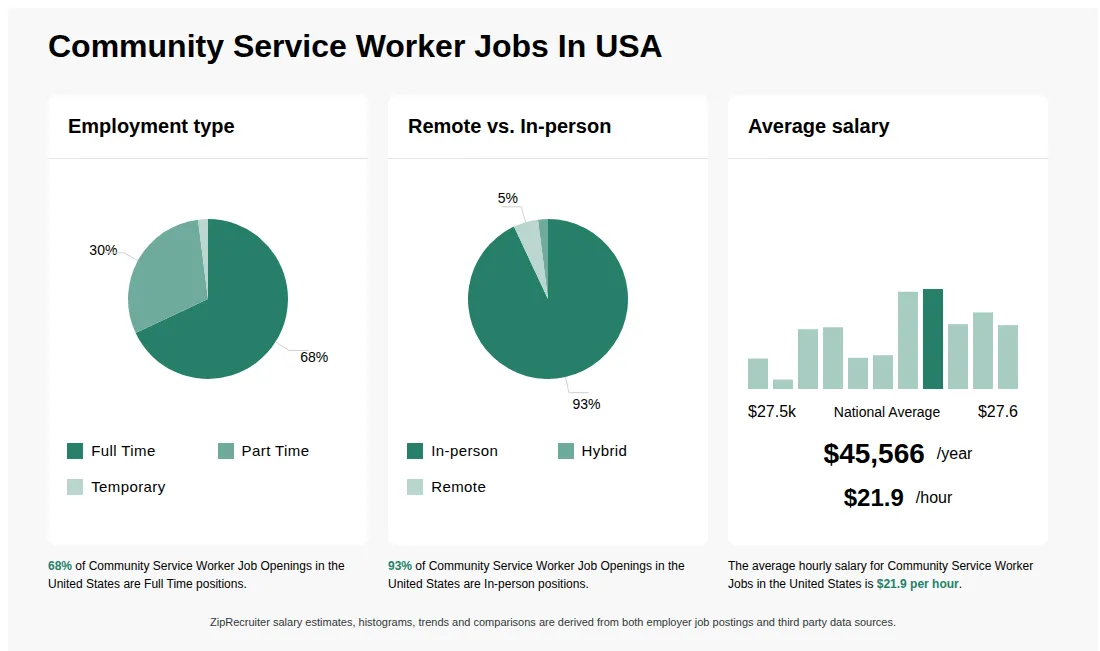
As of Sep 13, 2026, the average hourly pay for community service worker in the United States is $21.91, according to ZipRecruiter salary data. Most workers in this role earn between $18.27 and $25.00 per hour, depending on experience, location, and employer.
What is a community service worker?
As a community service worker, you provide support to the poor, elderly, disabled, and those systematically disadvantaged by oppressive structures. Assisting people throughout the community, you make communities more inclusive and well-rounded, and empower communities with the means of self-help, organization, and defense. Community service workers must have basic qualifications such as a bachelor’s degree in social services, sociology, or a related field. Necessary skills include communication, organizational, and interpersonal skills. Experience in social services, medicine, or community organizing will aid you throughout your career. Daily duties include helping elderly or disabled members of the community, assisting community members as they organize to represent their interests, and advocating on their behalf to government agencies.
What are the key skills and qualifications needed to thrive as a community service worker, and why are they important?
To thrive as a Community Service Worker, you need a background in social services or human services, often supported by a diploma or degree in social work or a related field. Familiarity with case management software, client intake systems, and community resource databases is commonly required. Strong interpersonal skills, cultural sensitivity, and effective communication are vital for building trust and advocating for diverse clients. These skills enable Community Service Workers to provide meaningful support, connect clients with resources, and promote positive outcomes within their communities.
What are some common challenges faced by community service workers when supporting diverse client populations?
Community Service Workers often support individuals from varied backgrounds, including those facing mental health issues, language barriers, or socioeconomic challenges. Navigating these differences requires strong communication, cultural sensitivity, and adaptability. Building trust with clients and helping them access the right resources can be complex, especially when clients are in crisis or resistant to assistance. However, ongoing training and collaboration with multidisciplinary teams help workers provide effective, tailored support.
What is the difference between Community Service Worker vs Social Worker?
| Aspect | Community Service Worker | Social Worker |
|---|---|---|
| Credentials | High school diploma or equivalent; some roles require certification | Bachelor's or Master's degree in social work; licensure often required |
| Work Environment | Community agencies, schools, healthcare facilities | Hospitals, government agencies, private practices |
| Employer & Industry | Nonprofits, government programs, schools | Healthcare, mental health, child welfare |
Community Service Workers typically have less formal education and focus on providing direct support and resources within communities. Social Workers usually hold advanced degrees and handle more complex cases, including counseling and advocacy. Both roles serve vital functions in social services but differ in scope and qualifications.
What are the duties of community service work?
Community service workers perform tasks such as assisting with community programs, supporting individuals in need, and helping with administrative duties. They often work in environments like social service agencies, schools, or non-profit organizations and may require good communication skills and relevant training or certifications.
What does it mean to be a community service worker?
A community service worker is a professional who provides support and assistance to individuals and communities in need, often addressing social, emotional, or practical issues. They may work in settings such as social service agencies, schools, or healthcare facilities, and often require strong communication skills and relevant certifications or training.
More about Community Service Worker jobs
What cities are hiring for Community Service Worker jobs?
Cities with the most Community Service Worker job openings:
What states have the most Community Service Worker jobs?
States with the most job openings for Community Service Worker jobs include:
What are popular job titles related to Community Service Worker jobs?
For Community Service Worker jobs, the most frequently searched job titles are:

Community Service Officer
La Crosse, WI
City of La Crosse
• Public Administration • 51 - 200 employees51 - 200 employees
$20.45/hr
Full-time, Part-time
Medical, Dental, Vision, Life, Retirement, PTO
Re-posted 25 days ago
Key responsibilities
Perform law enforcement support functions such as parking enforcement, directing traffic, and handling minor assistance calls.
Assist sworn officers and respond to incidents, including accidents and citizen complaints.
Complete clerical tasks such as preparing reports, sorting documents, and ordering supplies.
Job description
Description The City of La Crosse supports attaining a representative workforce and workplace equity. COMMUNITY SERVICE OFFICER: Position to perform a variety of law enforcement support functions such as parking enforcement, directing traffic, handling minor assistance calls, preparing reports and various clerical tasks. Candidates shall have an Associate degree or be enrolled in a Criminal Justice program or a related field.
Valid motor vehicle operator's license required. The position may require working various shifts, including evenings, weekends, and holidays as determined. PART-TIME positions work 20 hours per week.
This limited term employment is for the duration of up to two years. Flexibility with schedule may be available based on a candidate's school schedule. This part-time position offers a limited benefit package to include deferred compensation, Roth IRA, voluntary dental and vision plan, pro-rated paid holidays, vacation, and sick leave.
FULL-TIME positions work 40 hours per week. This full-time position offers a comprehensive benefit package including medical insurance, voluntary dental and vision plan, Wisconsin Retirement Plan, deferred compensation, Roth IRA, life insurance, income continuation insurance, paid holidays, vacation, and sick leave. Starting wage for full and part-time positions is $20.45 per hour
Selected candidate is subject to background and post offer/pre-employment drug screen, physical, and physical capacity exam and must pass and maintain a fingerprint-based criminal history records check. The City welcomes applications at all times. To be considered, submit an employment application by visiting the City of La Crosse website and clicking on City Services, then clicking Career Opportunities or by visiting https://www.governmentjobs.com/careers/lacrossewi
. Purpose of Position The purpose of this position is to perform a variety of non-sworn law enforcement support functions which are dependent on the bureau or shift assignment of the individual CSE. Assignments include, but are not limited to Front Desk/Records, Parking Enforcement, Property, Shift Assignments or Administrative Assignments as needed.
Appointed by the Chief to specified duty hours and assigned to work under close supervision as determined by their duty assignment. Distinguishing Characteristics Incumbents typically perform police support duties which do not require arrest powers or search and seizure authority granted sworn police officers. The work is performed under close supervision, and requires sound judgment, effective communication and customer service skills.
Essential Duties And Responsibilities The following duties are normal for this classification and are dependent on the CSE's specific duty assignment. These are not to be construed as exclusive or all-inclusive. Other duties may be required and assigned.
1. Provide customer service to the public at the Department lobby window or on the street. 2.
Enforces parking ordinances. Issues citations and arranges towing of violating vehicles. Responds to illegal parking, abandoned vehicle complaints, boot/tow of vehicles and night parking enforcement.
3. Directs traffic. Escorts oversized loads on city streets.
4. Assists sworn officers/supervisors as directed. 5.
Assists at accident scenes. 6. Performs clerical duties, sorts and files documents, completes forms, writes reports and orders supplies.
7. Performs crossing guard duties when needed. 8.
May receive citizen complaints. 9. Conducts follow-up calls to victims for additional information or case clearance.
10. Assist the Court Officer, other agencies as directed. 11.
Participates in on-going training including in-service sessions. 12. CSE's assigned to the Property area will have other specified duties/responsibilities as directed by the Administrative Sergeant and Supervisor.
13. Works special events in the City including Oktoberfest, River fest and many other events throughout the year. Additional Tasks and Responsibilities While the following tasks are necessary for the work of the unit, they are not an essential part of the purpose of this classification and may also be performed by other unit members.
1. Answers telephone calls. 2.
Runs errands. Minimum Training And Experience Required To Perform Essential Job Functions 1. Associate degree or enrolled in a Criminal Justice program or a related field.
Prior experience dealing with the public preferred, or any combination of education and experience that provides equivalent knowledge, skills and abilities. 2. Must possess a valid driver's license.
Physical and Mental Abilities Required To Perform Essential Job Functions Language Ability and Interpersonal Communication 1. Ability to classify, compute and tabulate data and information, following a prescribed plan requiring the exercise of some judgment. Ability to compare, count, differentiate, measure and sort information.
Ability to assemble, copy, record and transcribe data and information. 2. Ability to advise and provide interpretation to others how to apply policies, procedures and standards to specific situations.
3. Ability to utilize a wide variety of descriptive data and information such as regulations, citations, stolen property reports, vehicle tow forms, damage reports, parking ordinances, traffic statutes, maps, directories, bond schedules, evidence/property forms, correspondence and general operating manuals. 4.
Ability to communicate orally and in writing with complainants, department personnel, motorists, suspects, crime victims, attorneys and the general public. 5. Ability to follow specific instructions and respond to simple requests from others.
6. Must be able to demonstrate effective customer service skills. Mathematical Ability 1.
Ability to add, subtract, multiply and divide. Judgment and Situational Reasoning Ability 1. Ability to use functional reasoning in performing semi-routine functions involving standardized work with some choice of action.
2. Ability to exercise the judgment, decisiveness and creativity in situations involving a variety of generally pre-defined duties which may be subject to frequent change. Physical Requirements 1.
Ability to operate, maneuver and/or steer equipment and machinery requiring simple but continuous adjustments such as motor vehicle, camera, computer terminal, typewriter, telephone, calculator/adding machine and photocopier. 2. Ability to coordinate eyes, hands, feet and limbs in performing movements requiring moderate skill, such as typing or directing traffic.
3. Ability to exert very moderate physical effort in sedentary to light work, typically involving some combination of walking, running, stooping, kneeling, crouching, crawling, lifting, climbing, carrying, pushing and pulling. 4.
Ability to recognize and identify degrees of similarities or differences between characteristics of colors, shapes, sounds and odors associated with job-related objects, materials and tasks. Ability to sustain prolonged visual concentration. 5.
Ability to sustain prolonged visual and audio concentration. Environmental Adaptability 1. Ability to work under conditions which require exposure to environmental factors such as temperature variations and extremes, irate individuals, intimidation, violence and traffic hazards.
This exposure may cause some discomfort and presents a risk of injury. The City of La Crosse is an Equal Opportunity Employer. In compliance with the Americans with Disabilities Act, the City will provide reasonable accommodations to qualified individuals with disabilities and encourages both prospective and current employees to discuss potential accommodations with the employer.

About City Of La Crosse
Sourced by ZipRecruiter
Industry
Public administration
Company size
51 - 200 Employees
Headquarters location
La Crosse, WI, US
Year founded
1856