Microsoft
Microsoft

61 Microsoft Jobs Hiring Near You

Job Summary The Microsoft 365 Engineer is responsible for the design, implementation, administration, and optimization of the organization's Microsoft 365 ecosystem. This role ensures secure ...

This role focuses on Microsoft 365 administration with a working specialization in Microsoft Purview and Microsoft Data Loss Prevention (DLP), including information protection, sensitivity labeling ...

Microsoft 365 Administrator Location: Milford, Massachusetts Work Model: Onsite Contract Experience: 8+ Year Job Summary Overview We are seeking a highly skilled Microsoft 365 Administrator with ...

Microsoft 365 Administrator / Copilot Studio & GenAI Specialist Location: Phoenix, AZ (2 Days in a week) Duration: Long Term Contact / Full Time Job Summary We are seeking an experienced Microsoft ...

This role focuses on Microsoft 365 administration with a working specialization in Microsoft Purview and Microsoft Data Loss Prevention (DLP), including information protection, sensitivity labeling ...

CGI is seeking a Microsoft Intune Engineer to support and enhance a large scale Windows endpoint environment within a highly regulated financial services organization. This role is responsible for ...

Configure and manage Microsoft Purview compliance features, DLP policies, and Conditional Access controls. * Use PowerShell to automate user provisioning, licensing, and tenant administration.

Showing results 21-40

Microsoft Jobs Information

What is it like to work at Microsoft?

Microsoft is known for its collaborative and innovative culture, prioritizing employee growth and well-being while fostering a sense of community and teamwork. The company's diverse teams work on various projects, from software development to artificial intelligence, in a dynamic and fast-paced environment that encourages experimentation and learning. Working at Microsoft may appeal to candidates who are passionate about technology and innovation, with opportunities to contribute to groundbreaking projects and collaborate with experts from around the world.

What makes Microsoft an attractive place to work?

Microsoft is a leading technology company with a long history of innovation and a strong reputation for delivering cutting-edge solutions to the global market. The company offers a dynamic and collaborative work environment that fosters creativity, experimentation, and learning, with opportunities to work on diverse projects and contribute to the development of new technologies. By joining Microsoft, professionals can tap into a vast network of resources, mentorship, and training programs, enabling them to grow their skills, advance their careers, and make a meaningful impact in the tech industry.

Do workers at Microsoft get paid breaks?

Yes. Most people get paid breaks.
75% of people say they get paid breaks.
Based on data from 40 people who took the Breakroom Quiz between July 2025 and July 2026.

Does Microsoft pay people when they’re sick?

Yes. Most people get paid when they’re sick.
77% of people say they would get paid if they were sick but scheduled to work.
Based on data from 56 people who took the Breakroom Quiz between July 2025 and July 2026.

At Microsoft, are sick days and vacation days separate paid time off?

Sick days and vacation days are separate paid time off.
73% of people say they don’t have to use vacation days when they’re out sick.
Based on data from 70 people who took the Breakroom Quiz between May 2025 and May 2026.

Is the health insurance from Microsoft affordable enough for their workers?

Most people say the health insurance costs are okay.
97% of people say the health insurance costs are okay
Based on data from 65 people who took the Breakroom Quiz between May 2025 and May 2026.

Do people get paid time off at Microsoft?

Most people get paid time off work.
93% of people say they get paid time off.
Based on data from 60 people who took the Breakroom Quiz between July 2025 and July 2026.

How far ahead of time do people find out their work schedule?

Most people find out their schedule less than four weeks ahead of time.
  • 66% of people with changing schedules find out their shifts one week or less ahead of time.
  • 21% of people with changing schedules find out their shifts two weeks ahead of time.
  • 3% of people with changing schedules find out their shifts three weeks ahead of time.
  • 10% of people with changing schedules find out their shifts four weeks or more ahead of time.

Based on data from 29 people who took the Breakroom Quiz between January 2025 and March 2026.

Do workers at Microsoft worry about hours?

Most people don’t worry about getting enough hours.
84% of people report they don’t worry about getting enough hours.
Based on data from 43 people who took the Breakroom Quiz between April 2025 and April 2026.

Do Microsoft workers get to choose the shifts they work?

Some people don’t get to choose which shifts they work.
38% report that they don’t have enough control over which shifts they work.
Based on data from 40 people who took the Breakroom Quiz between March 2025 and March 2026.

How easy is it for Microsoft workers to change shifts?

Most people find it easy to change shifts.
73% of people report that it’s easy to change shifts if they need to.
Based on data from 33 people who took the Breakroom Quiz between March 2025 and March 2026.

How easy is it to get time off at Microsoft?

Most people find it easy to get time off.
87% of people report it’s easy to get time off.
Based on data from 70 people who took the Breakroom Quiz between May 2025 and May 2026.

Do Microsoft managers change schedules at the last minute?

Most managers don’t change people’s schedules at the last minute.
90% of people say their manager doesn’t change their shift schedule at the last minute.
Based on data from 49 people who took the Breakroom Quiz between April 2025 and April 2026.

Do jobs at Microsoft spill into time workers aren’t paid for?

Rarely. The job doesn't usually spill into unpaid time.
20% of people report that their job takes up time that they don’t get paid for.
Based on data from 51 people who took the Breakroom Quiz between April 2025 and April 2026.

How easy is it to take sick days at Microsoft?

Most people find it easy to take sick days.
89% of people report that it’s easy to take time off if they are sick.
Based on data from 55 people who took the Breakroom Quiz between July 2025 and July 2026.

Is a Microsoft job good for students?

Only some students say this is a good place to work if you’re studying.
38% of students report this isn’t a good place to work if you’re studying.
Based on data from 8 people who took the Breakroom Quiz between December 2024 and May 2026.

Is working at Microsoft good if you’re a parent or caregiver?

Most parents and caregivers say this is a good place to work.
82% of people who care for a child or other relative report this is a good place to work.
Based on data from 39 people who took the Breakroom Quiz between January 2025 and May 2026.

Do people at Microsoft feel treated with respect by their managers?

Most people feel treated with respect by their managers.
95% of people say they’re treated with respect by their managers.
Based on data from 57 people who took the Breakroom Quiz between July 2025 and July 2026.

Do people at Microsoft get to take their breaks without interruption?

Most people get breaks without interruption.
86% of people report that they get to take their breaks without interruption.
Based on data from 50 people who took the Breakroom Quiz between July 2025 and July 2026.

Is it stressful to work at Microsoft?

Some people feel stressed out here.
60% of people say they often feel stressed out at work.
Based on data from 53 people who took the Breakroom Quiz between July 2025 and July 2026.

Do people at Microsoft enjoy their jobs?

Most people enjoy their job.
88% of people report they enjoy their job.
Based on data from 64 people who took the Breakroom Quiz between May 2025 and May 2026.

Do people at Microsoft recommend working with their team?

Most people recommend working with their team.
73% of people report that they would recommend working with their immediate team to a friend.
Based on data from 60 people who took the Breakroom Quiz between July 2025 and July 2026.

Do people get enough training when they start at Microsoft?

Some people didn’t get enough training when they started.
35% of people report they didn’t get enough training when they started working here.
Based on data from 54 people who took the Breakroom Quiz between July 2025 and July 2026.

Do people get support to advance at Microsoft?

Most people are given support to advance their career here.
In the last year, 78% of people report being given support to advance their career here.
Based on data from 51 people who took the Breakroom Quiz between July 2025 and July 2026.

Do people think Microsoft’s headquarters understands what’s happening where they work?

Most people think headquarters doesn’t understand what’s happening where they work.
73% of people think that this employer’s headquarters or owners don’t have a good understanding of what’s really happening where they work.
Based on data from 73 people who took the Breakroom Quiz between May 2025 and May 2026.

Do workers feel well informed about how Microsoft is doing?
Most people feel well informed about how the company is doing.
83% of people feel that they are kept well informed about how the company is doing as a whole.
Based on data from 53 people who took the Breakroom Quiz between July 2025 and July 2026.
What are the most popular states for Microsoft jobs?
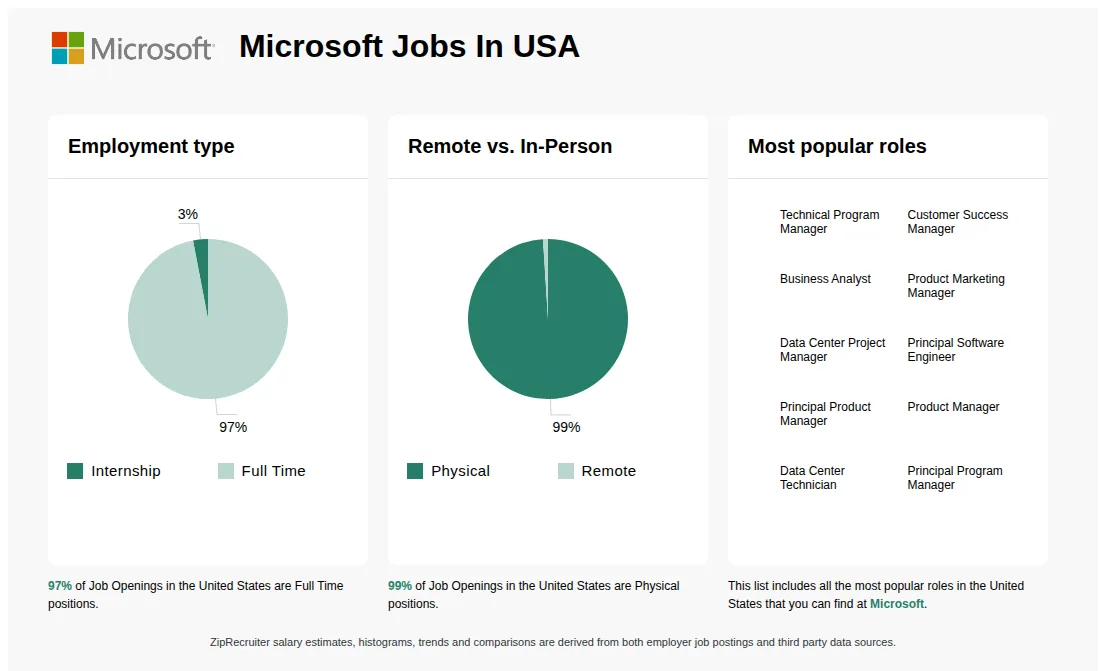
Infographic showing various job openings at Microsoft in the United States as of July 2026, with employment types broken down into 97% Full Time, and 3% Contract. Highlights an 100% Physical job distribution.
Member of Technical Staff, Microsoft Robotics

Member of Technical Staff, Microsoft Robotics

Microsoft

Redmond, WA • On-site

Full-time

Posted 21 days ago


Microsoft rating

8.5

Company rating: 8.5 out of 10

Based on 131 frontline employees who took The Breakroom Quiz

68th of 209 rated software companies


Job description

Overview
Microsoft's Discovery and Quantum (MDQ) division develops and delivers advanced artificial intelligence (AI), cloud-enabled capabilities, and strategic technologies to help solve the world's major challenges. From accelerating scientific discovery with advanced AI tools, to pioneering breakthroughs in quantum computing, to advancing robotics and AI capabilities that drive real-world impact, joining MDQ means building the future, partnering with fast-moving innovators, and operating in a high-impact, mission-driven environment.
At Microsoft Robotics within MDQ, we build and deploy technologies that enable people, robots, and AI agents to collaborate and achieve more.
We are building Microsoft's platform for physical intelligence-an integrated robotics software and AI platform that brings together humans, robots, and agents through robotics AI models, innovative teaming solutions and experiences, physically grounded agentic AI workflows, trustworthy test and evaluation, and real-world customer-focused validation. Built on Microsoft's core platforms and delivered through and with a global ecosystem of partners and customers, this platform accelerates AI for the physical world and helps robotics solutions move from experimentation to reliable, scaled deployment.
We are hiring a Member of Technical Staff, Microsoft Robotics at the Principal level to set the technical direction for the systems every other engineer, partner, and customer builds on. This is a cross-cutting systems-focused leadership role, not limited to narrowly scoped projects. You will own the hardest problems in the stack and raise the bar for how the team builds and delivers.
Microsoft's mission is to empower every person and every organization on the planet to achieve more. As employees we come together with a growth mindset, innovate to empower others, and collaborate to realize our shared goals. Each day we build on our values of respect, integrity, and accountability to create a culture of inclusion where everyone can thrive at work and beyond.
Responsibilities
  • Own the multi-year technical architecture for the Microsoft Robotics platform, setting the direction the broader engineering organization, partners, and customers build on, and holding that architecture coherent as it scales across teams and deployments.
  • Make the foundational design decisions that determine how robotics software, AI models, and cloud and edge components fit together, defining the core interfaces and engineering contracts other teams depend on.
  • Architect systems that meet demanding real-world constraints, balancing latency, throughput, compute efficiency, reliability, and cost across cloud and on-robot edge environments.
  • Lead the evaluation and validation strategy that gates what ships, establishing the benchmarks, test approach, and quality bar for autonomy, safety, and task performance across simulation, lab, and field, including safe-autonomy boundaries and human-in-the-loop fallback.
  • Drive the hardest cross-stack technical problems personally, taking on the integration failure modes that emerge where AI models meet production robots, and resolving them through rigorous root-cause analysis of system behavior and field data.
  • Connect classical robotics engineering with modern AI, partnering across foundation-model, perception, manipulation, locomotion, and simulation teams to bring learned capabilities into a common, production-grade platform rather than one-off integrations.
  • Establish the engineering bar for the team, owning design standards and review practices, leading the consequential technical reviews, and lifting the quality, testability, and operability of the systems that matter most.
  • Influence direction across MDQ, Microsoft Research, Azure, hardware and silicon partners, and customers without relying on formal authority, building technical consensus and aligning many teams on a single coherent platform strategy, including representing the platform in the open-source and standards community.
  • Multiply the team's output through technical leadership, mentoring senior and principal engineers and raising the technical ceiling of the organization rather than only its headcount.
  • Track the state of the art across embodied AI, robot learning, robotics middleware, and simulation, and decide deliberately how and when new techniques are incorporated into the platform.
  • Other:
    • Embody our Culture and Values

Qualifications
Required Qualifications:
  • Bachelor's Degree in Computer Science or related technical field AND 8+ years technical engineering experience with coding in languages including, but not limited to, C, C++, C#, Java, JavaScript, or Python
    • OR equivalent experience.

Other Requirements:
  • Ability to meet Microsoft, customer and/or government security screening requirements is required for this role. These requirements include, but are not limited to the following specialized security screenings:
    • Microsoft Cloud Background Check: This position will be required to pass the Microsoft Cloud Background Check upon hire/transfer and every two years thereafter.

Preferred Qualifications:
  • Master's Degree in Computer Science or related technical field AND 12+ years technical engineering experience with coding in languages including, but not limited to, C, C++, C#, Java, JavaScript, or Python
    • OR Bachelor's Degree in Computer Science or related technical field AND 15+ years technical engineering experience with coding in languages including, but not limited to, C, C++, C#, Java, JavaScript, or Python
    • OR equivalent experience.
  • Demonstrated ownership of a major platform, framework, runtime, or large-scale distributed system used in production by other engineering teams, with accountability for its architecture, reliability, and long-term evolution.
  • Experience with robot learning at scale, including vision-language-action policies, foundation models for robotics, imitation learning, reinforcement learning, or embodied artificial intelligence.
  • Experience deploying and operating robots in the real world at fleet scale, including fleet orchestration, over-the-air update systems, observability, and edge runtime on compute-constrained and intermittently connected hardware.
  • Deep systems-level understanding of how perception, learning, planning, control, simulation, and fleet operations interact in deployed autonomous systems, including the failure modes, latency budgets, and trade-offs that emerge at integration boundaries.
  • Demonstrated ability to lead cross-disciplinary technical efforts spanning robotics hardware, perception, learning, planning, simulation, platform infrastructure, field testing, and artificial intelligence and machine learning teams, and to drive consensus across organizational boundaries.
  • Demonstrated ability to mentor and grow senior and principal engineers and to raise the technical bar of an organization through architecture, review, and direction rather than increasing team size.
  • Experience designing and operating machine learning infrastructure and model serving at scale, including inference optimization, low-latency serving, and the versioning, evaluation, and rollback workflows that production models require.
  • Experience with robotics middleware and autonomy tooling such as Robot Operating System (ROS), Robot Operating System 2 (ROS2), Navigation 2 (Nav2), MoveIt, Robot Visualization (RViz), or Foxglove, and the architectural judgment to know where such frameworks fit in a production platform and where they do not.
  • Experience with large-scale simulation and sim-to-real transfer using Isaac Sim, MuJoCo, Drake, Gazebo, or equivalent, including domain randomization, synthetic data generation, and scenario-based validation.
  • Experience with cloud platform engineering, Microsoft Azure preferred, including low-latency edge-to-cloud architectures, high-throughput data pipelines, and graphics processing unit-backed training and inference at scale.
  • Experience with safety-critical or human-in-the-loop autonomy, including evaluation and governance gates and the trust and security controls that regulated and enterprise customers require.
  • Proficiency in C++ and Python, with a track record of building performant, testable, production-quality robotics or systems software, and the judgment to set engineering standards others follow.
  • Published research, open-source platform leadership, patents, standards contributions, or comparable external technical leadership in robotics, autonomous systems, embodied artificial intelligence, machine learning infrastructure, or physical artificial intelligence platforms is a strong plus.

#MicrosoftRobotics #MDQ
Software Engineering IC6 - The typical base pay range for this role across the U.S. is USD $165,600 - $296,400 per year. There is a different range applicable to specific work locations, within the San Francisco Bay area and New York City metropolitan area, and the base pay range for this role in those locations is USD $220,800 - $331,200 per year.
Certain roles may be eligible for benefits and other compensation. Find additional benefits and pay information here:
https://careers.microsoft.com/us/en/us-corporate-pay
This position will be open for a minimum of 5 days, with applications accepted on an ongoing basis until the position is filled.
Microsoft is an equal opportunity employer. All qualified applicants will receive consideration for employment without regard to age, ancestry, citizenship, color, family or medical care leave, gender identity or expression, genetic information, immigration status, marital status, medical condition, national origin, physical or mental disability, political affiliation, protected veteran or military status, race, ethnicity, religion, sex (including pregnancy), sexual orientation, or any other characteristic protected by applicable local laws, regulations and ordinances. If you need assistance with religious accommodations and/or a reasonable accommodation due to a disability during the application process, read more about requesting accommodations.

What Microsoft employees say

Pay

Benefits

Hours and flexibility

Workplace

Get the full story on Breakroom


Microsoft logo

About Microsoft

Sourced by ZipRecruiter

Our infrastructure is comprised of a large global portfolio of more than 100 datacenters and 1 million servers. Our foundation is built upon and managed by a team of subject matter experts working to support services for more than 1 billion customers and 20 million businesses in over 90 countries worldwide. With environmental sustainability and optimization at the forefront of our datacenter design and operations, we continue to grow and evolve as we meet the ever-changing business demands that hold Microsoft as a world-class cloud provider.

Industry

Computer and computer peripheral equipment and software wholesalers

Company size

10,000+ Employees

Headquarters location

Redmond, WA, US

Year founded

1975

Social media