... management of highly technical initiatives, as well as strategic program management. Candidate must be comfortable supporting project delivery teams, networking, infrastructure and regional ...
... management of highly technical initiatives, as well as strategic program management. Candidate must be comfortable supporting project delivery teams, networking, infrastructure and regional ...
Sr Technical Infrastructure Program Manager , Data Center Infrastructure Engineering (DCIE)
Nashville, TN · On-site
The Technical Infrastructure Program Manager III (TIPM III) within Data Center Infrastructure Engineering (DCIE) manages the lifecycle of complex, cross-functional infrastructure programs across ...
Sr Technical Infrastructure Program Manager , Data Center Infrastructure Engineering (DCIE)
Nashville, TN · On-site
The Technical Infrastructure Program Manager III (TIPM III) within Data Center Infrastructure Engineering (DCIE) manages the lifecycle of complex, cross-functional infrastructure programs across ...

Energy Infrastructure Program Manager
Washington, DC · On-site +1
$146K/yr
Reviews project documentation, evaluates technical and commercial interfaces, identifies risks and ... Infrastructure Program Manager | Independent Engineering (IE) Advisory Services / Program ...
Quick apply
Energy Infrastructure Program Manager
Washington, DC · On-site +1
$146K/yr
Reviews project documentation, evaluates technical and commercial interfaces, identifies risks and ... Infrastructure Program Manager | Independent Engineering (IE) Advisory Services / Program ...
Amazon Web Services is looking for a Technical Infrastructure Program Manager (TIPM) to support and deploy one of the world's largest and most complex telecommunication networks The role is ...
Amazon Web Services is looking for a Technical Infrastructure Program Manager (TIPM) to support and deploy one of the world's largest and most complex telecommunication networks The role is ...
Technical Infrastructure Program Manager, Refrigeration Engineering , Global Energy, Sustainability
Bellevue, WA · On-site
$145K - $188K/yr
To that end, Amazon is seeking an Technical Infrastructure Program Manager to help deliver maintenance, repair and vendor management operations to support grocery expansion across the North American ...
Technical Infrastructure Program Manager, Refrigeration Engineering , Global Energy, Sustainability
Bellevue, WA · On-site
$145K - $188K/yr
To that end, Amazon is seeking an Technical Infrastructure Program Manager to help deliver maintenance, repair and vendor management operations to support grocery expansion across the North American ...
We're looking for a Principal Technical Infrastructure Program Manager to drive manufacturing design and execution You will be an extension of the senior leadership team and will drive collaboration ...
We're looking for a Principal Technical Infrastructure Program Manager to drive manufacturing design and execution You will be an extension of the senior leadership team and will drive collaboration ...
Principal Infrastructure Technical Program Manager, Industrial Robotics Group
Austin, TX · On-site
$127K - $165K/yr
We're looking for a Principal Technical Infrastructure Program Manager to drive manufacturing design and execution You will be an extension of the senior leadership team and will drive collaboration ...
Principal Infrastructure Technical Program Manager, Industrial Robotics Group
Austin, TX · On-site
$127K - $165K/yr
We're looking for a Principal Technical Infrastructure Program Manager to drive manufacturing design and execution You will be an extension of the senior leadership team and will drive collaboration ...
Technical Infrastructure Program Manager, Refrigeration Engineering , Global Energy, Sustainabili...
$145K - $188K/yr
To that end, Amazon is seeking an Technical Infrastructure Program Manager to help deliver maintenance, repair and vendor management operations to support grocery expansion across the North American ...
Technical Infrastructure Program Manager, Refrigeration Engineering , Global Energy, Sustainabili...
$145K - $188K/yr
To that end, Amazon is seeking an Technical Infrastructure Program Manager to help deliver maintenance, repair and vendor management operations to support grocery expansion across the North American ...
Amazon Web Services is looking for a Technical Infrastructure Program Manager (TIPM) to support and deploy one of the world's largest and most complex telecommunication networks. The role is ...
Amazon Web Services is looking for a Technical Infrastructure Program Manager (TIPM) to support and deploy one of the world's largest and most complex telecommunication networks. The role is ...
AIS Supply Chain's Manufacturing, Transportation, and Reverse Operations team is seeking a Technical Infrastructure Program Manager (TIPM) to help enable AWS' new availability and local zones This ...
AIS Supply Chain's Manufacturing, Transportation, and Reverse Operations team is seeking a Technical Infrastructure Program Manager (TIPM) to help enable AWS' new availability and local zones This ...
Technical Infrastructure Program Manager, Refrigeration Engineering , Global Energy, Sustainabili...
$145K - $188K/yr
To that end, Amazon is seeking an Technical Infrastructure Program Manager to help deliver maintenance, repair and vendor management operations to support grocery expansion across the North American ...
Technical Infrastructure Program Manager, Refrigeration Engineering , Global Energy, Sustainabili...
$145K - $188K/yr
To that end, Amazon is seeking an Technical Infrastructure Program Manager to help deliver maintenance, repair and vendor management operations to support grocery expansion across the North American ...
AIS Supply Chain's Manufacturing, Transportation, and Reverse Operations team is seeking a Technical Infrastructure Program Manager (TIPM) to help enable AWS' new availability and local zones This ...
AIS Supply Chain's Manufacturing, Transportation, and Reverse Operations team is seeking a Technical Infrastructure Program Manager (TIPM) to help enable AWS' new availability and local zones This ...
Technical Infrastructure Program Manager I , Data Center Power Utilization Management & Planning ...
As a Technical Infrastructure Program Manager within this team focused on global data center inventory and power topology accuracy, you will be responsible for organizing and managing continuous ...
Technical Infrastructure Program Manager I , Data Center Power Utilization Management & Planning ...
As a Technical Infrastructure Program Manager within this team focused on global data center inventory and power topology accuracy, you will be responsible for organizing and managing continuous ...
Full Life Cycle Recruiter - AWS Networking, AWS Infrastructure Services (AIS) TA
Arlington, VA · On-site
You will support AWS technical teams to manage end-to-end recruiting for Technical Infrastructure Program Managers and International Business Developers - Tech roles, from sourcing through offer ...
Full Life Cycle Recruiter - AWS Networking, AWS Infrastructure Services (AIS) TA
Arlington, VA · On-site
You will support AWS technical teams to manage end-to-end recruiting for Technical Infrastructure Program Managers and International Business Developers - Tech roles, from sourcing through offer ...
AWS Infrastructure Services owns the design, planning, delivery, and operation of all AWS global ... The Senior Technical Infrastructure Program Manager will lead cross-functional and technical teams ...
AWS Infrastructure Services owns the design, planning, delivery, and operation of all AWS global ... The Senior Technical Infrastructure Program Manager will lead cross-functional and technical teams ...
AWS Infrastructure Services owns the design, planning, delivery, and operation of all AWS global ... We're seeking an experienced Senior Technical Infrastructure Program Manager to oversee data center ...
AWS Infrastructure Services owns the design, planning, delivery, and operation of all AWS global ... We're seeking an experienced Senior Technical Infrastructure Program Manager to oversee data center ...
Technical Infrastructure Program Manager I , Data Center Power Utilization Management & Planning (PU
Herndon, VA · On-site
As a Technical Infrastructure Program Manager within this team focused on global data center inventory and power topology accuracy, you will be responsible for organizing and managing continuous ...
Technical Infrastructure Program Manager I , Data Center Power Utilization Management & Planning (PU
Herndon, VA · On-site
As a Technical Infrastructure Program Manager within this team focused on global data center inventory and power topology accuracy, you will be responsible for organizing and managing continuous ...

Technical Program Manager, Infrastructure
San Francisco, CA · On-site
$152K - $196K/yr
Develop and drive best practices in infrastructure program management, improving visibility into progress, risks, and technical dependencies * Facilitate large-scale testing and rollout strategies ...
Technical Program Manager, Infrastructure
San Francisco, CA · On-site
$152K - $196K/yr
Develop and drive best practices in infrastructure program management, improving visibility into progress, risks, and technical dependencies * Facilitate large-scale testing and rollout strategies ...
To support Amazon LEO, the Ground Infrastructure Services Physical Security team is seeking a Physical Security Technical Infrastructure Program Manager (TIPM) to drive the deployment of physical ...
To support Amazon LEO, the Ground Infrastructure Services Physical Security team is seeking a Physical Security Technical Infrastructure Program Manager (TIPM) to drive the deployment of physical ...

Managing Project Manager Sr. IT Infrastructure PM Update 8/19: No to 100% remote but dependent on the location, if candidate can travel easily like in east coast even if not in New York metro polytan ...
Quick apply
Managing Project Manager Sr. IT Infrastructure PM Update 8/19: No to 100% remote but dependent on the location, if candidate can travel easily like in east coast even if not in New York metro polytan ...
Technical Infrastructure Program Manager information
See salary details
$89K - $96.2K
0% of jobs
$96.2K - $103.5K
4% of jobs
$103.5K - $110.7K
0% of jobs
$110.7K - $117.9K
3% of jobs
$117.9K - $125.1K
1% of jobs
$128.9K is the 25th percentile. Wages below this are outliers.
$125.1K - $132.4K
32% of jobs
The median wage is $136.4K / yr.
$132.4K - $139.6K
18% of jobs
$139.6K - $146.8K
0% of jobs
$146.8K - $154K
0% of jobs
$154K - $161.3K
13% of jobs
$162.4K is the 75th percentile. Wages above this are outliers.
$161.3K - $168.5K
29% of jobs
$89K
$145.6K
$168.5K
How much do technical infrastructure program manager jobs pay per year?
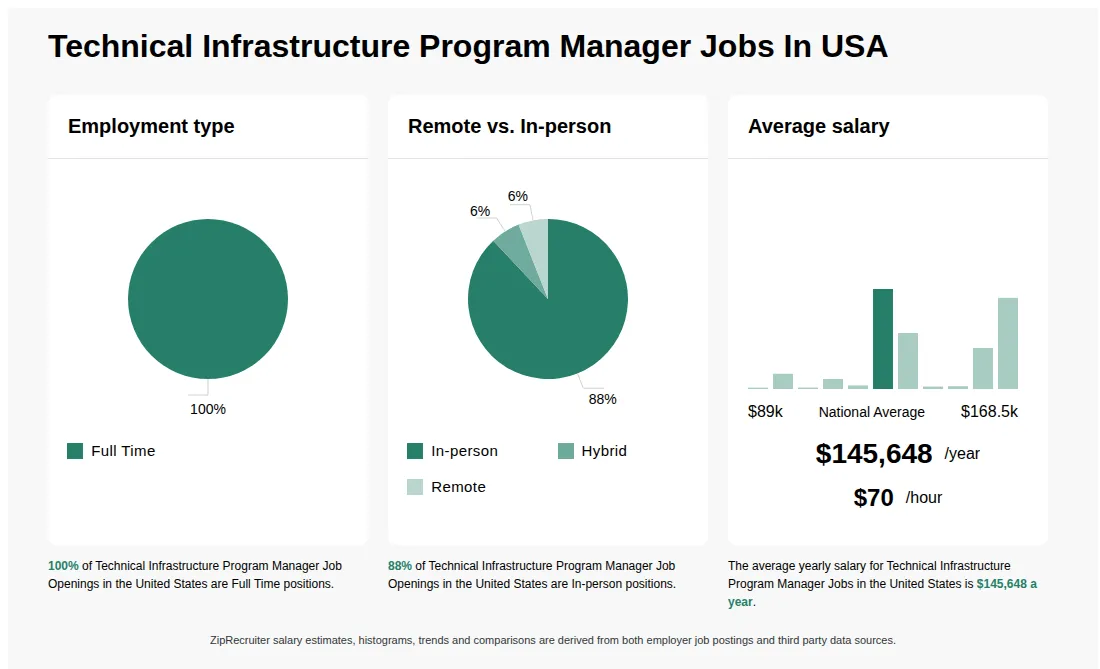
As of Jul 26, 2026, the average yearly pay for technical infrastructure program manager in the United States is $145,648.00, according to ZipRecruiter salary data. Most workers in this role earn between $129,000.00 and $167,000.00 per year, depending on experience, location, and employer.
What are the key skills and qualifications needed to thrive as a Technical Infrastructure Program Manager, and why are they important?
To thrive as a Technical Infrastructure Program Manager, you need strong project management skills, a solid understanding of IT infrastructure concepts, and relevant experience, often supported by a degree in computer science or engineering. Familiarity with project management tools like Jira or Microsoft Project, and certifications such as PMP or ITIL, are commonly required. Exceptional communication, problem-solving, and leadership skills help you coordinate cross-functional teams and manage stakeholders effectively. These skills are crucial for ensuring the successful delivery of complex infrastructure projects on time and within budget.
What is the difference between Technical Infrastructure Program Manager vs Network Engineer?
| Aspect | Technical Infrastructure Program Manager | Network Engineer |
|---|---|---|
| Credentials | Project management certifications (PMP), technical knowledge | Networking certifications (CCNA, CCNP), technical degrees |
| Work Environment | Cross-functional teams, project planning, strategic oversight | Network design, implementation, troubleshooting |
| Industry Usage | IT, telecommunications, large enterprises | IT, telecommunications, data centers |
The Technical Infrastructure Program Manager focuses on overseeing infrastructure projects, coordinating teams, and ensuring strategic goals are met. In contrast, a Network Engineer specializes in designing, implementing, and maintaining network systems. While both roles require technical knowledge, the Program Manager emphasizes project management and coordination, whereas the Network Engineer concentrates on technical network operations.
What are some common challenges Technical Infrastructure Program Managers face when coordinating cross-functional teams?
Technical Infrastructure Program Managers often encounter challenges in aligning priorities among engineering, operations, and business stakeholders. Navigating competing deadlines and balancing technical constraints with business objectives requires strong communication and negotiation skills. Additionally, managing risks related to infrastructure scalability or security and ensuring clear documentation across teams are critical for successful project delivery. Maintaining transparency and fostering collaboration help address these challenges effectively.
What does a Technical Infrastructure Program Manager do?
A Technical Infrastructure Program Manager oversees projects related to a company's IT infrastructure, such as networks, servers, and data centers. They coordinate between technical teams, stakeholders, and vendors to ensure projects are delivered on time and meet business requirements. Responsibilities include planning, budgeting, risk management, and ensuring that infrastructure aligns with organizational goals. They also help resolve technical challenges and maintain effective communication across teams.
More about Technical Infrastructure Program Manager jobs
What cities are hiring for Technical Infrastructure Program Manager jobs? Cities with the most Technical Infrastructure Program Manager job openings:
What states have the most Technical Infrastructure Program Manager jobs? States with the most job openings for Technical Infrastructure Program Manager jobs include:
What job categories do people searching Technical Infrastructure Program Manager jobs look for? The top searched job categories for Technical Infrastructure Program Manager jobs are:
- Sr Infrastructure Program Manager
- It Infrastructure Program Manager
- Infrastructure Program Manager
- Product Technical Program Management
- Remote Lean Six Sigma Green Belt
- Technical Program Manager Iii
- Technical Project Program Manager
- User Experience Program Manager
- Remote Gold Mine Security
- Senior Infrastructure Project Manager

Full-time
Posted 7 days ago
Amazon rating

7.4
Based on 7,012 frontline employees who took The Breakroom Quiz
6th of 39 rated national retailers
Job description
AWS Infrastructure Services owns the design, planning, delivery, and operation of all AWS global infrastructure. In other words, we're the people who keep the cloud running. We support all AWS data centers and all of the servers, storage, networking, power, and cooling equipment that ensure our customers have continual access to the innovation they rely on.
We work on the most challenging problems, with thousands of variables impacting the supply chain - and we're looking for talented people who want to help.
You'll join a diverse team of software, hardware, and network engineers, supply chain specialists, security experts, operations managers, and other vital roles. You'll collaborate with people across AWS to help us deliver the highest standards for safety and security while providing seemingly infinite capacity at the lowest possible cost for our customers.
And you'll experience an inclusive culture that welcomes bold ideas and empowers you to own them to completion.
We have an opening for a TIPM who will be responsible for delivering, coordinating and prioritizing data center lifecycle projects which provide capacity and improve our ability to serve customers. This includes developing and implementing scalable, data-driven process improvement/automated solutions opportunities to scale manual tasks in the end-to-end processes for lifecycle programs with critical networking dependencies. The Data Center Lifecycle Management (DCLM) team delivers strategic AWS core site turndowns, including site and availability zone (AZ) exits, site and data hall consolidations, conversions, and remodels
Our programs optimize data center infrastructure and footprint utilization, reduce operational costs, mitigate availability risks, support regional real estate strategies, and enable strategic repurposing of data centers to meet evolving business needs.
The ideal candidate will be an exceptionally strong communicator, both written and verbally, and possess experience in tactical project management of highly technical initiatives, as well as strategic program management.
Candidate must be comfortable supporting project delivery teams, networking, infrastructure and regional operations teams. Ability to work cross-functional matrix-based teams, establish trust with a variety of stakeholders across multiple time zones, and develop workflows that eliminate non-value-add activity, remove blockers, and find creative ways to optimize our existing data centers.
Key job responsibilities
Provide program progress reporting on a regular basis to senior leadership
Articulating root-cause analysis, and linking to specific improvement areas.
Summarize escalation support and critical leadership decisions.
Manage multiple competing projects/programs simultaneously.
Develop, plan and build implementation solutions that allow cross functional project collaboration to unblock programs with infrastructure dependencies.
Identify process improvement opportunities and gather user requirements with key internal customers.
Develop standard operating procedures, change/communication plans, and project/program-level status updates.
Drive adoption with internal customers through effective change management.
Anticipate potential issues and risks, and escalate appropriately and in a timely manner.
Remain flexible to changing priorities and open to new ideas.
Keep the customer experience as the primary focus.
About the team
*Why AWS*
Amazon Web Services (AWS) is the world's most comprehensive and broadly adopted cloud platform. We pioneered cloud computing and never stopped innovating - that's why customers from the most successful startups to Global 500 companies trust our robust suite of products and services to power their businesses.
*Diverse Experiences*
Amazon values diverse experiences
Even if you do not meet all of the preferred qualifications and skills listed in the job description, we encourage candidates to apply. If your career is just starting, hasn't followed a traditional path, or includes alternative experiences, don't let it stop you from applying.
*Work/Life Balance*
We value work-life harmony. Achieving success at work should never come at the expense of sacrifices at home, which is why we strive for flexibility as part of our working culture
When we feel supported in the workplace and at home, there's nothing we can't achieve in the cloud.
*Inclusive Team Culture*
Here at AWS, it's in our nature to learn and be curious. Our employee-led affinity groups foster a culture of inclusion that empower us to be proud of our differences. Ongoing events and learning experiences, including our Conversations on Race and Ethnicity (CORE) and AmazeCon (gender diversity) conferences, inspire us to never stop embracing our uniqueness.
*Mentorship and Career Growth*
We're continuously raising our performance bar as we strive to become Earth's Best Employer
That's why you'll find endless knowledge-sharing, mentorship and other career-advancing resources here to help you develop into a better-rounded professional.

About Amazon
Sourced by ZipRecruiter
Amazon.com, Inc., commonly known as Amazon, is an American multinational technology company. It was founded by Jeff Bezos in 1994 and initially started as an online marketplace for books. Since then, Amazon has expanded its operations and become one of the largest e-commerce companies in the world. Amazon's primary business is its online retail platform, where customers can purchase a vast array of products, including electronics, clothing, books, home goods, and much more. The company offers a convenient and user-friendly shopping experience, with features such as fast shipping, customer reviews, and personalized recommendations. In addition to its e-commerce platform, Amazon has diversified its business into various other areas. One of its notable ventures is Amazon Web Services (AWS), a comprehensive cloud computing platform that provides services such as storage, compute power, and database management to individuals and businesses. AWS has become a leader in the cloud computing industry, powering many websites and applications worldwide. Amazon has also developed its own consumer electronics, including the popular Amazon Kindle e-reader, Fire tablets, Fire TV streaming devices, and the Alexa-powered Echo smart speakers. The Alexa voice assistant, integrated into these devices, allows users to interact with their devices using voice commands, perform tasks, and access information. Furthermore, Amazon has expanded into media and entertainment. It operates Prime Video, a streaming service that offers a wide range of movies, TV shows, and original content. Amazon Music provides a platform for streaming and purchasing digital music, while Audible offers audiobooks and other audio content. The company's commitment to customer satisfaction and convenience is demonstrated by its membership program, Amazon Prime. Prime members receive various benefits, including free two-day shipping, access to streaming services, exclusive deals, and more.
Industry
It services, book publishers, retail, real estate and computer and electronic product manufacturing
Company size
10,000+ Employees
Headquarters location
Seattle, WA, US